
You are here
It is 2:13 a.m. You have three active patients, two admits pending, notes half-finished, and suddenly someone yells down the hall:
“Hey, can you come see this guy? He is not looking good.”
You sprint in. Tachy, hypotensive, looks terrible. You do the basics, start interventions, call for help. The code or rapid response team shows up. The attending turns to you:
“Okay, give me the story. What do we have?”
Your brain knows the case. Your mouth starts with: “So… he is a 68‑year‑old with a history of… uh… I think CKD? He came in for… I do not have the full note… but today he…”
You feel yourself losing the room. People are waiting on you to drive the plan, and your presentation is wandering all over the place.
This is what we are going to fix.
You need a tight, repeatable, 60‑second on‑call presentation for emergencies. One structure. All specialties. Any chaos.
Here is the protocol.
Core rule: 60 seconds, 4 jobs
In an emergency, your job is not to “present the whole chart.” Your job is four things:
- Say who this patient is and why we are in crisis.
- Say what you think is happening (even if you are not totally sure).
- Say what you have already done.
- Say what you need right now.
You do all of that in about 60 seconds, then shut up so people can act and ask focused questions.
The structure that works:
IDENT – INSTABILITY – IDEA – INTERVENTIONS – ASK
Or, shorter:
ID – BAD – CAUSE – DONE – NEED
We will build it step by step.
The 60‑Second Emergency Script (exact format)
Use this exact skeleton. Then customize to your specialty.
- IDENT – 1 sentence.
- INSTABILITY – 1–2 sentences.
- IDEA (working diagnosis) – 1–2 sentences.
- INTERVENTIONS so far – 2–3 short clauses.
- ASK (what you need) – 1 sentence.
Let us go through each piece with exact language you can steal.
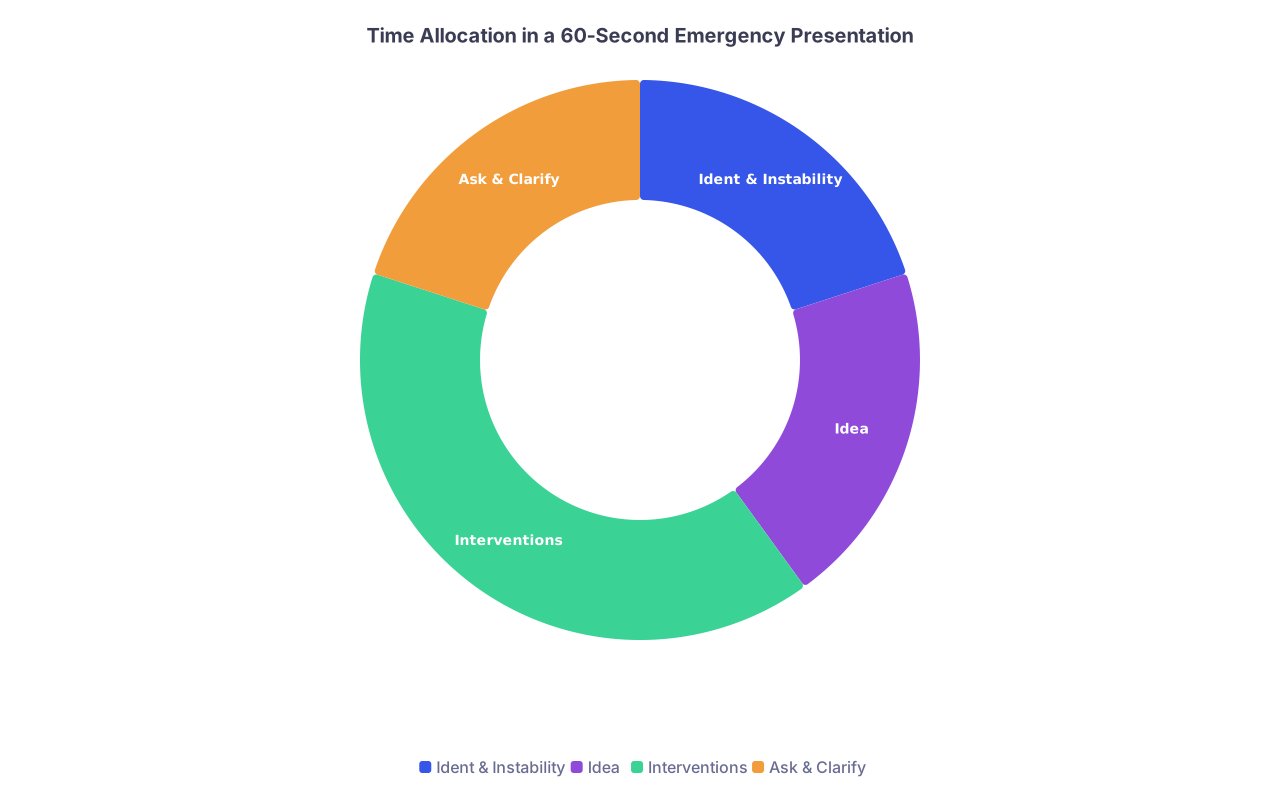
| Category | Value |
|---|---|
| Ident & Instability | 20 |
| Idea | 20 |
| Interventions | 40 |
| Ask & Clarify | 20 |
1. IDENT: Anchor the room in 1 sentence
Goal: Everyone knows who and big‑picture why.
Template:
“We have a [age]‑year‑old [sex] with [key problem or admission reason] now with [acute issue].”
Examples:
- “We have a 68‑year‑old man admitted for pneumonia, now in acute respiratory distress.”
- “We have a 45‑year‑old woman with metastatic breast cancer, now hypotensive and altered.”
- “We have a 23‑year‑old previously healthy man who came in with chest pain, now in ventricular tachycardia.”
Do not start with past medical history laundry lists. If they were admitted earlier tonight for a UTI and now they are coding, the team needs that link in one clean shot, not a novel.
What to include:
- Age
- Sex (if clinically relevant; often is)
- One key prior context (admission reason / major illness)
- The acute problem in 3–5 words
What to leave out here:
- Full PMH list
- Home meds
- Detailed timeline
Those can come later if needed. Right now you are dropping a headline.
2. INSTABILITY: Prove this is an emergency
Next, you justify urgency in one or two sentences focused on:
- Vital sign threats
- Airway/Breathing/Circulation problems
- Mental status changes
Template:
“He is [vital sign / mental status], with [specific critical findings].”
Examples:
- “He is hypotensive to 70s over 40s, tachycardic to 140s, and requiring 15 liters via non‑rebreather to maintain sats in the high 80s.”
- “She is unresponsive to voice, localizes to pain, and is having witnessed tonic‑clonic activity.”
- “He is in monomorphic VT at 190, systolic BP in the 80s, cool and diaphoretic.”
Keep it brutal and concrete. Numbers, not vibes.
If you only manage one sentence, say:
“He is unstable with [x] and [y].”
3. IDEA: State your working diagnosis (even if you are not sure)
This is where most interns get timid. They describe for five minutes and never say what they think is happening. That is a mistake.
You must commit to a working diagnosis or at least a short differential. It directs the room.
Template:
“I am most concerned for [leading diagnosis] given [key supporting data].”
Backup if you are not certain:
“My differential is [A vs B], leaning toward [A] because [one reason].”
Examples:
- “I am most concerned for septic shock from pneumonia given fever to 39.5, WBC 24, new hypotension, and increasing oxygen needs.”
- “I think this is cardiogenic shock from acute MI. He had chest pain earlier, ST elevations in II, III, aVF, now in VT with hypotension.”
- “This looks like status epilepticus in a known epileptic who has missed multiple doses, now with ongoing generalized seizures without return to baseline.”
You will be wrong sometimes. Fine. A wrong but specific hypothesis is easier to fix than a vague description.
If all you truly know is “he is crashing and I do not know why,” then say:
“He is acutely unstable and I do not yet know the cause. I have checked [x], [y], [z] and have not found a source yet.”
That is still useful.

| Step | Description |
|---|---|
| Step 1 | Start |
| Step 2 | IDENT |
| Step 3 | INSTABILITY |
| Step 4 | IDEA |
| Step 5 | INTERVENTIONS |
| Step 6 | ASK |
| Step 7 | Questions and orders |
4. INTERVENTIONS: What you have done so far
Now you show you are not just narrating; you are acting.
No rambling procedure stories. Just: what is already in motion.
Template:
“So far we have [airway/breathing step], [circulation step], [critical diagnostics].”
Think in ABC order:
Airway/Breathing
- “Placed on non‑rebreather at 15 L.”
- “Escalated to BiPAP 14/8, FiO2 60%.”
- “Activated anesthesia for intubation.”
Circulation
- “Established two large‑bore IVs, 1 liter LR bolus running.”
- “Started norepinephrine at 0.05 mcg/kg/min via peripheral line.”
- “Synchronized cardioversion at 150 J x1, now preparing for second shock.”
Diagnostics
- “Sent stat labs including lactate, troponin, VBG, cultures.”
- “Got an EKG showing ST elevations in II, III, aVF.”
- “Point‑of‑care ultrasound shows a dilated IVC and poor LV function.”
You do not list every order. You hit the high‑impact moves and any critical test results that change management.
Good example in one breath:
“So far he is on non‑rebreather at 15 L, we have given 1.5 liters LR, started norepinephrine, obtained an EKG with inferior ST elevations, and drawn stat labs and cultures.”
Notice the sequence: airway/oxygen, fluids, pressors, EKG, labs.
5. ASK: Be explicit about what you want
This is where you stop being generic and actually use the attending or code leader.
Do not end with “…and that is all I have” or stare at them. Say exactly what help you need.
Template:
“I need your help with [decision / procedure / escalation]. Specifically, I am asking for [concrete thing].”
Examples:
- “I need your help deciding how aggressively to fluid resuscitate versus escalate pressors, and whether we should intubate now.”
- “I am asking to activate the cath lab emergently and transfer to the ICU after cardioversion.”
- “I would like to give a second bolus of levetiracetam and start a midazolam infusion; I need your guidance on dosing and whether to intubate for airway protection.”
If this is a rapid response where the attending is the team leader, your ask can be:
“I would like you to take over as code leader and help with next steps on pressors and airway.”
Direct. Clear.
Putting it together: Full 60‑second examples
Example 1: Septic shock on the floor
“We have a 68‑year‑old man admitted earlier tonight for pneumonia, now in acute respiratory distress and shock. He is hypotensive to 70s over 40s, tachycardic to 140s, febrile to 39.8, and on 15 liters via non‑rebreather with saturations in the high 80s. I am most concerned for septic shock from pneumonia with impending respiratory failure. So far we have activated a rapid response, placed him on non‑rebreather, given 1.5 liters of lactated Ringer’s, drawn stat labs and blood cultures, started broad‑spectrum antibiotics, and started norepinephrine peripherally. I need your help deciding about immediate intubation and whether we should give more fluids versus escalating pressors and transferring to the ICU.”
That is ~40–45 seconds when spoken well. Leaves room for one or two follow‑up questions.
Example 2: VT arrest in the ED
“We have a 54‑year‑old man who came in one hour ago with crushing chest pain, now in monomorphic VT with hypotension. He is in VT at 190, systolic BP in the 80s, cool, diaphoretic, and intermittently losing pulses. I am most concerned for an acute inferior STEMI causing cardiogenic shock and malignant arrhythmia. We have confirmed ST elevations in II, III, aVF on EKG, placed pads, attempted synchronized cardioversion at 150 joules once with transient conversion then recurrence, started amiodarone bolus and infusion, and given aspirin and heparin. I am asking to activate the cath lab emergently and would like your guidance on repeating cardioversion versus moving straight to sedation and immediate transfer while on a vasopressor.”
Again, under 60 seconds if you keep your pace.
Example 3: Status epilepticus on the neurology floor
“We have a 32‑year‑old woman with known epilepsy and poor medication adherence, now in ongoing generalized tonic‑clonic seizures. She is unresponsive to voice, seizing continuously for about 12 minutes by nursing report, with oxygen saturations dropping into the low 80s on 4 liters nasal cannula and BP 150 over 95. I am most concerned for status epilepticus with risk of respiratory failure. So far we have given lorazepam 4 mg IV, loaded levetiracetam 60 mg/kg, placed her on non‑rebreather, and drawn basic labs and an antiseizure drug level. I need your help with next‑line antiepileptic therapy, whether to start a continuous infusion, and whether we should intubate now for airway protection.”
Notice the pattern? Same skeleton, different content.
How to train yourself: A practice protocol
You will not magically present like this in chaos if you never practice when it is quiet.
Here is a simple 4‑step training protocol.
Step 1: Build your personal script
Write your own version of:
- IDENT line
- INSTABILITY line
- IDEA phrase
- INTERVENTIONS phrase
- ASK line
Literally script it. Something like:
- “We have a [age]‑year‑old [sex] with [reason here], now with [acute problem].”
- “He is [vitals/mental status] with [key findings].”
- “I am most concerned for [diagnosis] given [data].”
- “So far we have [airway/breathing], [circulation], [key diagnostics].”
- “I need your help with [decision/procedure], specifically [ask].”
Keep that as a note on your phone or folded in your badge.
Step 2: Use the structure on every non‑urgent call
On call, for any new significant event (not just arrests), practice the same structure in your head before calling:
- New AF with RVR
- Chest pain on the floor
- Sudden drop in urine output
- Post‑op hypotension
Time yourself. You have 60 seconds to cover:
- Who / why here
- What is wrong right now
- What you think it is
- What you have done
- What you need
If you do this 2–3 times per call night, it becomes automatic.
Step 3: Simulate the chaos
Grab a co‑resident or medical student and do quick drills.
- One person: throws a scenario at you with 3–4 data points.
- You: have 15 seconds to think, 60 seconds to present using the structure.
- They: time you and call out when you hit 60 seconds.
Vary difficulty:
- Clear diagnoses (e.g., GI bleed with melena and hypotension)
- Messy ones (undifferentiated shock, mixed picture)
- Specialty‑specific (DKA, stroke, PE, post‑op complications)
You will notice your weak spots fast: either you ramble on PMH, or you never commit to a diagnosis, or you forget to say what you have done.
Fix one issue per drill.
Step 4: Post‑event debrief
After a real rapid or code, once the dust settles:
- Take 2 minutes alone.
- Reconstruct what you presented.
- Ask yourself:
- Did I hit IDENT clearly?
- Did I state the instability with numbers?
- Did I clearly say what I thought it was?
- Did I list key interventions?
- Did I ask for something specific?
If you are on a decent team, ask a senior:
“Can you give me 30 seconds of feedback on how I presented that rapid?”
You will get very direct, very actionable comments. I have heard attendings say things like:
- “You lost me on the diagnosis. Just say you think it is sepsis.”
- “Too much past history. I need vitals and what you have done sooner.”
- “Next time, ask me directly if you want me to take over code leadership.”
Use that. Adjust your script.

Specialty tweaks: How this looks in different fields
The core structure stays the same. You change details.
Internal Medicine / Hospitalist
You lean hard on:
- Vitals
- Labs (lactate, troponin, ABG/VBG)
- Imaging already obtained
- Response to fluids / pressors
Your IDEA often splits:
- Septic vs cardiogenic vs hypovolemic vs obstructive shock
- Respiratory failure: pneumonia vs COPD/asthma vs PE vs volume overload
You should practice two or three stock lines for each.
Surgery
You emphasize:
- Operative status (pre‑op, PACU, POD number)
- Surgical site / type of procedure
- Bleeding, abdominal findings, drains, urine output
Example tweak:
“We have a 62‑year‑old man POD2 from right hemicolectomy, now hypotensive with tachycardia and new abdominal distension. I am most concerned for intra‑abdominal bleeding versus anastomotic leak. So far we have called a rapid response, given 1 liter crystalloid, drawn stat labs including Hgb and lactate, checked the wound and drains, and done a bedside ultrasound for free fluid. I need your guidance on resuscitation targets and whether we should get emergent CT or move straight toward the OR.”
Same skeleton. Different content.
Emergency Medicine
You often are the team leader. Your 60‑second presentation is upward (to consultants) and sideways (to nurses and RT).
On the phone with ICU, for example, this structure is gold:
- IDENT: “45‑year‑old woman, previously healthy, came in 30 minutes ago with shortness of breath, now in severe hypoxemic respiratory failure.”
- INSTABILITY: “Sat 82% on 15 L non‑rebreather, tachypneic to 36, HR 120, BP 90/50.”
- IDEA: “I am most worried about massive PE versus flash pulmonary edema; risk factors and bedside ultrasound lean toward PE.”
- INTERVENTIONS: “We have placed on BiPAP 14/8 at FiO2 100%, given 500 mL LR, drawn full labs and D‑dimer, obtained bedside echo showing RV dilation, and ordered CT PE protocol.”
- ASK: “I need your help with thrombolysis decision and would like to transfer her to ICU as soon as imaging confirms.”
Again, 45–60 seconds, then questions.
Pediatrics
Small twist: weight‑based dosing and developmental baseline matter.
You still:
- IDENT with age, chronic conditions
- INSTABILITY with numbers and behavior
- IDEA with the top 1–2 causes
- INTERVENTIONS including doses
- ASK with a specific management question
Example:
“We have a 5‑year‑old boy with no major history, now in respiratory distress with suspected asthma exacerbation. RR 40, sats 88% on room air, now 94% on 2 liters, HR 150, speaking in two‑word phrases. I am concerned for a moderate to severe asthma exacerbation. So far we have given albuterol and ipratropium nebs, oral steroids at 2 mg/kg, and started continuous pulse ox and cardiorespiratory monitoring. I need your guidance on whether to escalate to continuous nebs, start IV magnesium, and admit to the PICU versus the floor.”
Same script. Different details.
| Specialty | Unique Emphasis | Common Pitfall |
|---|---|---|
| Internal Med | Vitals, labs, shock type | Long PMH before acute problem |
| Surgery | Post-op status, bleeding | Skipping exam/abdomen findings |
| Emergency Med | Disposition, time course | No clear ask of consultants |
| Pediatrics | Weight, baseline behavior | Vague description of instability |
| Neurology | Neuro exam, timing | No clear working localization |

Common mistakes and how to fix them fast
Let me be blunt. I see the same errors from interns every year.
Mistake 1: Starting with a full H&P
You: “He is a 68‑year‑old with a history of diabetes, hypertension, hyperlipidemia, COPD, CKD stage 3, prior stroke in 2010, came in 5 days ago with, uh, I think pneumonia, but maybe CHF—”
Stop. You lost the room.
Fix: Force yourself to say the acute problem in your first sentence. Practice:
“We have a [age]‑year‑old [sex] with [one key history], now with [acute problem].”
If you hear yourself listing more than one chronic disease before mentioning the emergency, you are doing it wrong.
Mistake 2: Hiding your opinion
You ramble about lactate, WBC, creatinine, CXR, but never say: “I think this is sepsis.”
People cannot read your mind, and no one has time to infer.
Fix: Always include some version of:
“I am most concerned for [x] given [y].”
Even if you are uncertain, say what you think is most likely.
Mistake 3: No clear ask
You end on: “So… yeah… that is where we are at.”
Now the attending has to fish:
- “What do you want?”
- “Why did you call?”
- “What are you asking me to do?”
Fix: Script your ask ahead of time. Examples:
- “I am asking for ICU transfer and help with pressor titration.”
- “I would like to activate the cath lab.”
- “I need your help deciding whether to intubate now.”
If you do not know exactly what you want, at least say:
“I need your help with next steps for airway and hemodynamic support.”
That is better than nothing.
Mistake 4: Talking over the team in a code
Different scenario: full code in progress. CPR, nurses shouting, alarms everywhere. This is not the time for a 90‑second monologue.
In that situation, you compress your structure to 20–30 seconds tops the first time you speak:
“This is a 72‑year‑old man admitted for CHF exacerbation, now in PEA arrest. Down for about 3 minutes by nursing report. Likely cause is hypoxemic and cardiogenic given worsening pulmonary edema earlier. We have high‑quality CPR in progress, he is intubated, on 100% FiO2, and we have given 1 mg epinephrine. I need help with reversible causes and whether to add vasopressin.”
Then you shut up and update in one‑liners as things change:
- “Rhythm check: still PEA.”
- “We have IV access x2, epi times 2 given.”
- “ROSC at 8 minutes, BP 90/50 on norepi.”
Same principles. Smaller chunks.

Quick mental checklist you can run in chaos
When the attending looks at you and says, “Tell me about this patient,” run this in your head:
- Who + why now?
- How bad? (numbers and mental status)
- What do I think it is?
- What have I done?
- What do I need?
If you hit all five in about a minute, you did your job.
FAQ (exactly 3 questions)
1. What if I genuinely do not know the diagnosis yet—should I still guess?
You do not guess blindly, but you still owe the team your best working hypothesis, even if it is a short differential. Say something like: “I am considering septic versus cardiogenic shock, leaning toward septic given fever, leukocytosis, and a likely pulmonary source, but his JVP is elevated so I am also worried about some cardiogenic component.” That tells everyone where your head is and invites targeted correction, which is far better than vague “he is just bad.”
2. How do I handle an attending who keeps interrupting my structure?
Stick to the backbone but adapt. If they cut in with, “Wait, what were his vitals?” you answer directly, then return to where you were: “BP 78/42, HR 130, sats 86% on non‑rebreather. As I was saying, I am most concerned for septic shock and so far we have given 1.5 liters and started norepinephrine.” Over time they will notice that your structure consistently gives them what they want, and the interruptions usually decrease.
3. Should I change how I present if the situation feels less critical (e.g., concerning but stable)?
The same structure works; you just down‑shift the INSTABILITY and urgency. You can say, “He is currently hemodynamically stable but has new chest pain with dynamic EKG changes,” or “She is normotensive but increasingly hypoxic, now requiring 4 liters.” Then your ASK might be more about diagnostic strategy than immediate rescue. Keeping the frame identical lets you switch smoothly between true emergencies and “borderline” situations without reinventing your approach each time.
Key points:
- Use one consistent 60‑second structure: IDENT – INSTABILITY – IDEA – INTERVENTIONS – ASK.
- Practice it on every significant overnight event, not just codes, until it is automatic under pressure.
- Always end with a specific ask; do not dump information and walk away from the decision.