
The first time you run night codes, the medicine isn’t what gets judged. You are.
People love to pretend code blues are pure ACLS algorithms and textbook responses. That’s not how attendings talk about you in the workroom afterwards. On your first real code night, they’re quietly scoring something very different: how you think, how you handle chaos, and whether anyone feels safe with you in charge.
Let me walk you through what’s actually being evaluated when that first 3 a.m. “CODE BLUE, ROOM 742” screams overhead and everyone looks at you.
The Myth vs. The Reality Of Your First Codes
There’s a comforting myth residents cling to: If I know ACLS cold, I’ll be fine.
No. You can pass every ACLS megacode and still look terrible on a real code.
I’ve watched interns who fumbled the drug doses earn instant trust from a jaded ICU attending because of how they communicated. I’ve also watched PGY‑3s with perfect board scores lose all credibility in a single night because they panicked, went silent, or started yelling instead of leading.
On your first code night, attendings are not sitting there mentally grading your adherence to the ACLS flowchart line by line. They’re watching something more primitive and more important: can this person function as a doctor when everything is loud, chaotic, and headed south?
So no, they’re not judging whether you remembered the exact second dose timing of amio. They’re judging:
- Do you freeze or move?
- Do you sound like a leader or a terrified student?
- Do you protect the patient, the team, and the dignity of the moment?
Let’s break down how that looks from their side of the room.
1. Your First 60 Seconds: Fight, Flight… Or Physician
The first minute of a code is where attendings form their gut impression. And once they have that, it takes a lot to overwrite it.
Here’s the ugly truth: most attendings can tell in about 20 seconds whether you’re going to help or make the chaos worse.
They’re clocking:
How you enter the room
If you stroll in late, scanning the ceiling tiles, fiddling with your badge? You’ve already lost ground.
What they want to see:
- You arrive moving with purpose, not sprinting like a maniac.
- You identify yourself. Out loud. “I’m Dr. ___, the resident. What’s happening?”
- Your eyes go straight to the patient and the monitor, not the crowd.
I’ve watched an attending mutter under his breath, “We’re screwed,” when the senior walked in, folded their arms, and blended into the back wall. You do not want to be invisible.
Your first command
There’s a moment when everyone’s waiting to see if you’re actually going to lead. Nurses are looking at you. The intern is looking at you. The RT is looking at the nurse to see if she trusts you.
The attending is watching one thing: do you claim the room?
That doesn’t mean screaming. It can be as simple and controlled as:
“Okay. I’m running this code. Keep compressions going. Someone give me a quick one‑liner on what happened.”
You either say something like that, or you disappear into the noise. And disappearing is what gets remembered.
Your ability to absorb a “one‑liner”
If the nurse says, “He just went brady then pulseless, history of end‑stage CHF, was hypotensive on pressors,” and you look blank? Not great.
If you can take that and immediately translate it into action—“Pulseless, PEA? Okay, keep compressions, epi ready, check IV access, someone grab the chart or open Epic”—you’ve just proven you can think while the room is on fire.
That’s what they’re judging.
2. What You Say (And How) During The Chaos
Attendings are ruthless about communication under pressure, even if they never tell you that to your face. They know bad communication kills patients in codes more often than bad pharmacology.
Here’s what they’re actually listening for.
Closed‑loop vs. word salad
There’s a big difference between:
“Uh, can someone get, like, epi?”
and
“Epi 1 mg IV push now. Kim, you take it. Say it back to me.”
In their heads, attendings are thinking: does this resident understand closed‑loop communication? Are they precise? Or are they spraying words into the room and hoping someone does the right thing?
The first style feels safe. The second style feels dangerous.
Voice under pressure
They’re hearing:
- Do you get shrill?
- Do you mumble?
- Do you go completely silent and hover at the foot of the bed?
An attending once told me, “If I can’t hear the resident clearly from the doorway, they’re not running the code. The loudest calm voice is in charge.”
You don’t have to be booming. But you need a steady, audible, unhurried tone. It signals control even when you’re improvising.
Owning mistakes out loud
Here’s a secret: they expect you to screw something up on your first code night.
What they’re watching is how you recover.
If you say, “Wait, I misspoke—that was the second epi, next one in 3 minutes,” and adjust, you get points. You noticed, you corrected, you didn’t try to hide.
If you dig in, get defensive, or argue with the nurse who catches it… that gets remembered. The nursing supervisor will tell the attending later exactly how you handled being corrected.
3. Leadership: Who You Protect And Who You Lose
This is the part no one teaches you on ACLS day: you’re not just resuscitating a heart. You’re managing humans in a confined space, all with their own anxieties, agendas, and levels of skill.
Attendings are watching who you protect.
Your compressor
Good residents guard the person doing compressions like gold. They:
- Check depth and rate with their own eyes.
- Rotate people every 2 minutes without being asked.
- Don’t allow compressions to stop during line placement or intubation unless absolutely necessary.
Bad residents get hypnotized by the monitor and forget that CPR is the main therapy. The attending will notice you letting compressions pause for 15 seconds while someone fumbles with the defib pads. And they will talk about it in the lounge later.
Your most junior person
Watch who you throw into the deep end.
If you’ve got a terrified med student in the room and you ask them to push meds because “someone has to,” attendings see that as reckless. On your first code night, you should be assigning high‑risk tasks to people who know how to do them in their sleep: ICU nurses, experienced RT, the senior who’s done a hundred of these.
A smart move? “You”—pointing to the student—“you’re timekeeper. Call out every 2 minutes for rhythm checks and meds.” Low‑risk, high‑value. Shows you understand team utilization.
Family presence
Even if you don’t see the family, attendings are checking whether it occurs to you to ask. In some hospitals, families are often nearby.
A senior who says, “Is family here? Can someone update them in the hall?” shows maturity. You might not be the one to talk to them, but the attending will clock that you’re aware there’s a human cost unfolding just outside the door.
Residents who run codes like a video game—no awareness of the ripples around them—get filed as technically adequate, emotionally tone‑deaf. That reputation sticks.
4. Medical Judgment: What Actually Matters To Them
Let’s be blunt: most code decisions are scripted. The algorithm is not rocket science. What attendings really scrutinize is when you choose to deviate—or whether you even realize when you should.
Pattern recognition vs. autopilot ACLS
Some of you will show up on your first code night and run pure autopilot.
PEA? Epi q3–5, compressions, rhythm check. Repeat until ROSC or death. You never once stop to ask, “Why?”
Attendings hate this. They’re thinking: this patient had massive melena an hour ago and is probably empty of blood, and you’re just pounding on their chest with epi baths.
They’re watching for you to say things like:
- “Given she was hypoxic on the floor, this might be a massive PE—RT, let’s make sure we’re really ventilating well; any sign of right heart strain earlier?”
- “This guy is dialysis‑dependent and just came up from ED—check his potassium in Epic. Wide complexes? We should treat hyperK aggressively.”
You’re not expected to nail every etiology. You’re expected to show that your brain didn’t shut off the moment the overhead call went out.
Knowing when to stop
This one is brutal, and attendings won’t say it directly. How you respond when the code is going nowhere tells them a lot about your judgment.
A code that’s gone 30–40 minutes with no change, in a multi‑morbid DNR‑discussion‑never‑happened patient, is where attending eyes are on you.
They’re watching:
- Do you ever ask, “What was this patient’s baseline? Goals of care? Any advance directives on file?”
- Can you say, “We’ve been resuscitating for 30 minutes with no response. I don’t think ongoing efforts are in the patient’s best interest. Does anyone object if we call time of death at…?”
If you drag on indefinitely because you’re afraid to stop without the attending’s permission, you look timid. If you cavalierly call it after 5 minutes in an otherwise healthy post‑op who just arrested, you look dangerous.
You’re being judged on discernment.
5. Your Emotional Control: Panic, Detachment, Or That Narrow Middle
There are three emotional postures residents default to in early code nights. Attendings hate two of them.
Panic. Obvious. Rapid, scattered speech, tasks half‑done, argument with the nurse at minute seven. Nobody trusts you.
Detached robot. The opposite extreme. Totally flat, no acknowledgment of the gravity, jokes immediately after time of death, treating it like an OSCE. Nurses despise this. Attendings notice.
Grounded seriousness. You’re clearly focused, not cracking jokes, but also not melodramatic. You don’t scream. You say “This is hard” after, but you still sign the note and check on the other patients waiting.
They’re judging your ability to stay in that narrow middle. Because residency will throw worse at you than a code.
I’ve seen an attending decide on the spot not to write a strong letter for a resident because she giggled nervously when pronouncing time of death and then talked about her DoorDash order in front of the nurse who’d been taking care of the patient for weeks. It wasn’t malice. It was immaturity. But it sent a clear signal about her judgment and empathy.
6. What They Notice After The Code Ends
A surprising amount of judgment comes from what you do in the 10–20 minutes after the room clears.
You think the event is over. The attending knows this is where they see who you really are.
The debrief (or the quiet whiplash)
Strong residents will say: “Okay, quick debrief—what went well, anything we should have done differently?” Even a 60‑second version shows you’re reflective, not just trying to run from the discomfort.
If you somehow find a way to blame “nursing” or “the floor,” attendings file that under: doesn’t own their part, will be trouble when something serious happens.
Charting and responsibility
I know you’re exhausted. You will want to shove the note to the bottom of your list. But attendings absolutely notice who documents promptly and accurately.
Because that note isn’t just paperwork. It’s the only coherent story once everyone’s adrenaline wears off.
They’re looking for:
- Clear timeline (“At 03:12 patient found pulseless…”),
- Major interventions,
- Reasonable suspected etiology,
- Time of death and who was present.
Sloppy notes, missing times, or obvious cut‑and‑paste junk? You look careless at best, legally dangerous at worst.
How you show up to the next patient
One more thing they quietly watch: your next interaction.
If you walk into the next room with your stress all over your face, snapping at the nurse because your night is ruined, that travels. Nurses talk. Rapid response teams talk. That gets back to attendings.
The resident who can step out of a failed code, take one deep breath at the sink, then walk into the next room and say, “Hi, I’m Dr. ____, how are you feeling tonight?” without dumping emotional debris onto that patient—that’s someone attendings trust with bigger responsibilities later.
7. How Your Reputation Gets Written From One Code Night
You think of your first code night as “practice.” Attendings think of it as early data.
Here’s the pipeline you don’t see.
At 7 a.m., after a rough night of codes, the night attending will wander into the workroom, grab lukewarm coffee, and someone will ask, “How was call? How’s the new class?”
You are about to be summarized in one sentence. I’ve heard versions of these:
- “She’s green but she stayed calm. She’ll be fine.”
- “He knows ACLS, but he disappears. Nurses had to lead.”
- “Honestly, dangerous. Panicked, wouldn’t listen, almost shocked a sinus tach. Needs close supervision.”
That one sentence will follow you. Into evals, into letters, into fellowship discussions years later.
You cannot control every outcome in a code. But you can absolutely control whether the sentence attached to your name is about panic, arrogance, or steady leadership-in-progress.
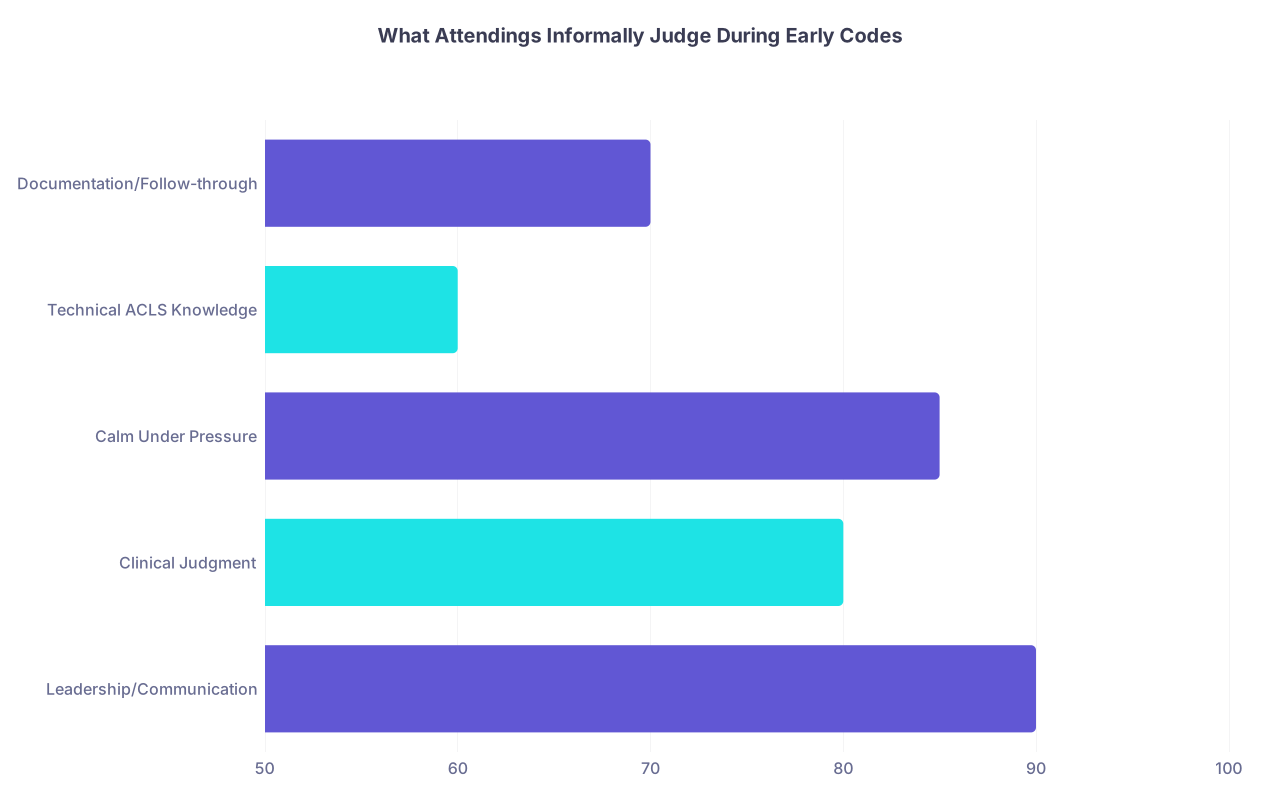
| Category | Value |
|---|---|
| Leadership/Communication | 90 |
| Clinical Judgment | 80 |
| Calm Under Pressure | 85 |
| Technical ACLS Knowledge | 60 |
| Documentation/Follow-through | 70 |
8. How To Prepare Yourself For That First Real Night
I’m not going to insult you with “review ACLS.” You know that.
What actually moves the needle in how attendings judge you:
Rehearse the first 30 seconds out loud
Not in your head. Say it. In your call room. In the shower.
“I’m Dr. __, I’m running this code. Keep compressions going. Someone tell me what happened. You on compressions, you’re switching every 2 minutes. Epi is ready?”
If those words are already muscle memory, you buy yourself mental bandwidth for everything else.
Decide who you want to be in that room
You will act how you’ve secretly decided you are.
If your internal story is “I’m just an intern, I don’t know anything, I hope the nurse will save me,” that will show.
If it’s, “I’m a junior physician. I will be calm, I will speak clearly, I will lean on the team,” that will show too.
Attendings are experts in picking up that posture within seconds. Set it beforehand.
Talk to nurses and RTs before your first code night
Ask them, straight up: “What makes a resident good in a code from your perspective? What drives you crazy?”
You’ll hear the same themes I just told you. But when they see that you cared enough to ask on a calm day, they’ll cut you some slack on the crazy nights. And they will advocate for you with attendings, which matters more than you realize.

| Step | Description |
|---|---|
| Step 1 | Overhead Code Blue |
| Step 2 | Arrive and Identify Yourself |
| Step 3 | Assess Patient and Get One Liner |
| Step 4 | Claim Leadership and Assign Roles |
| Step 5 | Run Algorithm and Think Etiology |
| Step 6 | Reassess and Decide Continue or Stop |
| Step 7 | Debrief Team |
| Step 8 | Document and Resume Rounds |
FAQ: What Attendings Really Judge During Your First Code Blue Night
Will attendings hold it against me if I freeze during my very first code?
If you completely freeze, yes, it leaves a mark—but it’s not permanent. What they really care about is whether you improve quickly. If your next few codes show growth—more voice, more structure, better communication—most will rewrite their first impression. The problem is when you freeze repeatedly and never seem to learn.Is it better to defer to the attending and let them run the code?
On your first night, the attending may naturally take over if things are going badly. But they expect you to at least try to run the basics. If you stand back waiting for them to lead every time, you get labeled as passive and non‑progressive. The sweet spot is: you lead out loud, but you’re very open to their mid‑course corrections.How much does it matter if I mess up the exact timing of meds or shocks?
Compared to your leadership and communication, minor timing issues are low on the list. If compressions are high‑quality and continuous, most attendings won’t crucify you for a 30–60 second drift off ideal timing. They will react if your timing errors are due to chaos you created by poor leadership or inattention.What if I disagree with a nurse or RT during the code? Do attendings judge that?
They’re not judging disagreement. They’re judging how you disagree. If a nurse says, “We already gave epi,” and you snap back, “No you didn’t, just do it,” that’s a problem. If you say, “Okay, let’s confirm—timekeeper, what do you have for meds so far?” you’re using structure to resolve conflict. Attendings respect that.How honest should I be in the post‑code debrief with the attending?
Completely honest. If you say, “I felt lost when the rhythm changed and I wasn’t sure what to do next,” most attendings will lean in and teach. If you pretend you were in control when you clearly weren’t, they’ll see it as lack of insight. Admitting one or two concrete things you want to improve actually raises their estimation of you.
Years from now, you won’t remember the exact rhythm strips from your first code blue night. You’ll remember how it felt when everyone turned to you and waited for you to act. And your attendings will remember who you were in that moment—scared but steady, or scared and silent.
You can’t control every outcome. But you can absolutely control the kind of physician you sound like when the room goes quiet and the alarms start. That’s what they’re really judging.