
The family demanding to see “the real doctor” at 2 a.m. isn’t a communication problem. It’s a power problem—and you need a strategy, not a nice smile.
You’re on call. Something destabilizes. You rush in, manage the acute issue, and as the dust settles the family decides you’re not enough. They want “the real doctor,” “the one in charge,” “not the trainee.” If you handle this badly, two things happen: you lose control of the room, and your attending gets a distorted version of what happened by morning.
Handled well, though, you keep the patient safe, preserve your authority, and still give the family enough of what they actually want: reassurance, clarity, and someone to blame if things go bad.
Let’s walk through exactly what to do.
1. First 60 seconds: Don’t defend your ego, secure the situation
Your first job is not to prove that you’re a real doctor. It’s to stop the situation from spiraling while keeping clinical priorities straight.
The typical sequence looks like this:
- Patient acutely worsens (desat, hypotension, post-op change, whatever)
- You respond, stabilize, start orders
- Family walks in or is updated
- Someone says: “We want to speak to the real doctor. Not the student. Not the trainee. The real one.”
Here’s your internal checklist for the first minute:
- Is the patient actually stable?
- Is there anything time-sensitive still pending? (STAT labs, imaging, escalation to ICU, pain/crisis management)
- Are you alone or is there any staff ally (nurse, charge RN, RT, security) nearby?
If the patient isn’t stable, you do not engage in a long conversation. You say something like:
“Right now my focus has to be on keeping them stable. I am the doctor here at the bedside. I’m going to finish what needs to be done, and then I will update you. I hear that you want to talk with the attending—I’ll address that, but first I need to keep them safe.”
Then you turn back to the patient. Full stop. You’re allowed to prioritize the airway over their anxiety.
If the situation is already stabilized, then you move into controlled engagement. Notice: controlled. You choose when and how you talk, not them.
2. How to respond to “I want the real doctor” without losing authority
The worst thing you can do here is snap, get defensive, or oversell your independence. Anything that sounds like, “I’m just as good as the attending” will blow up when something complex comes up and you need help.
You need a short, calm, confident script that does three things at once:
- Acknowledges they want more senior input
- Affirms your actual role and competence
- Sets expectations about availability and timing
Use something like this (adapt it to your style and level):
“I understand you want to speak with the attending. I’m the doctor on the team in the hospital overnight. I’ve evaluated [patient name], reviewed their results, and I’m managing their care right now. I’m also in direct contact with the attending who supervises our team. I’ll update them after we talk, and we can discuss if they need to come in or call you directly.”
If they push:
“So you’re not the real doctor. We want the real one.”
You hold your tone:
“I am a licensed physician and part of the primary team caring for [patient name]. Your attending physician leads the team and is not physically in the hospital overnight, but is available to me. Right now, I’m the doctor at the bedside making decisions for your family member. I will absolutely loop the attending in.”
Key moves here:
- You name your role clearly: “licensed physician,” “resident physician,” “doctor on the team overnight”
- You don’t apologize for being who you are
- You show that you have a line to the attending, not that you’re a powerless middleman
If you’re an intern and still feel wobbly saying that, say it anyway. Confidence is not about lying; it’s about owning your lane.
3. Decide: When do you actually wake/call the attending?
This is where residents get in trouble. Either they call for every annoyed family and get labeled “needy,” or they under-call, and the morning story is, “Why didn’t you tell me this was blowing up?”
You need a simple mental algorithm. Something like this:

| Step | Description |
|---|---|
| Step 1 | Family demands real doctor |
| Step 2 | Focus on stabilization |
| Step 3 | Update attending after crisis |
| Step 4 | Call attending now |
| Step 5 | Call charge nurse and attending |
| Step 6 | Explain team structure and plan |
| Step 7 | Update attending via message or sign out |
| Step 8 | Patient stable? |
| Step 9 | Any new significant change? |
| Step 10 | Family escalating or abusive? |
Call the attending now at night when:
- There is a real change in clinical status (new chest pain, neuro change, acute decompensation, code, rapid response)
- You’re about to make a major decision (ICU transfer, change code status, high-risk med/clot buster, going back to OR)
- The family is refusing critical care based on mistrust of you (“We won’t let you do this until the attending comes”)
- The situation is escalating toward security and you need leadership backup
In those cases, your page should sound like:
“Hi Dr. Smith, sorry to wake you. I’m with Mr. Lopez in room 412. He had [brief clinical summary], now [specific change]. I’ve done [what you’ve done]. He’s currently [vitals/appearance]. The family is asking to speak to the attending and are hesitant about [X decision]. I think we should [what you think]. I’d appreciate if you could [come in / call in / agree to X / speak briefly with them by phone].”
This tells your attending:
- You are clinically on top of it
- The request for them to be involved is tied to real clinical stuff, not just vibes
- You have a proposed plan, not just “Help, they’re mad”
If the patient is stable and the family just doesn’t like residents, many attendings prefer you do not wake them just for a “real doctor” demand. Instead, do two things:
- Document that the family requested to speak with the attending
- Hand this off clearly in morning sign-out so the attending can round and address it early
That way, when the family says, “We asked to see you last night,” your attending can respond, “Yes, I saw that in the chart and I’m here this morning to talk through everything.”
4. De-escalation tactics that work at 3 a.m.
Most “we want the real doctor” demands are not actually about your credentials. They’re about fear, anger, and loss of control. You do not have to be a therapist, but you should know the levers that work.
Use structured empathy, not vague sympathy
Skip “I know how you feel.” You do not. Use specific, grounded lines:
- “This is a lot to take in, especially in the middle of the night.”
- “You’ve been watching [patient] get worse and that’s scary.”
- “It sounds like you’re worried something will be missed.”
Then add a concrete anchor:
“My job is to make sure that doesn’t happen. Let me walk you through what we’ve done and what we’re watching for.”
Put visuals or specifics between you and their fear
Walk them through:
- Monitoring (telemetry, neuro checks, repeat labs)
- Time frames (“Our next reassessment is in two hours; if anything changes before then, the nurse calls me immediately.”)
- What would trigger upgrades (rapid response, ICU transfer, calling surgeons back in)
If you have a whiteboard or progress note, use it. People calm down when they see a system, not just a person they don’t trust.
5. Clarify the team structure without sounding like a gatekeeper
Families often genuinely don’t understand who’s who at night. They hear “night float,” “cross-cover,” “resident,” “hospitalist,” and it all blurs into “not the real one.”
Use a clear, simple structure:
“During the day, your main doctor—Dr. Patel—leads the team and is usually in the hospital. At night, I’m the doctor covering the floor. I manage emergencies, changes, and decisions overnight. I’m in contact with Dr. Patel or the attending on call as needed, and then they see you in the morning. This is how the hospital keeps patients covered 24/7.”
If they say, “So no attending is here at all?” be honest:
“There is always an attending physician responsible for this service, but they are not physically in this building overnight unless needed. That’s standard for most hospitals. If I see something that needs their in-person attention, I call them, and they come in or give direct instructions.”
You’re not the bouncer guarding the attending. You’re the filter that keeps the system from collapsing. Own that.
6. When the family refuses care until they see “the real doctor”
This is where it gets hairy. You order a CT, consent for a procedure, or start a critical med, and the family says:
“We’re not agreeing to anything until the real doctor comes.”
Now you have two responsibilities:
- Respect their right to be informed and involved
- Prevent harm from delays
You handle it like this:
Clarify urgency:
“The reason I’m recommending this now is because waiting could increase the risk of [stroke, permanent damage, ICU transfer]. I do not want that to happen.”
Offer a time-bounded attending contact if appropriate:
“I can page the attending and see if they’re able to speak by phone in the next few minutes. While I do that, can I answer any specific questions about the test or treatment?”
Be explicit about risk of waiting (and document it):
“If we wait for an in-person attending evaluation, that will likely be in the morning. That means we’d be accepting the risk that [spell out risk]. I’ll document that you prefer to wait. My medical recommendation is to proceed now.”
This is where you get nursing and possibly your charge nurse to the bedside, partly as witnesses, partly as support.
If the attending backs your plan and speaks to the family and they still refuse, you’ve done your job. You chart it thoroughly.
7. Handling disrespect and microaggressions without losing your cool
Let’s be blunt. “Real doctor” talk is often loaded—age, race, gender, accent, or even specialty.
You will hear:
- “We want someone older.”
- “We want an American doctor.”
- “We want a male/female doctor.”
- “We want the boss, not the student.”
You get to set boundaries.
You can say:
“I understand you want someone with more authority. I’m the physician covering tonight. My responsibility is to care for [patient] to the best of my training and judgment. I will also update the attending. Comments about my [age/accent/gender] don’t change the fact that I’m the doctor at the bedside right now.”
If they cross into outright abuse—yelling, slurs, threats—this is not “customer service”; it’s a safety issue. Loop in nursing leadership and security.

Many hospitals have policies: you are not required to tolerate verbal abuse. Use them. Document the behavior. Get your attending and program director involved if it becomes a pattern or serious incident.
8. Documentation that protects you at M&M and in the morning
Your chart is your best defense when the story gets retold later as “no doctor saw them at night.”
You need a brief but specific note. Something like:
- “Called to bedside for [issue]. Patient evaluated: [key exam, vitals].”
- “Family expressed desire to speak with attending physician, stating ‘we want the real doctor.’”
- “Explained team structure, my role as overnight resident, and that attending is available by phone and will evaluate in morning rounds.”
- “Discussed recommended plan: [tests/treatments]. Answered questions. Family [agreed/refused] to proceed.”
- “Attending Dr. X [was/will be] updated [by phone at 02:30 / via morning sign-out].”
If your attending actually speaks with them overnight by phone, add:
- “Attending Dr. X spoke with family by phone at ~02:45, confirmed plan for [X].”
This way, when there’s a complaint, the record shows: there was a doctor, you did explain things, and the request for “real doctor” was acknowledged and managed.
9. Your own mental game: Not internalizing every insult
You’re tired. You’re overworked. Being told you’re not a real doctor at 3 a.m. hits harder than at 3 p.m.
Here’s the truth:
Families at 2 a.m. are not evaluating your worth. They’re flailing for control in a setting they don’t understand. You’re the closest target.
A few practical ways to not let it eat you alive:
- Debrief with the night nurse for 2 minutes after: “How did that land from your side?” Nurses see this pattern constantly; you’ll get some perspective.
- Pick one line that grounds you: “I am the doctor at the bedside.” Repeat it in your head if you have to.
- On post-call, mention tough cases briefly at sign-out or to a senior you trust. People will remind you: this is common, not a personal failure.
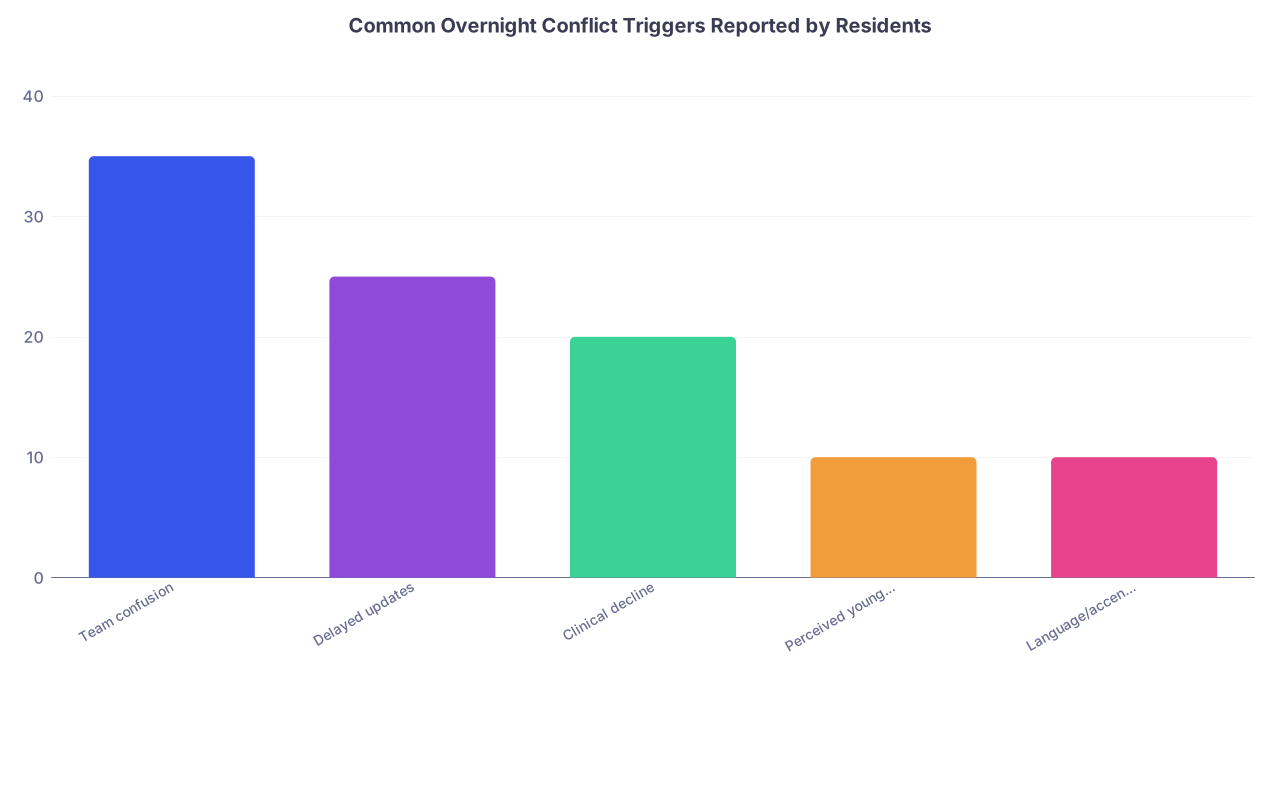
| Category | Value |
|---|---|
| Team confusion | 35 |
| Delayed updates | 25 |
| Clinical decline | 20 |
| Perceived young age | 10 |
| Language/accent issues | 10 |
You will not fix hospital culture or public perception in one night. Your job is narrower: keep the patient safe and keep your own boundaries intact.
10. Example scripts you can basically steal
You do not need to improvise all this from scratch. Here are plug-and-play scripts for common variations:
Scenario A: Family just arrived, patient stable, demanding attending
“I’m Dr. [Name], the resident physician on the team caring for [patient]. I understand you’d like to speak with the attending, the senior doctor who leads our team. At night, I’m the doctor in the hospital managing care and in contact with the attending as needed. I’ve just evaluated [patient] and here’s what’s going on… After we talk, I’ll update the attending and they’ll see you during morning rounds.”
Scenario B: Family is upset during a real change in status
“Right now I need to focus on stabilizing [patient]. I’m the doctor here at the bedside. Let me finish this immediate care, and then I’ll explain exactly what happened and call the attending to update them as well.”
Scenario C: They question your competency directly
“You’re right to care who’s making decisions. I’m a licensed physician in [X year] of residency in [specialty], and I care for patients like [patient] every night. I work closely with Dr. [Attending] who oversees our team. I’m managing the situation now and will keep them updated.”

Scenario D: They refuse a needed test until they see the attending
“My medical recommendation is that we do this test now because waiting could increase the risk of [X]. The attending is not in the hospital overnight but is available to me by phone. I can page them to discuss the plan, but there may be a delay before they can speak with you directly. If we wait for an in-person attending evaluation, that will likely be in the morning; that means accepting the risk of [X]. I’ll document your preference, but my recommendation is to proceed now.”
Scenario E: They’re clearly biased (age, race, gender)
“I hear that you’re uncomfortable. I am the physician assigned to care for [patient] tonight, and I’ll continue to do that to the best of my training and judgment. Requests based on my [age/race/gender] are not something we can accommodate. The attending physician oversees our team, and I will update them about [patient].”
11. Use your allies: Nursing, charge, security, and your peers
Do not white-knuckle through every difficult family alone. That’s how people burn out or snap.
- Ask the nurse to stay in the room for part of the conversation. It reinforces that you’re part of a team.
- If the family is clearly escalating or has a history, loop in the charge nurse early.
- If you’re on a big service, ask your senior to join for 5 minutes if they’re free. Sometimes a PGY3 walking in and repeating the same message defuses things.
- In extreme cases, involve security pre-emptively to stand nearby. Their presence alone often cools the room.

| Step | Description |
|---|---|
| Step 1 | Resident at bedside |
| Step 2 | Nurse |
| Step 3 | Charge nurse |
| Step 4 | Security |
| Step 5 | Senior resident |
| Step 6 | Attending |
You’re not weak for pulling others in. You’re smart.
12. Quick comparison: When to call vs when to just document
| Situation | Call Now | Document & Sign Out |
|---|---|---|
| New chest pain, neuro change, rapid response | Yes | Also yes |
| Stable patient, family just prefers attending | No | Yes |
| Family refusing critical care until attending | Yes | Also yes |
| Abusive/threatening behavior | Usually | Yes |
| Routine concern, no change in status | Usually no | Yes |

Use that table as your mental shortcut. If patient safety or major decisions are in play, call. If it’s preference and hurt feelings only, document and hand off.
FAQs

1. What if my attending gets angry that I called them for a “real doctor” demand?
Some attendings will grumble no matter what. Your job is to make sure your call is defensible. If there was a real change in status, refusal of important care, or serious escalation, you’re covered. If they snap at you, you can calmly say, “I understand. The family was refusing [X] until you were involved, and I was concerned about delay.” If they’re consistently unreasonable, talk to your senior or program leadership. But when in doubt on critical issues, call.
2. How do I handle it if I actually don’t know what to do clinically and they also want the real doctor?
Admit the clinical uncertainty, not incompetence. “This situation is complex, and I want the attending involved in this decision. I’m going to call them now so we can make the best plan.” Then call, present a clear summary, and propose what you think even if you’re unsure. Families generally calm down when they see you know your limits and escalate appropriately.
3. What if the attending refuses to talk directly to the family at night?
Then you don’t promise them a direct conversation you can’t deliver. You say, “I’ve spoken with the attending, and we’ve agreed on this plan for tonight. They’ll see you in person during morning rounds.” If the family demands a phone conversation and the attending has clearly said no, don’t lie. You can say, “They’re not able to get on the phone right now, but I’ve reviewed everything with them. I can go over the plan again and answer your questions.”
4. How do I respond if a nurse undermines me by saying, ‘Let me call the real doctor’?
You address it later, in private, never in front of the family. “When you said you’d call the ‘real doctor,’ it undercut my role with the family. I need us presenting a united front. If you’re concerned I’m missing something, please pull me aside and we can discuss or escalate together.” If it keeps happening, involve the charge nurse or your chief. Disunity at the bedside will haunt you.
5. Is it ever appropriate to say, ‘I’m the doctor; there is no one else for you to talk to tonight’?
Rarely, and only if you’ve already offered reasonable options (update in the morning, call if appropriate) and they’re using “real doctor” as a weapon to keep arguing. A softer but firm version is better: “I’m the physician available in the hospital tonight, and I’m responsible for [patient]’s care. I will update the attending, and they’ll see you in the morning. Right now, I need to focus on keeping [patient] safe and carrying out the plan we’ve discussed.” It keeps you in control without sounding dismissive.
Bottom line:
You are the doctor at the bedside. Act like it, speak like it, and document like it.
Protect the patient, protect your authority, and use your attendings strategically—not as shields, but as backup when it truly matters.