The culture of “just push through” when you’re sick or exhausted on call is dangerous—for patients and for you.
You already know that. You feel it at 4:30 a.m. when your vision blurs writing orders, or when you’re febrile and still cross-covering three services because “there’s no backup.” The problem isn’t that you’re weak. The problem is that residency systems are often built on magical thinking about human limits.
So let’s be concrete: when you’re on call and ill or wiped out, what are you actually supposed to do? Not the theoretical professionalism answer. The real-world, “it’s 2:17 a.m. and I feel like I might pass out” answer.
This is the playbook.
1. Know Where the Line Is: Impaired vs Just Tired
You will be tired on call. A lot. That’s baked into the job. But there is a difference between “appropriately exhausted” and “not safe to practice.”
Here’s the line I use, and it’s more strict than what many programs pretend to have but never enforce.
You are functionally impaired (and need to escalate) when any of these are true:
- You can’t safely drive a car.
- You’re struggling to track what the nurse just said on the phone.
- You re-read an order three times and still aren’t sure it’s right.
- You’re dizzy, short of breath, febrile with chills, or having chest pain.
- You feel like you could fall asleep standing up.
If you’re not safe behind the wheel, you’re not safe writing for pressors or insulin.
Do not wait until you literally collapse. Programs love to say “we support wellness” but quietly reward people who pretend they’re fine. You have to be more honest with yourself than the system is with you.
Quick self-check at low points in the night:
- Can I recite my patient’s one-liner without looking?
- Can I do basic math (drip rate, weight-based dose) in a reasonable amount of time?
- Did I almost click “sign” on a clearly wrong order in the last hour?
- Do I remember the last 10 minutes clearly?
If you’re consistently failing that check, you’re in the yellow or red zone.
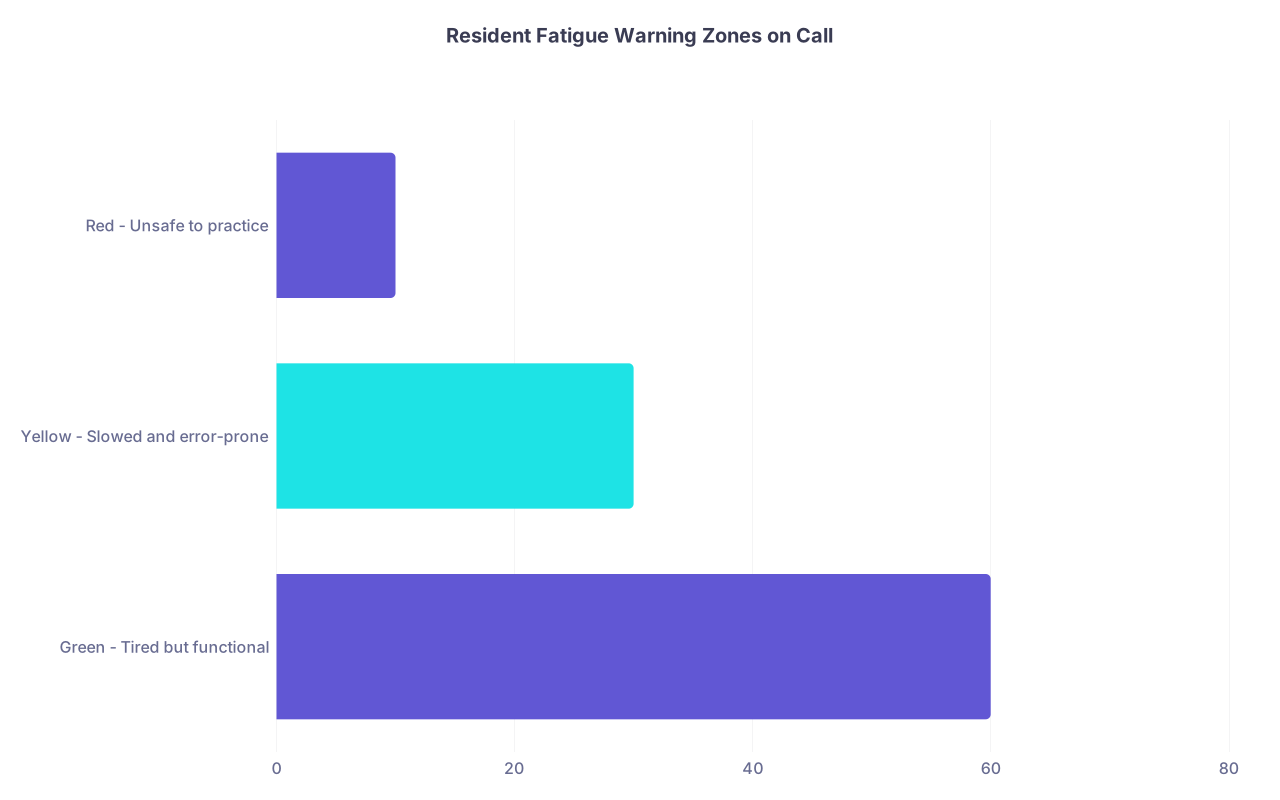
| Category | Value |
|---|---|
| Green - Tired but functional | 60 |
| Yellow - Slowed and error-prone | 30 |
| Red - Unsafe to practice | 10 |
This isn’t perfectionism. This is harm reduction—because you will be tired, and you will sometimes be sick. The question is how you respond when it crosses from uncomfortable to unsafe.
2. Before the Call: Set Up Your Boundaries in Advance
You can’t build boundaries at 3 a.m. in front of a malignant senior. You build them weeks earlier.
If you’re starting a rotation known for brutal call (surgery trauma nights, MICU 24s, ED nights), do this upfront:
Ask directly in orientation:
“If I become acutely ill during call—fever, food poisoning, migraine—what is the process for backup coverage?”If the answer is vague, keep pushing:
“Who do I actually call first? Chief? Admin? Attending?”
Get names, not generalities.Clarify the fatigue policy. Many programs technically have one. Few residents know how to use it. Ask:
“How do we activate the fatigue policy in real time? Is there a documented process?”Talk to recent residents on the rotation:
“What actually happened the last time someone got sick on call?”
That gives you reality, not handbook fantasy.
Write it down in a note on your phone:
“Rotation X – if I’m too sick: Call night float chief at [number], then page attending, then email program coordinator.”
When you already know the chain, you’re much more likely to actually use it.
3. You’re Sick and On Call: What to Do Hour by Hour
Let’s walk through the real situation.
Scenario A: You wake up obviously sick before a call shift
You wake up with 102°F fever, GI issues, or a migraine that makes light unbearable. Then you remember: you’re on a 28-hour call starting at 7 a.m.
Here’s the move:
Decide early. Don’t wait “to see if it gets better” until 30 minutes before shift. If you’re obviously unwell at 4–5 a.m., act.
Contact the right person in this order (modify for your program):
- Text or call your chief / scheduling resident:
“Hi [Name], I’m scheduled for call today. I woke up with fever 102, nausea and diarrhea since 3 a.m. I do not feel safe to cover patients. What’s the protocol for sick call coverage for today?” - If no response within 15–20 minutes, escalate to:
- Second chief or PD-designated contact
- Rotation attending (if your program expects this)
- Text or call your chief / scheduling resident:
Use specific language:
- “I do not feel safe to care for patients today.”
- Not “I’m a little under the weather” or “I’m not sure if I can.”
Clear language triggers responsibility in the person above you.
Expect guilt. Manage it like this:
- You’re not calling out because you’re “soft.” You’re preventing medication errors, missed sepsis, and bad handoffs.
- You will get looks and maybe comments later. Accept that. You’re not responsible for their poor boundaries.
Scenario B: You become sick or severely fatigued during call
This is more common and trickier. You were fine at 7 p.m. Now it’s 1:45 a.m. You’re diaphoretic, lightheaded, or fading hard.
Step 1: Stabilize your body for 10–15 minutes.
You are allowed to pause. Right now, it’s about triage.
- Tell the nurse who pages you:
“I’m having a brief medical issue myself. I’m going to step aside for 10 minutes. For anything emergent (hypotension, chest pain, respiratory distress), please page the attending directly or call rapid response. I’ll be right back.” - Grab water, sit, check your vitals if needed (yes, people actually do this on night float).
- Quick assessment: is this likely transient (hypoglycemia, dehydration, brief anxiety spike) or something bigger (flu, food poisoning, chest pain, migraine)?
Step 2: Decide if you can safely continue for the next 2–3 hours, not just now.
Ask yourself:
- Can I comfortably walk to a code and actively manage it?
- Can I respond reasonably to 3–4 more pages in the next hour?
- Am I making dumb mistakes in notes and orders?
If the answer is “no” or “barely,” you need to escalate.
Step 3: Loop in your senior or attending—quickly and concretely.
Use a script. Don’t try to wing it when you’re shaky.
Example to your senior: “Hey [Name], I need to tell you something. Over the last hour I’ve developed severe nausea and dizziness. I’m having trouble concentrating on orders. Right now I don’t feel safe covering independently. I think we need to discuss backup or redistributing coverage.”
If they brush you off with “we’re all tired,” repeat once, more firmly: “I know we’re all tired. This is beyond that. I am concerned I may miss something critical or write an unsafe order. I need help.”
If they still dismiss you, go up a level:
- Page the attending: “Dr. X, I’m the [PGY] on call. I’m currently experiencing [symptoms]. I’ve already spoken with [senior], but I still do not feel safe continuing independent coverage. Can we discuss options?”
You are not being dramatic. You’re deputized to protect patients. This is part of that job.
4. Handling Pushback, Guilt, and Subtle Threats
You will run into versions of this:
- “We all have to power through sometimes.”
- “If you go home, you’ll screw your co-residents.”
- “There’s no backup. You’re it.”
Here’s the uncomfortable truth: residency often runs on emotional blackmail. You feeling bad is what keeps the machine going. Once you see that, it’s easier to detach.
Some responses you can use without torching relationships:
When they appeal to “we all did it”:
- “I get that. But that doesn’t make it safe. I’m telling you I’m not safe to practice right now.”
When they guilt you about colleagues:
- “I hate putting extra work on the team. But an error or bad outcome will put a lot more on them. This is me trying to prevent that.”
When they say “there’s no backup”:
- “Then we need to call the chief/PD and document that I raised safety concerns. I can’t be the only safety plan.”
You are framing it around patient safety and institutional responsibility. That language matters.
5. When You Stay: Rules That Keep You (and Patients) Alive
Sometimes, despite all of this, you’ll still be there. Maybe there truly is no backup. Maybe everyone above you is “old-school.” Maybe you decided you can push through this one.
Then it becomes risk management.
Here are concrete guardrails:
Slow down orders by 10–20%.
If you usually whip through cross-cover orders, force yourself to pause:- Read back every order before signing.
- Explicitly check weight, allergies, renal function before high-risk meds (anticoagulation, insulin, contrast, sedatives).
Use nurses as your safety net more intentionally. Say it out loud to a couple of key nurses:
- “I’m more tired than usual tonight. If anything seems off about an order or a plan, I’d appreciate you double-checking with me.” Nurses already do this; you’re just making it explicit and easier.
Escalate earlier than usual to your attending. If you’re borderline about calling the attending on a borderline situation, just call.
- “I’m more fatigued than usual tonight, so I’m asking you to weigh in a bit more than I typically would.”
Avoid non-essential tasks.
- Defer “nice-to-have” notes, non-urgent med rec clean-up, and usual over-documentation habits.
- Focus on: active issues, pages, codes, new admissions.
Use micro-breaks as medication.
- 5 minutes with your eyes closed in the call room between pages.
- 2 minutes of stretching + water after a code.
You think that’s trivial when you’re buried. I’ve seen it rescue residents from spiraling—especially between 3–5 a.m., the absolute danger window.
6. Legal and Ethical Reality: Protecting Yourself
Nobody likes talking about this, but I’m going to.
If something goes very wrong—a catastrophic error, a serious adverse event—and they reconstruct the timeline and see:
- You were febrile, vomiting, or clearly impaired
- You told someone, and they told you to “push through”
- No one documented or acted on your concern
The institution is not going to stand up and say, “This is our fault, we understaffed.” They will be very interested in what you did and what you documented.
So:
When you notify someone you’re impaired, send a brief follow-up email if you can.
“Per our conversation at 01:30, I am currently experiencing severe fatigue and nausea and expressed concern about my ability to safely cover the service. I am continuing duties under your guidance. – [Name]”You’re not threatening. You’re creating a record that you raised the safety flag.
If an incident happens that night:
Document the medical facts, not excuses. Don’t editorialize in the chart. But in any internal QA/morbidity review or debrief, do not hide that you were unwell and had escalated. Hiding it does not protect you; it just hides systemic risk.
You are not just a lone weak link. You’re part of a flawed system. Protect yourself like it’s flawed. Because it is.
7. When This Becomes a Pattern: Chronic Exhaustion, Not One Bad Night
Sometimes the problem isn’t acute illness. It’s that you’re on your sixth 28-hour call in two weeks, barely sleeping on post-call days, and you live in a chronic fog.
You already know this isn’t sustainable. So what can you actually do besides complain to co-interns?
Here’s where to start.
Track, briefly but brutally
For 2 weeks, write down:
- Call dates and hours in-hospital
- Actual sleep hours per 24 h (rough estimates)
- Number of patients you’re responsible for overnight
- Any near-miss events you catch (almost wrong dose, almost missed lab, etc.)
Then you have data, not vibes.
| Day | Hours in Hospital | Sleep (hrs) | Number of Patients | Near Misses |
|---|---|---|---|---|
| Mon | 28 | 3 | 24 | 2 |
| Wed | 14 | 5 | 18 | 1 |
| Fri | 28 | 2 | 26 | 3 |
| Sun | 12 | 4 | 20 | 0 |
Then bring this, calmly, to:
- Your chief
- Or your program director
- Or both
Your script: “I want to show you what the last two weeks on this call schedule have looked like. I’m not here to complain; I’m here because I’m noticing concrete safety risks. Here are the hours, number of patients, and near misses I caught. I’m worried that if this continues, we’re set up for a bad outcome.”
You are framing this as patient safety and institutional risk, not “I’m tired and unhappy.”
Potential specific asks:
- “Can day residents finish admission orders before leaving?”
- “Can we cap the number of patients one resident covers overnight?”
- “Can the attending help with admission bottlenecks from 5–9 p.m.?”
You might get: “We can’t do much right now.” That doesn’t mean the conversation was useless. You’re building a record. You’re also quietly flagging that everyone owns the risk, not just you.
8. After the Night From Hell: How to Recover and Reset
You survived the shift where you were barely functional. Maybe you were sick. Maybe just obliterated. Either way, you’re post-call and wrecked.
Here’s how to actually recover instead of dragging this for a week:
On your way home:
- If you’re so tired you’re nodding off at red lights, do not drive. Sleep in the call room for 60–90 minutes, then go. Or ask a co-resident for a ride, then Uber back later. We’ve all seen the “fell asleep driving post-call” emails.
When you get home:
- Eat something small with protein and carbs (eggs and toast, yogurt and granola).
- Shower. Then blackout sleep for 3–5 hours max. If you crash for 10 hours, your circadian rhythm takes a bigger hit.
At wake-up (early evening):
- Hydrate. Walk outside for 10–15 minutes.
- No major life admin that night. Do not schedule flights, sign leases, make big decisions.
Mentally:
- Ask: Did I have any near misses or errors while impaired/sick? If yes, review them briefly when you’re clearer. Learn what you can—different order sets, earlier calls, better handoffs.
- Then drop the shame. You operating at 20% is a systems problem, not a moral failure.
9. How to Say “No” Without Burning Bridges
You are allowed to say “I can’t safely do that” to people above you. It just has to be done strategically.
Some language that works:
“Given how exhausted I am right now, I’m concerned that if I start another full admission after 7 a.m., I’ll miss something critical in the handoff. Can we either split the work or have day team pick up the note?”
“I’m happy to stay 30 more minutes to wrap active issues, but I’m past the point of safe decision-making for new problems. I’ve been on for 27 hours.”
“I understand coverage is tight. For patient safety, I need to step away for 20 minutes and regroup. If something emergent happens in that time, please call the attending directly.”
You’re not saying “I won’t.” You’re saying “I can’t safely”—and that word “safely” changes the legal and ethical equation for whoever hears it.
10. Bottom Line: Your Boundaries Are a Safety Tool, Not a Luxury
Let me strip it down.
There is a line where you are too sick or too tired to be safe. You’ve probably crossed it before and just got lucky. You don’t need to do that again to prove anything.
You must know, beforehand, who to call and what to say when you’re impaired on call. You will not figure it out in the moment if you’re dizzy and overwhelmed.
When you can’t step away, you switch into risk-minimization mode: slow down, double-check, pull nurses and attendings closer, and aggressively cut non-essential tasks.
You are not a hero for destroying yourself to keep a broken system running. You’re more valuable when you protect your own brain—because that’s the only thing standing between a vulnerable patient and a really bad order at 4:30 a.m.