The worst part of residency isn’t the hours. It’s walking out of a room at 3:17 a.m. knowing something went very wrong—and wondering what’s going to happen to you because of it.
Let me tell you what actually happens after a bad outcome on night float. Not the sanitized version they feed you during orientation. The real sequence. The phone calls. The quiet meetings. The stuff attendings only talk about behind closed doors.
Because every resident who has done enough nights has had that shift. You will, too.
The First Hour: Chaos, Documentation, and Quiet Triage of Blame
The formal event might be a code, a rapid response that spiraled, a missed diagnosis that declares itself at 5 a.m., or a crashing patient you inherited without a clean sign-out. The specific story varies. The anatomy of what happens next does not.
You do the immediate work: ACLS, procedures, scrambling for blood, calling ICU, pushing pressors. The room is loud. Everyone is focused on the patient. Nobody is talking about responsibility. Yet.
But as that code ends—ROSC or time of death—something else starts.
Step 1: The Unsanctioned Hallway Huddle
As the nurses clean up and RT rolls the vent back, there is almost always a small, very quick conversation in the hallway or at the desk. Usually:
- Charge nurse
- The most senior nurse involved
- You (if you do not walk away)
- Sometimes the resident from another team who showed up
The charge nurse will ask a very neutral but very pointed question that sounds like logistics and is actually about responsibility: “So when was the last set of vitals documented?” or “Who was covering this patient overnight?” or “Were they ICU status yet?”
That conversation is mental triage: “Was this inevitable?” vs “Did someone drop the ball?”
You are being assessed before you even know there’s a “case.”
If you’re smart, you stay calm, answer factually, and say what you did, not what you meant to do.
“I saw them at 22:30 after the nurse called about hypotension, started fluids, broadened antibiotics, and ordered repeat labs. They worsened around 02:15 and I was called for that.”
No excuses. No defensiveness. Just clean facts.
Step 2: You Document While Still Adrenalized
You then do the note. This is where a lot of residents quietly incriminate themselves or, worse, make themselves look careless.
Your brain will want to write, “I got called late.” Or “No one notified me.” Or “Labs still pending.” Or some passive voice nonsense: “Patient was hypotensive.” Program directors hate that tone. So do risk management and lawyers.
What experienced residents do instead: time-stamped actions. “At 02:18 I was notified of SBP in 70s; I evaluated the patient at bedside at 02:23…” etc.
And yes—other people will read that note. Not just the rounding team.
The Rest of the Night: The Emotional Hit and the Unwritten Rules
You walk back to your workroom. The adrenaline is crashing. The pager does not care that you may have just watched someone die. You still have cross-cover, admits, orders waiting.
Here’s the secret: attendings and program leadership expect you to be emotionally wrecked—and they also expect you to keep functioning. It is a cruel dual expectation, but it’s real.
You are allowed a few minutes alone. You are not allowed to completely disappear from the rest of the shift.
The nurse who saw you running that code will silently judge how you handle the next consult. If you start snapping at staff or freezing on straightforward pages, that will end up in the narrative later: “They were really overwhelmed.”
And I promise you this: the other residents find out before morning. There is always one nurse who says something like, “Rough night?” at the worst possible time.
Morning: Sign-Out, the Attending Reaction, and the Invisible Scorecard
The next big step is morning sign-out. This is where the story of the bad outcome gets shaped.
How You Present the Case
There are two ways residents present these at morning sign-out:
- The defensive data dump
- The clean, accountable narrative
The defensive version sounds like: “So uh, bed 12 coded… they were super sick, septic shock, I wasn’t called until really late…” and then an avalanche of vitals and labs with no clear story.
The accountable version: “Bed 12, 68-year-old male with septic shock, DNR-CCA, coded at 02:32. Overnight, I saw them at 22:30 for worsening hypotension, started additional fluids and broadened to meropenem. Repeat lactate was 6.1 at 01:50; at 02:18 nursing called for MAP in the 50s and new confusion. I went to bedside, started norepinephrine, called ICU, but patient lost pulses during transfer. Full code; no ROSC after 25 minutes. Family notified.”
Same facts. Very different impression.
Your attendings are tracking three things: recognition, escalation, and communication. Not perfection. They want to know: did you see the deterioration, did you try to get help, did you tell the right people.
What Attendings Say Out Loud vs What They Think
Out loud, a good attending will say something measured: “Okay, we’ll review the chart and talk more later. These patients are very sick.”
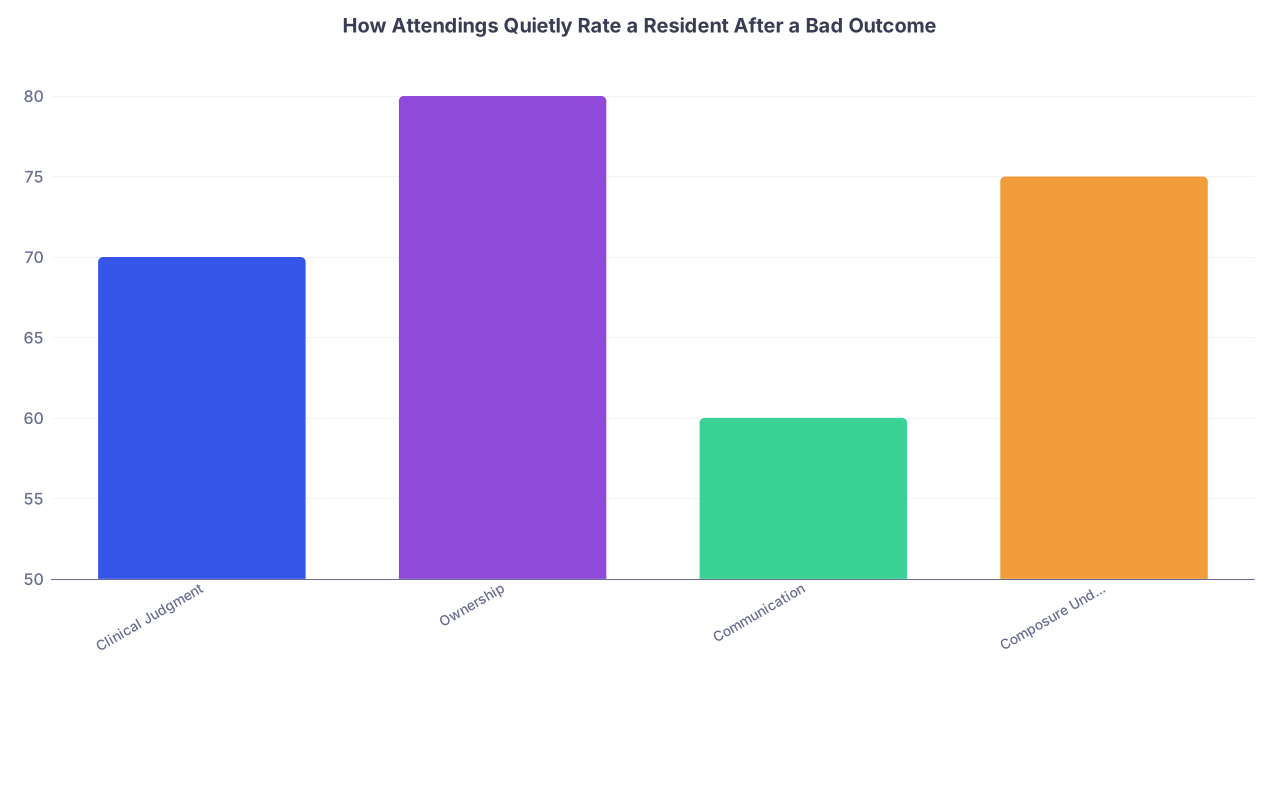
In their head, they’re slotting you on a mental slider:
| Category | Value |
|---|---|
| Clinical Judgment | 70 |
| Ownership | 80 |
| Communication | 60 |
| Composure Under Stress | 75 |
If your story sounds like you were surprised by something that was obviously brewing for 8 hours, that “Clinical Judgment” bar drops. If you keep saying “no one told me,” that “Ownership” bar tanks.
They won’t say this to your face that morning. But it comes up later—in faculty rooms, at CCC meetings, during letters for fellowship.
Behind Closed Doors: The Real Post-Mortem
Let’s get to the part nobody tells you: what your program and hospital actually do after a bad outcome on night float.
There are multiple reviews, each with its own culture and agenda.
1. The Attending-Only (or Faculty) Debrief
Usually happens the same day or next. It’s not in your calendar. You’re not invited.
The overnight attending, day attending, sometimes the chief, and maybe a hospitalist lead or ICU doc will sit down and walk through the case.
They pull up vitals, nursing notes, lab timestamps, your notes, order times. They reconstruct the night.
This is where the initial narrative crystallizes:
- “This was inevitable. Fulminant shock. Resident did fine.”
- “There was a delay in escalation. Resident didn’t grasp how unstable the patient was.”
- “System issue—no ICU beds, labs delayed, chronic understaffing.”
- Or the worst: “This was a miss.”
You will hear a filtered version of this. Maybe. Weeks later. Often watered down.
I’ve sat in those rooms. I’ve heard lines like: “They’re a good resident, but this shows they’re not ready to be left alone on nights without closer oversight.” That sentence has consequences—you just won’t see them immediately.
2. The Nursing and Risk Management Pathway
Separately, nursing leadership and hospital risk management may flag the case. Especially if:
- The family is angry
- There were multiple complaints
- Documentation conflicts
- House supervisor felt uncomfortable with what they saw
Sometimes they run through a structured tool, sometimes it’s informal. But if risk gets involved, they read everything. Including your wording in the note. Including time stamps.
You know those vague chart phrases—“patient found unresponsive,” “vitals unstable,” “team notified”? Risk management hates that. They want who, when, how.
If they think care was within acceptable range but communication was sloppy, this gets labeled as “opportunity for education.”
If they see obvious delay, they start using the phrase “opportunity for improvement in care escalation” which is the bureaucratic way of saying, “Someone should have called earlier.”
M&M and the Politics of Being the Case
If the outcome is high-profile enough—or if it intersects with some institutional priority—your case may be selected for Morbidity and Mortality (M&M).
Here’s the ugly truth: picking an M&M case is partly about education and partly about politics.

| Step | Description |
|---|---|
| Step 1 | Bad Outcome on Nights |
| Step 2 | Attending Review |
| Step 3 | Consider M&M as System Case |
| Step 4 | Case Flagged for Education |
| Step 5 | No M&M |
| Step 6 | Residency/Dept Leadership |
| Step 7 | M&M Selection Meeting |
| Step 8 | Formal M&M Presentation |
| Step 9 | Clear System Issue? |
| Step 10 | Clear Individual Error? |
Your name might get removed or softened in the presentation. On slides, it might be “Night resident evaluated” instead of “Dr. Smith delayed calling ICU.” But everyone in your program will know exactly who it was. That’s the reality.
Residents worry M&M will destroy their reputation. Here’s the inside view: the way you show up at M&M matters more than the case itself.
Residents who survive M&M well:
- Show up
- Present or comment in a calm, factual way
- Own what they’d do differently next time
- Don’t throw nurses or other residents under the bus
Everyone in that room knows they’re an imperfect trainee in an imperfect system. What they’re grading is your maturity and honesty.
Residents who hurt themselves:
- Get defensive and blame “the system” for everything
- Emphasize how overworked they were without acknowledging misjudgments
- Argue minor details instead of accepting big-picture lessons
Faculty have long memories for this. I’ve been in a CCC (Clinical Competency Committee) where someone said, months later, “Remember how they handled that M&M? That bothered me.”
Program-Level Consequences: What Actually Lands in Your File
Residents always ask, “Will this go in my file?” That question misunderstands how programs work.
Here’s the real structure:
| Item | Usually Documented? |
|---|---|
| Single bad outcome, good response | Rarely formally |
| Pattern of similar issues | Yes |
| Formal patient safety report | Yes |
| Unprofessional behavior after | Yes |
| Honest self-reflection, improvement | Informally remembered |
One bad night float outcome, where:
- You escalated reasonably
- You documented clearly
- You communicated with the team and family
- You responded maturely in follow-up
…will not usually become a formal black mark. It will be discussed. It will be remembered. But it won’t automatically tank your fellowship chances.
A pattern is different. Three cases in six months with similar themes—delayed recognition, not calling for help, poor communication—that does get formally tracked. That’s when you start seeing words like “requires closer supervision” in faculty emails. And yes, that kind of language bleeds into your final evaluations.
The Emotional Fallout: What Colleagues Say When You’re Not There
Let’s talk about something more raw: what other residents actually say after your bad night.
When you’re the one on nights, you always feel like the main character. You’re not. Everyone else has their own chaos. Your bad outcome is a 3–10 minute topic at most.
Conversations the next day sound like:
- “Did you hear about that code on 7 West? Yeah, apparently they crumped fast.”
- “Damn, that sucks. Who was on nights?”
- “Oh, R3 Smith. They’re solid. Just a bad case.” Or “Yeah, they kind of struggle with recognizing sick from not-sick. Not surprised.”
Your reputation going into the event heavily colors how people interpret it. A trusted, hardworking, humble resident who has a bad outcome gets the benefit of the doubt. The one who’s been known as disengaged or arrogant does not.
Your behavior right after the case also travels. If you came into the workroom and ripped into nursing or complained that “no one ever tells me anything,” that will be repeated. If you came in pale, said quietly, “That was rough,” and then kept working, that gets remembered a very different way.
This is the ugly part no one admits: people use bad outcomes to confirm the story they already believe about you. Better to make sure the story about you before the bad night is solid.
What You Can Do Right After: Salvage vs Spiral
You cannot retroactively fix the medicine. You can heavily influence the narrative that forms around the case.
Here’s what experienced, well-regarded residents do after a bad outcome on night float:
They initiate the follow-up.
Not in a groveling, “Please don’t hate me” way. In a direct, professional way.
Something like: “I’d like to go through that case with you when you have time. There are a couple of decision points I’m not sure I handled optimally.”
When I was on the faculty side, that sentence immediately raised a resident in my estimation. It signals three things: insight, humility, and teachability. Faculty will go to bat for someone like that, even if they truly did mess up earlier that night.
The other crucial move: talk to your senior or chief honestly. Not performatively.
What doesn’t help: “The case was crazy, the nurses didn’t call, labs took forever, ICU wouldn’t take them…”
What does help: “Here’s where I struggled with the decision. Here’s what I saw. Here’s what I was afraid of missing.”
Good chiefs will then coach you on how to frame this when attendings or program leadership follow up.
How Bad Is “Bad”? A Reality Check on Outcomes
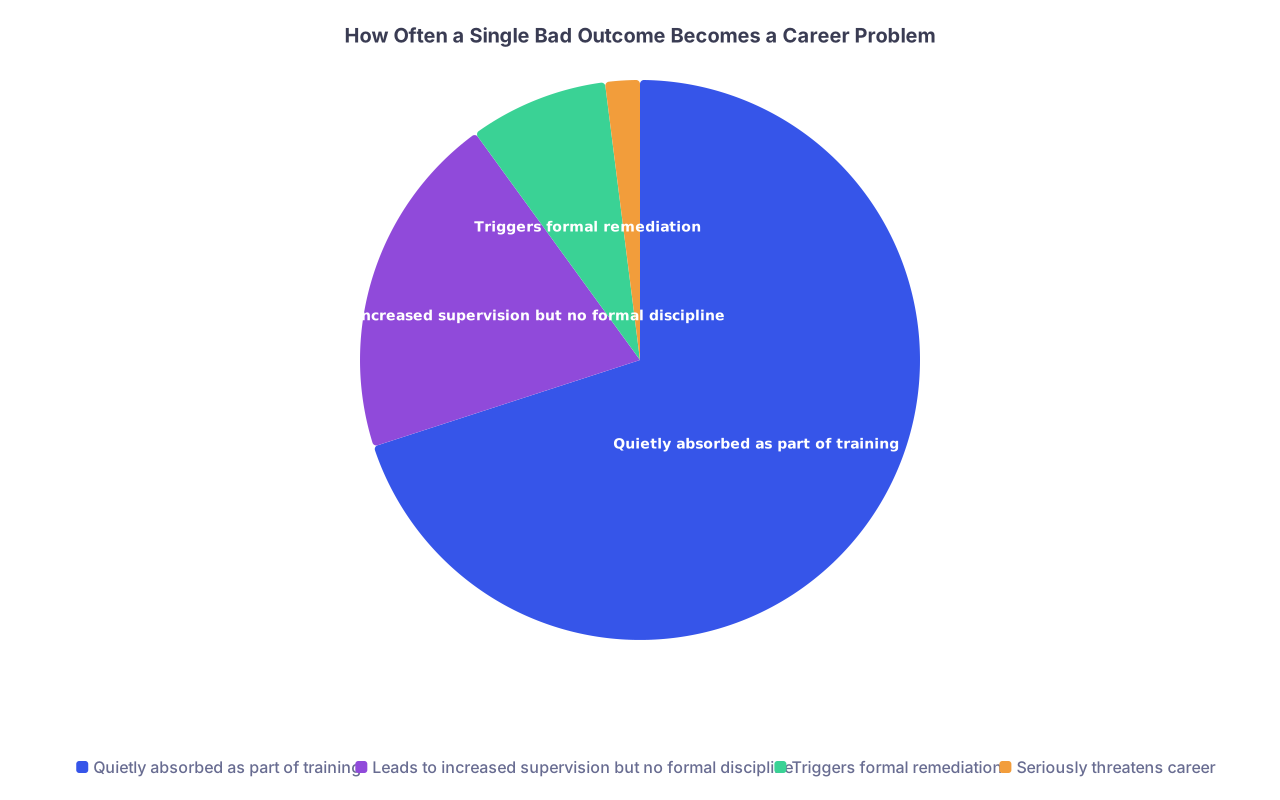
Let’s quantify this, because your anxiety will exaggerate everything at 4 a.m.
| Category | Value |
|---|---|
| Quietly absorbed as part of training | 70 |
| Leads to increased supervision but no formal discipline | 20 |
| Triggers formal remediation | 8 |
| Seriously threatens career | 2 |
Those numbers are approximate, but they match what I’ve seen across multiple programs:
- The majority of bad outcomes in reasonably run programs are treated as expected parts of resident training.
- A subset generates closer supervision and coaching. Annoying, yes. Career-ending, no.
- Truly career-threatening cases usually involve either gross negligence, dishonesty, or repeated patterns of unsafe behavior.
The thing that moves you from “painful learning event” into “formal problem resident” is not the existence of a bad outcome. It’s how you consistently respond before and after those events.
What Changes Next: Subtle Shifts in Trust and Autonomy
You won’t always get an email that says, “Because of that case, we’re doing X.” Most of the consequences are quieter.
You might notice:
- An attending who previously let you manage independently starts asking you for more frequent updates on sick patients.
- Chiefs assign you to a specific rotation sooner than others—like extra ICU or nights with a very hands-on attending—because they want you to get more reps under supervision.
- In conference, your attendings start cold-calling you a bit more on cases that mirror what went wrong. That’s intentional.
There’s a whole hidden curriculum of “autonomy signals” that residents pick up on but rarely name. After a rough case, you may feel some of those dial back for a while.
If you respond to that by pouting, withdrawing, or complaining that you’re being “micromanaged,” you confirm the negative narrative. If you respond by saying, “I appreciate the extra feedback; I want to get better at this,” a surprising number of faculty will relax and let the case go.
How to Use a Bad Night Instead of Being Crushed by It
I’m not going to sugarcoat this: some bad outcomes will stick with you for years. They should. That’s part of becoming a real physician, not just someone who got good grades.
But there’s a difference between being shaped by them and being defined by them.
Residents who grow from bad nights tend to do a few things consistently:
They turn those cases into explicit “defining moments” in their personal growth story. When it comes time for fellowship interviews, they can say, “There was a patient on night float where I missed X. Since then, I always Y.” That kind of narrative is powerful.
They quietly change their practice habits. They start walking to bedside more. They call ICU earlier. They double-check vitals at certain thresholds. They use their seniors differently. Faculty see that. Nursing sees that.
They stay in the arena. They don’t try to avoid sick patients or nights or responsibility. They ask for help more intelligently. They accept that feeling scared and still acting decisively is part of the job.
You are not supposed to be perfect on night float. You are supposed to be supervised. You are supposed to be learning your edges. That means sometimes you will go past them.
The people evaluating you know this. They’re not looking for the resident who’s never had a bad outcome. That person does not exist. They’re looking for the resident who, after that 3:17 a.m. disaster, comes back and is a little wiser, a little humbler, and still willing to answer the next pager.