The idea that you can “power through” overnight call without your judgment changing is fiction. The data are brutal: sleep loss and circadian disruption quietly dismantle your decision‑making long before you feel “tired enough.”
Let me walk through what actually happens to your brain on call, what really worsens decision fatigue, and what strategies have evidence behind them — not just folklore from the loudest senior in the workroom.
What Decision Fatigue Really Is (And Isn’t)
People throw “decision fatigue” around like it’s a vibe. “I’m so decision fatigued.” That’s not what the literature is actually describing.
Psychologically, decision fatigue refers to the progressive deterioration in decision quality as you make more choices, especially under conditions of strain, limited resources, or self‑control demands. It’s related to, but not identical with, simple sleep deprivation.
On call, you usually get a toxic mix of:
- Acute sleep loss
- Circadian misalignment (you are awake when your brain expects deep sleep)
- High decision volume (pages, admissions, cross‑cover calls)
- High stakes (you are not choosing Netflix shows; you are triaging sepsis)
Those combine into a very specific pattern of cognitive damage:
- Slower processing speed
- More defaulting to “status quo” or “decision avoidance”
- More reliance on heuristics and pattern recognition (sometimes good, sometimes dangerous)
- Deterioration in working memory and complex reasoning
Here’s the key myth to kill upfront: you don’t need to feel exhausted to show significant performance decline. Many residents “feel fine” at 3–4 AM and are already performing like they have a blood alcohol level around 0.05–0.08 in certain domains.
What the Evidence Actually Says About Night Work and Judgment
There is a mountain of data here. Let’s cut out the anecdotes.
Sleep loss and performance: how bad is it, really?
Classic controlled sleep studies show that 17–19 hours awake gives you performance declines on psychomotor tests similar to a blood alcohol of ~0.05. Push that to 24 hours awake and impairment matches or exceeds 0.08 in many tasks.
Residents routinely hit 20–28 hours on call. That’s not controversial. That’s just math.
The cognitive domains most affected:
- Vigilance and sustained attention
- Working memory
- Complex decision‑making and flexible thinking
- Risk assessment
You know where that matters? Exactly in the kind of “gray zone” calls you get overnight: borderline sepsis, questionable chest pain, early decompensation.
Nights vs days: are we just being dramatic?
No. There’s decent observational evidence across specialties that night shifts and extended duty are associated with more:
- Diagnostic errors
- Medication errors
- Near misses
- Self‑reported attentional failures
Is every night an apocalypse of bad decisions? No. But the risk profile shifts meaningfully.
Does decision volume itself matter?
Yes, and this is the part people underappreciate.
There’s a famous paper on judges granting parole less often as they get further away from meal breaks — they defaulted increasingly to the “safer” option (no parole) as mental energy drained. In other words: more decisions, worse risk‑benefit balancing, more status quo bias.
Overnight, you’re doing the same thing:
- Pager never stops → decision after decision after decision
- Each one seems small (“Tylenol?” “Labs now or AM?” “Admit vs OBS?”)
- By 4 AM, you’re much more likely to default to your easy heuristic:
- Admit vs discharge
- CT vs no CT
- ICU vs floor
Sometimes that default is conservative, sometimes reckless, but it is less thoughtful either way.
Myths About “Surviving” Call That Need To Die
You’ve probably heard all the usual advice. A lot of it sounds reasonable and is flat‑out wrong when you look at data.
Myth 1: “I can train myself to need less sleep”
No, you can train yourself to complain less about sleep. Your neurobiology does not agree to new terms.
Chronic partial sleep restriction (e.g., 4–6 hours per night for days) leads to performance declines that plateau at a very low level. The catch: subjective sleepiness plateaus too, so you feel “used to it” while still performing poorly.
Residents are classic examples: after a heavy ICU month, people swear they’ve “adapted.” Their cognitive testing says otherwise.
Myth 2: “Caffeine fixes it if you hit it hard enough”
Caffeine helps with sleepiness and simple reaction time. It does not fully rescue complex decision‑making, working memory, or creativity.
Past a certain point, more caffeine just:
- Worsens anxiety and jitteriness
- Fragments what little sleep you might get post‑call
- Masks your sense of impairment
A 3 AM cup can be useful. A 3 AM plus 4 AM plus 5 AM drip is self‑inflicted sabotage.
Myth 3: “Naps make me groggy, so they don’t work”
This one drives me nuts. Short naps work. You just have to stop doing them wrong.
The physiology:
- 10–20 minute “power naps” improve alertness, vigilance, and performance and have minimal sleep inertia
- 30–60 minute naps give more recovery but come with heavier sleep inertia if you wake from deeper sleep
- Waking from deep slow‑wave sleep in the wrong circadian phase = you feel like sludge
What most residents do: they crash for 40–70 minutes at 2 AM, wake up to a pager, stumble through the next call, and then declare: “Naps don’t help me.” That’s user error, not biology.
What Actually Fuels Overnight Decision Fatigue
Decision fatigue on call is not just “being tired.” It’s a systems problem plus physiology.
1. Unbounded decision streams
When your pager is a constant firehose, your brain doesn’t get consolidation time. Each tiny decision drains a little more executive function.
The worst offenders:
- Constant “FYI” or low‑value pages
- Poorly structured cross‑cover, where you’re handling everything from insulin sliding scales to complex hemodynamics
- No filtering or batching of routine issues
Every interruption has a cognitive cost. There’s literature on “task switching” showing that even tiny interruptions degrade performance and increase error rates.
2. Circadian trough timing
Your absolute worst cognitive window is roughly:
- 02:00–06:00, with peak impairment around 03–05:00
That’s when your core body temperature is lowest, melatonin is high, and every cell in your body is screaming: “Sleep now.”
Which is, of course, when you get the “can you come see this hypotensive, febrile patient” page.
3. Decision quality degrades before you feel wrecked
Repeated studies show a lag between objective performance decline and subjective awareness. Residents, in particular, underestimate impairment:
- They rate their performance as “fine” even when their psychomotor vigilance tests tank
- They believe they’re “safe to drive” post‑call when crash risk is significantly elevated
That same miscalibration infects clinical decisions. “I feel okay” is not a safety metric.
Evidence‑Based Countermeasures (Not Vibes, Not Heroics)
Let’s talk about what actually moves the needle. Not everything is under your control as a resident, but more is modifiable than you think.
Strategic napping: done right, not randomly
You want to treat naps as a drug with dose, timing, and indications.
Best‑supported use on call:
- Pre‑call nap: 60–90 minutes in the late afternoon/early evening before starting a night shift improves later performance and alertness
- On‑call naps: 10–25 minutes, intentionally limited, preferably before your worst circadian dip if you can swing it
The key is controlling duration. Set an alarm for 20 minutes, not “I’ll just lay down for a bit.” And yes, 20 minutes still helps. There are RCTs in shift workers and residents showing measurable performance benefits.
Caffeine as a tool, not religion
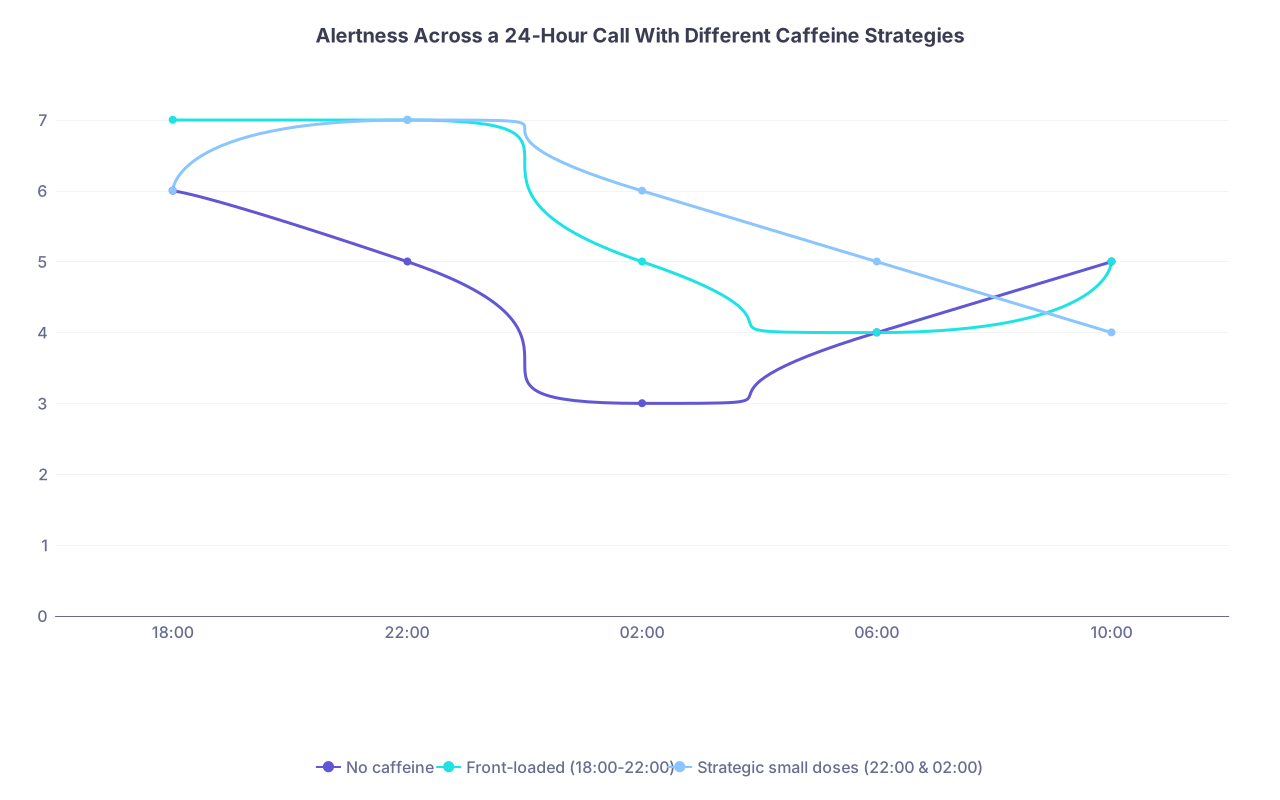
Think caffeine timing, not volume.
| Category | No caffeine | Front-loaded (18:00-22:00) | Strategic small doses (22:00 & 02:00) |
|---|---|---|---|
| 18:00 | 6 | 7 | 6 |
| 22:00 | 5 | 7 | 7 |
| 02:00 | 3 | 5 | 6 |
| 06:00 | 4 | 4 | 5 |
| 10:00 | 5 | 5 | 4 |
Practical rules that line up with the literature:
- Small, repeated doses (50–100 mg) are more effective and have fewer side effects than giant 300–400 mg slams
- Avoid caffeine in the last 4–6 hours before your expected post‑call sleep if you want any chance of good recovery
- Pair caffeine with naps: a “caffeine nap” (drink ~100 mg, immediately lie down for 15–20 minutes) can yield a strong alertness bump as the caffeine kicks in just as you wake
Residents who gradually cut total overnight caffeine and front‑load or strategically micro‑dose usually report feeling less destroyed post‑call and thinking more clearly at 3–4 AM.
Structuring your decision environment
You won’t make your prefrontal cortex magically resilient, but you can offload it.
This is where being deliberate matters:
- Use checklists for high‑risk tasks: handoffs, central lines, sepsis bundles, anticoagulation decisions
- Standardize common overnight choices: for example, default order sets for “chest pain low risk,” “uncomplicated UTI,” “mild DKA” so you aren’t reinventing the wheel at 4 AM
- Pre‑decide your thresholds while you’re still fresh: at the start of the night, decide with your senior attending/senior resident what triggers escalation, ICU transfer, CT head, stat labs, etc.
Think of it like “pre‑planning the tough calls while your brain is still online.”
System‑Level Realities: Why This Isn’t Just a “You” Problem
You can optimize your sleep hygiene all you want. If the system is designed to wring you dry, you will hit a ceiling.
Look at three structural factors that worsen overnight decision fatigue:
| Factor | Effect on Decisions |
|---|---|
| Long duty hours | Accumulates sleep debt |
| High page volume | Increases decision load |
| Poor cross-cover | Increases complexity per call |
None of that is under full resident control. But you can push around the edges.
Paging culture
Most hospitals have never seriously audited pager noise. When people do, they discover a shocking proportion of:
- Nonurgent issues paged STAT
- “FYI” messages that didn’t need real‑time interruption
- Issues that could be batched or routed to a different team
Residents who’ve worked with nursing leadership to clarify “when to page,” create simple algorithms for overnight issues, or institute batching of nonurgent concerns see real reduction in interruptions. That’s not mindfulness. That’s systems engineering.
Cross‑cover design
The worst possible setup for decision fatigue: one resident cross‑covering 70+ patients across 3–4 teams they barely know.
Better models (and yes, some programs actually do this):
- Smaller, geographically cohorted cross‑cover lists
- Clear escalation protocols with attendings expecting calls for defined issues
- Day teams leaving concise “if/then” plans in the sign‑out for unstable patients
The more uncertainty you remove from your overnight world, the less each decision burns glucose.
What You Can Do Tonight (Realistically)
Let’s be concrete. You’re a resident with limited power. What’s actually on the menu?
Before the call
- Treat a 60–90 minute pre‑call nap as mandatory, not optional “if I have time”
- Plan your caffeine: decide when you’ll use it and how much, instead of chasing fatigue reactively
- Clarify with seniors: “For X, Y, Z issues tonight, I’ll call you. Agreed?” This pre‑commitment shrinks the 3 AM “do I or don’t I bother them?” mental load
During the call
- Take micro‑breaks. 2–3 minutes between tasks to breathe, stand up, reset. It sounds soft. It improves performance.
- Use a written or digital checklist for high‑risk decisions — and actually look at it at 4 AM
- When you feel yourself defaulting to the laziest option, force a 10‑second pause: “If this were 3 PM, would I do the same thing?”

| Step | Description |
|---|---|
| Step 1 | Page received |
| Step 2 | Urgent or unstable? |
| Step 3 | Act immediately and call senior |
| Step 4 | Check sign out and orders |
| Step 5 | Use protocol or checklist |
| Step 6 | Still uncertain? |
| Step 7 | Call senior and discuss |
| Step 8 | Place orders and document |
That tiny layer of structure keeps 4 AM you from freelancing too hard.
After the call
This is boring but non‑negotiable if you care about long‑term function:
- Get real recovery sleep, not “I’ll just nap two hours then run errands”
- Don’t drive home if you are nodding off; post‑call car crash risk is absolutely real
- Notice near‑misses and actual errors from the night — and adjust your personal rules (“next time this happens at 4 AM, I will call the attending by default”)
Common Traps I See Residents Fall Into
You can spot these patterns from a mile away:
- The hero: brags about “never calling the attending overnight.” Also has the most questionable decisions and the worst near‑miss stories if you get them talking off the record.
- The caffeine abuser: lives on mega‑doses, can’t sleep post‑call, accumulates chronic sleep debt, wonders why their baseline feels like trash.
- The nihilist: “Everyone’s impaired, what’s the point.” Uses that as an excuse not to tighten up any process around them.
All three are understandable. All three are beatable if you treat your cognitive bandwidth as a limited resource that needs active management — not as some bottomless pool that residency “toughens up.”
A Quick Reality Check
You’re not going to make overnight call safe in the absolute sense. Medicine is messy. Systems are underpowered. Human brains aren’t designed to work carefully at 4 AM.
But you can:
- Reduce preventable deterioration in your judgment
- Offload some cognitive load to structure, checklists, and pre‑planning
- Push your program and unit toward saner paging and cross‑cover patterns
- Stop pretending “I feel okay” means “I’m making great decisions”
That’s the difference between surviving call and just accumulating damage.