
The belief that “ICU transfers overnight mean you failed” is garbage. And it quietly makes residents unsafe.
The people who actually run good programs? They do not judge you by how many patients don’t go to the ICU. They judge you by how early you escalate, how clearly you communicate, and whether you learn from the close calls.
Let’s dismantle this myth properly.
The Myth: “If You Send Too Many Patients to the ICU, You’re Weak”
You hear versions of it all the time on call:
- “The last team managed him on the floor all night.”
- “Are you sure they need the unit?”
- “ICU’s going to hate us if we call again.”
This shapes behavior. Residents sit on borderline patients until they’re truly crashing. They push a little more fluid, a little more oxygen, one more bolus. They “see what happens in an hour” when that hour is exactly when the patient should already be in a monitored bed with a nurse whose ratio isn’t 1:6.
Here’s what the actual data and culture trends show:
Delayed ICU transfer is consistently associated with worse outcomes. Multiple studies across sepsis, respiratory failure, and GI bleeds show the same pattern: patients who should go to the ICU but are kept on the floor longer do worse. More intubations. Longer stays. Higher mortality.
“Out-of-hours” deterioration is predictable, not shameful. Nights and weekends have fewer staff, fewer eyes, slower labs, and more fatigue. Patients don’t check the clock before they decompensate.
Programs that shame ICU calls create unsafe residents. Fear of escalation doesn’t magically make you a better doctor. It just makes you a quieter one.
So no, ICU transfers overnight are not a moral failure. They are often a sign that you’re doing your job: recognizing that the patient’s physiology is outgrowing the floor.
What Programs Actually Track and Care About
Let me be blunt: most program directors don’t have the time or interest to micromanage how many ICU transfers you triggered at 3 a.m.
What they usually care about with sick patients is this:
- Did you recognize the patient was sick early?
- Did you communicate clearly and efficiently?
- Did you activate resources appropriately (rapid response, ICU, attending)?
- Did you document your thinking and actions?
- Do you learn and improve after bad nights?
Notice what’s missing: “Did you tough it out and keep them on the floor?”
Are there attendings who make smug comments like, “In my day we would have managed this on the ward”? Yes. Some of them are the same people who trained when there were fewer monitors, fewer step-downs, no sepsis bundles, and a lot more unmeasured harm.
Modern residency and modern hospital medicine run on a different operating system: early recognition, early escalation.
To make this concrete, here’s how programs actually think in practice:
| Situation | How a good program sees it |
|---|---|
| Early ICU transfer, patient stabilizes quickly | Good judgment, conservative and safe |
| Late transfer after hours of decline | Systems and recognition failure, needs debrief |
| Multiple appropriate ICU calls in one month | Busy rotation, not a character flaw |
| Repeated delays in escalation across different patients | Pattern needing coaching |
They care about the pattern of your decisions, not a raw tally of how many times you dialed the ICU fellow.
What the Evidence Actually Shows About Timing ICU Transfers
Let’s put numbers behind this.
There’s a fairly consistent finding across the literature:
- Patients who require ICU transfer from the floor have high mortality, often around 10–30% depending on the cohort.
- Delayed transfer (often defined as deterioration for several hours or repeated rapid responses before ICU) is associated with significantly higher mortality compared to early transfer.
You’ll find this pattern in:
- Ward-to-ICU transfer studies: Delays of even 6–12 hours after clear physiologic red flags (tachypnea, hypotension, rising lactate, escalating oxygen) are linked to worse outcomes.
- Sepsis data: The longer you delay appropriate escalation (including ICU-level care when needed), the worse the survival. This is so robust it’s now embedded into sepsis bundles and quality metrics.
- Respiratory failure cohorts: Patients with increasing oxygen needs and work of breathing do better when moved earlier rather than after a crash intubation on the floor.
No reputable ICU or hospitalist group looks at this data and concludes, “You know what we need? More residents gritting their teeth on the wards for longer.”
They conclude something else:
- Recognize shock early.
- Move unstable or borderline unstable patients to a setting where they can be observed minute-to-minute, not hour-to-hour.
Overnight, the margin for error shrinks further: thinner staffing, more cross-coverage, everyone stretched. That’s exactly when you should have a lower threshold to escalate, not a higher one.
The Real Red Flag: Not That You Call, But How You Call
Now for the nuance. ICU transfers are not a sign of failure, but chaotic, poorly thought-out ICU calls can reveal something about you as a resident.
Program leadership and ICUs notice:
- Calls that sound confused: “Uh, the nurse is just worried, I don’t know.”
- No clear story: vitals only, no context, no trend, no working diagnosis.
- Obvious lack of initial stabilization before calling.
- Missing key data you could’ve had in 5–10 minutes: basic labs, lactate, gas, quick exam findings.
On the flip side, when you:
- Quickly assess the patient,
- Start immediate stabilizing steps (fluids, oxygen, pressor setup if appropriate),
- Gather key objective data,
- Then call ICU with a structured story…
…you present as a safe, thoughtful physician, whether or not the ICU ends up accepting the patient.
Programs like that resident. ICU attendings like that resident. They “trust your eyeballs,” which in practice means: when you say “I’m worried,” they take it seriously.
So the goal is not “don’t call ICU.” The goal is “don’t call ICU unprepared and unclear.”
What Good Programs Quietly Reward on Call
Here’s what actually earns you respect (even if no one says this explicitly):
Early escalation for real instability
The patient on high-flow oxygen climbing from 40% to 80% in 2 hours with increasing work of breathing? Calling the ICU before they’re peri-arrest is a sign you understand trajectory, not just snapshots.
Using rapid response and ICU as tools, not last resorts
Programs want you to recognize that the nurse saying “I’m nervous about this patient” at 2 a.m. is not noise. It’s data. Triggering rapid response or ICU evaluation is often the correct move, not an embarrassment.
Owning the narrative, not just paging reflexively
“This is a 68-year-old with pneumonia on hospital day 3, now with escalating O2 needs, rising RR from 20 to 32, hypotension after 2 L fluids, lactate 3.8, and new confusion. I’ve started broad-spectrum antibiotics, another fluid bolus, and called for pressors to the bedside. I don’t think we can safely manage her on the floor.”
That’s a resident who gets it.
Debriefing the close calls
When a transfer goes badly or feels messy, the residents who ask, “Can we review what I missed or could’ve done earlier?” are the ones who grow. Program leadership absolutely notices that attitude.
How to Decide: “Is This an ICU Patient?” at 3 a.m.
Let’s get practical. You’re on call. It’s 2:47 a.m. You’re exhausted. You’re trying not to be “that person” who sends everyone upstairs.
Here’s a brutal but useful mental framework: if you need minute-to-minute awareness of the patient’s status to feel safe, they are an ICU-or-step-down patient.
Examples where you should lean toward ICU / higher level of care:
- Escalating oxygen: progressively increasing from nasal cannula to high-flow or non-rebreather, especially if RR stays high.
- Shock suspicion: hypotension needing pressors, not just fluids. Or pressures that keep dipping despite repeated boluses.
- Real-time titration: you’re constantly adjusting drips, oxygen, or watching mental status change in real time.
- You or the nurse feel that “sinking” gut feeling that this could go sideways fast.
And here’s the unglamorous truth: programs would rather you over-escalate a bit with clear reasoning than under-escalate and send a code blue to the ICU.
To visualize how these decisions often flow:

| Step | Description |
|---|---|
| Step 1 | Notified of concern |
| Step 2 | Assess bedside within minutes |
| Step 3 | Treat on floor with close follow up |
| Step 4 | Start stabilization steps |
| Step 5 | Get key labs imaging |
| Step 6 | Call ICU with structured story |
| Step 7 | Consider step down higher monitoring |
| Step 8 | Unstable vitals or trend? |
| Step 9 | Needs minute to minute care? |
Notice the question is not, “Can I technically manage this on the floor if everything goes perfectly?” The question is, “What level of care is safest for the patient given our actual night resources?”
The Political Reality: Do Some ICU Teams Complain? Yes. So What?
Let’s not pretend every ICU fellow is an angel of collaboration. You will occasionally get:
- Sighs.
- “You could have done X, Y, Z first.”
- “We’re full, can you try one more thing?”
- Snark about “floor dumping.”
Here’s how to decode this:
Bed pressure is real.
ICUs run hot. When they’re at 97% census, every bed is a political event. That pressure falls on them, and it leaks out in the form of attitude.Their irritability is not a grading system for your competence.
Your job is to be accurate and clear, not to keep them happy at all costs.Programs know which ICUs and which individuals are chronically difficult.
You’re not the first resident to get pushback. Good program directors discount some of that noise.
What they will judge is whether you:
- Back down from appropriate escalation because someone sounded annoyed.
- Fail to re-escalate when a patient clearly worsens after an initial “no” from ICU.
- Avoid calling the attending when you should.
If you’re getting repeated pushback from ICU and you truly think the patient needs a higher level of care, say a calm, dangerous sentence:
“I hear you. I’m documenting that ICU declined admission despite ongoing hemodynamic instability and escalating respiratory support, and I’ll be updating my attending now.”
That’s not being dramatic. That’s real accountability. It also tends to clarify people’s thinking pretty fast.
How to Talk About ICU Transfers With Your Program
You’re worried about what your program thinks. Fine. Here’s how to make ICU transfers actually work in your favor:
In sign-out or debrief, don’t just say “he went to ICU.”
Say: “He started to deteriorate around midnight—rising O2 needs, new hypotension. We started fluids and broadened antibiotics, got a lactate, called rapid response, and transferred him early while he was still protecting his airway.”Ask for feedback:
“Would you have called ICU earlier? Anything you would’ve done differently on the floor before transferring?”If an ICU transfer went badly (code, peri-arrest):
Request a case review. It signals maturity, not guilt.
Over time, the story your program hears about you is not “calls ICU a lot.” It’s “recognizes sick, doesn’t sit on them, and thinks in systems.”
One More Myth to Kill: “If ICU Sends Them Back in 12 Hours, I Overreacted”
This is another mental trap. You send a patient to ICU overnight, they stabilize by morning, get a line, maybe a few hours of pressors, then the day team transfers them back before lunch.
Night float culture then runs that through the gossip mill as “didn’t really need ICU.”
That’s upside down.
Frequently, the reason they could be safely downgraded quickly is because they were upgraded early. They got:
- Continuous monitoring,
- Aggressive nursing attention,
- Rapid titration of fluids/pressors/ventilation,
- Faster imaging and interventions.
The alternative was not “coast comfortably on the floor.” The alternative was “maybe crash in an understaffed hallway bed at 4 a.m.”
Programs that understand modern acute care medicine don’t penalize you for early, reversible ICU stays. They prefer that over late, catastrophic ones.
Quick Reality Check: What Counts As a “Failure” To Programs?
This is what actually raises eyebrows:
- Repeated patterns of not recognizing deterioration.
- Documented delays of hours between clear instability and calling for help.
- Dismissing nursing concerns consistently.
- Codes on the floor where chart review shows you could have, and should have, escalated long before.
Notice the theme: failures of recognition and escalation, not “too many patients in the unit.”
The Bottom Line
Let’s strip this to the studs.
ICU transfers overnight are not a sign you failed. They’re usually a sign you recognized instability and did what the data supports: early escalation saves patients; delays kill them.
Programs judge your judgment, not your ICU count. They care how you assessed, stabilized, communicated, and learned—not whether you had the “guts” to keep a borderline patient on the ward.
Your threshold should drop at night, not rise. Less staffing, more chaos, and slower systems mean you should be quicker, not slower, to ask for ICU-level care when a patient’s physiology starts to fall apart.
You’re not paid to be a hero on the floor. You’re trained to be a physician who recognizes when the ward is no longer the right level of care—and acts before the crash, not after.
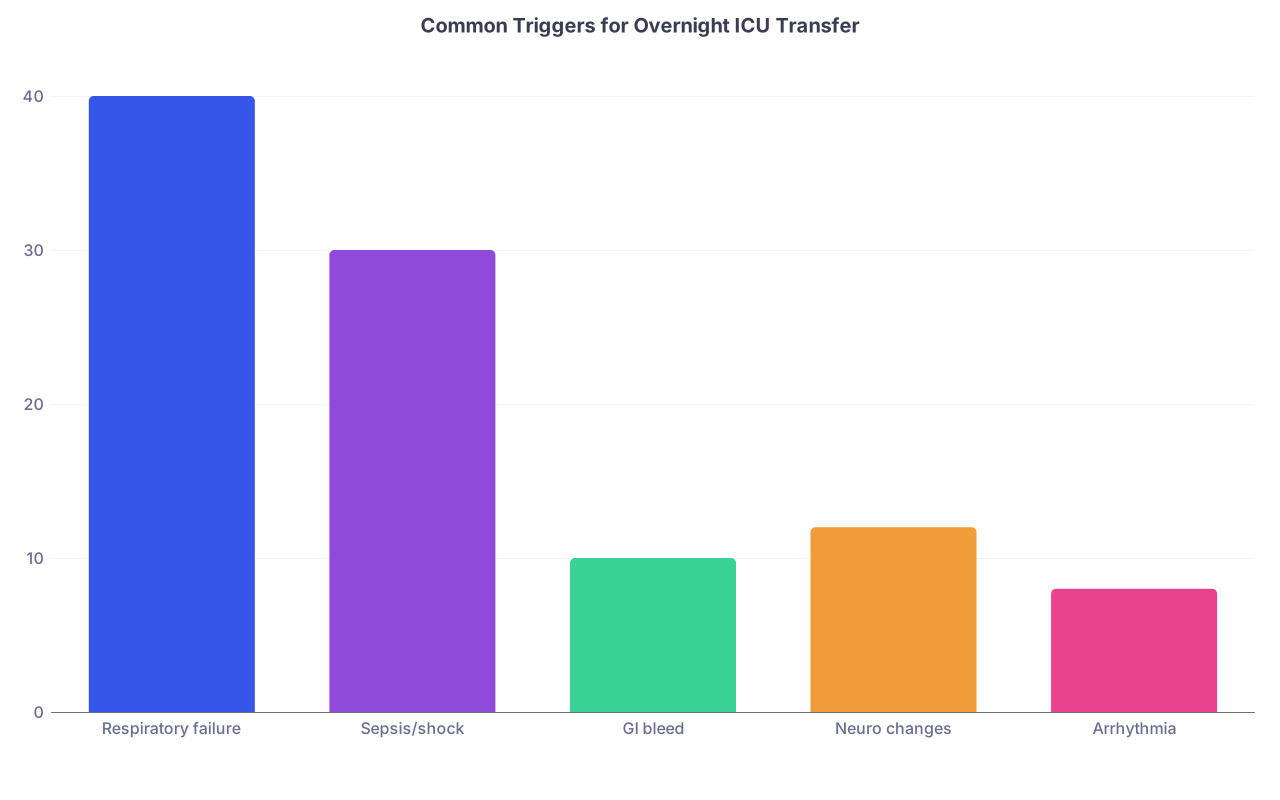
| Category | Value |
|---|---|
| Respiratory failure | 40 |
| Sepsis/shock | 30 |
| GI bleed | 10 |
| Neuro changes | 12 |
| Arrhythmia | 8 |