
Do Residents Really Get Punished for Too Many Rapid Responses?
Rapid responses do not ruin your evals. Silent floors do.
Let me be blunt: the culture that makes you afraid to call for help is more dangerous than any “you over-call RRTs” comment on a shift evaluation. And no, there is no secret ACGME metric that dings you for triggering too many rapid responses. That belief is pure residency folklore.
But the myth persists. You hear versions of it all the time:
“Don’t call a rapid, just call the senior first.”
“Medicine hates when you dump RRTs on them.”
“If you call too many, attendings think you can’t manage patients.”
I have watched interns freeze at 3 a.m. with a crashing patient because they were more afraid of an angry email than of a blood pressure of 60/30.
Let’s dismantle this nonsense systematically.
What a Rapid Response Actually Is (And What It Isn’t)
Hospitals didn’t invent rapid response teams to grade your clinical courage. They were created because patients were literally dying on the floor after hours of abnormal vitals that nobody escalated.
The data is old but clear. Studies after the IHI’s “100,000 Lives Campaign” and early MET (Medical Emergency Team) implementations showed:
- Many in‑hospital cardiac arrests are preceded by hours of abnormal vitals.
- When hospitals introduced rapid response teams and early escalation pathways, unexpected codes and mortality often dropped, especially in high-risk populations.
- The biggest barrier to effective use? Staff hesitancy to activate them. Not overuse. Underuse.
Do all RRT programs show mortality benefit? No. The literature is mixed. But not a single decent study shows that “too many RRTs” harms patients. What you see instead is:
- When staff are afraid to call, deteriorations get missed.
- When escalation thresholds are clear and culturally supported, bad outcomes drop or at least are caught earlier.
So from a systems and safety standpoint, your “trigger finger” on the rapid response button is not the problem. Delayed activation is.
Where the “You’ll Be Punished” Myth Comes From
Nobody made this up from thin air. It’s a stew of bad messaging, tired seniors, and thinly veiled resentment. Here’s the actual ecosystem:
Volume and fatigue
Night float cross-covering 80 patients + three RRTs in an hour = frayed nerves. The senior or code team can absolutely be annoyed. But annoyance doesn’t equal institutional punishment. It means humans are tired, overworked, and sometimes take it out on the easiest target: the intern who “over-called.”
Bad role modeling
You hear stuff like:
- “That wasn’t a real rapid.”
- “Next time, page me first.”
- “You just cost me an hour for nothing.”
That gets coded in your brain as: calling RRT = incompetence. So you file it under “avoid when possible,” instead of “escalate for sick patients, then debrief if thresholds need refining.”
Retrospective bravado
After a stable outcome, people rewrite history:
- “We didn’t need all that.”
- “You just needed fluids and monitoring.”
Conveniently ignoring the fact that at the time, you didn’t know the patient would respond to 250 cc of LR and a hug.
Misunderstanding of documentation and QI
Every rapid response is logged and often reviewed by hospital quality committees. Residents assume:
- “They’re tracking my RRT rate.”
- “If I have more than others, I’ll look bad.”
In reality, committees look for patterns: delays, recurring contributors (like inadequate post-op monitoring), recurrent floor issues. They are not ranking interns by RRT-per-rotation like some twisted leaderboard.
Cultural shame around “not handling it yourself”
Especially in surgical and ICU-heavy institutions, there’s an unspoken pride in “we stabilize our own before we call anyone.” That’s great until a borderline patient crumps while you’re still experimenting with your third fluid bolus.
So yes, you might encounter snide comments. You might even see an eval line like “tends to escalate quickly.” But an actual career impact for calling rapid responses appropriately? Vanishingly rare.
What Evaluations and Accreditation Bodies Actually Care About
Let’s look at what your program and the ACGME are actually evaluated on and what your milestones say.
ACGME core competencies and milestones emphasize:
- Patient safety and advocacy
- Recognizing when patients are unstable
- Knowing your limits and calling for help
- Systems-based practice, including using institutional resources appropriately (like RRTs)
There is no milestone for “manages to keep the RRT dashboard visually pleasing.”
Most eval forms I’ve seen for residents on call have items like:
- Recognizes and responds to acute decompensation
- Escalates appropriately to senior/attending
- Uses consultation services effectively
- Responds promptly to pages and urgent issues
Note the language: “appropriately,” not “rarely.” Under-calling and overconfidence are much more likely to get flagged than “too many rapid responses.”
Here’s how the real calculus tends to look when faculty discuss trainees:
| Pattern of Behavior | How It’s Really Interpreted |
|---|---|
| Calls RRT late or not at all | Unsafe, poor judgment |
| Calls RRT appropriately and early | Safe, aware of limits |
| Calls RRT on clearly stable patients | Needs coaching on triage, still safer |
| Never calls RRT, ever | Either superhuman or dangerously oblivious |
Nobody says, “This intern calls for help when worried, let’s tank their fellowship chances.” They say, “This intern doesn’t recognize sick patients until they’re peri-arrest.”
If you want something to actually be afraid of, it’s that last sentence.
What the Data Shows: Overcalling vs Undercalling
Let’s talk risk.
When you “overcall” an RRT for borderline-but-concerning vitals and worrisome exam, these are the risks:
- You wake people up / pull them away.
- You potentially annoy the responding team.
- You may look “green” or cautious.
But if the patient is actually unstable or about to be, you just bought them:
- Faster access to ICU-level evaluation.
- Earlier interventions (pressors, BiPAP, lines, etc.).
- Documented evidence that you escalated appropriately.
Now the other side. When you don’t call and try to “ride it out”:
- If the patient improves: you feel like a hero.
- If the patient codes: everyone asks, “Why wasn’t a rapid called?”
And that second scenario generates real scrutiny: risk management reviews, morbidity & mortality conferences, written follow-ups, sometimes formal remediation.
Your personal downside from a “too early” RRT? Minor annoyance and maybe some guidance.
Your downside from a “too late” RRT? Patient harm, formal QI review, and possibly a big black mark in your file.
The asymmetry is massive.
To put it visually:
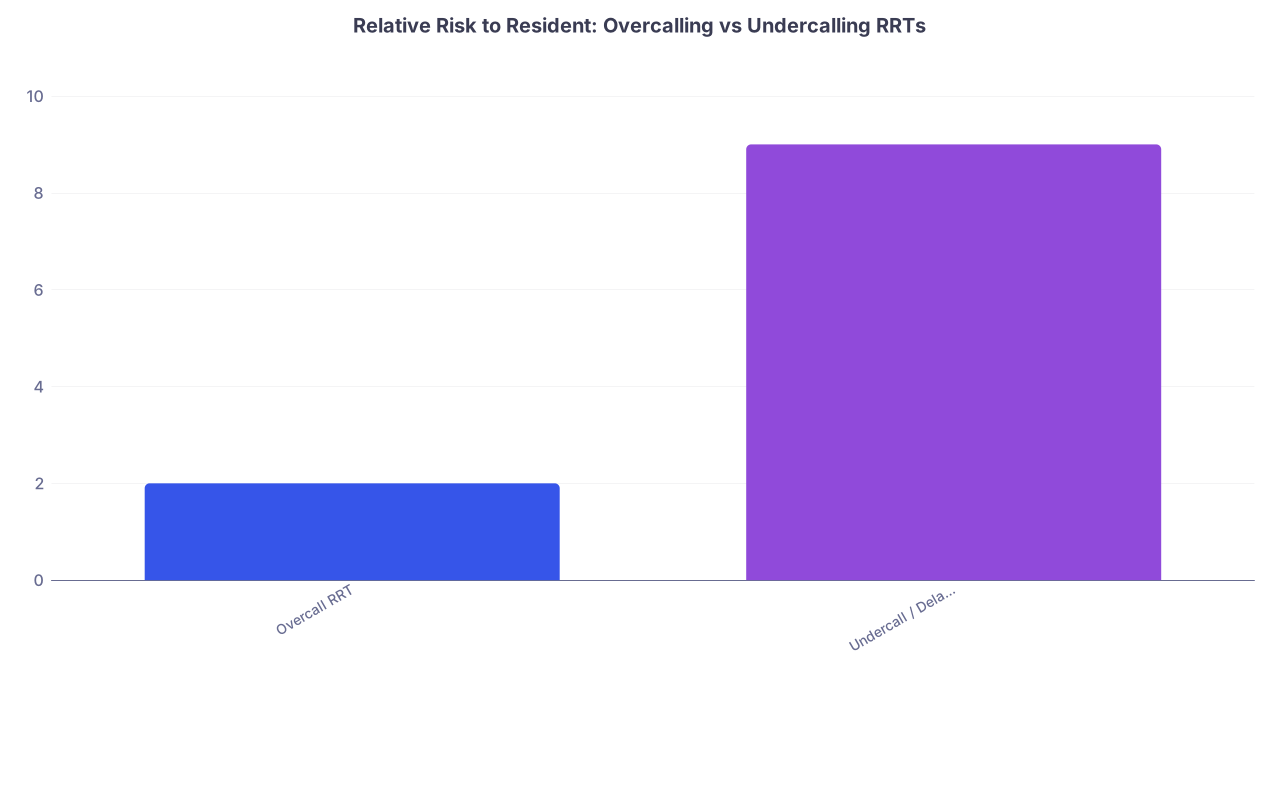
| Category | Value |
|---|---|
| Overcall RRT | 2 |
| Undercall / Delayed RRT | 9 |
Call that rough, not literal. But directionally accurate: the risk to your career and conscience is overwhelmingly higher on the undercall side.
The Hidden Metric That Actually Hurts You
Programs and hospitals care about: unplanned ICU transfers, codes outside ICU, and preventable harms. Those get tracked.
What quietly damages reputations is not “RRT frequency” but “we keep having floor codes where early warning signs were ignored or under-escalated.”
Quality committees will say things like:
- “This patient had four hours of MAPs in the 50s and rising lactate before the code.”
- “Nurses felt uncomfortable but were told to just recheck later.”
- “No RRT was called despite multiple concerning vitals.”
That’s when names get discussed. Not because you called help too quickly. Because you did not.
“But My Senior Literally Told Me I’d Be Punished”
I believe you. I’ve heard this too:
- “Don’t be that person who calls a rapid for every soft BP.”
- “You’re going to get a reputation with ICU.”
- “The chair sees the RRT stats.”
Translation, once you strip out the frustration and ego:
- Try to think through reversible causes while you escalate.
- Don’t bypass your immediate team for non-urgent issues.
- Yes, some attendings look at system-level RRT trends and grumble.
Here’s the boundary that keeps you safe:
- If you think the patient might crash or you feel a strong “this is bad” gut alarm → you are allowed to pull the rapid response trigger even if your senior hasn’t seen the patient yet.
- If it’s not time-critical (e.g., new oxygen requirement from 2L to 3L, HR 105 in a stable, talking patient), you can:
- Go assess quickly.
- Call the nurse.
- Page your senior or primary team.
- Reserve RRT for clear worsening / instability.
In other words, “call your senior first” is fine for non-crashing patients. The myth is when that phrase gets abused as a blanket prohibition.
How to Use Rapid Responses Without Making Enemies
You can be both safe and respected. They’re not mutually exclusive.
A few concrete habits that separate the solid resident from the chaos generator:
Do a 60–90 second huddle with yourself before calling
You don’t need a full SOAP note, but have:
- Brief one-liner (e.g., “76F, septic shock, now hypotensive to 70/40 despite 2L.”)
- Last vitals trend.
- Last labs (lactate, creatinine, troponin, etc.).
- Code status.
Then call. You’re not writing a novel; you’re avoiding sounding like you haven’t thought at all.
Loop in your senior quickly
Ideal flow on nights when time permits:
- Nurse: “BP 70/40, patient looks gray.”
- You: Go see patient immediately.
- You: “This looks bad. I’m calling an RRT now and paging my senior.”
If the senior answers instantly and says “I’m two doors down, will be there in 30 seconds, don’t hit the button yet,” fine. But if they’re not there and patient’s crashing, do not wait to protect anyone’s ego.
Use debriefs to fine-tune your triggers
After a borderline RRT, ask your senior or ICU fellow privately:
- “Would you have called for that?”
- “What would have been safe to handle without the team?”
You’ll sharpen your instincts fast. And you signal that you’re coachable, not reckless.
Own your decision when it was justified
If someone complains “that wasn’t a real rapid,” answer calmly:
- “At the time, they were tachypneic to 40 with new oxygen needs and hypotension. I was worried about a sudden crash and didn’t want to delay escalation.”
Most reasonable people back off when they realize you weren’t just panicking— you saw a true pattern.
When RRT Calling Can Actually Look Bad
There is a way to weaponize rapid responses against yourself. It’s not about quantity; it’s about context.
You start to get a reputation for poor judgment if:
- You call RRT without ever laying eyes on the patient when you could have.
- You repeatedly ignore clear treatable issues (pain, anxiety, simple dehydration) and jump straight to a team call instead of basic management.
- Nurses start saying, “We avoid paging that resident and go straight to rapid because they never come.”
In other words, if RRT is your default instead of your escalation pathway, that’s a problem. But that’s not too many rapids. That’s clinical disengagement.
There’s a big difference between:
- “You activated an RRT for a patient with real red flags who ended up okay.”
- “You haven’t been to that side of the floor in 4 hours and the only way to get you to the bedside is to hit the button.”
One is defensive medicine with a safety bias. The other is dereliction.
Mental Reframe: What You’re Actually Protecting
You’re not protecting your evals when you avoid calling RRT. You’re protecting your comfort. Because calling a rapid response exposes you. Everyone sees your assessment, your orders, your knowledge gaps.
Here’s the twisted truth: the most confident seniors and attendings usually encourage early escalation. It’s the insecure, burned-out middle who snap “you didn’t need that.”
If you remember nothing else, hold onto this:
- No patient has ever died because a resident called for help too early.
- Plenty have died because someone was afraid to look “weak” or “needy” and waited.
Years from now, you won’t remember the exact number of rapid responses you called as an intern. You will remember the patient you were afraid to escalate on fast enough. Make sure, when that memory hits you at 2 a.m., it’s one where you chose to act rather than protect your ego.