The belief that “strong” residents should handle call alone is not just wrong—it’s dangerous.
You’ve heard the line. Maybe you’ve even internalized it: “You should be able to manage that yourself.” Or the more poisonous version that circulates in whispers after sign-out: “She calls her senior for everything. She’s not independent.”
Let me be blunt: in real data, real malpractice cases, and real morbidity-and-mortality conferences, the pattern is almost always the opposite. The residents who never ask for help do not look “strong” when you zoom out. They look unsafe.
Let’s walk through what the literature, safety data, and actual outcomes show—because the culture around calling for help on call is stuck about 20 years behind reality.
The Myth: Asking for Help = Weak, Needy, or Incompetent
On call, hierarchy and insecurity amplify each other. You’re alone at 2 a.m., your senior is technically “available,” but you’ve heard:
- “Don’t wake me up unless someone is dying.”
- “You should be able to handle cross-cover stuff.”
- “By second year you shouldn’t be calling for basic things.”
So you hesitate.
You’re worried what will end up in your evaluation. Worried you’ll be labeled “needs too much supervision.” Worried your reputation will be sealed before you even get to fellowship applications.
Here’s the problem: that fear is based on an outdated, macho version of medicine that does not line up with how modern systems evaluate performance or safety.
Programs say they want “independent” residents. What they actually want—if they’re serious about patient safety—is residents who recognize limits early, escalate appropriately, and use the system the way it’s designed. Independence without judgment is just recklessness with better branding.
What the Data Actually Shows About Help-Seeking
No, there is not a randomized trial of “calling your senior vs. winging it at 3 a.m.” But we do have solid signals from patient safety research, malpractice litigation, and resident performance studies. And they all tell a consistent story.
1. Most serious errors on call share one theme: delayed escalation
If you sit through enough M&M conferences, you see the pattern. The story usually looks like this:
- Vital signs trending the wrong way
- Concern from nursing staff
- Junior resident evaluates, thinks “borderline,” makes a small change
- No call to senior
- Patient worsens
- Hours later, crash call, ICU transfer, or code
Then the line appears in the M&M slide: “Opportunities for earlier escalation.” That’s sanitized language for: someone should have called for help.
Safety agencies have quantified this in broader terms. Analyses from the Agency for Healthcare Research and Quality and national incident-reporting systems repeatedly flag failure to escalate or delay in seeking senior input as a common factor in preventable harm events, especially overnight and on weekends.
Those cases do not read like, “Resident over-called; too cautious.” They read like, “Resident underestimated severity and did not contact senior or attending despite concerning signs.”
2. Underconfidence is not the main problem. Overconfidence is.
Here’s something that rarely gets said out loud: across multiple domains in medicine, clinicians’ self-confidence correlates poorly with actual accuracy.
Studies of diagnostic reasoning and clinical decision-making consistently show:
- People who are wrong are often very confident.
- People who are right are sometimes less certain and more willing to double-check or ask.
In one classic line of research on diagnostic error, wrong diagnoses were frequently accompanied by high confidence ratings. The cognitive bias is well-known: the Dunning–Kruger effect. Low performers overestimate their ability; high performers are more aware of uncertainty.
Translated to call:
The resident who never calls may not be the star. They may be the one who doesn’t recognize what they do not know.
3. Psychological safety predicts performance and safety
There’s robust data—especially from Amy Edmondson’s work on healthcare teams—that teams with high psychological safety perform better and make fewer serious errors, despite reporting more minor issues.
Psychological safety means people feel they can:
- Admit uncertainty
- Ask for help
- Speak up about concerns
In high-performing units (ICUs, high-volume surgical services), staff report more speaking up, not less. They escalate sooner. They ask more “stupid questions.” Outcomes are better.
Residents are not an exception. A resident who operates in an environment where “call me if you’re unsure” is real, not performative, will escalate earlier. That’s not fragility. That’s good medicine.
What Actually Happens to Residents Who Call vs. Those Who Don’t
Let’s talk outcomes for you, not just the patient.
Does calling for help tank evaluations, make you look weak, and ruin your independence narrative? Programs that are even halfway serious about competency-based training aren’t looking at “raw number of calls” as a sign of weakness. They’re looking at pattern and judgment.
Here’s how this really plays out over time.
Residents who call for help appropriately tend to:
- Stabilize faster and learn faster. They see how their senior thinks in real time, in context, on actual cases—not just chalk talks at noon conference.
- Make fewer repeated mistakes. Because they get feedback at the moment of decision, not 3 weeks later in a vague evaluation comment.
- Build trust with nursing and ancillary staff. Nurses quickly learn which residents “actually come see the patient and call the senior if needed.” Those residents get told about problems earlier.
- Get high marks on professionalism and judgment. Self-awareness and early escalation are literally ACGME milestones.
Residents who rarely or never call for help may:
- Look “confident” in the short term
- Accumulate near-misses that never get explicitly tied back to their hesitation
- Show up in M&M or complaint patterns as “resident failed to notify senior/attending”
Over a 3-year residency, faculty start to notice which residents reliably know when they’re at the edge of their ability. Those are the ones they want as colleagues.
The ones who radiate “I’ve got this” but have repeated episodes of silent deterioration or unexpected crashes? Those get labeled something very different: unsafe.
Systems Reality: Call Is Literally Designed for Escalation
The hidden joke in all of this is that your call structure is built on the assumption that you will ask for help.
On almost any reasonable service, the call chain looks something like:
- Intern or junior covering the floor
- Senior resident in-house or from home
- Fellow (depending on specialty)
- Attending on call, reachable 24/7
This is not decorative. It exists because decades of bad outcomes taught hospitals you cannot safely staff with a single unsupervised trainee at night.
Let’s stop pretending that “not calling” is some heroic deviation from the plan. It’s not. It’s ignoring how the system is designed.
To make this explicit, here’s how a healthy escalation mindset looks compared to the toxic version.
| Situation | Toxic View ("Strong") | Healthy View (Safe) |
|---|---|---|
| Unsure about lab abnormality | Figure it out alone | Call senior to sanity-check |
| Nurse worried about patient | Order PRN, move on | Reassess, consider escalation |
| New consult outside comfort zone | Wing it, minimal workup | Call fellow/attending early |
| Overnight deterioration with gray area | Wait and see | Escalate and document plan |
On every JCAHO visit, every safety initiative, leadership parades the phrase “culture of safety.” A culture of safety and “never bother your senior” cannot coexist. One of them is fake.
The “Independence” Myth and What Competence Really Looks Like
You are being trained in a system that still glorifies the cowboy attending who “never needs help” and handles three crashing patients alone. The archetype is seductive. It’s also professionally obsolete.
Modern competency-based training is built around graduated responsibility. That means:
- You start with high supervision.
- You demonstrate good judgment, including knowing when to call.
- You earn more autonomy as you repeatedly show that you escalate appropriately when needed.
Notice the loop: your autonomy grows because you show that you ask for help at the right times. Not because you “never ask anything.”
When I’ve sat in Clinical Competency Committee meetings, the comments that terrify people aren’t:
- “Calls a bit too often; needs some reassurance.”
Those are fixable.
The ones that make people shift in their chairs are:
- “Overestimates own abilities.”
- “Slow to ask for help in deteriorating situations.”
- “Does not always recognize limitations.”
Those are red flags. Residency directors know who shows up in adverse event reviews. They remember.
So if you’re aiming for fellowship, a job in a good group, or even chief resident, your reputation for safe judgment matters more than your reputation for “never calling overnight.”
What About Evaluation Comments and “Over-Calling”?
Let’s address the fear that actually sits in your gut: What if I get dinged for calling too often?
Yes, there is such a thing as over-calling in a truly trivial way. If you page your senior at 3 a.m. for Tylenol dosing or a routine home med reconciliation you could have handled, you’ll annoy them. You’ll deserve the feedback.
That’s not what we’re talking about.
We’re talking about:
- New hypoxia in a stable patient
- Chest pain with non-definitive EKG
- Rising lactate, borderline vitals
- Something about the exam that feels “off” even if labs are okay
- A consult from a service you barely understand asking you to “admit and manage”
Those are the moments your brain tries to negotiate: Maybe I can just…
Those are not the times to protect your image. Those are precisely the cases faculty expect to hear about.
In fact, many quality-minded attendings would much rather get a 2 a.m. “I might be overreacting but this is bothering me” call than read a 10 a.m. incident report about a patient who crashed two hours after “reassuring” documentation.
To make this concrete, think of your threshold like this:
- Calling for comfort with truly low-stakes issues? Not great.
- Calling for patient safety when there is uncertainty, trajectory change, or systems implications? That’s competence.
You are not graded on how often you hit the “help” button. You are graded on whether the situations that truly required that button were handled appropriately.
Measuring What Actually Matters: Outcomes and Learning
If you want to be hard-nosed about it, ignore the culture. Look at outputs.
Residents who ask for help at the right time tend to:
- Have fewer catastrophic surprises on their shifts
- Build a mental library of “I saw my senior handle X” that accelerates their growth
- Make earlier, cleaner diagnoses because they use their senior’s pattern recognition
That’s not hypothetical. In simulation-based studies, trainees who verbalize uncertainty and pull in help earlier learn faster and perform better on later independent assessments. They encode decision pathways instead of just outcomes.
Now zoom out to the system level.
Hospitals that build strong escalation protocols and normalize calling have:
- Lower codes on the floor
- Better rapid response activation metrics
- Fewer unplanned ICU transfers after hours
None of that happens if everyone is paralyzed by “I don’t want to look weak.”
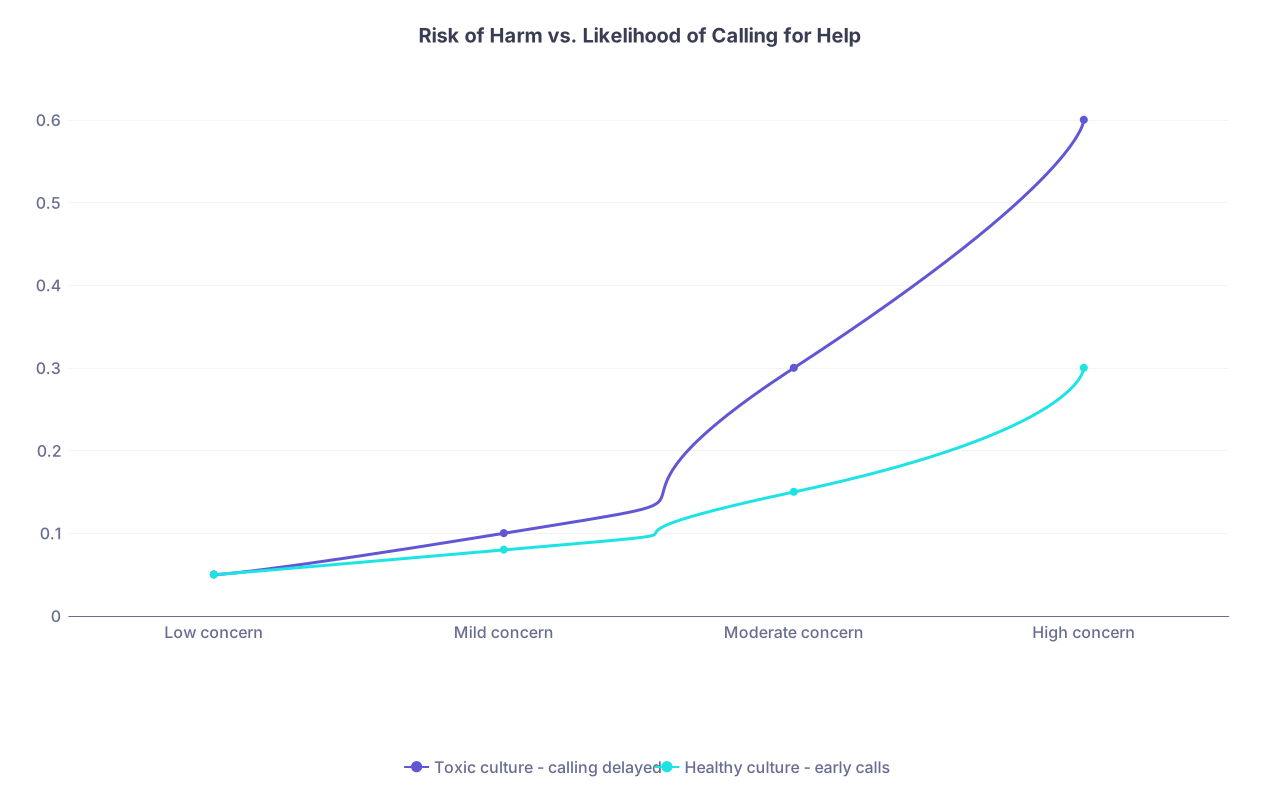
To visualize the basic tradeoff:
| Category | Toxic culture - calling delayed | Healthy culture - early calls |
|---|---|---|
| Low concern | 0.05 | 0.05 |
| Mild concern | 0.1 | 0.08 |
| Moderate concern | 0.3 | 0.15 |
| High concern | 0.6 | 0.3 |
The absolute numbers here are illustrative, not literal, but the shape is real: when you normalize earlier calls, the risk curve flattens long before “crash cart” territory.
So How Do You Ask for Help Without Being Dismissed?
Here’s the part that matters practically: how you frame the call.
You can massively change how “competent” you sound by how you present the situation. Seniors and attendings are often annoyed not that you called, but that you called with chaos and zero structuring.
Instead of rambling, structure it:
- One or two sentences of context
- Key vitals and trajectory
- What changed
- What you think is going on
- What you want from them (come see, advice, sign-off on plan)
Something like:
“Hey, sorry to wake you. I’m covering 6W. Mr. Jones, 68, admitted for CHF exacerbation, was stable earlier. Over the last hour his sats dropped from 96 on 2L to 88 on 4L, RR is up, and he looks more dyspneic. I examined him—crackles are worse, mild increased work of breathing, BP okay. I got a stat CXR and ABG. I’m worried this is more than just fluid. I’d like you to come see him with me and make sure I’m not missing something.”
This is not weakness. This is exactly how good physicians operate when they talk to each other. Direct. Concrete. Concern framed around the patient, not your anxiety.
And yes, sometimes the answer will be, “You’re fine, that was appropriate, keep doing X.” Perfect. You just learned where the line is.
The Bottom Line: What Strong Residents Actually Do
Let’s strip the mythology and look at what strong, safe, high-performing residents actually share in common:
They don’t flex about managing everything alone. They flex about getting it right.
They internalize that:
- Medicine is a team sport with a built-in escalation ladder for a reason.
- Recognizing limits is part of competence, not an admission of failure.
- Reputation as a safe, thoughtful clinician beats reputation as the “hero” who flies solo—especially when you’re the one people trust with their own family member.
And when you’re on call, staring at the vitals that do not quite make sense, hearing the nurse say, “I just don’t like how he looks”…they pick up the phone.
Not because they are weak.
Because they know what the outcomes actually show.
Key points to leave with you:
- Residents who never ask for help are not “strong”—they’re often unsafe. Most bad overnight outcomes share delayed escalation, not “too many calls.”
- Modern training and safety data consistently reward early, appropriate help-seeking as a marker of good judgment, not incompetence.