The unwritten rule of residency—“don’t call the attending at night”—isn’t just bad advice. It is dangerous, culture‑driven nonsense that conflicts directly with every safety framework we claim to believe in.
Let’s pull this apart.
The Myth: “Don’t Call Unless the Patient Is Crashing”
You know exactly how this sounds in real life:
- “Are you really going to wake him up for that?”
- “We don’t call for stuff like this here.”
- “Figure it out and present it in the morning.”
That’s how you end up with a PGY‑1 staring at a borderline vitals trend at 2:13 a.m., wondering if they’re overreacting… or about to miss the deterioration that sends a patient to the ICU at 6:00 a.m.
The myth says:
- Nighttime calls should be rare.
- “Good” residents handle things independently.
- You only call if the patient is coding, crashing, or on fire.
Reality: high‑reliability systems don’t work like this. Aviation, nuclear power, anesthesia—any field that actually studies error—builds redundancy and low‑threshold escalation into the system. Medicine, especially inpatient general medicine and surgery, too often runs on ego and vibes.
You’re told not to “bother” the attending. You’re never told how many morbidity and mortality (M&M) cases have some version of: “Resident was uncomfortable but did not escalate overnight.”
Because I’ve sat in those conferences. That line comes up more than anyone wants to admit.
What the Data Actually Shows About Nighttime Risk
If you strip away the folklore and look at numbers, nights are not just “regular medicine but darker.”
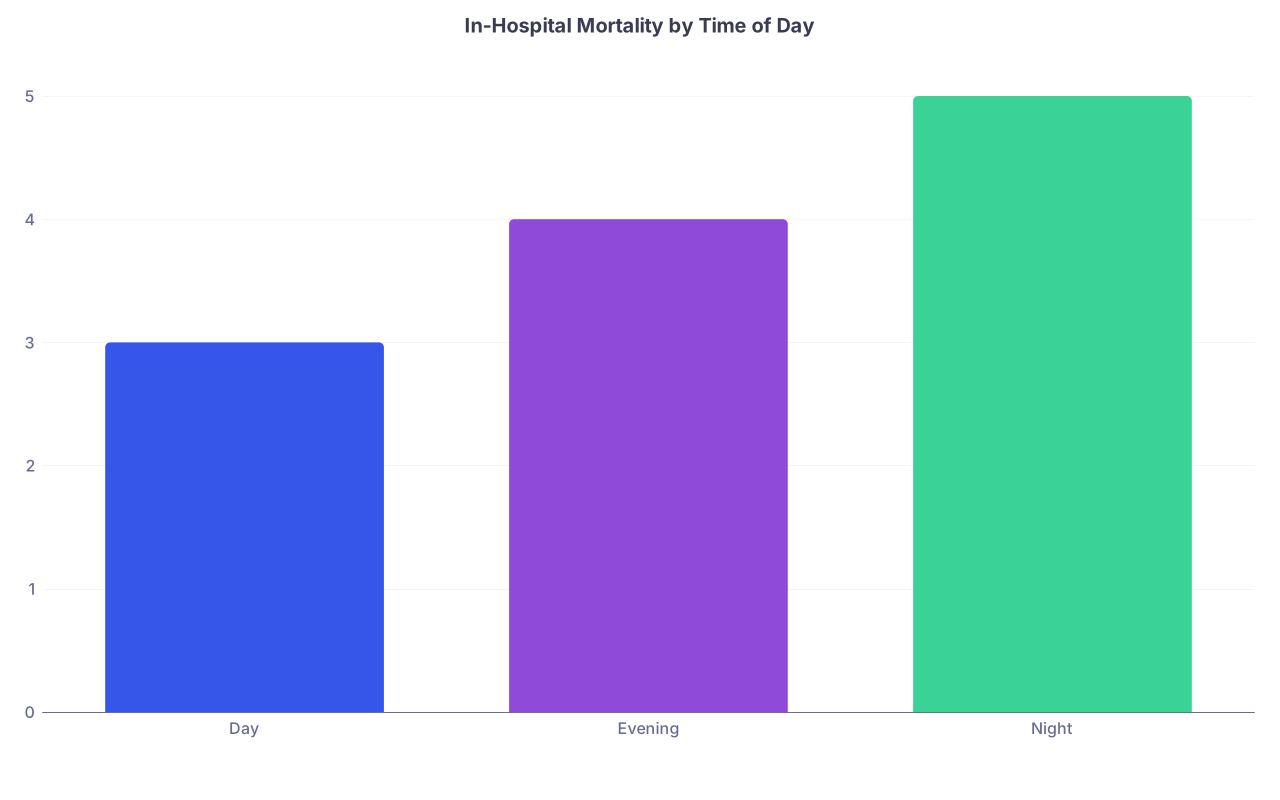
| Category | Value |
|---|---|
| Day | 3 |
| Evening | 4 |
| Night | 5 |
The exact percentages vary by study and hospital, but the pattern is boringly consistent: adverse events and in‑hospital mortality are higher on nights and weekends.
Why?
Not because patients magically become sicker at 2 a.m. But because:
- Fewer staff are physically present.
- Less experience is at the bedside.
- Response times are slower.
- Communication is worse, more fragmented, and more tentative.
Now layer on top: a culture where junior trainees are socially punished for “over‑calling” the attending.
That’s how you turn an already higher‑risk shift into a setup for preventable harm.
A few hard truths backed by literature and QI data:
Failure to recognize and escalate is a major component of preventable death.
Rapid response team (RRT) reviews, Code Blue debriefs, and chart reviews from multiple institutions keep showing the same chain: early warning signs → delayed response → late escalation → poor outcome.Residents are not good at predicting which “borderline” patients will crash.
Predictive models and early warning scores (NEWS, MEWS, etc.) consistently outperform unstructured “clinical intuition,” especially in fatigued trainees. That’s not an insult—it’s a human limitation problem, not a character flaw.Timely communication with senior physicians improves outcomes.
In ICUs and high‑acuity units, structures that force low‑threshold communication—like mandatory attending notification for certain triggers—reduce adverse events. Yet on the floor, we tell PGY‑1s to “use their judgment” and “don’t call unless you have to.” That’s backwards.
So when someone says, “We don’t wake Dr. X for that,” what they’re really saying is: “We’d rather protect Dr. X’s sleep than reduce the probability of a catastrophic miss.”
They will not phrase it like that in M&M, of course. Then it becomes “communication breakdown.”
Where the Myth Comes From (And Why It Persists)
This superstition didn’t appear spontaneously. It’s the product of several ugly forces:
1. Hierarchy and fear
Older attendings trained in a world where you never called your chief, much less an attending, unless the patient was coding. That mindset gets passed down as a badge of toughness.
You hear things like:
- “In my day, my attending would’ve killed me if I called for that.”
- “We handled whole services alone overnight.”
Translating: “We normalized unsafe staffing and made psychological safety a joke.”
The problem is not that they were tougher. It’s that the bar for “acceptable risk” was absurdly high, and many near‑misses never got recorded.
2. Misplaced pride in independence
There’s a weird macho streak in residency: the best resident is the one who “doesn’t need help.” You see it most in PGY‑2s and PGY‑3s who survived by white‑knuckling their early nights and now romanticize it.
So the hidden curriculum says:
- Calling = weakness.
- Managing alone = competence.
- “Bothering” the attending = you’re not cut out for this.
What the outcomes data actually say:
- Early escalation = good situational awareness.
- Getting input before the patient crashes = better care.
- Residents who use supervision well make fewer harmful errors.
3. Attendings protecting their own comfort
This part no one likes to say out loud.
Some attendings explicitly or implicitly signal that calls are annoying:
- Sighing heavily when they pick up.
- Saying “this could have waited until morning” in a scolding tone.
- Retelling call stories in front of the team: “Can you believe they woke me up for constipation?”
Residents learn fast what gets punished.
But here are the facts: if you are the attending of record, you are responsible 24/7. Full stop. You are being paid (directly or indirectly) for that. A call at 2:30 a.m. goes with the job description, not as a personal favor.
The idea that your REM sleep is a higher priority than a junior doctor’s uncertainty about a decompensating patient is not just arrogant. It’s reckless.
What Actually Happens When Residents Don’t Call
Let’s move from theory to actual failure modes I’ve seen repeatedly.
The slow‑burn decompensation
- 11:30 p.m.: Vitals slightly worse, heart rate 105 → 115, BP 92/58. Resident thinks, “I’ll watch and recheck.”
- 1:15 a.m.: Lactate 3.1, UOP trending down. Resident orders a 500 mL bolus, thinks it helped “a little.”
- 4:45 a.m.: Nurse calls—patient altered, hypotensive, now 80/40. RRT is called.
- 5:00 a.m.: ICU takes over, attending is now awake anyway, but the window for earlier source control/antibiotics/fluids is gone.
At M&M, everyone agrees “earlier escalation might have altered the course.” Translation: someone felt the pressure not to call.
The “I’ll wait for results” trap
Resident at night is uneasy about chest pain or neuro change, but thinks:
- “There’s already a troponin / CT pending; better to have data first.”
- “I don’t want to wake them with nothing concrete.”
So they delay the call until after the result, which returns worse than expected. Now they call, but the attending has to scramble half asleep, with zero runway to think or plan.
The safer pattern is: “Here’s my concern. Here’s what I’ve ordered. I’ll call you back with results, but I want this on your radar now.”
But that runs directly against the informal rule: “Only call once everything’s wrapped in a nice bow.”
The documentation problem
Residents who don’t call also don’t document their concern clearly. You see:
- Vitals buried in the flowsheet.
- One‑liner “monitor” notes.
- No explicit statement: “I’m concerned this patient is at high risk of deterioration overnight.”
So when the bad outcome happens, the chart reads like everyone was fine with the status quo. The pressure not to call and the pressure to not look “anxious” on paper reinforce each other.
When You Should Call: A Reality‑Based Threshold
You’ll never get a universal “call vs don’t call” list that covers everything, but you can do better than whispers and vibes.
Here’s the mental shift: stop asking “Is this bad enough to bother the attending?” and start asking “Is there any meaningful chance this could be worse than I think or spiral before morning?”
If the answer is yes or even “I don’t know,” your bar for calling should be low.
Concretely, these categories almost always justify a call:
Acute change in ABCs
Any real shift in airway, breathing, or circulation—even if “they recovered”—deserves attending situational awareness.New or worsening chest pain, neuro deficit, or mental status change
Stroke, MI, sepsis, delirium—timing matters. Wasting 4 hours to avoid a phone call is a bad trade.Escalating support
Needing multiple fluid boluses, increasing oxygen, adding pressors, starting or escalating sedation—these are not “routine tweaks.”Procedures or major management pivots
New pressor, emergent transfusion, unexpected arrhythmia treatment, starting second‑line antibiotics for suspected sepsis source—this isn’t “I gave some melatonin.”You feel out of your depth
This is the one people ignore. If you’re re‑reading UpToDate for the fifth time and still feel uneasy, you’re not “weak.” You’ve hit the point where supervision is supposed to enter.
Notice what isn’t on that list: “I’ve collected every lab and radiology result and packaged them into a perfect presentation.” You call when the trajectory or uncertainty is concerning, not when the story is tidy.
Practical Tactics: Calling Without Getting Steamrolled
You do not control your attending’s personality. Some will be great; some will be grumpy; a few will be actively toxic. You do control how you prepare and structure the call.
Here’s a simple, efficient pattern that’s hard to argue with:
One‑line frame:
“Sorry to wake you. I’m calling about Mr. Smith in 10B—new hypotension and rising lactate, and I’m concerned he may be worsening sepsis.”20–30 second headline summary:
“He’s a 68‑year‑old with pneumonia on ceftriaxone, was marginal all day. Around midnight his BP drifted down to 90s over 50s, HR 110s. I gave a 500 mL LR bolus, minimal improvement. Lactate is now 3.2 from 1.1 this afternoon, UOP has dropped. He’s mentating but looks more fatigued.”What you’ve already done:
“I’ve repeated vitals, ordered a second bolus, drew repeat labs and blood cultures, and broadened antibiotics to cover possible resistant organisms based on his prior cultures.”Your question / ask:
“I’m worried about him heading toward shock. Would you like to come see him, or should we transfer to higher level of care now? I’d appreciate your eyes on whether we need ICU tonight.”
That is not “bothering the attending.” That is baseline responsible communication about a high‑risk change in a sick patient.
If they respond with annoyance?
That’s their professionalism problem, not your clinical judgment problem.
The Silent Cost: Resident Burnout and Moral Injury
Everyone talks about burnout like it’s mostly about hours or documentation volume. The part people underplay is moral injury—the chronic feeling that you’re being forced to practice below the standard you believe in.
Nothing erodes you faster than:
- Being alone at 3 a.m. with a crashing patient and no real back‑up.
- Worrying about calling for help not because it’s clinically pointless, but because of social blowback.
- Replaying cases in your head: “If I had pushed harder or escalated earlier, would this have gone differently?”
Residents who feel they can call, and do call, sleep better on post‑call not just because they leave earlier. Their conscience is quieter.
And yes, there’s data for this. Programs with a stronger culture of supervision and psychological safety don’t just have better safety metrics—they have lower burnout and higher trainee satisfaction. That’s not a coincidence.
Program Reality Check: What You Should Expect from Leadership
Let’s be blunt. A residency program that tolerates a “don’t call me at night” culture is failing you and your patients.
Baseline expectations you are allowed to hold:
Clear, written guidance on when attendings expect to be called.
Not vibes. Not folklore. Actual words.Attendings who explicitly say, “I would rather you over‑call than under‑call.”
And then actually act like they mean it when the pager goes off.Support when you escalate for patient safety, even if it annoys someone.
If your chief or PD throws you under the bus to placate a cranky attending, that’s a red flag about the program, not you.
If your program does have a healthy culture, use it. Call. Learn. Normalize telling your junior: “If you’re not sure, call me. If I’m not sure, I’ll call the attending. That’s how this is supposed to work.”
If it doesn’t? Document. Find allies. Loop in chiefs and PDs when there’s a clear safety concern. You are not obligated to preserve someone’s comfort at the expense of patients—and your own mental health.

| Step | Description |
|---|---|
| Step 1 | Resident concern |
| Step 2 | Monitor with plan |
| Step 3 | Call senior or fellow |
| Step 4 | Call attending |
| Step 5 | Document and monitor |
| Step 6 | Acute change or high risk? |
| Step 7 | Uncertain or still worried? |
Myth vs Reality: The Bottom Line
Let’s make the contrast explicit.
| Aspect | Myth | Reality |
|---|---|---|
| What “good” residents do | Handle everything alone | Escalate early and appropriately |
| Purpose of call | To get permission | To share risk and improve decisions |
| Risk of over-calling | Looking weak | Mild annoyance, quickly forgotten |
| Risk of under-calling | None if no crash | Missed deterioration, patient harm, moral injury |
| What attendings are paid for | Daytime rounds only | 24/7 responsibility for their patients |
The culture that tells you “don’t call the attending at night” is not brave, or efficient, or old‑school hardcore. It is a relic of a time when we did not measure our errors, did not respect human limits, and did not take psychological safety seriously.
You are not there to protect your attending’s sleep. You are there to protect your patient’s life, and your own integrity as a physician.
Years from now, you won’t remember which attending sighed when you paged them at 2 a.m. You will remember the nights you listened to your unease, made the call, and knew—whatever happened—that you did not leave your patient alone.