The belief that good residents never say “I don’t know” on call is dangerous nonsense.
The best residents I’ve worked with say “I don’t know” more than almost anyone else. They just never stop the sentence there. It sounds more like: “I don’t know — here’s what I’m thinking and here’s what I’ve done so far.”
That difference is the line between safe, respected colleagues and the people everyone quietly double-checks.
Let’s dismantle this myth and look at what actually makes you a good resident on call.
Where This Myth Comes From (And Why It Won’t Die)
You did not invent this anxiety. It’s baked into the culture.
You hear it in intern year, whispered in workrooms at 1 a.m.:
“If you tell the attending you don’t know, they’ll think you’re incompetent.”
“Never say you don’t know on the phone. Just pick something.”
“Fake it till you make it.”
This mentality comes from three places:
Pre-med perfectionism – You’ve been conditioned for a decade that not knowing is failure. MCATs, shelf exams, pimping. There’s always a “right” answer and you’re supposed to have it instantly.
Old-school shame culture – The generation that trained under “See one, do one, kill one” still haunts some programs. Admitting uncertainty was once treated like weakness instead of basic intellectual honesty.
Performance anxiety on call – At 2 a.m. with an unstable patient, your lizard brain screams: “If I look unsure, I’ll lose credibility.” So you bluff. Or you freeze. Both are worse than “I don’t know — yet.”
Notice what’s missing from that list: patient outcomes, safety data, or evidence. Because the evidence points the other way.
What the Data Actually Shows About “Not Knowing”
High-reliability industries — aviation, nuclear power, anesthesia, critical care — all converge on one conclusion:
Overconfidence kills. Accurate self-assessment saves lives.
In medicine, you see this in several lines of evidence.
1. Diagnostic error and overconfidence
Studies on diagnostic error consistently show a pattern: clinicians who are overconfident in their initial impressions are more likely to miss the correct diagnosis, even when new data contradicts them.
You’re tired, anchoring on “it’s probably sepsis,” and then you stop thinking. You stop asking. You stop saying, “Something’s not right here, I might be missing something.”
“I don’t know yet” keeps your brain open. “I’m sure it’s X” when you’re actually not sure shuts it down.
2. Simulation studies of residents on call
In simulation labs, residents managing acute situations (codes, rapid responses, crashing patients) are often graded on teamwork, communication, and situational awareness.
The high performers?
They don’t pretend omniscience. They:
- State what they don’t know.
- Ask for help early.
- Verbalize uncertainty and next steps.
The low performers are often the ones who stay silent, bluff, or avoid admitting knowledge gaps until the scenario is collapsing.
3. Patient safety and escalation culture
Look at any safety-oriented hospital initiative: rapid response criteria, chain-of-command protocols, early warning scores. All of them are built around early escalation and humility about risk.
Saying “I don’t know if this is just post-op pain or something worse, so I’m calling you” is exactly the kind of behavior these systems are trying to encourage. The Joint Commission is not handing out awards for “confident-sounding intern who didn’t call.”
The Real Problem Isn’t “I Don’t Know” — It’s What Comes Next
Here’s the nuance almost everyone misses: attendings are not judging you for not knowing everything. They’re judging you for what you do with not knowing.
There are two versions of “I don’t know” on call.
Version 1: The Useless “I Don’t Know”
You know this one. You’ve heard it.
Nurse: “The patient’s more short of breath, sat is 88% on 3 liters, what do you want to do?”
Resident: “Uh… I don’t know…”
Silence. No plan. No questions. No movement.
This “I don’t know” says: I’m overwhelmed and I’m going to hand you my anxiety instead of a plan.
That’s what seniors and attendings hate. Because it forces them to do your thinking for you from a distance with half the data.
Version 2: The Competent “I Don’t Know (Yet)”
Now compare this.
You: “I don’t know exactly why she’s more short of breath, but I have some concerns. I’ve:
– Checked vitals: BP 102/60, HR 115, RR 26, sat 88% on 3 L
– Exam: new crackles at bases, increased work of breathing, JVP slightly up from before
– Ordered: stat CXR, ABG, repeat BMP, troponin, BNP
– Immediate: bumped O2 to 6 L, sat now 92%, got EKG, started considering BiPAP vs. diuresis
I’m worried about acute decompensated heart failure vs. PE vs. pneumonia. I’m not sure which yet. I’d like your help thinking through whether to start diuresis now or wait for imaging.”
That’s still “I don’t know.” But it’s useful. It shows:
- You recognize the problem.
- You’ve taken concrete steps.
- You’re thinking in a structured way.
- You know where your boundary is.
Good residents do this constantly. They acknowledge uncertainty, but they never leave it bare.
How Good Residents Actually Talk on Call
Let’s get practical. Here’s what separates residents people trust from the ones everyone side-eyes.
| Weak Phrase Alone | Strong Alternative |
|---|---|
| I don’t know. | I don’t know yet, but here’s what I’m thinking and what I’ve done so far. |
| I’m not sure. | I’m not sure which is most likely – my top three are X, Y, Z because… |
| I haven’t seen this before. | I haven’t seen this before, so I looked up A vs B and here’s what I found. |
| What should I do? | Options I see are X and Y; I’m leaning toward X because…, do you agree? |
| Everything looks fine. | Right now vitals are stable, exam is unchanged, and there are no red flags like A/B/C. I don’t have a clear cause yet. |
Notice the pattern: strong residents pair uncertainty with structure.
The Three-Part Formula: The Right Way to Say “I Don’t Know”
When you’re on call, use this simple mental template. It works at 3 p.m. and at 3 a.m.
State what you know.
Facts. Vitals. Labs. Timeline. One or two exam findings that matter.State what you think.
Your differential. Your leading concern. How worried you are.State what you’ve done and where you’re stuck.
Immediate actions taken. Orders placed. Then clearly say what you’re unsure about or what decision threshold you’ve hit.
Put together, it sounds like:
“Right now I don’t know exactly what’s driving this hypotension. What I know: BP dropped from 120s to 80s over the last hour, HR climbed from 90s to 120s, urine output has been low, he got 10 mg oxycodone an hour ago, no fever, lactate 3.1. On exam he’s cool, mottled, a bit altered from baseline, lungs clear, JVP low.
I’m thinking distributive vs hypovolemic shock; sepsis vs medication effect vs bleeding. I’ve already bolused 1 L, drawn repeat lactate and CBC, and ordered a stat CT abdomen to rule out bleeding. Where I’m stuck is whether I should start pressors in the unit or keep trying fluids on the floor. I’d like your guidance there.”
That’s not weakness. That’s exactly what a competent, safe clinician sounds like.
The Hidden Cost of Faking It on Call
Let’s be blunt: trying to perform “perfect resident who never says I don’t know” comes with a bill. You pay it in three currencies.
1. Patient safety
You delay escalation because you’re afraid looking unsure = looking dumb.
So instead of calling the senior at 11 p.m. and saying “I’m not sure, but I’m worried,” you wait until 2 a.m. when the patient is truly crashing. The thing that could have been managed on the floor is now an ICU transfer with intubation.
I’ve seen more harm from delayed calls than from “unnecessary” ones. Almost every experienced attending would say the same.
2. Your learning
If you never say “I don’t know” out loud, you never get high-yield corrections. You just silently Google things at 4 a.m. and hope you’re not missing something big.
Residents who progress the fastest ask targeted questions:
- “I’m not sure why option A is better than B here — can you walk me through it once?”
- “I didn’t know you could use that drug in this context. What’s the risk you’re watching for?”
Those questions require admitting a gap. They also compress years of trial-and-error into a 5-minute conversation.
3. Burnout and imposter syndrome
Pretending you know everything at all times is exhausting. You carry constant background fear that someone will finally notice you don’t.
Residents who allow themselves to say “I don’t know, but I will find out” paradoxically feel more competent. Because their internal story shifts from “I must already know” to “I’m great at closing gaps quickly and safely.”
What Attendings Actually Think When You Say “I Don’t Know”
Let me decode the hidden curriculum for you.
Attendings are subconsciously asking three questions about you on call:
- Are you safe?
- Are you thoughtful?
- Can I trust you with more autonomy next time?
Here’s how different behaviors land.
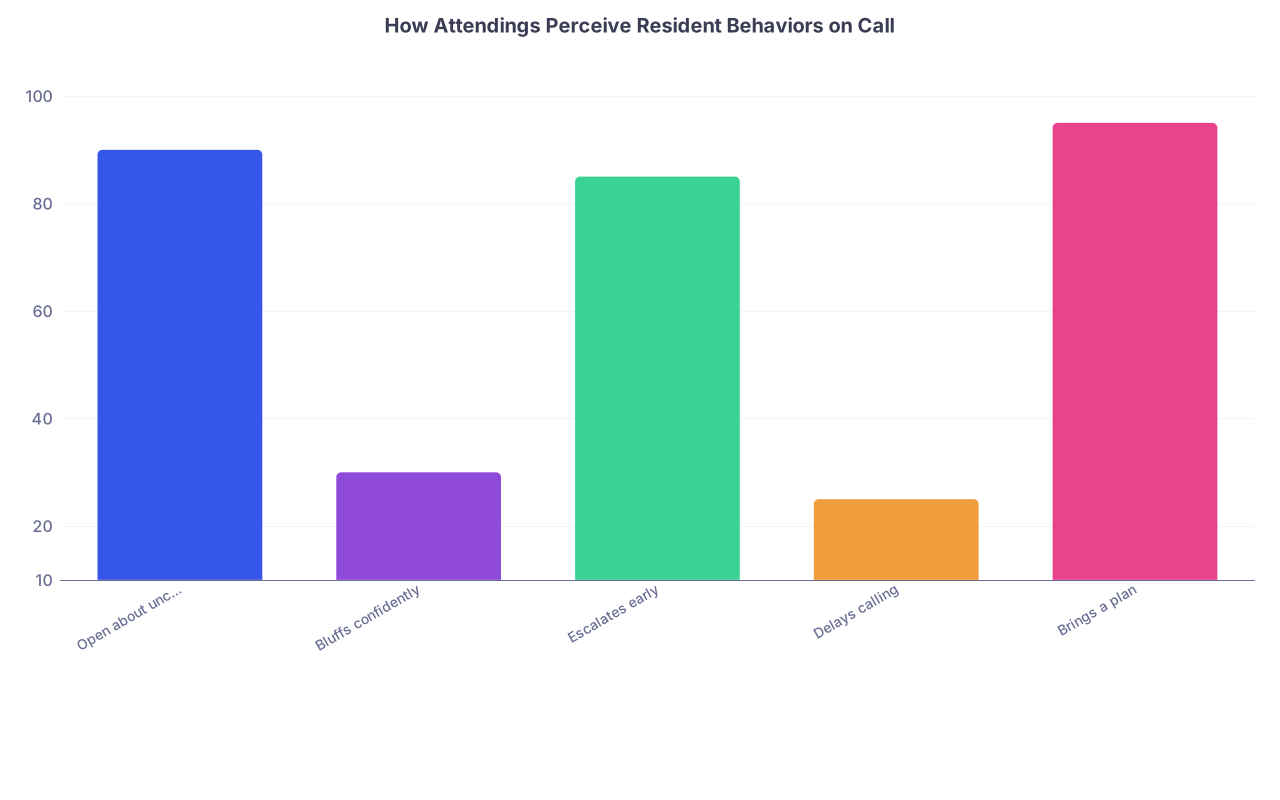
| Category | Value |
|---|---|
| Open about uncertainty | 90 |
| Bluffs confidently | 30 |
| Escalates early | 85 |
| Delays calling | 25 |
| Brings a plan | 95 |
(Values represent perceived “trustworthiness” on a 0–100 scale, based on what attendings actually say when residents are not in the room.)
When you say:
“I don’t know exactly what’s going on, but here’s the data and my best guess,”
most attendings think:
- Good. They’re not reckless.
- They’re thinking in the right direction.
- I can shape their reasoning in real time.
When you try to fake it and crumble under mild questioning:
- They don’t know what they don’t know.
- I need to double-check their decisions.
- I’m not giving them more rope yet.
You are not fooling anyone. The veneer of confidence without substance is paper-thin.
How to Use “I Don’t Know” Without Sounding Helpless
Here’s how to keep the honesty and ditch the helplessness.
Anchor your “I don’t know” to action words:
- “I don’t know yet, so I’ve started by…”
- “I’m not sure, which is why I did X, Y, Z.”
- “I haven’t seen this before, so I checked [guideline/resource] and it suggests…”
- “I don’t know the exact dose off the top of my head; I’m going to confirm in Lexicomp before I order it.”
- “I’m not confident choosing between A and B; I’d like your input because I’m leaning toward A for these reasons.”
You’re not just broadcasting confusion. You’re showing process, safety checks, and a bias toward action tempered by humility.
When You Absolutely Should Say “I Don’t Know” Immediately
There are moments when you stop everything and admit ignorance early and loudly.
- Med dosing with a narrow therapeutic window: “I don’t know the correct loading dose offhand; I’m looking it up now before I order it.”
- Procedures beyond your training: “I don’t know how to safely do that chest tube yet; I need someone experienced at bedside.”
- Legal/ethical minefields: “I don’t know the legal requirements for this capacity question; I’m calling risk management/ethics.”
- Systems/policy issues: “I don’t know the transfer protocol; I’m calling the charge nurse/supervisor.”
This is not optional. This is how you avoid harming patients, losing your license, or putting your program in a bad spot.
A Simple Reframe for Your Next Call Night
So here’s the mindset shift I want you to carry into your next night on call:
Good residents are not the ones who never say “I don’t know.”
Good residents are the ones who never stop at “I don’t know.”
You’re not being graded on omniscience. You’re being graded on:
- How quickly you recognize when you’re out of your depth.
- How efficiently you gather relevant data.
- How clearly you communicate your uncertainty and actions.
- How willing you are to escalate early rather than heroically guess.
One last visual to keep in your head:

| Step | Description |
|---|---|
| Step 1 | New problem on call |
| Step 2 | Act with standard care |
| Step 3 | Document and reassess |
| Step 4 | Stabilize basics |
| Step 5 | Gather key data |
| Step 6 | Form early differential |
| Step 7 | Call for help |
| Step 8 | Say I do not know yet + share plan |
| Step 9 | Refine with senior input |
| Step 10 | Do I know what to do? |
You live mostly in that “No, I don’t fully know” branch during residency. That’s normal. That’s the job.
Years from now you will not remember every 2 a.m. “I don’t know” moment. You’ll remember whether you were the kind of doctor who pretended, or the kind who owned uncertainty, did the work, and kept your patients safe.