No, you’re not supposed to know everything on call. In fact, the systems around you are literally built on the assumption that you don’t.
The myth that “you should be able to manage anything by yourself on call” is one of the most persistent, damaging pieces of residency folklore. It is also flatly contradicted by every serious study of resident performance, supervision, safety, and learning.
Let’s tear it apart.
The Hidden Curriculum: “Figure It Out Alone”
Walk into any call room at 2 a.m. and you’ll hear some version of this whispered to an intern:
“Don’t bother the senior unless the patient is crashing.”
“You should probably know this by now.”
“Just make a decision.”
This is the hidden curriculum talking. Not the real standard. Not what your program director signs their name under. Just peer mythology and cultural baggage passed down from a time when nobody tracked outcomes and residents worked 120 hours a week.
What do the actual rules and data say?
1. Accreditation bodies assume you don’t know everything
The ACGME doesn’t mince words. Programs are required to ensure:
- “readily available supervision” at all times
- graded, progressive responsibility
- clear policies specifying when residents must call for help
That’s the system design. You are not credentialed as an independent physician during residency. You are credentialed as a supervised trainee. If your hospital truly expected you to know and manage everything, they’d grant you attending privileges and be done with it.
2. Residents routinely fail “perfect knowledge” tests — and still practice safely
Studies of resident diagnostic accuracy, prescribing errors, and procedural skills show a predictable pattern: residents are imperfect, often very wrong on first pass, and patients still do reasonably well when supervision systems work.
For example, work comparing resident vs attending diagnostic accuracy in internal medicine and emergency medicine consistently shows attendings outperform residents by a very real margin. No one is surprised by this. It’s why supervision exists.
If your “on call” performance had to match a seasoned attending to be acceptable, residency would basically be impossible.
What the Data Actually Shows About Resident Performance on Call
Let’s get specific. When you strip away the bravado and look at the evidence, three things jump out:
- Residents miss things. A lot.
- Good systems catch those misses.
- Programs that pretend residents should be self-sufficient have more safety issues and worse educational climates.
Night float and cross-cover: built on incomplete knowledge
Night call and cross-cover are basically stress tests of this assumption. You’re covering patients you’ve never met with notes you didn’t write, orders you didn’t place, consultants you haven’t met. You’re tired. Labs are delayed. Imaging is limited.
Nobody looking at that setup expects 100% independent mastery.
That’s why hospitals structure the night this way:
- Night float residents
- In-house attendings in ED/ICU in many institutions
- Supervising seniors available by phone or in person
- Explicit “must call” scenarios (rapid response, codes, new admit with X)
If administrators genuinely believed residents had to “know and manage everything,” they’d never allow cross-cover of 40–60 patients by a single PGY-1 with one senior backing them up.
Here’s the real story: the medical system assumes you will not know everything and will not catch everything. Then it layers:
- nursing vigilance
- pharmacy checks
- lab critical value alerts
- attending oversight
- sign-out systems
on top of your imperfect but improving clinical judgment.
Supervision: What Programs Say vs What Residents Believe
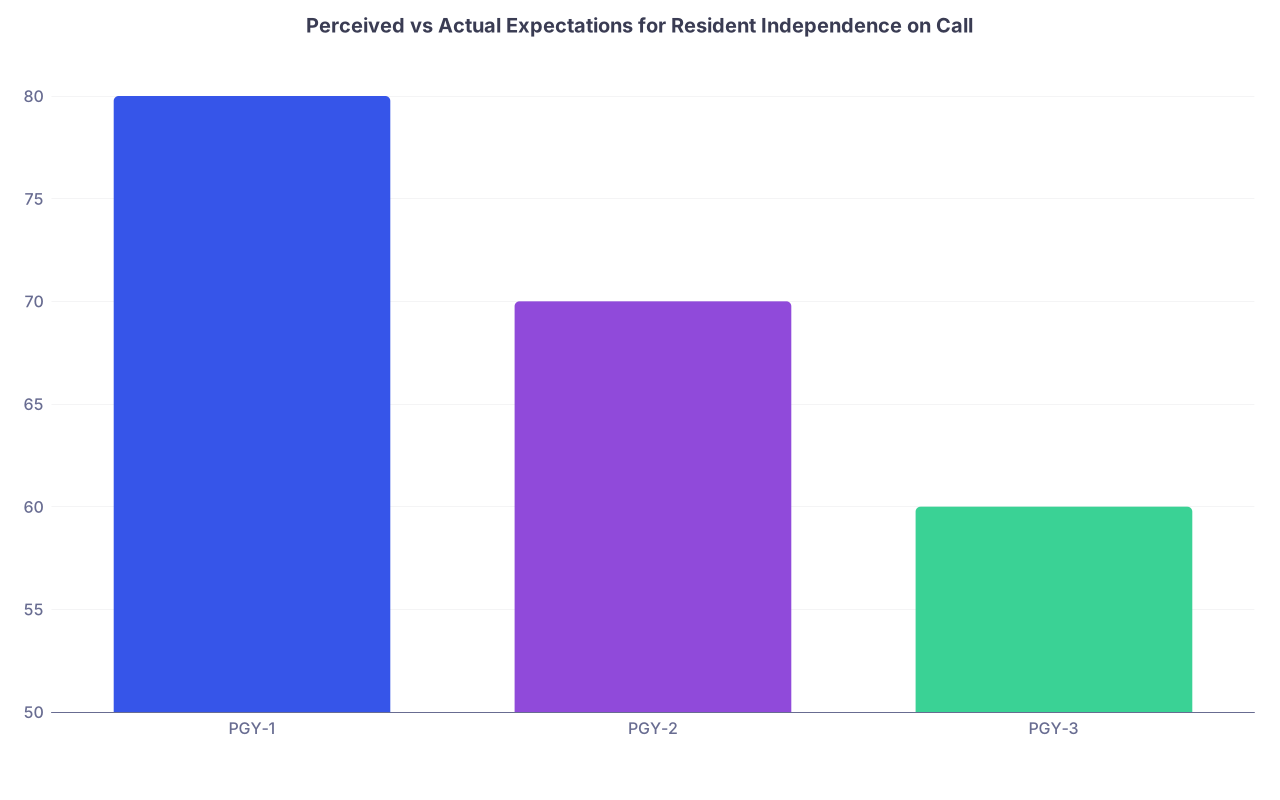
The expectation gap is measurable. Surveys of residents vs faculty show a mismatch: residents think they should be more independent than faculty actually expect.
| Category | Value |
|---|---|
| PGY-1 | 80 |
| PGY-2 | 70 |
| PGY-3 | 60 |
Assume those numbers as the percentage of residents who believe they’re expected to manage “almost everything independently” at each level. When you survey program directors and faculty about what they expect residents to do independently at those same levels, the percentages are significantly lower—often by 20–30 points.
Faculty think: “Call me. That’s what I’m here for.”
Residents think: “If I call, I’ve failed.”
I’ve sat in morbidity and mortality conferences where faculty literally say:
- “I wish they had called me earlier.”
- “I never mind getting called for this.”
- “This is exactly what I want to be woken up about.”
Yet the residents involved often preface their case with, “I didn’t want to bother my senior/attending.”
Someone is lying to you about what’s expected. It’s usually not the policies. It’s the culture.
The Real Standard: Safe, System-Aware, Call for Help
Let me reframe this bluntly.
On call, you’re not being tested on:
- Do you instantly know the diagnosis?
- Can you recall every dosing nuance from memory?
- Can you independently manage a crashing patient end-to-end?
You’re being evaluated on:
- Can you recognize when a situation is serious?
- Can you stabilize the patient to the level of your training (ABCs, basic orders, call the right people)?
- Do you use your supervision chain appropriately?
- Do you document and communicate clearly?
That’s it. That’s the bar.

| Step | Description |
|---|---|
| Step 1 | New issue on call |
| Step 2 | Activate rapid/code |
| Step 3 | Call senior and attending |
| Step 4 | Call senior for help |
| Step 5 | Assess and start treatment |
| Step 6 | Monitor and follow up |
| Step 7 | Stable or unstable |
| Step 8 | Within my competency |
| Step 9 | Concern persists |
Notice what is not on that flowchart: “Silently struggle for 45 minutes so nobody thinks you’re dumb.”
What faculty actually watch for on call
When attendings debrief call performance, the red flags they mention most often are:
- “They didn’t call me when they should have.”
- “They didn’t recognize how sick the patient was.”
- “They didn’t follow through or re-check the patient.”
- “They didn’t communicate important changes.”
Missing a rare side effect? Not knowing the obscure reversal agent dose off the top of your head at 3 a.m.? Those are minor. Quickly looking it up or asking pharmacy is expected behavior, not a sign of weakness.
The Unsafe Myth: “You Should Have Managed That Alone”
Let’s deal with the toxic side of this head-on.
You will likely encounter someone—another resident, maybe even a fellow or attending—who says something like:
- “You called me for that?”
- “You should know that by now.”
- “Why didn’t you just handle it?”
They’re wrong. And usually they’re hiding their own anxiety or insecurity.
Ask yourself: how do actual bad outcomes show up in root cause analyses?
- Delay in escalating care
- Failure to recognize deterioration
- Poor communication between teams
- Errors under fatigue without cross-checking
Not: “Intern over-communicated with senior.”
| Behavior / Issue | Risk Level for You and Patient |
|---|---|
| Calling too often for clarification | Low |
| Looking up doses/guidelines | Low |
| Admitting uncertainty | Low |
| Not calling when patient unstable | Critical |
| Guessing doses without checking | High |
| Ignoring nursing concerns | High |
If you internalize one thing, make it this: over-communication is safe; under-communication is what shows up in M&M.
How Much Are You Actually Expected to Know by PGY Level?
There is a progression of expectations. But it’s not “know everything vs know nothing.” It’s more like:
- PGY-1: Recognize trouble, start basics, call early
- PGY-2: Structure workup, anticipate next steps, know when you must pull in senior/attending
- PGY-3+: Manage most common scenarios, escalate early for anything unusual, teach others to do the same
Here’s a rough mental model—again, not perfection, just direction.
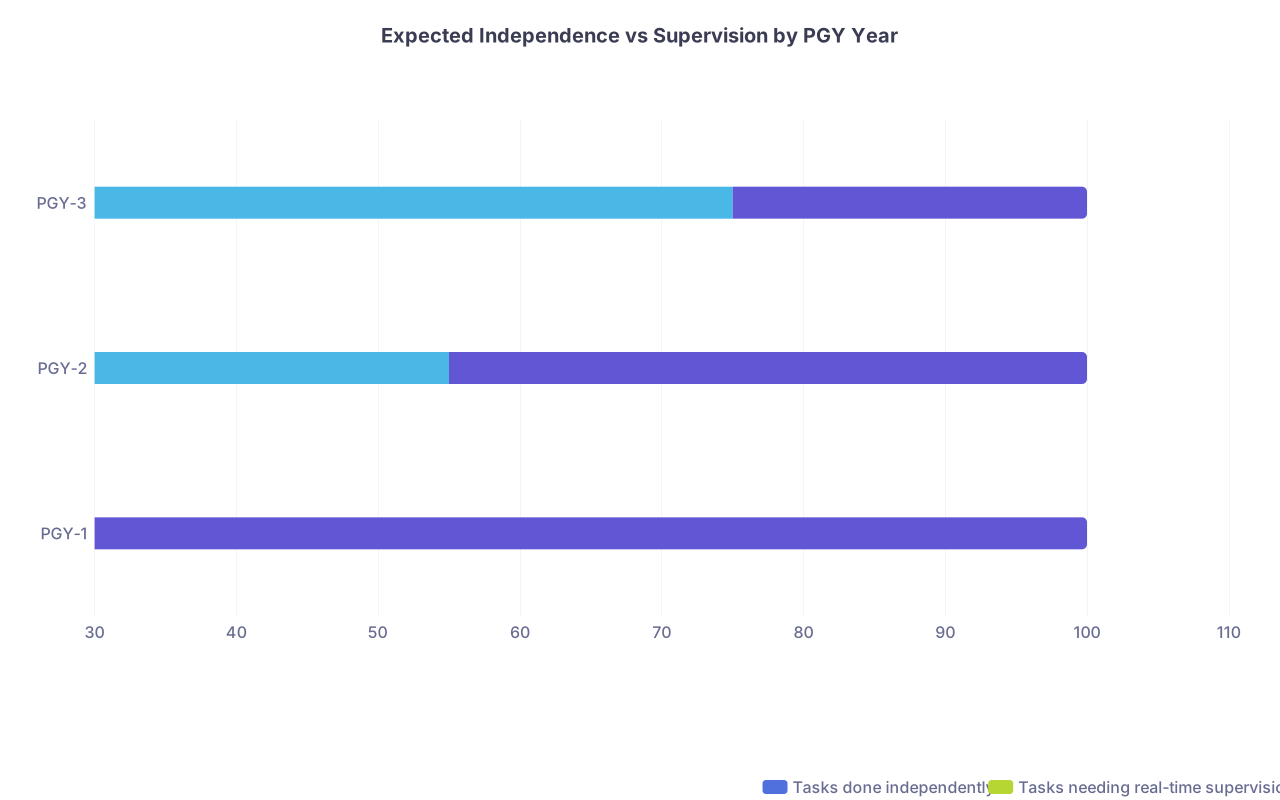
| Category | Tasks done independently | Tasks needing real-time supervision |
|---|---|---|
| PGY-1 | 30 | 70 |
| PGY-2 | 55 | 45 |
| PGY-3 | 75 | 25 |
Nobody sane expects a PGY-1 on their first month of nights to:
- independently manage new-onset atrial fibrillation with RVR in a decompensating patient
- decide whether to delay emergent surgery in an unstable patient
- interpret complex imaging without radiology input
- adjust multi-pressor shock in a crashing ICU patient
What they do expect is:
- you’ll recognize it’s serious, not brush it off
- you’ll show up quickly
- you’ll start basic, safe interventions (fluids, O2, stat EKG, tell the nurse you’re coming)
- you’ll call your senior/attending and say:
“Mr. X is hypotensive, tachycardic, altered, on pressors, I’m at the bedside, here’s what I’ve done so far.”
That’s competence. Even if you don’t know the final diagnosis yet.
How to Survive Call Without Pretending to Be an Attending
Let’s get practical. How do you meet real expectations on call without buying into the “know everything” myth?
1. Use structured thinking, not omniscience
You don’t need all the answers. You do need a framework.
For almost every on-call problem, you can start with:
- Is the patient stable or unstable?
- What could kill them in the next 30–60 minutes?
- What can I do now that is safe, reversible, and stabilizing?
- Who else needs to know about this?
Being systematic beats being brilliant at 3 a.m.
2. Normalize calling early—for yourself and others
If you’re the junior:
- Preempt the “sorry to bother you” reflex. Instead:
“I’ve got a situation I want your help thinking through…” - Call earlier than you think you need to, especially for: hypotension, respiratory changes, neuro changes, unexpected chest pain, sepsis, post-op changes.
If you’re the senior:
- Say this out loud at the start of the night:
“Call me for anything you’re not comfortable with. You will never get in trouble for calling.” - Then back it up with behavior. No sighing. No shaming.
3. Offload memory to systems
You’re not supposed to carry the entire pharmacopeia in your frontal lobe at 4:12 a.m.
Use:
- weight-based order sets
- EMR-approved dosing tools
- pharmacy consultation
- local guidelines (sepsis, DKA, AFib, ACS, etc.)
Smart residents are the ones who habitually check themselves, not the ones who write everything from memory with swagger.
4. Know the non-negotiable “call for help” triggers
Every service has some version of these written down. Internalize them. Examples:
- New O2 requirement or acute respiratory distress
- Sustained hypotension or MAP drop plus symptoms
- Acute mental status change
- Chest pain in at-risk patients
- New focal neuro deficits
- Rapid post-op change
- Any “bad feeling” from experienced nursing staff
If you’re on the fence, you’re not on the fence. Call.
Why This Myth Persists (And Why You Should Ignore It)
So why does the “you should know everything” myth survive despite data and policy?
Because residency is:
- Hierarchical
- Competitive
- Insecure as hell
People cope by overcompensating. They rewrite their own insecurity as “standards” for their juniors. You don’t have to continue that pattern.
You’re already being evaluated on real behaviors: safety, communication, willingness to learn, clinical reasoning over time. Not instantaneous omniscience on post-call day 7 of your life.
The Bottom Line
You are not expected to know everything on call. You are expected to:
- Recognize when something is wrong and respond fast.
- Use your supervision and hospital systems instead of pretending you’re alone.
- Communicate clearly, act within your level, and ask for help early.
Do that consistently, and you’re not just “good enough” on call. You’re exactly what residency is designed for.