
Night float is not scut work. It is your most compressed, high-yield rotation in clinical judgment that residency will ever give you—whether your program admits it or not.
The myth that “night float is just cross-cover, pages, and paperwork” survives because day teams rarely see what actually happens between 7 p.m. and 7 a.m. They get the sanitized sign-out version. “Overnight, patient had some chest pain, got trops, EKG, all good.” Translation: you got three pages in five minutes, sorted out which patient might actually be infarcting, overrode a bogus troponin order, and talked a panicked intern out of doing something unsafe at 3:24 a.m.
This is not scut. This is decision-making under uncertainty with limited backup. That’s the exact definition of clinical judgment.
Let’s dismantle the myth properly.
Where the Myth Comes From (And Why It’s Wrong)
The story you usually hear:
“Night float is low-value. You just answer pages, reorder missing meds, do admits, and babysit stable patients. Real learning happens on days—rounds, teaching, procedures.”
I have bad news for that narrative: it is comfortable, familiar, and mostly false.
Daytime is about discussion of clinical judgment. Nighttime is about execution of it.
On days, you present a patient with a curated story. Labs are back. Consultants have weighed in. Attendings correct your plan in front of the team. You have whiteboards, computers, coffee, and time.
On nights, you get:
- An incomplete chart
- A nurse saying, “He just doesn’t look right”
- Vitals that are either two hours old or suddenly terrifying
- An attending at home who is technically “available” but realistically asleep unless you prove it’s urgent
That shift—from long-form, supervised thinking to short-form, real-time choices—is what actually builds judgment.
The idea that this is “just scut” comes from two blind spots:
Attendings rarely see your first 10 minutes of thinking at night.
They see the final version: “I got an EKG, checked K and Mg, gave nitro, pain resolved.” They do not see the mental triage: Could be reflux. Could be PE. Could be anxiety. Could be STEMI. You made that call alone.Residents underestimate how much autonomy they’re actually exercising.
You start thinking the default: “If nothing terrible happened, then nothing important happened.” That’s wrong. “Nothing bad happened” is often the result of a dozen small, correct overnight decisions that prevented badness.
Night float looks like chaos. Underneath it, there’s a pattern: constant, forced prioritization with real stakes.
What the Data Actually Shows About Nights
Let’s talk numbers, not vibes.
Overnight is not just “continued daytime, but darker.” The risk profile is different, and that matters for judgment.
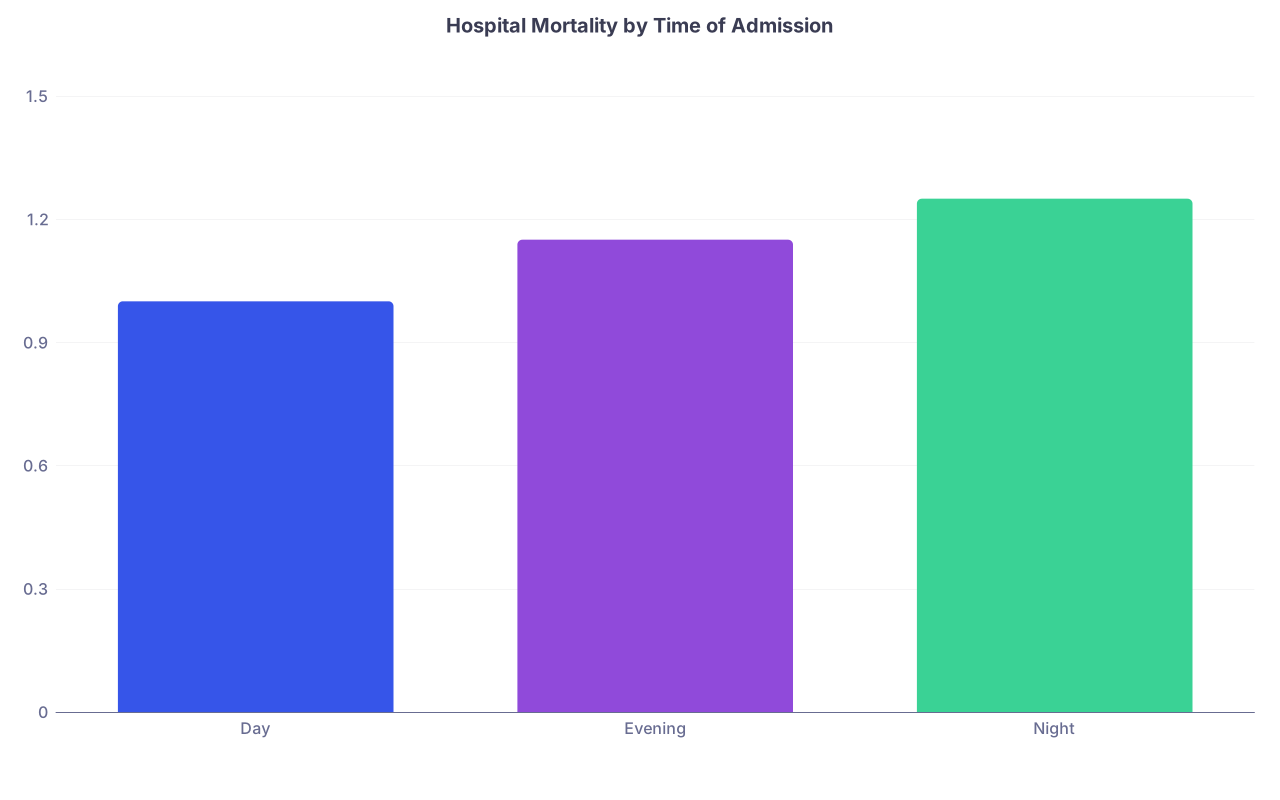
| Category | Value |
|---|---|
| Day | 1 |
| Evening | 1.15 |
| Night | 1.25 |
Multiple large studies have found:
- Patients admitted or deteriorating overnight have higher mortality and complication rates compared with daytime, even after adjusting for severity.
- Error rates and near-misses go up at night—fatigue, thinner staffing, and reduced supervision are not hypotheticals; they’re measurable.
- Response to deterioration (rapid response calls, codes) is more frequent at night and on weekends.
Translation: nights are not “less clinical.” They’re more dangerous.
So when you’re the one in-house at 2 a.m., your choices have disproportionate impact. You are the difference between “caught early and fixed” and “team surprised during morning rounds.”
That’s why night float is a crucible for clinical judgment. Not because programs are wise and intentional about it, but because risk concentrates at night whether programs acknowledge that or not.
The Unique Cognitive Workout of Night Float
Here’s what I see repeatedly, watching interns hit night float for the first time:
Day shift thinking:
“Let me dig through the chart, read the admission H&P, check the last 2 days of labs, review all consultant notes, look at the imaging, then slowly craft a plan.”
Night shift thinking:
“You have 30 seconds to decide if you are walking to this room now or in 20 minutes. Go.”
Those are different mental muscles. Night float forces you to train them.
Triage as a Skill, Not a Guess
On nights, you’re living in the land of:
- “New chest pain” x3 pages
- “Low urine output” in a septic patient
- “HR 150” in a post-op
- “Patient refusing BiPAP”
- “Family wants an update”
You can’t see everyone at once. You have to decide which of these is safe to delay, which is phone-manageable, and which demands a sprint to the bedside.
That prioritization—knowing what can wait, what cannot—is the beating heart of clinical judgment. It’s also exactly what you’ll do as an attending, except with your name on the line.
Good night float residents gradually learn patterns like:
- The one-liner that makes you move fast: “Nurse says, ‘He is not like himself’” in a cirrhotic patient
- The red-flag vital that is worse than it looks: RR from 16 to 28 with “mild” O2 requirement increase
- The “soft” symptom that usually precedes disaster: increasing confusion in anyone with infection and marginal blood pressure
You don’t get that calibration in conference rooms. You get it standing at the threshold of 20 rooms at 3 a.m.
Night Float vs Day Service: What Actually Builds Judgment?
Let’s make the comparison explicit.
| Aspect | Daytime Service | Night Float |
|---|---|---|
| Supervision | High, constant | Thin, mostly remote |
| Time for decisions | Minutes to hours | Seconds to minutes |
| Volume of interruptions | Moderate | Extreme |
| Complexity of cases | Often curated | Random, from trivial to catastrophic |
| Focus of learning | Reasoning, guidelines, presentations | Pattern recognition, triage, risk tolerance |
Daytime rounds are where you learn why a plan is right in an ideal context.
Night float is where you learn what you actually do when the context is nothing like ideal.
Both matter. But only one simulates what it’s like being the first phone call when things go wrong.
Myth: “It’s All Scut – Reordering Meds and Fixing Orders”
Let me be blunt: if you think reordering meds and fixing orders is beneath you, you’re missing the point.
The resident who blindly “just reorders” everything overnight is not doing less work. They’re doing unsafe work.
Here’s the quiet truth: those “scut” pages are disguised tests of your judgment.
The Pharmacy or Med Page
“Vancomycin dose not verified. Need new order.”
You could:
- Mindlessly click through whatever suggestion the system gives, or
- Check the timing, level trend, renal function, indication, and whether the patient even still needs broad coverage
At 3 a.m., you’re the only one deciding whether this person gets another huge nephrotoxic dose. That’s judgment, not clerical work.
The “Pain Med Not Working” Page
This is the classic throwaway page everyone jokes about.
Done poorly: “Okay, I’ll increase the oxy from 5 to 10.”
Done well:
- You check their respirations and mental status
- You peek at last ABG or CO2 if they’re on opioids + benzos
- You consider: postop day, epidural in place or not, NSAID options, bowel function, illicit use history
Same page. One is “scut.” The other is active risk assessment.
Night float gives you dozens of these reps every shift. You either lean into them as reps in judgment, or you sleepwalk through them and call the whole thing “annoying.”
The myth survives because the mental work you do doesn’t show up in the ACGME duty logs as anything fancier than “Cross coverage.”
How Nights Rewire Your Risk Tolerance (For Better or Worse)
One thing almost no one talks about: night float silently reshapes your risk thresholds.
Early on, I see this pattern:
- PGY-1: Overcalls everything. Every soft BP is sepsis. Every tachycardia is PE. Lots of labs, lots of calls, lots of anxiety.
- PGY-2+: Swing the other way. “He always runs soft.” “She’s always confused.” You start undercalling subtle deterioration because you’re drowning in pages and exhausted.
Both extremes are dangerous. Night float is where you learn to navigate the middle.
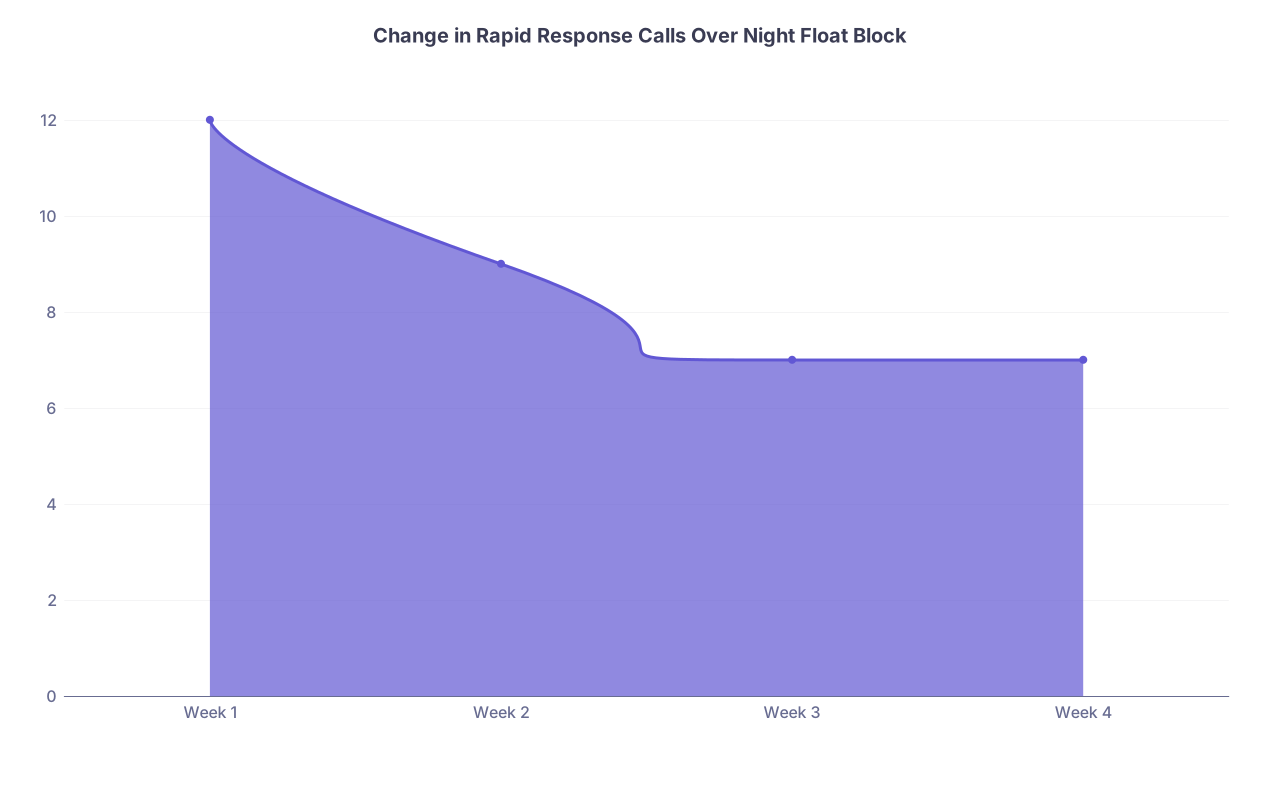
| Category | Value |
|---|---|
| Week 1 | 12 |
| Week 2 | 9 |
| Week 3 | 7 |
| Week 4 | 7 |
What usually happens:
- Week 1: Too many rapid responses. You’re scared and trigger-happy.
- Week 2–3: You start to recognize who actually crashes vs who just pages a lot.
- Week 4: Your call rate stabilizes, but now it matches actual risk better. You haven’t become “jaded.” You’ve become calibrated.
The critical piece is whether you reflect (even for 5 minutes post-call) on these:
- “That patient I watched overnight and didn’t call RRT—did they end up in the ICU anyway?”
- “That time I escalated early—did it actually change management, or was I just outsourcing my anxiety?”
If you never loop back, you either stay anxious or become complacent. Night float is powerful precisely because it can push you in either direction.
The Quiet Curriculum You Won’t Find in the Handbook
Programs love to hand you a night float “orientation”: pager etiquette, which attending to call, where to find the code cart. Fine.
The real night float curriculum is unofficial. It’s the accumulation of tiny, repeated decisions that change how you think forever.
Here’s what’s actually being trained:
Pattern recognition under sleep deprivation
Your brain starts flagging “this looks like that one bad case” even before you consciously know why. That’s System 1 thinking getting educated by repetition.Comfort with incomplete data
Labs pending, CT not done, history from a confused patient, sign-out that’s vague. You learn to move with partial information instead of freezing until the story is perfect. Attendings live here. So will you.Boundaries on autonomy
Good night residents figure out: “This is the line where I own the problem vs where I must wake someone up.” That line shifts as you grow, and nights force you to test it.Communication under stress
Explaining to a nurse why you’re not ordering a CT at 4 a.m. is not easy. Neither is calling a surgeon at 2 a.m. to say, “I think this abdomen is worse and I need you to come in.” You will not learn that skill in lecture.

| Step | Description |
|---|---|
| Step 1 | Page received |
| Step 2 | Go to bedside now |
| Step 3 | Chart review and phone call |
| Step 4 | Call senior or attending |
| Step 5 | Implement plan and reassess |
| Step 6 | Emergent concern? |
| Step 7 | Need higher level care? |
That flowchart is what’s happening in your head all night. Over and over. That repetition is how judgment is built.
How to Turn Night Float Into a Judgment Factory (Instead of Just Survival)
If you actually want to extract value from night float instead of just surviving it, you have to be intentional. No, this does not mean “read more UpToDate at 3 a.m.” You won’t.
Aim for small, high-yield habits:
One case review per night.
Just one. Pick the scariest or most confusing call. In the brief lull around 4–5 a.m., do a 3–5 minute chart review: what happened in the next 24 hours? Did your level of concern match reality?Always write a real assessment for any near-miss.
Not just “SBP 80s, gave fluids, improved.” Force yourself to write what you actually thought: “Concern for sepsis vs hypovolemia vs med effect. Chose fluids first because X, planned to escalate if Y.” That habit cements your reasoning.Ask one pointed feedback question to your day-team attending.
“That hypotensive patient from last night—when you saw them this morning, did I underestimate or overestimate how sick they were?” You’ll get more from that 30-second conversation than an hour-long noon conference.Track your own red-flag instincts.
Notice what made you uneasy: skin color, nurse tone, respiratory pattern, family comments. Those soft cues often beat the labs.
Does this take extra time? Barely. But it changes night float from “page-swatting endurance event” into a concentrated training block in judgment.
Why This Matters Long After Residency
Night float feels like a hazing ritual while you’re in it. Grueling hours, circadian wreckage, nobody really thanking you because all your best work is “nothing happened.”
But here’s the hidden, long-term effect: your brain is quietly building a case library.
Five years out, in your own clinic, when a post-op calls with “just not feeling right,” you won’t remember the specific night in PGY-2. You’ll just know—without entirely being able to explain—that this is someone you’re not comfortable managing over the phone.
That sense—your calibrated discomfort—is judgment. And it was carved into you at 2:37 a.m. while the rest of the hospital slept and you stood at the bedside trying to decide if a soft BP and a vague complaint were something or nothing.
Night float is not scut work. It is where you stop being someone who knows medicine and start becoming someone who can be trusted with it when no one is watching.
Years from now, you won’t remember each individual page or every grim sunrise walk to your car. You’ll remember the first time you realized, quietly and without fanfare, “I know what to do—and I know when to ask for help,” and you’ll realize that feeling was born in the dark.