
It’s 1:37 a.m. You just admitted a septic 78-year-old from the ED. Blood pressure is soft, lactate is climbing, pharmacy is short-staffed, and the nurse is asking, “Can I give the home metoprolol or are we holding it?” You scroll the med list. It’s chaos. Half of it looks copied from a 2016 discharge summary, the other half from the family’s handwritten note. You’re on your third night of call in a row.
This is exactly when medication reconciliation mistakes don’t just happen—they explode.
Let me be direct: most serious overnight screwups I’ve seen on call were not sexy diagnostic misses. They were boring, preventable medication errors that started with a sloppy med rec. You cannot afford to be casual about this, especially when you’re tired and trying to “just get through the list.”
We’re going to walk through five high-yield, high‑risk medication reconciliation errors that blow up after midnight—what they look like in real life, why they happen, and how to avoid them when you’re running on fumes.
Error #1: Blindly Continuing Home Meds That Should Be Held
This is the classic “I didn’t think about why they were on it” mistake.
You’re tired, you click “continue all” on the outpatient list, tell yourself you’ll review in the morning, and move on. By 5 a.m., the patient’s blood pressure is 70/40 and the ICU fellow is asking why your decompensated heart failure patient got their full-dose home nifedipine and lisinopril.
Common culprits that should not be reflexively continued on admission:
- ACE inhibitors / ARBs / ARNI in:
- Hypotension
- Sepsis
- Acute kidney injury
- Diuretics in:
- Sepsis with borderline pressure
- Pre-renal AKI
- NPO patients without clear volume status checks
- Beta-blockers in:
- Bradycardia
- Shock
- New heart block
- Oral diabetes meds in:
- NPO status
- Unstable glucose swings
- Renal failure (e.g., metformin in AKI, SGLT2 inhibitors with DKA risk)
- Anticoagulants in:
- Active bleeding
- High-risk procedures coming up
- Severe thrombocytopenia
What this looks like at 2 a.m.:
Septic patient, initial BP 85/50, but someone checked “continue home lisinopril 40 mg daily” and “continue torsemide 60 mg daily.”
Result: BP tanks after they get their “routine” meds at 6 a.m., you’re now starting pressors.AKI patient with Cr jump from 1.0 to 3.5, home ARB and spironolactone continued uncritically. Potassium comes back 6.3, peaked T-waves, and now you’re pushing calcium and calling nephrology.
How to avoid this:
At admission, especially overnight, force yourself through a 30-second filter for every chronic med class:
- Could this worsen hypotension, AKI, bleeding, or hypoglycemia tonight?
- Is the patient NPO, septic, or in any form of shock?
- Is there active bleeding or very high bleeding risk?
If yes to any—default to “hold,” and write it clearly:
- “Holding lisinopril and HCTZ on admission due to sepsis with soft pressures; re-eval in a.m.”
- “Holding metformin while NPO and with AKI; reassess when renal function improves.”
The mistake is not “holding too much.” The mistake is continuing everything mindlessly and hoping nothing bad happens before sign-out.
Error #2: Trusting a Single Source for the Med List
You know what gets residents constantly? Believing one source is “probably accurate.”
- You trust the EPIC outpatient med list.
- Or the crumpled list from the patient’s wallet.
- Or what the family says on speakerphone.
- Or the meds list faxed from the nursing home.
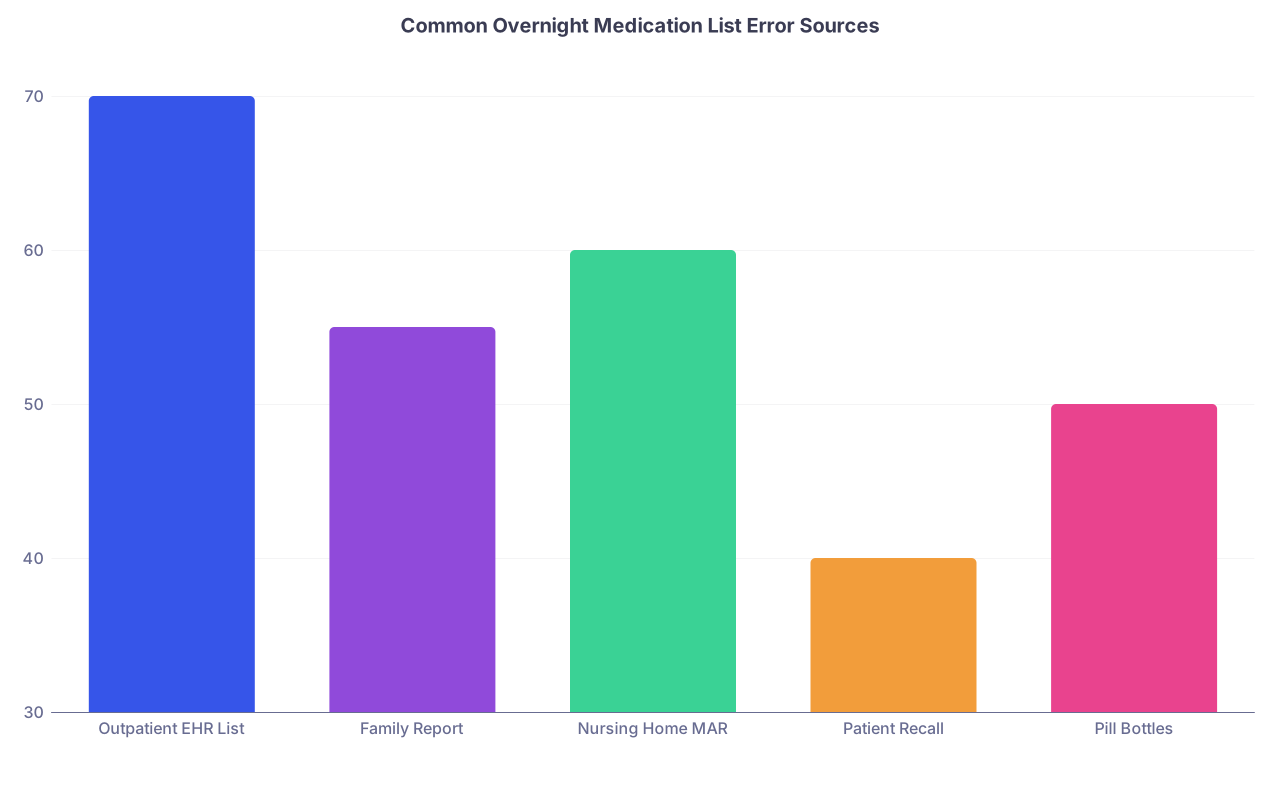
Each of these, alone, is dangerous.
| Category | Value |
|---|---|
| Outpatient EHR List | 70 |
| Family Report | 55 |
| Nursing Home MAR | 60 |
| Patient Recall | 40 |
| Pill Bottles | 50 |
(I’ve seen every single one be wildly wrong—wrong doses, meds that were stopped years ago, or major drugs missing.)
Specific train wreck scenarios:
- Nursing home fax omits the apixaban the patient started 2 weeks ago. You don’t ask. You admit them with afib and pneumonia, and conveniently start new apixaban. Double dosing once they’re back in the facility.
- Family swears “they stopped the insulin because his sugars were better.” Chart review next day shows multiple recent ED visits for DKA after missed insulin. Now you’re dealing with severe hyperglycemia because you believed “better.”
How to avoid this:
Overnight, you won’t have time for perfect. But you can avoid the one-source trap. Aim for at least two independent sources for any complex patient:
- Outpatient EHR + pharmacy dispense history
- Nursing home MAR + pill bottles brought in
- Family report + previous discharge summary
At minimum, document your uncertainty:
- “Med list partially confirmed via outpatient chart; unable to reach pharmacy overnight. Marking unconfirmed meds as ‘historical’ and will need a.m. reconciliation.”
And don’t quietly guess doses for critical meds (anticoagulants, insulin, anti-epileptics, transplant meds, chemo-related agents). That’s how you buy seizures, clots, and graft rejection for the day team.
Error #3: Mixing Up Formulations, Frequencies, and Units
You’re tired. The screen is full of look‑alike, sound‑alike drugs. Pharmacy is busy. This is where small ordering errors blow up into large patient harm.
Common dangerous patterns:
- Formulation mix-ups
- XL vs immediate-release
- 25 mcg vs 0.25 mg (e.g., levothyroxine)
- 5 mg BID vs 5 mg daily (apixaban, rivaroxaban)
- Route errors
- Writing PO when the patient has a PEG, is intubated, or has a gut issue
- Ordering topical vs oral (or vice versa) for meds that come both ways
- Sound-alike meds
- Hydromorphone vs morphine
- Lamotrigine vs lamivudine
- Keppra vs Keflex
Real overnight disasters I’ve seen:
- Elderly patient on metoprolol succinate 100 mg daily at home. You order metoprolol tartrate 100 mg BID because you didn’t notice the formulation. Heart rate drops to 30 at 4 a.m., rapid response called.
- Patient on outpatient levothyroxine 125 mcg. You mis-click and order 0.125 mg three times daily. Result: not instant catastrophe, but totally unnecessary hormone chaos and a miserable endocrine consult.

How to avoid this when you’re exhausted:
- For high‑risk drugs (anticoagulants, insulin, opioids, antiarrhythmics, AEDs, transplant meds):
- Read the entire line: drug, formulation, route, frequency, dose.
- Compare to home med: same formulation and frequency? If not, document why.
- Hard rule: if the dose seems off by a factor of 10, stop and re-check units.
- If you’re guessing the formulation (“I think they use the extended-release at home?”), you’re doing it wrong. Either:
- Look it up in the outpatient chart
- Or write: “Holding until a.m. for confirmation; unclear outpatient dose/formulation.”
And don’t forget to use pharmacy. Overnight pharmacists have saved residents more times than I can count. Call them. Ask: “Does this dose and formulation look consistent with typical outpatient prescribing for X?”
Error #4: Forgetting to Stop Duplicates and Conflicting Meds
“Just continue the home meds” + “start all the standard inpatient orders” = hidden landmine.
You admit a COPD exacerbation. You continue all inhalers from home, then order the hospital’s standard nebulizer regimen. Now they’re on three forms of bronchodilator plus systemic steroids. Tachycardic, agitated, hypokalemic by morning.
| Situation | Typical Duplicate / Conflict |
|---|---|
| CAD / stent | Two P2Y12 inhibitors (e.g., clopidogrel + ticagrelor) |
| Afib / VTE | Home DOAC + new heparin infusion |
| Diabetes | Home basal/bolus + full hospital insulin sliding scale |
| Pain control | Home long‑acting opioid + high‑dose PRN IV opioid |
| HTN / CHF | Multiple beta-blockers or ACE/ARB + ARNI combo |
Typical messy overnight scenarios:
- Patient with afib on apixaban at home. You miss it in the med list, start heparin drip for “new afib,” giving them full dual anticoagulation. Then they fall in the bathroom at 3 a.m.
- Cardiac patient on clopidogrel at home, ED started ticagrelor, you continued both “because that’s what’s in the ED orders.” Platelets 90k, Hgb dropping, GI now involved.
- Pain patient on OxyContin 40 mg BID at home. You add “morphine 4 mg IV q2h PRN” without adjusting. Night nurse gives full PRNs, and you’ve got hypoventilation and naloxone before sunrise.
How to avoid this:
When you’re doing admission orders, don’t think “add.” Think replace or adjust:
For anticoagulation:
- If continuing the home DOAC → do not start prophylactic or therapeutic heparin/LMWH unless there’s a very specific indication.
- If switching from DOAC to heparin drip → actually stop the DOAC in the orders.
For antiplatelets:
- Confirm: is dual antiplatelet therapy actually intended (recent stent, etc.)?
- Do not unknowingly add a second P2Y12 inhibitor.
For insulin:
- Don’t layer full sliding scale master orders on top of aggressive basal/bolus home regimen without adjustment and a clear plan.
You should always be asking:
- “Is this a new drug or just a new form of an old drug?”
- “Am I doubling up on the mechanism?”
If the situation is too complex (post-PCI on triple therapy, transplant meds, etc.), write a holding or continuation plan with a flag for the day team and document: “Complex antithrombotic regimen; continued as per most recent cardiology note—needs a.m. review.”
Error #5: Not Reconciling PRNs, OTCs, Herbals, and “Non-Serious” Meds
The most dangerous phrase in an overnight med rec?
“Oh, it’s just a PRN.”
I’ve watched residents ignore these because they’re tired and focused on “big” meds—antibiotics, pressors, insulin. Then you find out the patient has been taking:
- Nightly diphenhydramine for sleep (now confused and delirious on the floor)
- Regular NSAIDs with borderline kidney function and cirrhosis
- High-dose herbal supplements that interact with anticoagulants or chemo
- PRN benzos nearly every night (withdrawal risk if you suddenly stop them)
- PRN opioids at doses much higher than what you’ve ordered inpatient (real withdrawal and uncontrolled pain overnight)

Real‑world late-night fallout:
- Cirrhotic patient who’s been taking ibuprofen 800 mg TID at home “for years.” Nobody asks. You give them ketorolac in the ED and continue NSAIDs inpatient. By morning, creatinine is trashed and they’re oozing from every line.
- Elderly patient who “only takes Tylenol PM” at night at home. You start them on opioids and additional sedatives in the hospital. They’re somnolent, hypoxic, and now on BiPAP with concern for aspiration.
How to avoid this:
During overnight admission, you do not have time to catalog every vitamin. But you do have time to ask specifically about these categories:
- “Do you take anything to help you sleep?”
- “Any pain meds you take that aren’t prescriptions? Pills, creams, powders?”
- “Any herbal supplements, teas, or over-the-counter stuff you take every day?”
Then make decisions:
If they’re on nightly benzos or opioids:
- Either continue a tapered or safer equivalent with documentation.
- Or plan/flag for withdrawal monitoring and daytime taper plan.
If they’re on high‑risk OTCs or herbals:
- Document: “Patient reports regular [X], held inpatient due to [bleeding risk, interaction].”
- Let pharmacy or day team chase down details.
The mistake is pretending OTCs and PRNs are harmless background noise. They’re not. They’re often the missing piece when the patient behaves unpredictably overnight.
Your Overnight Med Rec Survival Pattern
You’re not going to do textbook-perfect med reconciliation at 3 a.m. That’s fantasy. But you can avoid the catastrophic errors by running a simple pattern every time:
Critical classes check:
- Anticoagulants, antiplatelets
- Insulin and diabetes meds
- Opioids and benzos
- Cardiac meds (beta-blockers, ACE/ARB, antiarrhythmics)
- Transplant / seizure meds
Should anything obviously be held?
- Sepsis + hypotension → hold ACE/ARB, big diuretics, some beta-blockers
- AKI → hold metformin, ACE/ARB, NSAIDs, some diuretics
- NPO → adjust diabetes meds, anticoagulation if procedures planned
Am I duplicating MOAs or creating conflicts?
- Two anticoagulants?
- Two P2Y12s?
- Home long-acting opioid + aggressive IV PRN?
Did I check more than one source for the med list?
- If not possible, did I document uncertainty and mark meds as historical or unverified?
Did I catch the risky “little stuff”?
- Bedtime sedatives
- Chronic NSAIDs in fragile kidneys/liver
- Regular benzos or opioids with withdrawal risk
| Category | Value |
|---|---|
| 0-1 min | 80 |
| 1-3 min | 40 |
| 3-5 min | 25 |
| 5-10 min | 20 |
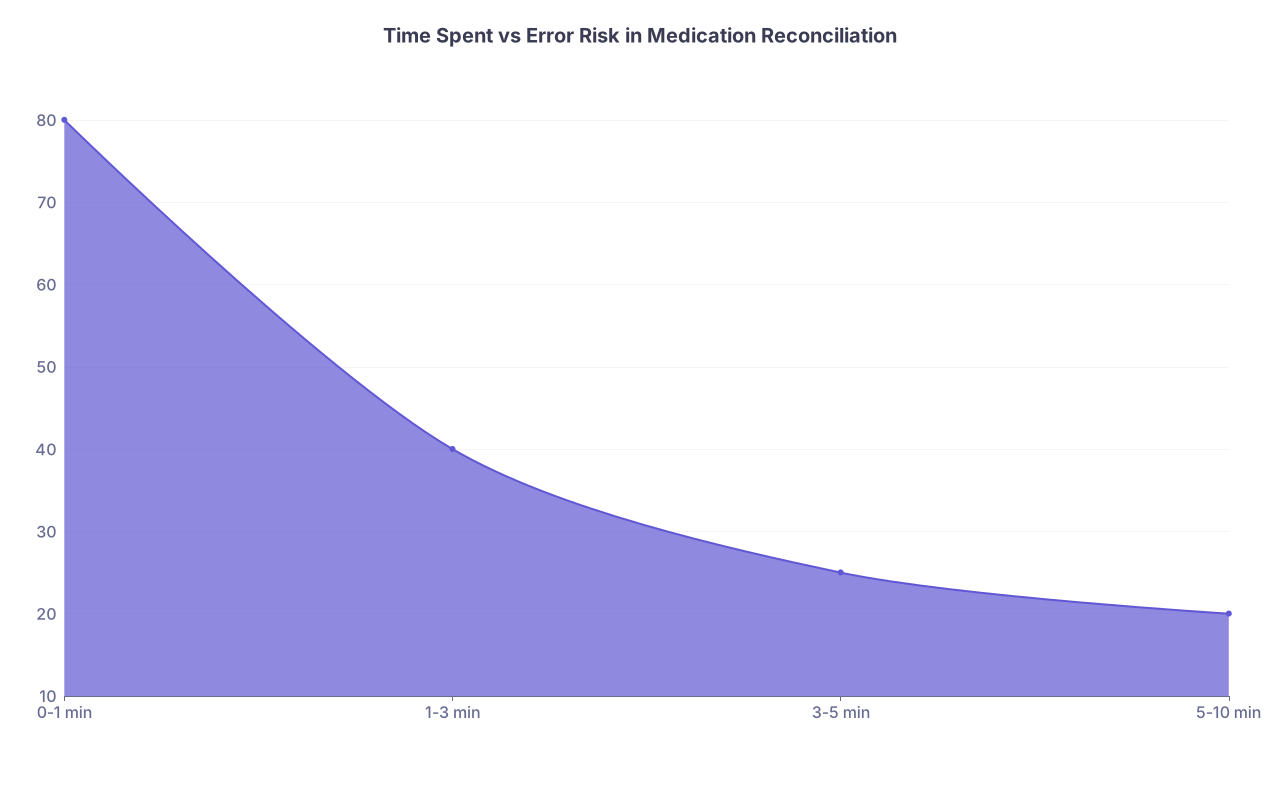
Spending an extra 3–5 minutes on these checks cuts your risk dramatically compared to the 30-second “continue all” click.
FAQ (Exactly 4 Questions)
1. What’s the single most dangerous medication class to screw up during overnight med rec?
Anticoagulants. Getting dose, indication, or duplication wrong (e.g., DOAC + heparin) can lead to catastrophic bleeds or major clots. Transplant meds and AEDs are close seconds, but anticoagulants are where I’ve seen the most life-threatening overnight errors.
2. If I’m unsure about a home med, is it safer to hold it or continue it?
Depends on the drug. For things like ACE/ARBs, NSAIDs, and non-essential PRNs in unstable patients, it’s often safer to hold and document clearly. For seizure meds, transplant immunosuppressants, and some psych meds, abrupt holding can be dangerous. When in doubt for those, call pharmacy or your senior, or continue a conservative version and flag it hard for the day team.
3. How do I handle med rec on a totally unreliable historian with no records available?
Be honest in your documentation: “Unable to obtain reliable med history overnight from patient/family. No external records accessible. Only life-sustaining meds (pressors, insulin as needed, antibiotics) ordered; full med rec deferred to daytime with pharmacy and outside record access.” Don’t fabricate. Don’t guess complex chronic regimens.
4. Is there a quick way to avoid duplicate or conflicting medications in the EHR?
Yes—use your EHR’s “meds by therapeutic class” view if available, and scan by category. Look at anticoagulants, antiplatelets, beta-blockers, and insulin together. If you see more than one in a category, ask: “Do we actually want all of these?” And always reconcile between ED orders and your admit orders—don’t just copy them forward blindly.
Key Takeaways:
- Do not click “continue all” at 2 a.m. without filtering for hypotension, AKI, bleeding risk, NPO status, and withdrawal risks.
- Anticoagulants, cardiac meds, insulin, opioids/benzos, and transplant/AED drugs deserve deliberate, double-checked decisions—not tired guesses.
- Use at least two sources when possible, document uncertainty, and remember: holding a questionable med with a clear note is almost always safer than pretending you know exactly what the patient takes when you really don’t.