
The most dangerous thing about night‑float isn’t sleep deprivation. It’s bad sign‑out.
You can be a brilliant resident and still terrify your day team if your night‑float sign‑out is sloppy, vague, or incomplete. I’ve watched great clinicians lose all credibility in one call night because they made the exact mistakes I’m about to walk through.
Let me be blunt: bad sign‑out is how patients get hurt at 3 a.m. It’s how your name ends up in M&M slides. And it’s almost always preventable.
Below are the top night‑float sign‑out mistakes that make day teams dread picking up your list—and how to avoid being that resident.
1. “Stable Overnight” Without Receipts
This one drives day teams insane: you write “No acute events. Stable overnight.” and think you’re done.
Then at 7:15 a.m. the nurse says, “Oh yeah, he was 80/40 around 3 a.m., they gave fluids and called someone.” And your name is in the note.
What went wrong?
You assumed “things turned out okay” = “nothing important to report.”
Here’s the rule:
If a nurse, RT, or consultant had enough concern to call you, it belongs in sign‑out. Even if the patient looks fine now.
Bad version:
- “Stable overnight, no issues.”
Safe version:
- “2 a.m. SBP dropped to 80s, 500 mL LR bolus, improved to 100s, no pressors, lactate normal. Will need day team to reassess volume status and BP trend.”
Do not:
- Hide overnight problems behind “resolved” language
- Assume “normal vitals now” = “not important”
- Skip things because they make you look like you had a busy or messy night
You want the day team to trust that if something happened, you’ll tell them. Once they realize you bury events, they’ll start combing the chart and calling nurses. And they will stop believing your sign‑out.
2. No Clear “If/Then” Plans
Night float is not just: “Here’s what happened.” It’s also: “Here’s what to do if it happens again.”
The worst sign‑outs dump information and zero contingency plans. That’s how the on‑call intern at 2 a.m. ends up thinking, “I don’t know this patient, I don’t know what the team wants, so I’ll just… do nothing…?”
For every known risk or active issue, there should be a clear, simple “if/then” plan:
- “If SBP < 90, give 500 mL LR bolus x1, recheck in 30 min, page me if no improvement.”
- “If patient becomes more dyspneic, repeat VBG, get STAT CXR, and call cross‑cover senior.”
- “If HR > 120 sustained and symptomatic, get EKG, BMP, Mg, and page cards fellow.”
Common mistake patterns:
- “Watch hypotension” with zero numbers or actions
- “Monitor for bleeding” without saying what labs, what thresholds, and who to call
- “Low threshold to transfer to ICU” (translation: you had no plan and just typed something)
If the person covering your patients has to guess what you would want, you failed your sign‑out.
3. Burying the Sickest Patients in the Middle of the List
If your list reads like it’s alphabetized by last name, you’re already making life harder for everyone.
Day teams hate when:
- The crashing GI bleeder is patient #11 of 19
- The DKA with K 6.0 is buried between “knee OA” and “failure to thrive”
- The pending ICU transfer is at the bottom because “I forgot to move them up”
On nights, your brain is fried. You will not remember every nuance of every patient. So the order of your list is a safety tool.
Prioritize your sign‑out like this:
- Sickest/Most unstable
- Time‑sensitive follow‑ups
- New admissions
- Boring but important chronic stuff
And during verbal sign‑out, say this out loud:
“Let me start with the patients I’m actually worried about.”
If the day team discovers at 9 a.m. that the sickest patient was hidden on page two of your list, they will not let that go.
4. No One‑Line Summary (The “Who Is This Patient?” Problem)
Nothing frustrates cross‑cover more than this:
- Note says: “82‑year‑old with multiple comorbidities admitted with SOB.”
- That’s it. No real summary. No diagnosis. No big picture.
So when the nurse calls at 1 a.m. with “patient is confused and tachycardic,” cross‑cover has no mental model. Is this:
- Septic?
- Hypoxic COPD?
- New PE?
- Advanced dementia baseline?
Your job is to give a sharp, 1–2 sentence identity for each patient:
- “82‑year‑old with HFrEF 25%, CAD, CKD4, admitted with acute decompensated HF, now improving on IV diuresis, still mildly volume overloaded.”
- “45‑year‑old with uncontrolled T1DM admitted with DKA likely due to insulin nonadherence, now anion gap closed, transitioning to subQ regimen.”
Day teams hate “admitted for workup” with no direction. That’s not a summary, that’s a shrug.
If they need to scroll through a 3‑page H&P just to understand why the patient’s in the hospital, your sign‑out failed.
5. Ignoring Nursing Perspectives and Bedside Reality
Another classic night‑float error: writing sign‑out from your chair, not from the bedside.
You look at vitals, labs, maybe imaging, and think: “Pretty stable.”
Then you fail to mention:
- “Refusing meds all night”
- “Pulling at lines, needed soft restraints”
- “Not eating or drinking anything”
- “O2 sat 92% on 2L… but desats to 80s just walking to the bathroom”
Those details usually come from:
- Talking to the nurse
- Actually walking into the room
- Reading nursing flowsheets and notes (yes, really)
Day teams absolutely remember who:
- Checks in with nursing before sign‑out
- Captures real behavior and functional changes
- Warns them: “The numbers look okay, but the nurse is worried—and I agree”
Quick filter: If the nurse would say, “Last night was rough,” and your sign‑out says “No events,” you screwed up.
6. Vague “Follow‑Up” Tasks With No Criteria or Deadline
Day teams hate this line more than almost anything:
- “Follow up labs.”
- “Follow up CT.”
- “Follow up cultures.”
Follow up for what? By when? To decide what?
This is how things get missed and bad stuff happens at 4 p.m. after turnover.
Each follow‑up needs:
- Exact thing to follow
- Rough timing
- What you’re looking for
- What it should trigger
Example of garbage:
- “Follow up morning BMP.”
Example of safe:
- “Follow up 6 a.m. BMP—K was 6.2 last check at midnight after Lokelma. If K still >5.8, re‑dose binder and page nephrology. If K ≥6.5 or EKG changes, call rapid response/ICU.”
If the day team has to play detective to figure out why your task exists, you didn’t finish the job.
7. Over‑Reassuring Language That Hides Real Risk
This one gets people hurt.
Phrases that are red flags:
- “A little hypotensive but probably fine.”
- “Low suspicion for PE.”
- “Mildly tachycardic, likely pain or anxiety.”
- “Sats ok on 4L, not too worried.”
You don’t get to say “not worried” without:
- Objective data
- Actual thinking
- Documentation that you thought through the dangerous stuff
Night float sign‑out should frame reality, not your hopes.
Instead of:
- “Probably pain or anxiety.”
Say:
- “HR 110–120s overnight. EKG sinus tach, no ischemia. No fever, no hypoxia, no chest pain. Pain 8/10 despite PRNs—likely driving tachycardia, but patient is high‑risk for PE so if tachycardia persists today, consider D‑dimer/CTA based on pretest probability.”
You’re not dumping work—you’re being honest about risk. Day teams hate inherited patients who were repeatedly hand‑waved as “fine” until they decompensate on their watch.
8. No Clear Code Status or Goals of Care Context
Few things are more dangerous than:
- Unclear code status
- “I think he’s DNR?”
- “Family wants everything” written 3 days ago with no update
When cross‑cover is called to a room with:
- Agonal breathing
- MAP 50
- Family at bedside crying
They need to know immediately:
- Code status
- Surrogate decision‑maker
- Recent goals‑of‑care discussions
And that needs to be in your sign‑out. Not just the chart.
Bad:
- “Full code” buried in admission H&P from 5 days ago.
Better:
- “FULL CODE as of admission 3 days ago. No recent GOC discussion. Patient now with worsening shock and likely poor prognosis—day team should revisit GOC with family today; wife is health care proxy.”
Worst mistake: You hint at “maybe we should talk about hospice soon” in sign‑out but never called the family, never documented, never told the day team explicitly. Then they walk into a code situation legally and ethically blind.
9. Sloppy Med Changes With No Explanation
Night float often changes meds:
- Holding anticoagulation
- Adjusting insulin
- Changing sedatives
- Starting pressors or fluids
Day teams hate mystery medication lists:
- “Who stopped the heparin?”
- “Why is this patient suddenly on 12 units glargine instead of 30?”
- “Who started this antipsychotic?”
Every significant med change should have:
- What changed
- Why you did it
- What to reassess
For example:
- “Held apixaban overnight after 2 episodes of melena and drop in Hgb 9.1 → 7.8. GI paged, they’ll see this morning. Day team to discuss resuming AC after GI eval.”
- “Decreased glargine from 30 to 15 units after multiple BGs in 60–70s range overnight. Day team to reassess meal intake and titrate.”
If they open the MAR and feel like they’re reading random edits from an unknown person, you’ve made their job—and the patient’s care—worse.
10. No Ownership of Near‑Misses or Unfinished Work
Night float gets chaotic. You will:
- Miss things
- Delay orders
- Forget a lab
- Choose not to call a consult at 3 a.m.
The mistake is not the imperfection. The mistake is burying it.
Day teams much prefer:
- “I should’ve ordered the CT at 2 a.m. but held off. Please order it first thing this morning; concern is X.”
- “I did not get to re‑check lactate after the bolus; please repeat this morning.”
- “Dark stools at 4 a.m., I did not have time to fully assess, please reassess and consider GI consult today.”
Over and over, the worst outcomes I’ve seen involved:
- Incomplete work that no one admitted was incomplete
- Near‑misses that never saw daylight
- “I kind of thought about it, but then the shift got busy” situations that disappeared into the ether
Own it in your sign‑out. You’ll earn respect, not blame.
11. No Structure, No Standard, Just Chaos
The ad‑hoc “I’ll just talk about stuff as I remember it” style of sign‑out is a setup for disaster when you’re exhausted.
Day teams can tell who has a mental template and who’s winging it. They trust the first group. They dread the second.
A simple structure (SBAR‑ish) saves you:
- ID/One‑liner – who is this?
- Hospital course snapshot – why here, what’s been done
- Overnight events – vitals, calls, changes
- Active problems – what’s unstable, what’s borderline
- If/Then plans & follow‑ups – clear tasks, contingencies, and ownership

| Step | Description |
|---|---|
| Step 1 | Start Sign Out |
| Step 2 | One liner ID |
| Step 3 | Hospital course snapshot |
| Step 4 | Overnight events |
| Step 5 | Active problems |
| Step 6 | If Then plans |
| Step 7 | Confirm code status |
| Step 8 | Clarify follow ups |
If your verbal and written sign‑out both follow some version of that, you’ll miss less. You’ll scare fewer people. And you’ll sleep a little easier when you leave at 7 a.m.
12. Forgetting That Cross‑Cover Is Not You
The night cross‑cover doesn’t know your patient like you do. They:
- Haven’t seen the family
- Don’t know the baseline mental status
- Don’t know what’s “normal weird” vs “new scary” for this person
Day teams hate when night sign‑out assumes omniscience:
- “He gets confused sometimes” (baseline? delirium? dementia?)
- “She’s always tachy” (how tachy? for how long? worked up?)
- “He tends to desat” (to what? with what triggers?)
You have to translate your knowledge into something they can safely act on.
Bad:
- “Baseline confused, likely sundowning.”
Better:
- “Baseline A&O x3 per family. Last 2 nights more confused after 9 p.m., pulls at lines, oriented only to self. Likely hospital delirium—if worsens or becomes agitated, check vitals, glucose, consider infection workup, and use non‑pharm strategies first; avoid benzos if possible.”
Night cross‑cover is not psychic. Your sign‑out is the only bridge between your familiar patient and their 3 a.m. version.
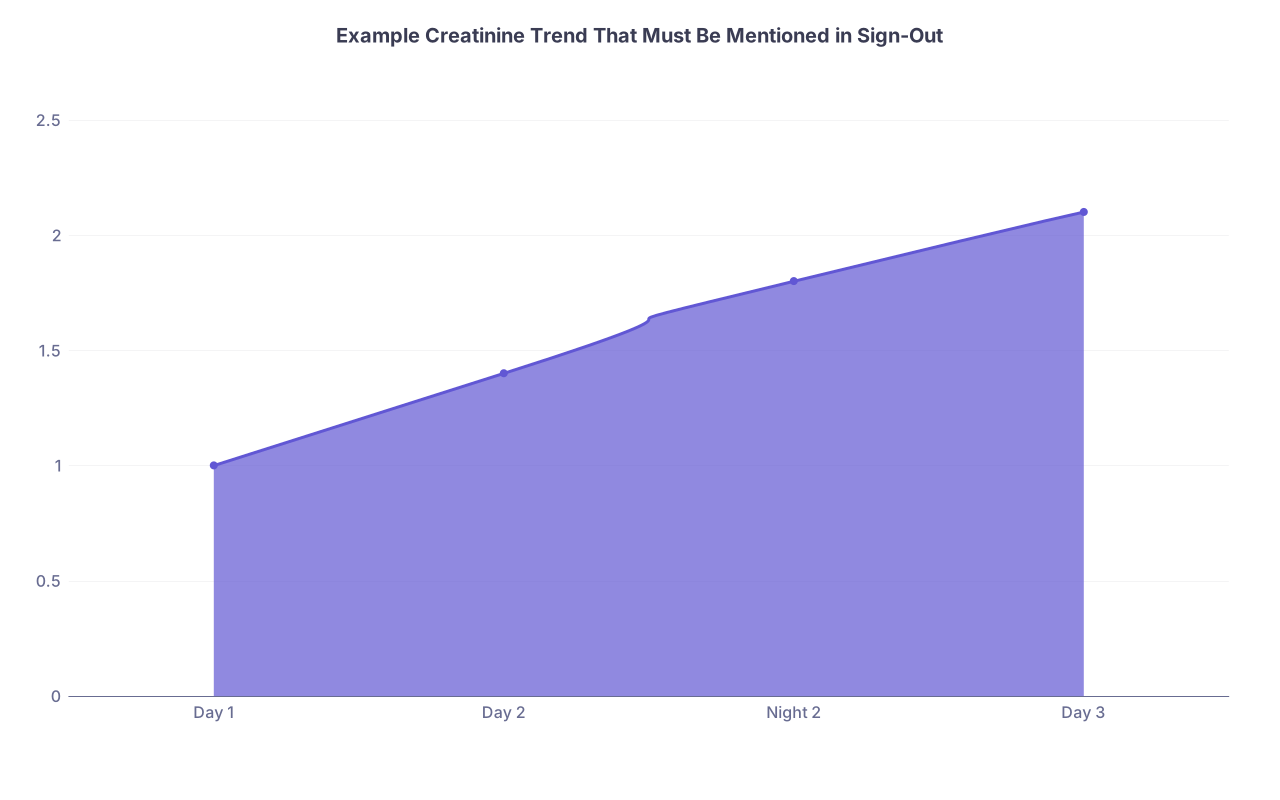
13. Not Using Data Trends (Just Single Numbers)
One more thing that quietly destroys trust: you hand over static numbers instead of trends.
Day teams hate hearing:
- “Cr is 2.0” without knowing it was 1.0 yesterday
- “WBC 14” without knowing it’s down from 18
- “BP 100/60” without knowing it’s been drifting from 140s all day
You don’t need to make charts, but you should at least mention direction:
- “Cr up from 1.0 to 2.0 in 24 hours, we’re treating as possible pre‑renal vs ATN; UOP borderline, following closely.”
- “WBC decreased 18 → 14 over 48 hours on ceftriaxone.”
If you want to avoid over‑ and under‑reassurance, trends are how you do it.
| Category | Value |
|---|---|
| Day 1 | 1 |
| Day 2 | 1.4 |
| Night 2 | 1.8 |
| Day 3 | 2.1 |
Numbers without trajectory are half‑truths. Half‑truths at night are dangerous.
14. Ignoring Time‑Critical Items (The “Oops, That Was Urgent” Problem)
Some tasks cannot wait until “whenever the day team sees it on the list”:
- STAT imaging with actionable results
- Critical labs (K 6.5, Hgb 6.1, troponin jump)
- New positive blood cultures
- New neuro deficits
Night‑float mistake: you bury time‑critical items with the rest of the “follow up” junk.
Day teams get terrified when they find:
- Positive blood cultures from 11 p.m. discovered at 9 a.m.
- Stat CT head at midnight with new subdural, never called to anyone
- Critical glucose of 30 at 5 a.m. treated by nurse but never documented or mentioned
Those are not “follow ups.” Those are alerts. They need:
- Direct verbal handoff
- Clear written highlight (all caps, starred, whatever your culture is)
- Explicit ownership: “YOU MUST ADDRESS THIS FIRST THING”
| Type | Routine Follow-Up Example | Time-Critical Example |
|---|---|---|
| Labs | Check AM BMP for electrolyte trend | K 6.5 at 5 a.m. after insulin given |
| Imaging | Read formal echo report | New CT head with bleed |
| Microbiology | Follow up urine culture | New positive blood culture with GNR |
| Clinical Status | Reassess pain regimen | New focal neuro deficit overnight |
If you treat everything like it can wait, something that can’t wait will be missed.
15. Handing Over Chaos: No Clean, Updated List
Last one. And it’s basic, but it matters.
Day teams hate receiving:
- Outdated census (discharged patients still on list, new ones missing)
- Wrong room numbers
- Labs from 24+ hours ago as “current”
- Tasks that were already done but never removed
It signals one thing: you don’t know your own list.
Before sign‑out, you should:
- Remove discharges
- Add new admits with at least a one‑liner & plan
- Update vitals/labs if they’re crucial
- Mark tasks as done or move them to “today” with time stamps
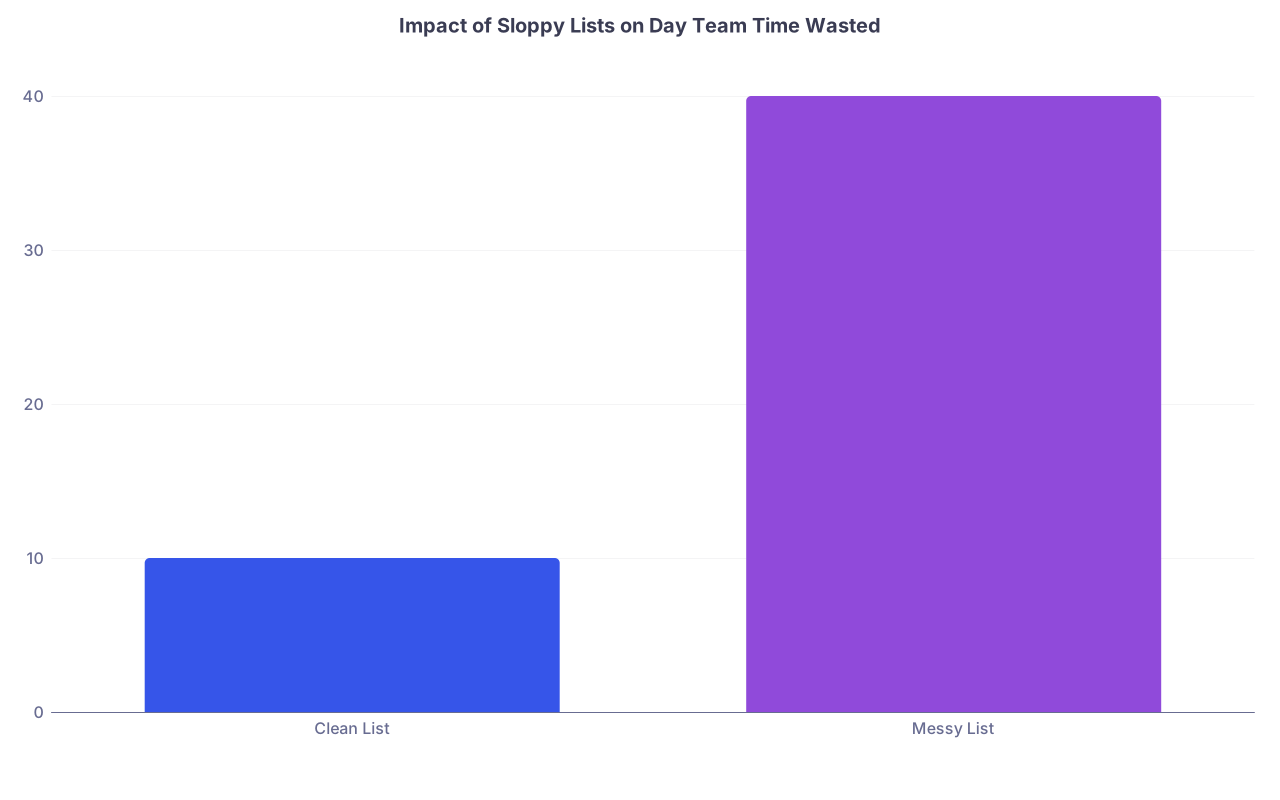
It takes 5–10 minutes. Skipping it screams, “I’m not in control.”
| Category | Value |
|---|---|
| Clean List | 10 |
| Messy List | 40 |
Messy lists don’t just annoy people. They hide real dangers.
The Bottom Line: How Not to Terrify Your Day Team
Boil all this down and you get three rules:
Tell the truth, not the wishful version.
Every significant overnight event gets documented and handed off. Over‑reassurance and omissions are what kill trust—and patients.Make it actionable, not just informational.
For every risk or unresolved problem, attach an “if/then” plan and a clear follow‑up with who owns it and when.Organize for reality, not your convenience.
Sickest first. Trends, not isolated numbers. Clear code status, clean list, and time‑critical items highlighted and verbalized.
You can survive night float making small clinical mistakes. You will not survive making big communication mistakes over and over. Fix your sign‑out, and you’ll protect your patients—and your reputation.