
The politics of ICU transfers will make or break your night call—and no one really teaches you how it works.
Everyone pretends it’s about “the patient’s best interest” and “objective criteria.” That’s the brochure version. On the ground at 2:37 a.m., what actually determines whether your crashing ward patient gets an ICU bed is a messy mix of power, personalities, institutional habits, and who owes whom a favor this month.
Let me walk you through how it really works when you’re the on‑call resident, because the attendings talk about this behind closed doors. You just never get invited to that conversation.
The Real Hierarchy Behind Every ICU Bed
On paper, ICU admission is simple: patient meets criteria, gets a bed. In reality, there’s an invisible chain of command that determines how hard or easy your transfer is going to be.
At most places, the true hierarchy of influence looks closer to this:
| Role | Actual Influence Level |
|---|---|
| ICU Attending | Very High |
| ICU Fellow | High |
| ICU Charge Nurse | High |
| Hospitalist/Primary Team Attending | Medium |
| On-Call Resident | Low to Medium |
| Bed Control / Throughput | Medium |
You’ll see the pattern after a few months:
The ICU fellow will tell you, “We’re full, but I’ll see them.”
The ICU charge nurse will say, “We’re full, I don’t know where we’d put them.”
If the ICU attending wants the patient, a bed appears.
I’ve watched this play out verbatim at three different academic centers. Same script, different logo on the badge.
Your job as the on‑call resident is to operate inside this ecosystem without getting eaten alive, while still not abandoning your patient. Which means you need to understand what’s actually driving the decision each time you pick up that phone.
What’s Really Going On When They Say “ICU Is Full”
That line—“ICU is full”—is the gateway phrase. Sometimes it’s legit. Often it’s code for something else.
Here are the translations nobody gives you:
“ICU is full” = We’re staffed to 14, not 16.
Officially, the unit has 16 beds. Tonight, they have one nurse out sick and a traveler who can’t take a fresh admit. So their real capacity is 14. Administration hates when this is acknowledged out loud, but everyone in the unit knows it.“They’re too sick for the floor but not sick enough for ICU” = No one wants ownership.
This is the purgatory phrase. I’ve heard attendings say it in the workroom: “We don’t need another borderline sepsis admit.” Translation: they’re guarding beds for the intubated, on-pressors, multi-organ failure patients—and your borderline one might eat bandwidth but not look impressive on the acuity board.“Can you optimize them a bit more first?” = Do more of the work and then maybe we’ll take them.
This is about workload transfer. If they can get you to do all the initial resuscitation, diagnostics, and documentation, the admit is “cleaner” for them. The fellow will look better on rounds. You’ll be the one who stayed late.“Let’s watch them on the floor for a bit” = If they tank, we’ll blame the floor. If they stabilize, we never needed the bed anyway.
When ICU beds are tight, they push risk downstream. That “trial of floor” is where you absorb the moral distress and liability.
, No ICU needed at all](https://cdn.residencyadvisor.com/images/articles_svg/chart-common-outcomes-after-initial-icu-bed-refusal-7931.svg "Common Outcomes After Initial ICU Bed Refusal")
| Category | Value |
|---|---|
| Stays on floor and stabilizes | 35 |
| Eventual ICU transfer within 12h | 30 |
| [Rapid response / code before transfer](https://residencyadvisor.com/resources/residency-on-call-tips/the-worst-way-to-call-a-rapid-response-communication-mistakes-to-avoid) | 10 |
| No ICU needed at all | 25 |
Those numbers are roughly what I’ve seen in internal QA meetings and informal reviews. A non-trivial number of “not yet ICU” patients end up going anyway—after scaring the hell out of the ward team.
The Unspoken Scoring System You’re Up Against
Nobody will admit this during M&M, but ICU teams keep an informal mental scorecard of your requests. They categorize you, your service, and your patient before you finish your second sentence.
Here’s the rough sorting that happens in their heads:
- Is this a “real ICU patient” or a “soft admit”?
- Is this caller reasonable or a chronic overcaller?
- Is this service good at managing sick patients on the floor?
- Is there political capital tied to this patient? (VIP, transplant, surgical complication, “our” patient, etc.)
If you get labeled as the resident who calls ICU for every borderline lactate, your future calls get treated differently. I’ve literally heard a fellow say, while the phone was still ringing, “It’s medicine night float again, let’s see what non-ICU patient this is.”
Is that fair? No. Is it real? Absolutely.
The ICU Side: How They’re Grading Your Request
Let me tell you how the conversation is actually evaluated on their side of the line. These are the skills no one names but everyone reacts to.
They’re listening for:
How sick is this patient right now?
Not just vitals. Trajectory. “Was 2L, now 6L, still 88%.” That line changes everything.How much have you already done?
If your first sentence is “So I have this patient who might need a higher level of care” and you haven’t ordered a lactate or ABG, they’ve mentally checked out.Do you understand the floor’s ceiling of care?
If you try to keep a BiPAP-on-10/5, FiO2 60%, borderline mentation patient on the floor, they lose trust in your judgement. If you ask to transfer someone who’s mildly tachycardic and anxious at 2 a.m., also bad.Are you calm and specific, or rambling and panicked?
The tone of your presentation influences how “serious” the request feels. I’ve seen the same physiology get a bed with a crisp, 45-second presentation and get blown off with a meandering, five-minute saga.
This is harsh, but true: they are assessing you as much as your patient.
How Program Directors Really Talk About This
You won’t hear this in orientation, but the ICU-transfer dynamic shows up in resident performance discussions all the time.
Behind the scenes, I’ve heard variations of:
- “She calls early and appropriately. ICU trusts her. Keep an eye on her for chief.”
- “He’s scared of pulling the trigger. Twice this month his patients coded on the floor before transfer.”
- “Surgery says medicine is dumping on them. ICU says medicine is dumping on them. Where is the breakdown?”
- “That class never learned how to push back when ICU inappropriately declines. We need to fix that.”
So yes, your transfer decisions and how you handle the resistance do get noticed. Not always formally. But attendings talk.
(Related: How Chiefs Decide Who They Trust With High‑Risk Night Admissions)
The Game Within the Game: Inter-Service Politics
Let’s talk about the ugliest layer of this: whose complication is this, and who’s going to “own” it in the unit?
If the patient is:
A post-op from a big-ticket surgical service (cardiac, transplant, neurosurg)
ICU is much more likely to accept quickly, especially in a surgical or mixed unit. “Our” post-op complications are expected and socially acceptable.A complicated medicine patient who’s been festering for days
Suddenly everyone has opinions on “goals of care” and “trajectory.” Same physiology, very different political handling.
I've watched this play out:
Post-op day 2 CABG with similar vitals and labs as a 72-year-old pneumonia + CHF exacerbation. Guess which one rolled into the ICU with four people escorting the bed and zero pushback? CABG. Every time.
Transplant and oncology patients also carry weight. Hospitals are terrified of bad outcomes in marquee programs. If your septic oncology patient needs an ICU bed, the whisper of “they’re on the transplant list” or “active chemo patient” changes the tone instantly.
No one says this out loud—but you’ll see it.
How To Frame the Call So Politics Tilt in Your Favor
You can’t change the bed census. You can change how your ask lands.
Here’s the structure attendings silently wish you’d use, because it taps into how ICU actually thinks:
Lead with the threat, not the story.
“I’m calling about a patient with rapidly escalating oxygen needs and rising lactate who I’m worried is heading toward shock.”Not: “So Mr. Smith is a 74-year-old with a history of COPD, CHF, CKD, came in three days ago with shortness of breath…”
Give a one-liner of who they are + why they matter.
“He’s a 74-year-old with COPD and CHF, admitted for pneumonia, now with worsening hypoxia and hypotension over the last four hours.”Show the trajectory clearly.
- O2 needs at admission vs now
- BP trend
- HR trend
- Urine output change
- Labs moving in the wrong direction (lactate, Cr, WBC, troponin, whatever is relevant)
Prove you’ve already done the basics.
“We’ve given 2L fluids, started broad-spectrum antibiotics, got an ABG, he’s on HFNC at 60L/70% and still satting 88–90%, mentation is drifting.”Name the specific floor limitations.
“He’s now on HFNC at settings that our floor can’t safely escalate beyond, and his mental status is changing. I’m concerned that if he decompensates he’ll need either emergent intubation or pressors—both beyond what we can do here.”
When you spell out the floor’s ceiling of care, you’re moving the question from “do they like you?” to “does the hospital want this on record?” It subtly invokes risk management without you ever saying the word.

| Step | Description |
|---|---|
| Step 1 | Recognize decompensation |
| Step 2 | Stabilize and resuscitate |
| Step 3 | Gather objective trends |
| Step 4 | Call senior/attending to align |
| Step 5 | Call ICU fellow |
| Step 6 | Arrange transfer quickly |
| Step 7 | Escalate to attendings |
| Step 8 | Document discussion and plan |
| Step 9 | ICU accepts? |
When ICU Pushes Back: How Far You’re Expected to Fight
Residents are terrified of “arguing with ICU.” Here’s the uncomfortable truth: your attendings expect you to push—politely but firmly—when the refusal doesn’t match the bedside reality.
I’ve sat in closed-door review conferences where cases sounded like this:
- Patient clearly unstable
- Resident called ICU once, accepted the “we’re full / watch on the floor” line
- Patient coded
- Attending: “Why didn’t anyone escalate?”
You know what never flies as a defense? “ICU said no.” That just spreads the blame around. Nobody wants that.
What a reasonable pushback looks like:
You: “I understand beds are tight. From my end, I’m worried he’s one event away from needing emergent intubation or pressors. Our floor can’t do either. Is there a stepdown option, or could he board in ICU with the understanding he’s high risk?”
If they still say no and you’re uncomfortable, loop your attending in explicitly:
You (to ICU): “I appreciate you discussing this. I’m going to update my attending now; they may want to speak directly with your attending to make sure we’re aligned.”
You (to your attending): “I’m really not comfortable with him staying on the floor. I’ve called ICU, they’re saying watch on the floor, but he’s on HFNC 70% and his pressure’s soft. I think he needs higher-level care. Will you call ICU attending?”
You are not being “difficult” when you do this. You’re doing your job.
The Nursing Factor: The Allies You’re Ignoring
ICU nurses and floor charge nurses have more soft power in this process than you think.
If the floor charge says, “We are not safely able to manage this patient,” that carries weight—because if something goes wrong, their documentation and staffing ratios become part of the investigation.
If the ICU charge nurse says, “We can’t take them, we’re barely managing our current assignment,” that also carries weight—because they’ll go straight to their director if forced.
Practical move that seasoned residents use but no one explains to you:
- Before you call ICU, talk to your floor charge nurse. “I’m really worried about Mr. X. Are you comfortable with him staying on this floor?”
- If they say no, you now have an aligned nursing partner. Mention that in your ICU call: “Our floor charge is also concerned we can’t safely meet his needs here.”
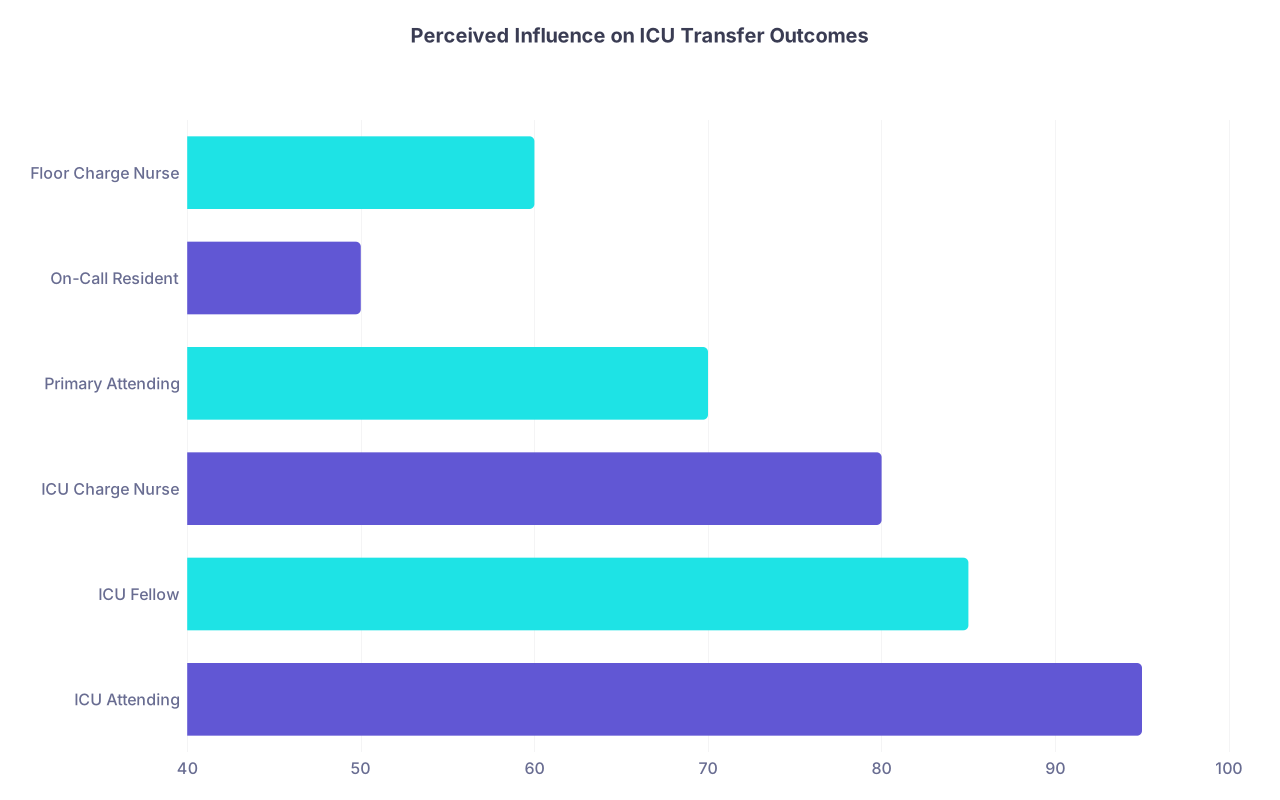
| Category | Value |
|---|---|
| ICU Attending | 95 |
| ICU Fellow | 85 |
| ICU Charge Nurse | 80 |
| Primary Attending | 70 |
| On-Call Resident | 50 |
| Floor Charge Nurse | 60 |
Those numbers aren’t official; they’re what it feels like at 3 a.m. in most academic centers.
Documentation: Your Only Real Shield When Things Go Sideways
Everyone relaxes after the crisis passes. Risk management does not.
If a patient deteriorates after a denied transfer, the first things that get scrutinized:
- Were there clear signs of instability?
- Did anyone recognize them?
- Did anyone ask for a higher level of care?
- What was the documented response?
You don’t need to write a legal brief. Two targeted sentences help you massively:
(See also: What Program Directors Infer From Your On‑Call Handoffs and Notes for more details.)
“Discussed with ICU fellow Dr. X at 02:12 about transfer for escalating oxygen needs and hypotension. ICU to reassess if further deterioration; plan is to continue management on floor with close monitoring.”
If your attending then talks to the ICU attending and they still say no, add:
“Case discussed attending-to-attending between Dr. Y (medicine) and Dr. Z (ICU). Consensus to monitor on floor for now; ICU aware and will accept if additional decompensation.”
That’s it. You’re not blaming anyone. You’re just making the reality transparent.
When You Shouldn’t Call ICU (And They’re Right To Be Annoyed)
Not every sick patient belongs in the unit. You’ll create your own political problems if you overcall. ICU develops a nose for services that use them as “expensive telemetry.”
Classic unnecessary calls they remember:
- Anxiety and mild tachycardia with normal vitals and labs because “nurse is nervous”
- Stable GI bleeds with normal mental status and no pressor requirement
- Mild DKA that corrects quickly on the floor protocol
- Patients whose main issue is social/placement but happen to be old and frail
Ask yourself three hard questions before you dial:
Does this patient actually need something the floor cannot provide? (Pressors, invasive monitoring, high-level respiratory support, continuous titration of multiple drips, frequent neuro checks, etc.)
Is the trajectory truly concerning, or am I reacting to one bad vital sign?
Is there a floor-based or stepdown solution I haven’t tried that would be reasonable for the next few hours?
If you keep calling ICU for patients who obviously don’t belong there, they stop listening when you really need them.
Training Your Own Instincts: You Won’t Learn This From a Policy PDF
No protocol will replace pattern recognition. You build that by deliberately reflecting on each near-miss and actual transfer.
Here’s what the good residents do that the average ones don’t:
After a hard night, they ask the ICU fellow the next day:
“Was that a good call to transfer?”
“What would have made you say yes sooner?”
“Were there earlier signs you would have acted on, that I missed?”
They ask their attendings on rounds:
“Would you have called ICU earlier or waited?”
“What would be your red-line vital / lab / exam change?”
They sit through M&M with a notebook—tracking patterns of “early vs late transfers” and what language attendings use to describe “acceptable risk.”
That’s how you internalize the politics and the physiology at the same time. That’s how you stop being the resident who’s either always late or always crying wolf.

The Moral Distress Nobody Names
Let’s be blunt: the politics of ICU transfers can make you feel complicit in bad care.
You’ll have nights where you know the patient belongs in the unit. You’ll be refused. You’ll watch them teeter on the edge on the floor. You’ll lie awake the next day replaying it in your head.
The senior people? They’ve had those nights too. They either pretend it’s all about “systems” or they quietly carry it. You’re not weak because this bothers you. You’re awake.
Talk to someone you trust after those cases—an attending with a spine, a co-resident who gets it. Debrief the medical piece (“What could I have done differently?”) and name the political piece (“I felt stuck between ICU refusal and my own instincts”).
You can’t fix hospital bed politics as a PGY-2. You can refuse to become numb to it.

What Actually Makes You “Good” At This
When attendings say, “She’s great at triage and escalation,” they’re not talking about your ability to quote sepsis criteria. They mean:
- You recognize badness early—before the vitals look cartoonish.
- You do the right immediate things without drama.
- You call for help at the right time, with the right details.
- You don’t fold at the first “no” when your gut and the data say otherwise.
- You don’t waste political capital on obvious non-ICU cases.
- You document reality without grandstanding.
You won’t bat a thousand. None of us do. But if you understand the hidden politics, you stop being a pawn in that game and start playing your own role with your eyes open.
You’re not just “asking for a transfer.” You’re advocating for a human being in a system that constantly pressures everyone to ration invisible resources. The system will not reward you for caring. Your patients might.
And once you’ve seen how this actually works, you won’t unsee it.
FAQs
1. What if my attending disagrees and thinks the patient can stay on the floor?
You’re junior, but you’re not powerless. State your concern clearly: “I hear you, but I’m worried that if they deteriorate, we won’t have time to safely intubate or start pressors on this floor.” If they still say no, document that you discussed it with your attending and what the joint plan is. And watch the patient like a hawk. If things change, you have every right to say, “They’ve worsened since we last discussed; I think we need to revisit ICU.”
2. How do I avoid being labeled as someone who “overcalls” ICU?
Be ruthless with your own reasoning. Ask yourself before every call: “What can the ICU do for this patient in the next 6–12 hours that we cannot safely do on the floor?” If you can answer that concretely—pressors, continuous titrated drips, high-level respiratory support, neuro checks every hour—you’re on solid ground. Also, debrief with ICU after borderline cases and tell them you’re trying to calibrate. That earns respect.
3. What if ICU says they’ll ‘keep an eye’ on the patient but won’t take them yet?
That’s the classic soft decline. Translate it into a concrete plan. Ask: “What specific changes would make you want them transferred right away? Can we agree on thresholds for MAP, O2, urine output?” Then document those thresholds and check in earlier if you hit them. If you’re still uneasy, bring your attending into the loop and make the ICU attending-to-attending conversation happen. Vague “we’ll keep an eye” without clear parameters is how patients fall through cracks.
With this under your belt, you’re better armed for the nights when every monitor seems to alarm at once. The next battleground you’ll face is just as political: consults that say “no benefit” when you know they’re punting. But that’s a story for another call night.