The most dangerous thing you will do on call is nothing—and call it “watchful waiting.”
If you are a resident, this is one of the quietest ways to get burned. Not the obvious, dramatic mistakes. The slow, “we’ll just see how they do overnight” decisions that unravel at 3:42 a.m. while you are half-conscious and three notes behind.
Let me be blunt: “Watchful waiting” is often code for “I am uncomfortable making a decision, so I will stall and hope the problem goes away.” That is how residents get blamed, patients get hurt, and careers get quietly re-labeled as “not great in a crisis.”
You are not going to avoid every bad outcome. But you can absolutely avoid the predictable ones.
This is how.
The Seduction and Trap of “Watchful Waiting”
The phrase sounds calm. Reasonable. Even scholarly.
I have heard it misused in almost every specialty:
- “Let’s watch the lactate and see.”
- “Let’s see how the blood pressure trends.”
- “We’ll re-evaluate in a few hours.”
- “She looks okay now; we will just monitor.”
The trap is simple:
- You underestimate how fast things can deteriorate.
- You overestimate how closely anyone is actually watching.
- You fail to define what “worse” looks like or what you will do about it.
Real “watchful waiting” is an active plan:
- Clear criteria for change.
- Defined time frame.
- Documented thought process.
- Everyone on the same page (you, nurses, team).
What residents usually do instead is passive drifting. And that is what burns you.
Red Flag #1: Vague, Nonspecific “Monitoring” Orders
If your “plan” could be copy-pasted onto any patient in the hospital, it is not a plan.
Classic dangerous phrases in your notes or orders:
- “Monitor vitals.”
- “Continue to observe.”
- “Trend labs.”
- “Reassess later.”
None of that means anything when something goes wrong and people are scrolling back through your notes asking: “So what exactly was the plan?”
You need specificity. Otherwise, the default is blame—you “saw the signs” and did nothing.
| Situation | Weak Plan | Safer Plan |
|---|---|---|
| Borderline BP post-op | "Monitor vitals" | "If SBP < 90 or MAP < 65 x2 in 15 min despite 500 mL bolus, page me stat and call ICU fellow." |
| Rising lactate | "Trend lactate" | "Repeat lactate in 2 hrs; if > 3.0 or increases by > 1.0, obtain blood cultures, broaden antibiotics, and call ICU." |
| Mild hypoxia | "Wean O2 as tolerated" | "Maintain SpO2 ≥ 92%; if needs > 4 L to maintain, get CXR and page me immediately." |
If your plan does not answer:
- What exactly are we watching?
- How often?
- What specific change triggers action?
- What is that action?
…you are setting yourself up.
Mistake to avoid: Leaving “monitor” as a substitute for a real decision. You are still responsible for the absence of a plan.
Red Flag #2: “They Look Okay Right Now” Bias
The most common rationalization on call: “They look good right now, let’s just see.”
I have watched this go bad so many times it makes me tired:
- The septic patient “looking okay” on 3 liters with a MAP of 66 who codes two hours later.
- The GI bleed “stable for now” who drops their hemoglobin by 3 points overnight.
- The borderline chest pain that “settled with nitro” and turns into an early-morning STEMI.
“Looks okay right now” is not a safety net. It is a snapshot.
You must look at:
- Trajectory (better, flat, or worse over last 6–12 hours?)
- Reserve (frail 84-year-old vs 30-year-old)
- Context (on pressors earlier? recent decompensation? new oxygen requirement?)
This is where residents get fooled: you anchor on how they look during your quick bedside check. You ignore the plot of their story and fixate on the single frame you saw.
On call, if:
- The story and the current vitals do not match, or
- The nurse says “they were not like this earlier,”
then “they look okay right now” cannot be your primary decision driver.
Mistake to avoid: Using your single-time-point exam as justification for inaction in a clearly unstable clinical story.
Red Flag #3: Ignoring Nurse Worry and “Soft” Signals
You will regret dismissing a worried nurse faster than almost anything else in residency.
Patterns I have seen:
- Nurse calls: “Something is off. He is not acting like himself.” Resident glances at vitals, sees them normal, says, “Just keep an eye and call me if it changes.”
- Several hours later: rapid response, hypotension, confusion. Now the chart shows: “RN called x3, MD notified, orders to monitor.”
Do you know what that looks like at morbidity and mortality conference? Like you ignored the one person who actually noticed the deterioration early.
Watchful waiting is especially dangerous when:
- The nurse is calling a second or third time about the same issue.
- There is a change in mental status, pain, or respiratory pattern, even if numbers are okay.
- The phrase “He/She is not like earlier today” appears.
Those are not “monitor” situations. Those are “I will come see the patient” situations.
Safe reflex: If a nurse sounds truly worried, either:
- Go see the patient, or
- If you genuinely cannot, explicitly ask for specifics (RR trend, UOP, mental status, color, numbers), make a clear plan, and document it: “RN reports increased work of breathing…If RR > 24 or SpO2 < 92 on 4 L, will call RRT.”
Mistake to avoid: Treating subjective nurse concern as noise instead of a critical input.
Red Flag #4: Soft Hypotension and Silent Hypoxia
Let me draw a boundary very clearly: “Borderline but probably fine” vital signs are where watchful waiting kills people.
I am talking about:
- SBP 90–100 in a previously hypertensive patient who was 160/80 all year.
- MAP hanging at 65 in a septic patient whose lactate was 3.2 three hours ago.
- SpO2 90–92% on 3–4 L in someone who was 94–96% on room air yesterday.
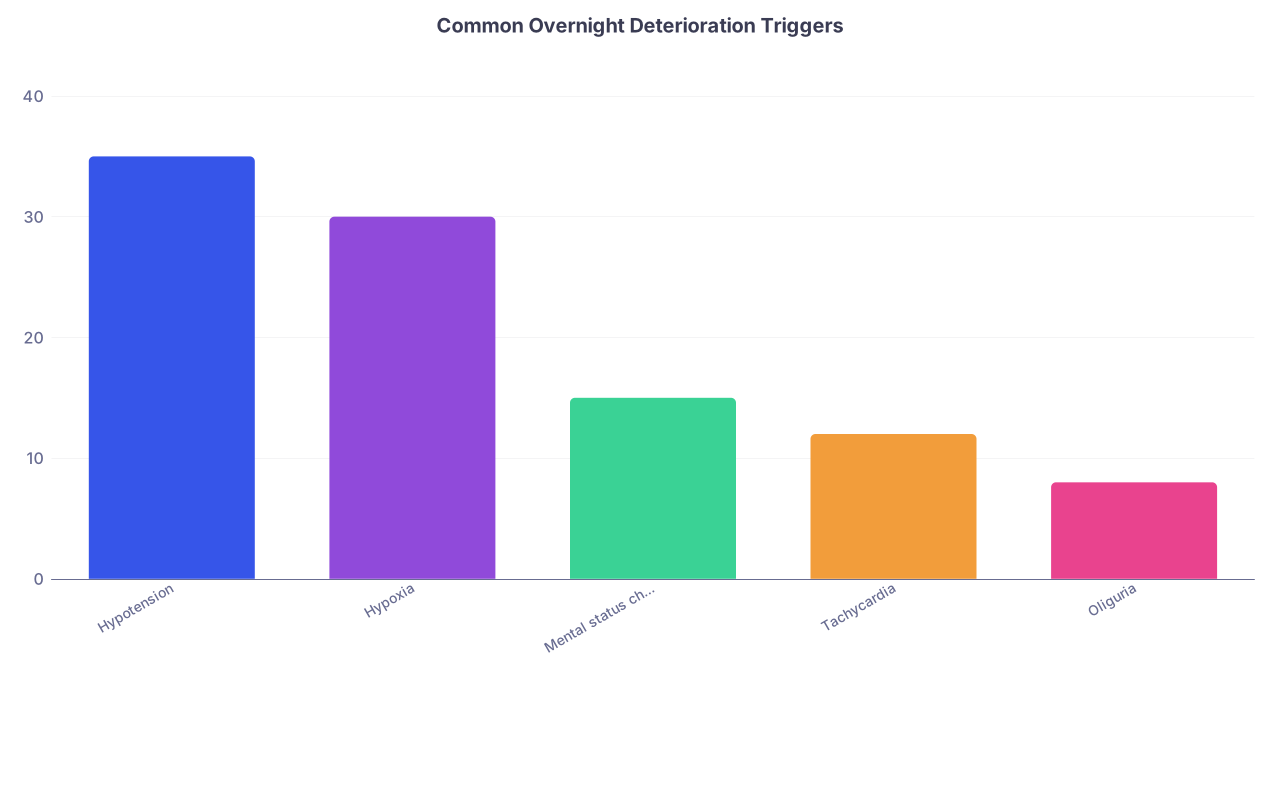
| Category | Value |
|---|---|
| Hypotension | 35 |
| Hypoxia | 30 |
| Mental status change | 15 |
| Tachycardia | 12 |
| Oliguria | 8 |
The mistake residents make:
- Calling this “their new baseline” because nothing dramatic has happened.
- Writing “continue to monitor” with zero escalation steps.
A few bad signs that should shut down any thought of lazy watchful waiting:
- Downtrending BP in a sick patient, even if still “normal.”
- Increasing oxygen requirement over hours.
- Rising heart rate into 110–120s without obvious trigger.
- New mild confusion or agitation.
Those are not “wait and see what happens overnight” situations. Those are “act now or you will be apologizing later” situations.
Mistake to avoid: Reclassifying early instability as “baseline” to avoid waking your attending, ICU, or a consultant.
Red Flag #5: No Defined Checkpoints or Time Limits
Open-ended watchful waiting is guaranteed to fail on call because:
- You are covering too many patients.
- You will forget.
- Something else will pull you away.
If your plan has no explicit time frame, it is not a plan. It is wishful thinking.
Bad example:
- “Reassess pain control later.”
- “Re-evaluate fluids if still tachycardic.”
Safer example:
- “Reassess vitals and pain within 1 hour; if HR still > 110 or pain uncontrolled, will order CT A/P tonight and discuss with surgery.”
- “Repeat BMP at 02:00; if K remains > 5.5, start insulin/dextrose and page me.”
You need timestamps and triggers. Otherwise, nothing happens until there is a crisis.
On call, I got in the habit of:
- Setting phone reminders for specific high-risk patients: “Check Mr. X vitals & lactate at 01:30.”
- Telling the nurse explicitly: “If this is not improved by midnight, page me again even if I do not call first.”
- Writing in the note: “Will personally reassess by 02:00.”
Is that extra work? Yes. Is it how you avoid explaining to a chief or attending why a slowly decompensating patient went untouched for six hours? Also yes.
Mistake to avoid: Leaving time and responsibility vague. “Sometime later” guarantees nobody owns the follow-up.
Red Flag #6: Afraid to Call for Help, Hiding Behind “Monitoring”
This is the uncomfortable truth: a lot of so-called “watchful waiting” is just fear of calling for backup.
You know the feeling:
- “If I call my attending for this and it turns out fine, I’ll look stupid.”
- “The ICU fellow was annoyed last time; I do not want to page again.”
- “Radiology already pushed back on the CT; I do not want another fight.”
So you hedge:
- You “monitor.”
- You write vague plans.
- You convince yourself it is not that bad.
And if the patient crashes, guess what everyone sees? A resident who knew something might be wrong and decided to ride it out instead of escalating.
I would rather see a resident overcall and be redirected than undercall and explain a preventable disaster.
Here is a very simple test: if the thought “I would feel stupid if I did not act and this got worse” crosses your mind, then do not hide behind “watchful waiting.” Call. Ask. Order the test. Get a second pair of eyes.
Mistake to avoid: Using “monitoring” as emotional self-protection instead of patient protection.
Red Flag #7: Documenting a Plan You Do Not Actually Believe
I have read hundreds of overnight notes where the subtext is obvious: the resident was nervous, but the documented plan is artificially optimistic.
Examples:
- “No evidence of sepsis” in a febrile, tachycardic, borderline hypotensive patient on broad-spectrum antibiotics.
- “Low suspicion for PE” in someone with pleuritic chest pain, tachycardia, and new O2 requirement, but no CTA ordered.
- “No acute distress” in a patient clearly working to breathe.
You can smell the defensive charting. It does not protect you.
In fact, it burns you, because:
- It looks like you minimized the problem.
- It creates cognitive dissonance: nurses report concern while your note says “no acute issues.”
- It makes your eventual escalation look late and reluctant.
Your documentation should match your actual concern level. If you are uneasy but elect to watch, say it clearly and define the guardrails:
“Patient at risk for further decompensation given X, Y. At this time, vitals and exam are stable without immediate indication for ICU transfer, but will maintain low threshold to escalate if [specific change] occurs.”
That sounds a lot better at M&M than “NAD, continue to monitor.”
Mistake to avoid: Charting away your own discomfort to create a false impression of stability.
Safe “Watchful Waiting”: What It Looks Like When Done Right
I am not saying you must act on everything immediately. There are absolutely situations where observation is correct. But it has to be structured.
Use this mental checklist any time you are tempted to “watch” instead of act:
Have I defined what I am watching?
Specific vital sign, lab value, symptom, mental status, urine output. Not “the patient.”Have I set clear thresholds for action?
“If HR > 120…”
“If creatinine rises by > 0.3…”
“If pain uncontrolled after 2 doses…”Have I committed to a time frame?
“Re-evaluate in 1–2 hours” is not enough unless someone owns that clock.Have I communicated this to the nurse?
Out loud, not just in the note: “If X happens, call me and we will do Y.”Have I considered escalation now, not just later?
Is there any real downside to moving them to a higher level of care or ordering the test now?Would I defend this plan in front of my PD tomorrow?
If you already feel defensive about it, that is a red flag.

| Step | Description |
|---|---|
| Step 1 | Recognize Issue |
| Step 2 | Act now - escalate or intervene |
| Step 3 | Reassure - simple monitoring |
| Step 4 | Communicate plan to RN |
| Step 5 | Set timer for reassessment |
| Step 6 | Continue plan |
| Step 7 | Low, moderate, or high risk? |
| Step 8 | Clear criteria and time? |
| Step 9 | Improved or stable? |
This is how you survive call without being reckless. You are not pulling the trigger on every borderline issue. You are building a concrete scaffold around your decision to watch.
Practical Examples: When “Wait” Is Reasonable vs Reckless
Let’s make this concrete with scenarios I have actually seen.
Scenario 1: Post-op Tachycardia
- POD#1, lap chole.
- HR 108–115, BP 115/70, afebrile, pain 6/10, walking, no chest pain, normal exam.
Reasonable “watch”:
- Give pain meds and fluids.
- Plan: “If HR remains > 110 after pain controlled and 500–1000 mL fluids, by 02:00 obtain EKG, CBC, BMP; call me. If HR > 120 or symptomatic, call earlier.”
Reckless “watch”:
- “Likely pain. Continue to monitor.”
- No orders. No time frame. No thresholds.
Scenario 2: Mild Hypoxia on the Floor
- 72-year-old with CHF, on 2 L normally. Tonight needs 4 L for SpO2 92%. Mild crackles, mild dyspnea, BP okay, no chest pain, CXR earlier showed congestion.
Reasonable “watch”:
- IV diuresis.
- Plan: “Repeat vitals and exam in 1 hour. If needing > 4–5 L, RR > 24, or SpO2 < 90% at any time, call me and consider RRT and transfer to higher level of care. Low threshold for ABG if worsening.”
Reckless “watch”:
- “O2 requirement slightly increased, consistent with CHF. Monitor.”
- No explicit dyspnea or RR trigger. No discussion of possible escalation.
Scenario 3: Borderline Sepsis
- Febrile, HR 104, BP 95/60, lactate 2.4, given fluids and antibiotics. Three hours later, MAP 65, mildly sleepy but arousable.
Reasonable “watch”:
- Honestly, strongly consider ICU step-up now. But if truly observed:
- “High risk for shock. If MAP < 65, HR > 110, or lactate > 3 on repeat at 02:00, will call ICU for transfer. RN to page me stat for any mental status decline or SBP < 90.”
Reckless “watch”:
- “Mild sepsis, responding to fluids. Will trend lactate, monitor vitals.”
- No mention of ICU, no hard lines, no time.
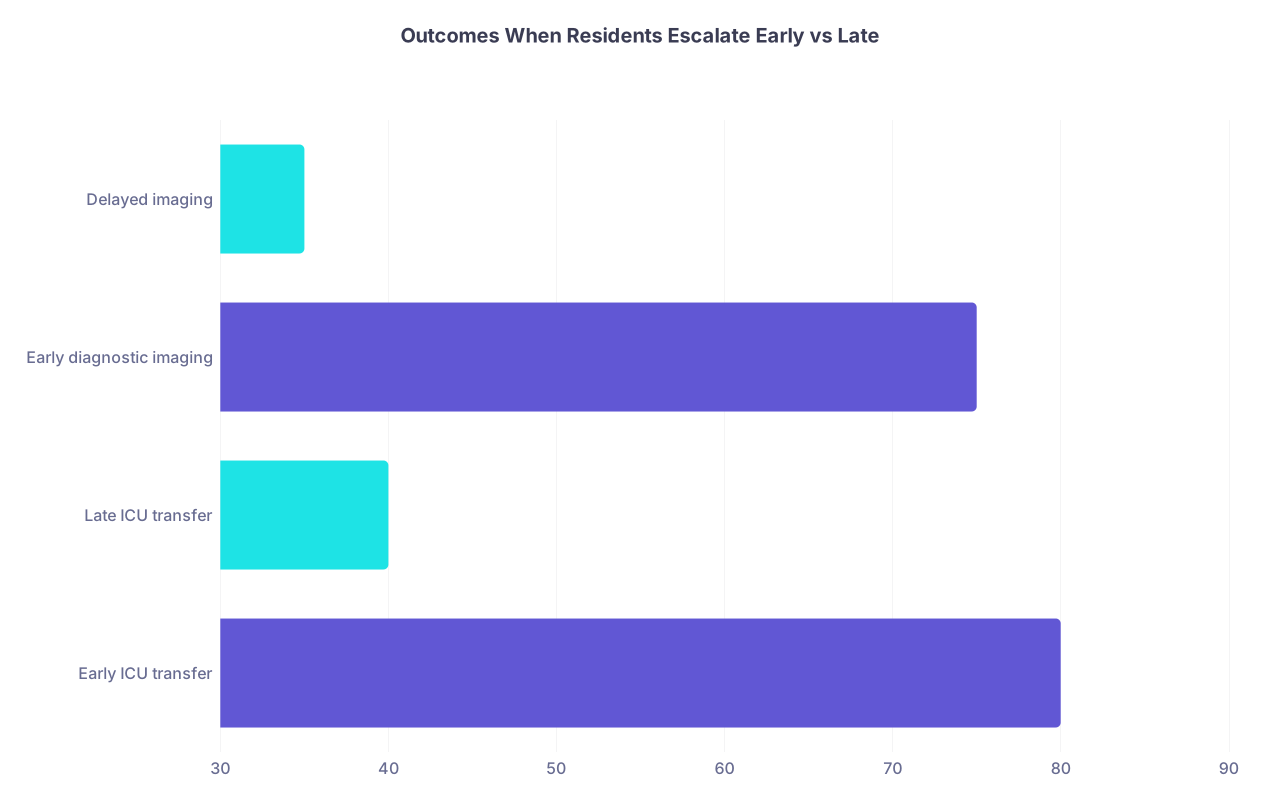
| Category | Value |
|---|---|
| Early ICU transfer | 80 |
| Late ICU transfer | 40 |
| Early diagnostic imaging | 75 |
| Delayed imaging | 35 |
You see the difference. It is not about whether you choose to act immediately or watch briefly. It is about whether your “watch” is real medicine or just procrastination.
How to Protect Yourself When You Do Choose to Watch
You will not always have backup immediately available. You will have attendings who say “just keep an eye on them” and disappear. You still have to protect yourself and your patients.
Here is the minimalist bundle I recommend on every “watchful waiting” call decision:
Bedside exam documented clearly.
Not “NAD.” Real vitals, mental status, work of breathing, perfusion.Explicit risk statement.
One line: “Patient at risk for [shock/respiratory failure/bleeding] given [reasons].”具体 triggers and time.
“If [X], then [Y]. Reassess by [time].”RN communication acknowledged.
“Discussed with RN; instructed to call for [specific change].”Consider one “pre-emptive” step.
- Draw the lactate now.
- Get the EKG now.
- Type & screen now.
- Put in a step-down/ICU consult early.
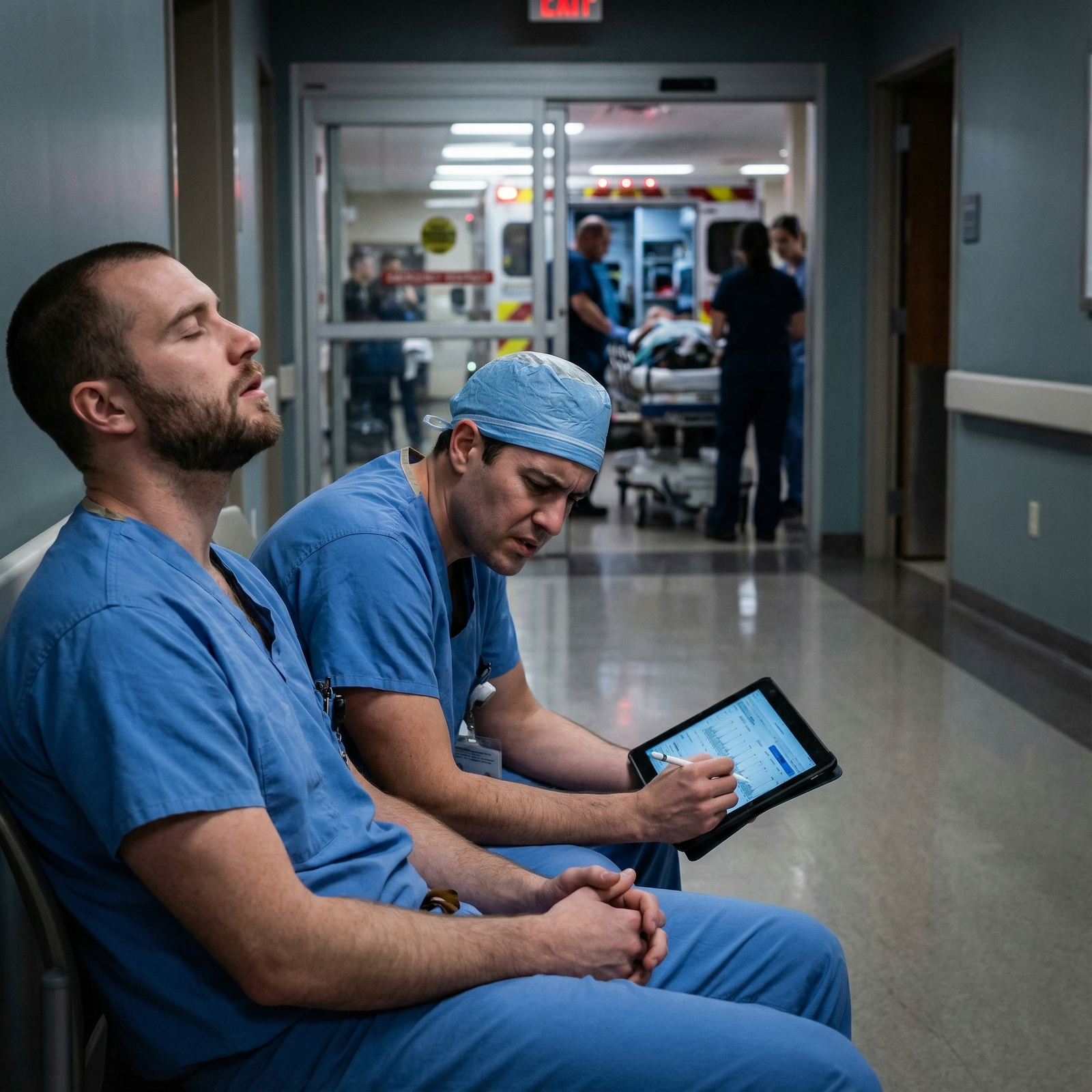
Defensive? Maybe. But the day you sit in a review meeting and your note says, “High risk for deterioration, will escalate if X; reassess by Y; nurse instructed,” you will be very grateful you were “paranoid.”
Subtle Cultural Pressures That Push You Into Bad Watchful Waiting
You are not making these mistakes in a vacuum. The system nudges you toward them:
- A senior says on sign-out: “He’s a little soft, but fine, just monitor.” You inherit their bias.
- The ICU resident complains: “We cannot take every borderline patient.” You become hesitant to call.
- Radiology pushes back on CTs overnight. You choose to “watch” instead of argue.
- Your co-residents brag about “never calling attendings overnight unless someone is dying.”
Recognize the culture. Then resist the worst parts of it.
You do not get extra points for stoicism if the patient suffers. The person who escalates early and is “wrong” occasionally is safer than the one who consistently waits too long trying to look unflappable.

Quick Mental Red-Flag Checklist Before You Say “We’ll Just Watch”
Before you walk out of the room or hang up with the nurse, ask yourself:
- Am I calling this “watchful waiting” because I am genuinely confident or because I am scared to escalate?
- If this patient deteriorates and someone asks, “What was your plan?” will I have a clear answer?
- Have I put in writing what we are looking for, by when, and what we will do?
- Has the nurse actually understood and agreed to the plan and triggers?
- Would my program director read this note and say, “Reasonable”?
If you cannot answer yes, you are not watching. You are hoping.
FAQ (Exactly 3 Questions)
1. How do I know when it is “overkill” to escalate instead of just monitoring?
You will occasionally overcall. That is acceptable. Look at trajectory and risk: unstable trajectory + limited physiologic reserve = escalate early. If you would feel uneasy going home with no further action, that is your signal to either step up the level of care, order a test now rather than later, or call a senior/attending. Err slightly on the side of over-escalation early in training and learn from feedback, rather than consistently cutting it too close.
2. What if my attending explicitly says “Just monitor” but I am still worried?
Clarify the plan in concrete terms: “Ok, so if the MAP drops below 65 again or their O2 requirement increases, do you want me to call you and consider ICU transfer?” Then follow that plan and document the discussion. If you remain truly uncomfortable despite that, involve your senior or chief. You are not obligated to ignore your own clinical alarm bells because someone higher up is blasé.
3. How can I keep track of multiple “watchful waiting” patients on a busy call?
You will drop balls if you rely on memory. Create a short, separate list or column on your sign-out labeled “active watch”: patient name, issue, trigger, time for reassessment. Set phone alarms for the time checkpoints. Tell the nurses, “These are my three fragile patients tonight—please page me early for any change.” Treat those few patients like your personal ICU inside the floor. That structure is what prevents passive, dangerous drift.
Key points:
- “Watchful waiting” without specific triggers, time frames, and communication is not a plan; it is a liability.
- Soft instability, nurse concern, and your own unease are the biggest red flags that make passive monitoring dangerous.
- Protect yourself by converting vague “we’ll see” into explicit, written, shared plans—with thresholds, timelines, and a low threshold to escalate.