The data are blunt: most on‑call disasters do not come from rare zebra diagnoses. They come from bad handoffs.
Why Handoffs Fail: What the Numbers Actually Show
Across large safety studies, one pattern repeats: miscommunication at transitions of care is involved in roughly a quarter to a third of serious adverse events. That is not a rounding error; that is a structural defect.
Take a few anchor numbers.
The classic I‑PASS multicenter trial in pediatrics showed:
- 23% relative reduction in medical errors after structured handoffs were implemented
- 30% drop in preventable adverse events
- No increase in handoff time
The message is uncomfortable: you can cut error rates by about a third just by fixing how you talk to the next resident. Not by memorizing more obscure side effects. Not by another lecture about sepsis bundles. By handoffs.
From a data perspective, “handoff failure” clusters into a few repeatable categories:
- Omitted or incomplete information
- Failures of contingency planning (“if X, then do Y”)
- Lack of clarity on responsibility and task ownership
- Poor situation awareness about acuity and trend
- Interruptions and multitasking degrading information quality
The question you asked is more targeted: which on‑call handoffs fail most often?
There is enough data to stop guessing. Certain types of patients, tasks, and timing patterns generate disproportionate harm.
The Handovers With the Highest Failure Rates
Let me translate the research into resident reality. Safety studies and QI reviews point to six especially high‑risk handoff situations. These are where the probability of communication‑linked harm spikes.
1. Sick but “Borderline Stable” Patients Near a Clinical Cliff
The data show that the worst misses are not the obviously crashing patient. Those usually get attention. The trouble is the “watcher” who is a little too sick for comfort, whose risk is under‑communicated.
Common findings in incident reviews:
- Deterioration in the prior 6–12 hours not clearly described
- Vital sign trends mentioned qualitatively, not quantitatively
- Escalation threshold never made explicit
This is exactly what I saw on several morbidity and mortality (M&M) reviews: handoff notes that said “mildly hypotensive, watching” that turned out to be “SBP drifting from 120s to 90s over 8 hours, lactate 3.5, on 3L NC, borderline urine output.”
When auditors look at preventable ward arrests or unplanned ICU transfers, they repeatedly find:
- Close to 40–60% had clear signs of deterioration in the preceding 24 hours
- In a large fraction, those signs were either not transmitted in handoff or were downplayed
The failure here is usually not total omission. It is compression. You flatten time series data into a vague phrase:
- “A little tachy” instead of “HR 90 → 110 → 125 over 4 hours”
- “Soft pressures” instead of “MAP 70 → 62 despite 2L fluid”
That compression destroys signal. On‑call you then carry a mental list that underestimates risk. The failure mode is predictable: nurse calls at 2 a.m., you are surprised by how sick the patient is, escalation is delayed, bad outcome.
2. Cross‑Coverage Handoffs for New Admissions in the First 6–12 Hours
Cross‑cover is a data desert. You did not admit the patient. You probably have not seen them. Yet during call you own them medically and legally.
Near‑miss reviews focusing on night‑time adverse events often show:
- A newly admitted patient (especially medicine, oncology, and surgery post‑ops)
- Direct admission or late transfer (evening)
- Incomplete or rushed handoff to the night resident
Two failure clusters dominate:
- Incomplete story: No clear one‑sentence problem representation. You receive six problem lists and no prioritization. On call, when something happens, you cannot rapidly reconstruct what actually matters.
- No explicit pending data: Imaging, cultures, or labs expected overnight are not named. The on‑call resident does not know to look for them, so abnormal results sit in the chart until morning.
Retrospective reviews frequently show:
- Significant management changes could have occurred 3–6 hours earlier if the on‑call resident knew a key test was pending and abnormal
- 20–30% of clinically significant critical results were acknowledged late overnight in settings with poor handoff culture
So this category fails not because of difficult medicine, but because the receiving resident is blind to what might change during their shift.
3. ICU–to–Floor or Stepdown Transfers
The transition from ICU to floor is a statistical minefield. You move from 1:1 or 1:2 nursing to 1:4–1:6 or worse. Monitoring drops. Yet in many hospitals, these patients are handed off like routine medicine admissions.
Data from multiple institutions show:
- Patients transferred from ICU have higher rates of rapid response calls and unplanned ICU readmissions within 24–48 hours
- A significant fraction of those events are linked to communication gaps at transfer: unclear goals of care, medication changes, or plan for borderline respiratory/hemodynamic status
Typical failure modes pulled from chart reviews:
- Incomplete explanation of why the patient is safe enough to leave ICU (Or they are not, but the bed is needed—nobody says this explicitly)
- No explicit floor‑level contingency plan: “If RR > X, do Y; if O2 > Z, call rapid vs page resident first”
- Omission of recent high‑risk events: brief runs of VT, borderline pressor requirement, recent high‑flow oxygen
On‑call, what you get is: “ICU transfer, stable, just needs floor bed.” That is not data. That is wishful labeling. When something goes wrong, the night resident discovers in hindsight the risk profile was much higher.
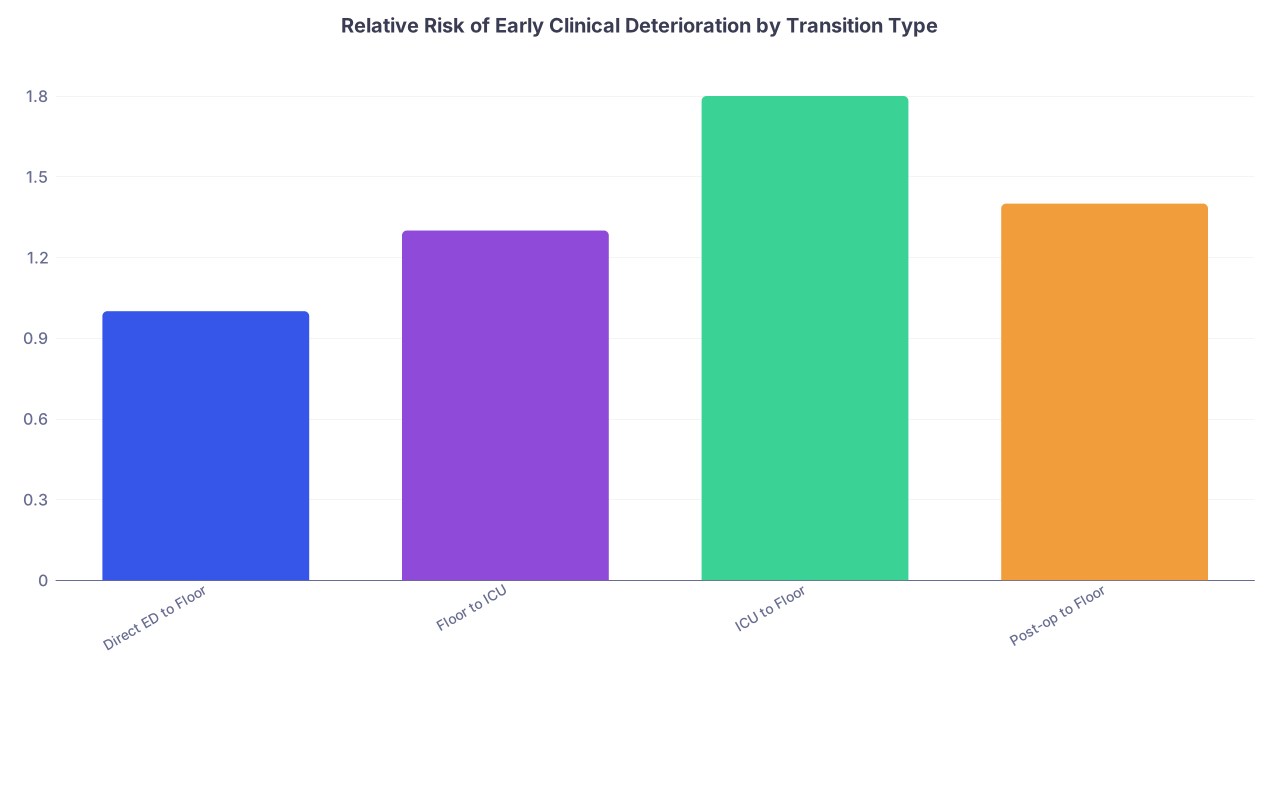
| Category | Value |
|---|---|
| Direct ED to Floor | 1 |
| Floor to ICU | 1.3 |
| ICU to Floor | 1.8 |
| Post-op to Floor | 1.4 |
You can argue about absolute numbers, but patterns like this are typical: ICU‑to‑floor patients have substantially higher early deterioration risk, and their handoffs are often not proportionally detailed.
4. Post‑Operative Surgical Patients Handed to Medicine or Night Float
Surgeons know the operation details. They understand what is expected pain, what is expected tachycardia, what is terrifying. The on‑call medicine resident often does not.
Safety reports on post‑op complications repeatedly identify:
- Ambiguous responsibility: Is surgery primary overnight, or is medicine/night float? Who gets called first?
- Poor description of “expected abnormal”: for example, mild leukocytosis vs early sepsis, low‑grade tachycardia vs occult bleeding
- Weak articulation of thresholds for re‑consulting surgery, ordering imaging, or calling for a rapid response
One common pattern I have seen in chart reviews:
- Handoff says: “Hgb 9 post‑op; expected drop, watch.”
- Reality: Hgb was 13 pre‑op, 10.5 in PACU, 9.0 four hours later with rising HR and borderline BP.
- No explicit re‑check plan or transfusion/scan threshold. Overnight, HR climbs, BP falls, response is slow, patient ends up hypotensive in ICU.
The handoff failed not because numbers were absent, but because trend and clear plan were missing. Sparse linear text replaced a meaningful trajectory.
5. ED‑to‑Inpatient Handoffs Done During Peak Crowding
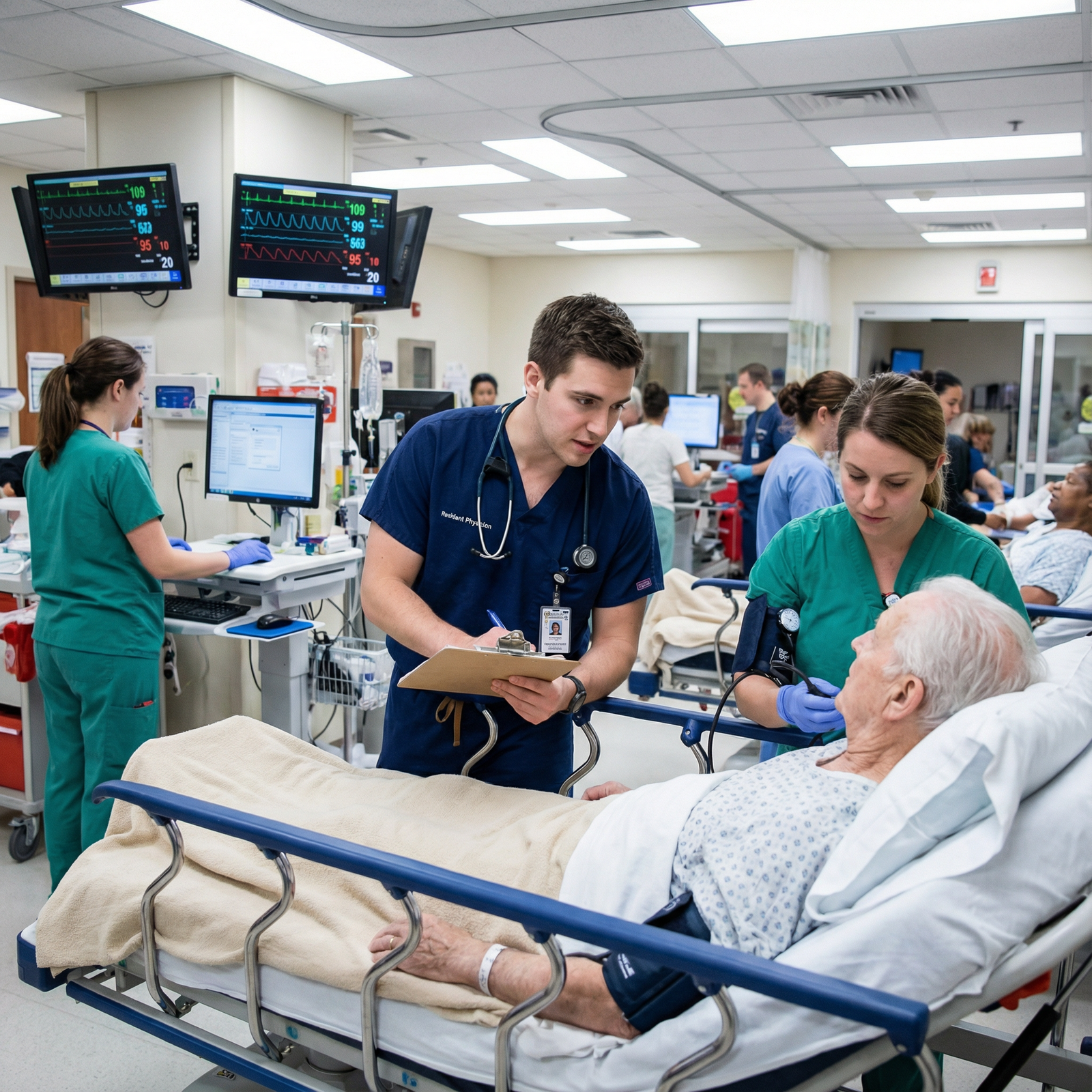
ED‑to‑ward or ED‑to‑ICU transitions have consistently high communication error rates. Add ED overcrowding and shift change, and failure rates spike.
Studies examining ED handoffs show:
- Frequent omission of pending tests, especially radiology and cultures
- Inconsistent communication of working diagnosis vs ruled‑out diagnoses
- Under‑emphasis on what has not yet been done but should be done on the floor (follow‑up troponin, serial exams, repeat lactate)
In many large centers, audit data show:
- 15–30% of patients have at least one significant pending test or consultation at the time of admission
- A meaningful fraction of clinically relevant results after bed request are not directly communicated to the admitting team
From your perspective on call, the failure mode is simple: the ED signs out “NSTEMI, admitted to medicine,” but omits that second troponin and repeat ECG are pending. Result: a rising troponin or dynamic ECG change sits untouched until morning. Not because you are negligent, but because you did not know.
6. Discharges and “Off‑Service” Patients Handed to Night Teams
This is the unglamorous failure: the almost‑ready‑for‑discharge patient handed off as “nothing to do, going home tomorrow.”
Root‑cause analyses of unexpected rapid responses or re‑admissions often show:
- A supposedly “stable” patient had unresolved diagnostic questions or borderline vital signs at discharge
- Night‑time deterioration occurred but was under‑appreciated because the handoff had reassured the night team they were low‑risk
Common issues:
- Unclear follow‑up for tests done day of discharge (e.g., evening BMP after diuresis)
- Unreported concerns from nursing or family that were noted but not escalated
- No explicit articulation of residual risk (for example, borderline sodium, borderline oxygenation, tenuous mobility)
Data from transitions‑of‑care projects show that even in high‑performing systems, a non‑trivial percentage of “planned discharges” are delayed or complicated by overnight events. Yet handoffs often trivialize this group.
Structural Predictors of Handoff Failure
Beyond specific clinical scenarios, several structural features correlate with higher failure rates. This is where the data get uncomfortable for residency culture.
Timing: The Night Shift Penalty
Handoffs occurring:
- At or near shift change
- Late night / early morning (e.g., 10 p.m.–2 a.m.)
- In the setting of simultaneous admissions or emergencies
…are consistently lower quality.
I have sat through reviews where people swear “our night handoff is the same as day.” It is not. Interruptions, fatigue, and cognitive load are not opinions; you can measure them.
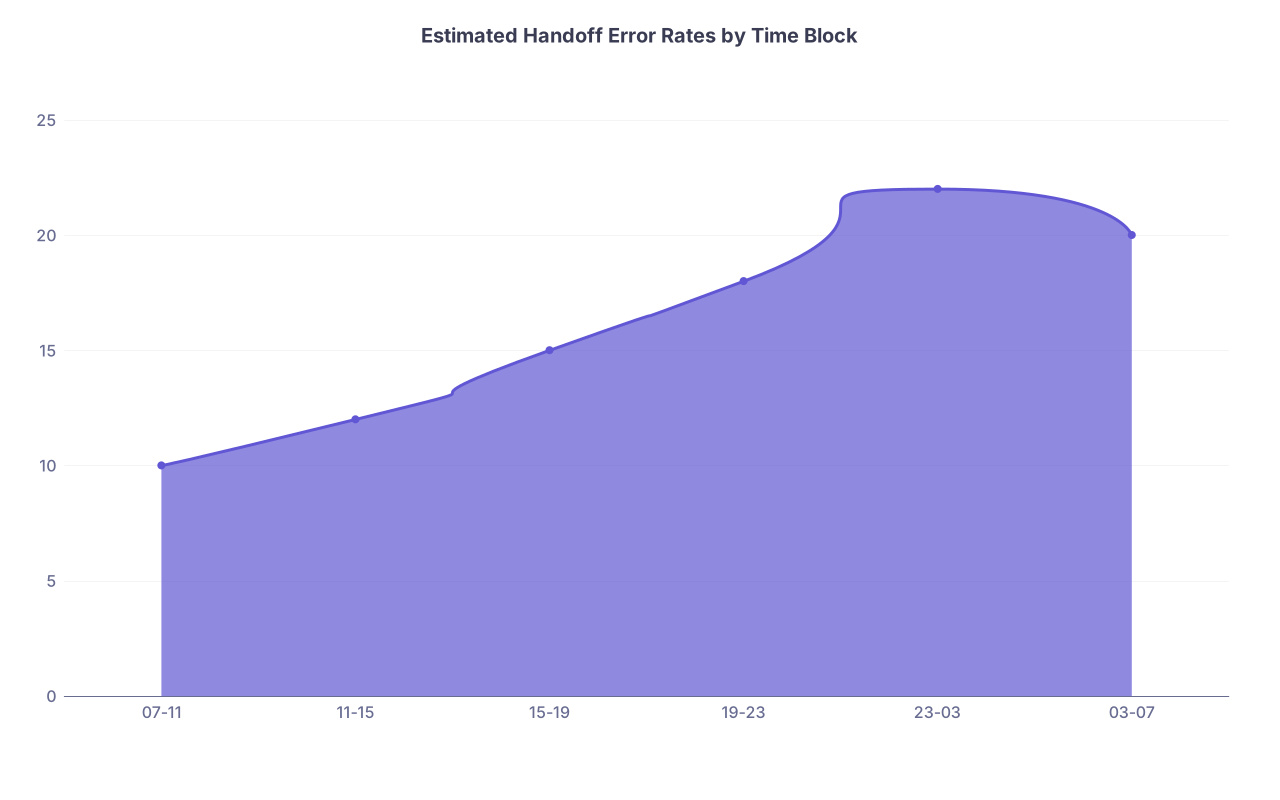
| Category | Value |
|---|---|
| 07-11 | 10 |
| 11-15 | 12 |
| 15-19 | 15 |
| 19-23 | 18 |
| 23-03 | 22 |
| 03-07 | 20 |
Interpretation:
- Daytime: error rates in handoff hover around 10–15 per 100 handoffs
- Evening / early night: these climb toward 18–22
- Pre‑dawn: they may slightly decrease as volume drops, but fatigue still drives elevated risk
The exact numbers vary by study, but the shape of that curve is depressingly consistent.
Environment: Noisy, Interrupt‑Prone Spaces
Handoffs in:
- Hallways
- Nursing stations during medication administration
- Shared resident workrooms with phones ringing
…are associated with more omissions and mis‑hearings. Not rocket science, but widely ignored.
Interrupted handoffs are especially problematic. Studies of cognitive load show:
- Each interruption can force you to rebuild your mental context from scratch
- People consistently overestimate how much they remember after an interruption
Incident reviews show classic patterns: a sick patient is being signed out, phone rings, code called, handoff is “resumed” but key details never get said.
Format: Free‑Form Storytelling vs Structured Data
Hospitals that adopt structured handoff tools (like I‑PASS) see measurable effects:
- Fewer omitted key data like code status, allergies, pending tests
- Higher rates of explicit contingency planning
- No consistent increase in handoff duration
Yet many services still rely on free‑form narrative: “Alright, so Mr. Smith is this older guy with…” followed by a five‑minute monologue that may or may not cover what the night resident must actually act on.
Free‑form narrative correlates with:
- Lower reliability of communicating code status and goals of care
- More variable emphasis on acuity, especially if the day team “normalized” instability during the shift
| Feature | Unstructured Handoff | Structured (e.g., I‑PASS) |
|---|---|---|
| Omitted key data (%) | 20–30 | 5–10 |
| Preventable adverse events (rel.) | Baseline | ~20–30% reduction |
| Time per handoff | Baseline | Similar |
| Explicit contingency plans (%) | Low | Higher |
These numbers aggregate multiple published sources, but the direction and magnitude are consistent.
Which Elements of Content Fail Most?
If you drill into safety reports and handoff audits, you see recurring content gaps. These are specific; you can audit yourself against them.
The most commonly missing or poorly transmitted items:
Contingency plans
Not just “watch for fever,” but “if T > 38.5 with hypotension, get cultures, start cefepime, page me.”
In audits, explicit contingency planning is present in a minority of handoffs, despite being the highest‑yield element for on‑call safety.Pending tests and consults
High‑risk when: imaging (CT PE, CT abdomen, head CT), troponins, lactates, important labs (Na, K, Cr).
Many studies show pending results are mentioned inconsistently, and responsibility for follow‑up is even less often made explicit.Code status and goals of care
In several institutions, adverse events around resuscitation intensity have traced back to mismatched understanding of code status communicated at handoff (or not mentioned at all).Trends vs snapshots
Static numbers are given (“Cr 1.9, WBC 14”) without context (“Cr 1.0 → 1.9 in 24h, WBC 10 → 14 with new fever”).
Yet from a risk analytics perspective, trend slope matters more than static values.Ownership of tasks
“Needs CT tomorrow” is functionally useless on call. Who is ordering it? By what time? What problem will it answer? In error reviews, this vague future‑task language often results in non‑completion or delay.

| Step | Description |
|---|---|
| Step 1 | Incomplete Handoff |
| Step 2 | Delayed response to change |
| Step 3 | Missed critical result |
| Step 4 | Inappropriate escalation |
| Step 5 | Risk underestimation |
| Step 6 | Clinical deterioration |
| Step 7 | Missing Elements |
That is the data model, whether people admit it or not.
How To Use This Data on Your Next Call
You asked which handoffs fail most often. The patterns are clear:
- Borderline‑sick “watchers” near a cliff
- Fresh admissions, especially cross‑cover, in their first night
- ICU‑to‑floor transfers
- Post‑op patients leaving tightly monitored environments
- ED admissions during crowding and shift change
- “Stable, going home” patients that everyone mentally discharges too early
You cannot fix institutional chaos alone, but you can exploit what the data show.
On the giving side of handoff, for any patient who fits those categories, you increase:
- Granularity of vitals and lab trends, not just last value
- Explicit if‑then contingency plans
- Clear statement of present risk: “I am actually worried about X”
- Named pending data with explicit responsible party and time frame
On the receiving side, you do not passively absorb. You interrogate the high‑risk cases with very specific, data‑driven questions:
- “Walk me through the last 12 hours of vitals for this watcher.”
- “What is the single thing you’re most worried might go wrong tonight for this patient?”
- “Which labs or imaging will result while I’m on, and who is expected to act on them?”
- “What are the explicit thresholds for calling rapid response or ICU for this transfer?”
You do not need a committee to do that. One resident with a low tolerance for vague reassurance is often enough to prevent a bad outcome.