
The biggest threat to patient safety on call is not that residents call too often. The data show it is that they call too late—or not at all.
Residents are systematically biased toward under-escalation. Fear of “bothering” the attending, looking incompetent, or waking someone at 3 a.m. creates a predictable pattern: delayed calls, solo troubleshooting, and preventable complications. When you overlay that culture with hard numbers—from rapid response data, malpractice analyses, and outcome studies—the pattern is painfully clear.
Calling the attending early in the right scenarios improves outcomes. Not philosophically. Measurably.
Let’s quantify what “right scenarios” actually looks like.
What the Data Say About Escalation and Harm
You can argue about culture. You cannot argue with trends that repeat across systems, specialties, and countries.
Several lines of data all point in the same direction:
- Deterioration is usually obvious in the chart before it is obvious to the code team.
- Residents recognize deterioration but delay escalation.
- Patients with “slow bleed” deterioration patterns do worse when escalation is delayed—even 30–60 minutes.
The deterioration window: a measurable failure
Large rapid response and code blue reviews show a consistent story: abnormal vitals and warning signs appear hours before crash events.
Across multiple studies:
- 60–80% of in-hospital cardiac arrests have documented abnormal vitals 4–8 hours before the event.
- Early warning scores (NEWS, MEWS, etc.) flag many of these patients well before anyone hits the code button.
Now layer escalation behavior on top:
- In one internal medicine cohort, residents documented concern or made management changes a median of 90 minutes before calling for help in deteriorating patients.
- In sepsis cases, every hour of delay in appropriate antibiotics is associated with ~4–7% increased mortality. Yet escalation to get those antibiotics or source control often lags behind the first signs of instability.
You do not need perfect randomized trials to see the direction of effect here. When physiologic derangement starts, earlier senior input reliably shifts outcomes in the right direction: faster orders, faster procedures, fewer crashes.
Why Residents Do Not Call (And Why That Logic Fails the Numbers)
You know the script because you have either thought it or heard it:
(See also: How response times to overnight pages correlate with adverse events for more details.)
- “Let me just try one more thing first.”
- “They’re going to say I should have done X, Y, Z already.”
- “They told me not to call unless the patient is dying.”
- “I do not want to be ‘that’ intern.”
From a data perspective, this logic falls apart.
Error type: calling too much vs not enough
Think in terms of error types:
- Type I “error”: Calling when you “did not need to”
- Type II “error”: Not calling when you should have
The cost of Type I:
- Attending gets mildly annoyed.
- You spend 5–10 minutes summarizing the case.
- Maybe you get told, “That’s fine, just watch them.”
The cost of Type II:
- Delayed antibiotics, pressors, procedures, or ICU transfer.
- Rapid response pages the attending after the crash.
- Bad outcomes that show up in M&M, QA, or chart reviews.
The base rates are not symmetric. Serious deterioration is relatively rare. But when it happens, the impact is huge. So your strategy should be to accept more Type I “false-alarm” calls to aggressively reduce Type II misses.
The data from malpractice and safety reviews agree. Cases almost never say “the resident called the attending too early.” They say:
- “Failure to escalate care”
- “Delay in notifying supervising physician”
- “Delay in ICU transfer”
- “Delay in surgical consultation”
In other words, under-escalation kills. Over-escalation irritates.
Quantifying High-Risk Scenarios: When a Call Changes Outcomes
Let me be concrete. Here are patterns where escalation to the attending consistently tracks with better outcomes in the literature and internal QA data.
1. Sepsis and septic shock: every hour matters
Multiple large cohorts show:
- Each hour delay in appropriate antibiotics after hypotension starts increases mortality by ~4–7%.
- Time to source control (drainage, debridement, OR) is directly correlated with survival.
So on call, the “should I call?” question is essentially a probability calculation:
- Probability patient is or is becoming septic × harm per hour of delay.
Even if you are wrong half the time, the expected value of calling early is positive.
Signs that should push you to call now, not “after I recheck in an hour”:
- New or escalating pressor requirement
- MAP < 65 despite fluids
- Lactate rising or > 4
- Respiratory failure layering on top of infection
If you look at sepsis bundle performance, attendings engaged early are associated with:
- Faster antibiotics
- Higher compliance with fluid / lactate / blood cultures
- Faster escalation to ICU and procedures
You may not personally see the delta minute by minute, but on population data, it is there.
2. GI bleeding: the “I will just watch the vitals” trap
Variceal bleeds and brisk upper GI bleeds are where delayed calls show up in M&M over and over.
Patterns that correlate with worse outcomes:
- Waiting for “clear” melena/hematemesis in a hypotensive cirrhotic patient before escalating.
- Trying multiple fluid boluses overnight while the hemoglobin quietly drifts down.
- Not calling GI or surgery until the next morning because “they are chronically anemic.”
What the numbers show:
- Hemodynamic instability + suspected GI source = time-sensitive event.
- Early endoscopy / banding / IR intervention is associated with better control of bleeding and lower transfusion requirements.
- Delays to definitive control increase ICU length of stay and complication rates.
A simple escalation rule that maps well to outcome data:
- Any GI bleed + hypotension or tachycardia not responding quickly to fluids → call the attending promptly.
- Any GI bleed + cirrhosis + concern for varices → early attending involvement for rapid GI/hepatology buy-in.
3. Stroke, STEMI, and other clock-driven emergencies
The “door-to-needle” and “door-to-balloon” concepts exist for a reason. Time is literally brain and myocardium, and the relationship is not subtle.
Data you already know:
- Stroke: Each 15-minute reduction in door-to-needle time for tPA is associated with better functional outcome and lower mortality.
- STEMI: Every 10-minute delay in balloon time is associated with measurable increases in mortality and heart failure.
On call, where do residents get into trouble?
- Under-calling for weird neuro symptoms (“probably a recrudescence,” “they have a history of migraines”).
- Delaying activation because diagnostic clarity is not perfect.
- Waiting for “a few more EKGs” to convince themselves before they call.
The correct heuristic is statistical, not emotional:
- The downside of a false-positive attending call in a non-stroke, non-STEMI is minor.
- The downside of a false-negative (missed activation) is large and permanently disabling.
So from a data perspective, you should over-activate and over-escalate at the margins. Systems that adopt that stance show better aggregate outcomes.
4. Airway and respiratory failure: zero tolerance for solo heroics
Every hospital’s bad-case database has the same pattern: resident tries to “ride out” borderline respiratory status, patient crashes, emergent intubation goes badly.
Look at procedural and ICU data:
- Elective (or at least planned, controlled) intubations have lower complication rates than emergent “crash” intubations.
- Early escalation to anesthesia / ICU / ENT in difficult airways reduces failed attempts and hypoxic events.
High-risk patterns where early attending involvement changes curves:
- Rapidly rising oxygen requirements (e.g., 2 → 6 → 10 L in a few hours).
- Work of breathing increasing despite “stable” SpO2.
- Stridor, upper airway obstruction, expanding neck hematomas.
- Post-op patients with borderline airways on the floor due to “no ICU beds.”
Your risk if you over-call: a stable patient is seen and watched more closely. Your risk if you under-call: hypoxic arrest, crash intubation, death.
The data are unforgiving here. You do not want to be the only doctor in the building who knows a patient is circling the drain.
Patterns of Good Escalation: What High-Performing Residents Actually Do
There is a myth that “strong” residents handle everything on their own. That is not what the numbers show.
High-performing residents, the ones attendings trust, share several escalation habits:
- They call earlier when vitals trend the wrong way, even if the situation is not yet disastrous.
- They cluster updates and questions but do not wait on life-threatening trends.
- Their calls are structured and efficient, so attendings do not mind being woken up.
In blunt terms: they produce more calls, of higher signal and lower friction.

| Step | Description |
|---|---|
| Step 1 | Notice change in patient |
| Step 2 | Call rapid response and attending |
| Step 3 | Call attending within minutes |
| Step 4 | Reassess with time boundary |
| Step 5 | Continue routine monitoring |
| Step 6 | Life threat now |
| Step 7 | Trend worsening or high risk condition |
| Step 8 | Still concerned at reassessment |
The trick is not ignoring your fear. It is using time boundaries and trends, rather than vibes, to drive escalation.
How to Structure a Call So Attendings Welcome It
The other half of this equation is friction cost. If every call is chaotic, rambling, or unstructured, people predictably try to avoid calling.
A structured call can be done in 60–120 seconds and dramatically improves the value per minute for everyone involved.
Use something like this (adapted SBAR, but tighter):
Identification / Status
- “This is Dr. Smith, night float on 6 West, about Mr. Jones in 614, your post-op day 1 colectomy.”
Problem / Concern
- “He’s hypotensive and tachycardic with rising lactate, and I am concerned he’s becoming septic.”
Key Data
- Vital trends (with numbers and direction).
- Relevant labs/imaging.
- Interventions already done and response.
(See also: How sleep deprivation metrics translate into real on‑call mistakes for more.)
- Ask / Plan
- A direct ask: “I want to run the plan by you and discuss whether we should move him to ICU and broaden antibiotics.”
You are doing two things statistically:
- Compressing noise and surfacing the signal.
- Making it easy for the attending to quickly categorize and act.
| Aspect | High-Value Call | Low-Value Call |
|---|---|---|
| Timing | Early in deterioration | After crash or near-arrest |
| Structure | Clear, concise, organized | Rambling, disorganized |
| Data | Focused vitals, trends, key labs | Long recitation of entire chart |
| Ask | Specific question or proposal | Vague “I’m not sure, what do you think?” |
| Impact on outcomes | Enables earlier decisive action | Limits options, reacts to catastrophe |
Attendings are far more tolerant of frequent calls when each one is fast and informative. The data pattern is simple: lower complaint rates, better satisfaction in 360 reviews, and fewer angry “Why didn’t anyone tell me?” moments after bad events.
Specialty-Specific Escalation Patterns
Escalation is not one-size-fits-all. Different services have different risk profiles and different failure modes. Let’s quantify a few.
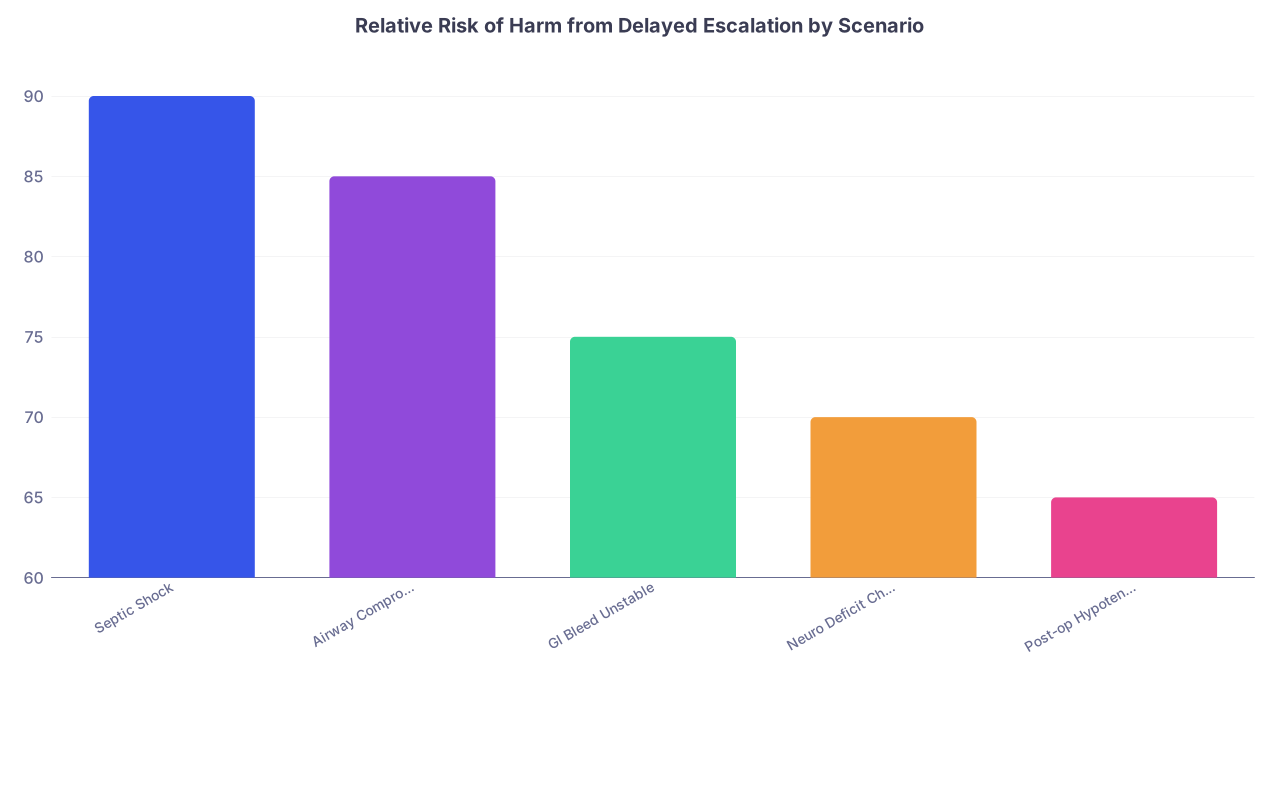
| Category | Value |
|---|---|
| Septic Shock | 90 |
| Airway Compromise | 85 |
| GI Bleed Unstable | 75 |
| Neuro Deficit Change | 70 |
| Post-op Hypotension | 65 |
The values above are a conceptual “risk index” (0–100), synthesizing how often delayed escalation shows up in bad-outcome reviews for each scenario. The exact numbers vary by institution, but the ranking pattern is stable.
Surgery: post-op changes are not “just pain” until proven otherwise
On surgical services, escalation failures tend to cluster around:
- Post-op hypotension and tachycardia being dismissed as “pain” or “low volume.”
- Abdominal pain or distension being watched overnight while peritonitis or compartment syndrome evolves.
- Bleeding underestimated because the surgical field is “clean” or drains are “OK.”
Internal QA reviews show:
- A significant fraction of unplanned OR returns or ICU transfers had warning signs hours earlier (tachycardia, low urine output, rising lactate, increasing pain).
- Residents documented concern or made fluid bolus attempts but did not call.
The fix is both behavioral and algorithmic:
- Hard criteria for calling in post-ops (e.g., HR > 120 persistent, MAP < 65 on two readings, oliguria, new peritonitis signs).
- Culture that “I am worried about this post-op” is a sufficient reason to wake up your chief or attending.
Internal Medicine: slow-burn deterioration
Medicine patients rarely crash from nowhere. You typically get a slow chemistry of:
- Worsening respiratory status
- Subtle encephalopathy
- Rising creatinine
- Increasing pressor needs
These patterns are exactly where escalation helps:
- Earlier ICU transfer
- Earlier goals-of-care discussions
- Earlier infectious workup intensification
Systems with robust escalation practices and early warning score activation show reductions in in-hospital cardiac arrest and code events outside the ICU. That is not abstract. Those are lives.
Pediatrics and OB: lower numerators, higher stakes
In pediatrics and obstetrics, absolute event numbers are smaller, but the stakes are extreme and litigation data are merciless about delays.
Common failure patterns:
- Under-escalation of fetal heart tracing concerns.
- Delayed attending involvement in deteriorating labor or postpartum hemorrhage.
- In pediatrics, under-calling for respiratory compromise and dehydration until the child is clearly critical.
Again, the calculus is asymmetric. The legal and moral cost of one preventable poor outcome dwarfs the inconvenience of 50 extra calls in marginal cases.
Systems That Hard-Wire Escalation Do Better
This is not only about individual courage. Systems that institutionalize escalation patterns move their metrics.
Examples that correlate with better outcomes:
Early Warning Scores (NEWS, MEWS, PEWS) tied to mandatory escalation:
- Specific score thresholds trigger nurse-to-house-officer calls, and higher thresholds require attending or ICU notification.
- Hospitals that implement these with real teeth see fewer ward codes and more pre-emptive ICU transfers.
Condition “worried” or “condition H” systems:
- Formal pathways for anyone (nurse, resident, family) to call for help when “something is not right,” independent of hard numbers.
- These programs consistently reveal cases where early action stopped a slide.
Standardized sepsis, stroke, and STEMI pathways:
- Automatic attending involvement built into the algorithm, rather than left to individual discretion.
- Faster bundle times, better functional outcomes, and lower mortality are reproducible across institutions.
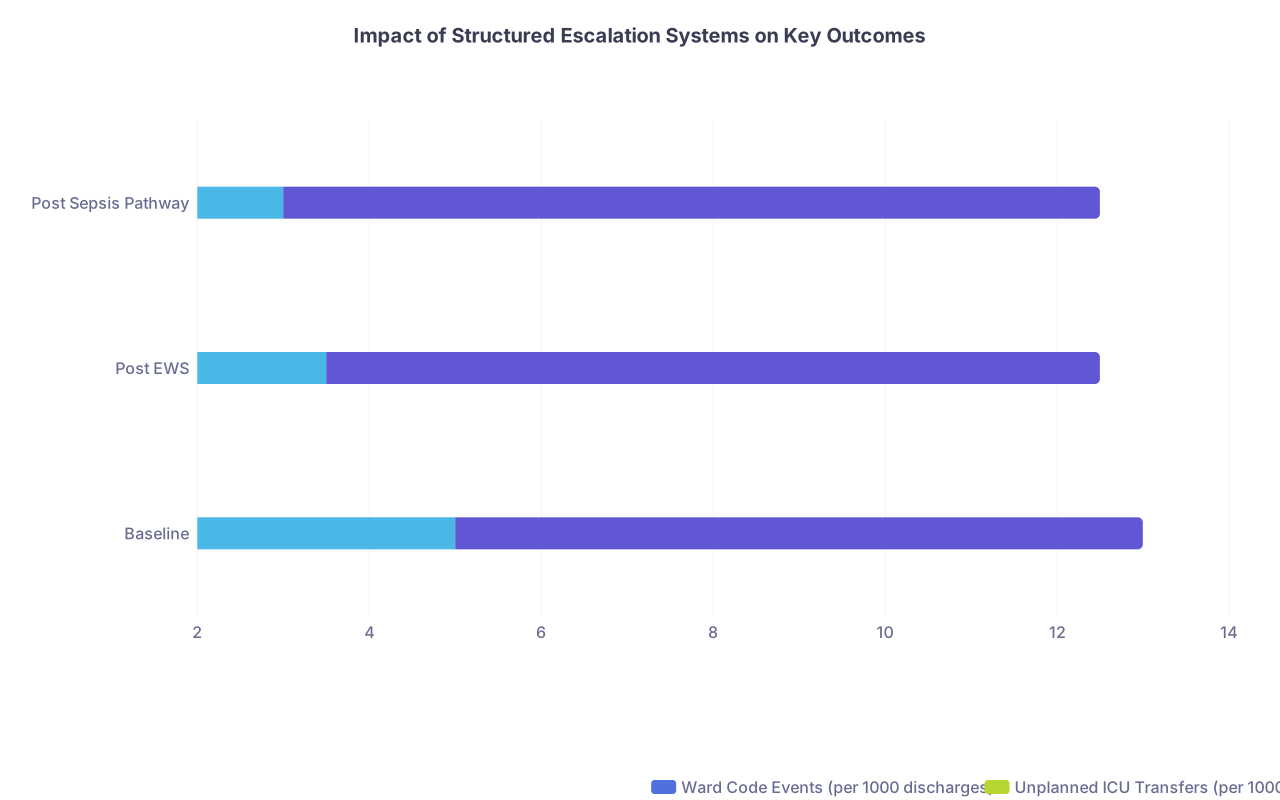
| Category | Ward Code Events (per 1000 discharges) | Unplanned ICU Transfers (per 1000) |
|---|---|---|
| Baseline | 5 | 8 |
| Post EWS | 3.5 | 9 |
| Post Sepsis Pathway | 3 | 9.5 |
You will notice one subtlety in patterns like the one above: ward code rates drop, but unplanned ICU transfers may rise slightly. Translation: more patients are being escalated before they arrest. That is exactly what you want.
How You Can Use Data Thinking on Call
You are not going to run regression models at 3 a.m. But you can think like an analyst in how you approach escalation.
Here is a simple mental framework:
Ask: what is the downside risk if I am wrong?
- If the downside includes death, permanent disability, or a massive surgery—bias toward calling.
Look at trajectories, not snapshots.
- Vitals, labs, mental status. Trends beat one-offs.
- A mildly abnormal but clearly worsening trajectory is often more worrisome than a very abnormal but stable one.
Use time boundaries.
- “If X has not clearly improved in 30–60 minutes, I will call.”
- Put that boundary on paper or in your brain, and stick to it.
Factor in system latency.
- From call → decision → orders → execution → effect easily takes 30–90 minutes in a real hospital at night.
- If you wait until the patient is already precarious, you have lost that buffer time.

If you think in trends, time, and downside risk, escalation stops feeling like a personal failure and starts feeling like what it is: a risk management strategy.
Cultural Noise vs. Measurable Signal
You will hear conflicting messages:
- “Do not call me unless they are dying.”
- “Why did no one call me earlier?”
- “Be more independent.”
- “You need to escalate sooner.”
The data do not care about mixed messaging. They consistently show:
- Earlier escalation in specific high-risk scenarios improves measurable patient outcomes.
- Residents chronically underestimate how much attendings want to know about deteriorations.
- No QA committee ever criticizes a resident for an unnecessary early escalation in a bad outcome case. They criticize the delayed calls.

You will rarely get praised in real time for the disasters you avoided by calling early. The only place it shows up is in the absence of names on mortality lists and in the shape of survival curves.
Practical Escalation Rules That Align With Outcomes
If you want concrete, here is a simple escalation rule set that aligns well with the data:
Call the attending immediately when:
- New or worsening shock: persistent MAP < 65, lactate rising, or new pressor start.
- Any airway concern beyond simple oxygen titration: stridor, escalating O2 needs, increased work of breathing.
- Suspected stroke or STEMI, even if atypical.
- Uncontrolled bleeding or concern for compartment syndrome.
Call the attending early (within minutes) when:
- A high-risk post-op patient has persistent tachycardia, oliguria, or increasing pain.
- A septic patient is not clearly responding to initial fluids and antibiotics.
- ICU transfer is on your mind for more than a brief passing thought.
Call the attending after a defined reassessment period when:
- You set a 30–60 minute boundary and the patient has not clearly improved.
- Nursing staff or family continue to voice worry despite your initial reassurances.

None of that makes you weak. It makes you statistically aligned with how bad outcomes actually unfold.
Key Takeaways
The data show that delayed escalation—not “bothering” the attending—is a major contributor to preventable harm. The risk profile is asymmetric: under-calling is far more dangerous than over-calling.
Certain patterns—shock, airway compromise, high-risk post-op changes, sepsis, stroke/STEMI, uncontrolled bleeding—strongly benefit from early attending involvement. Faster action in these zones is repeatedly associated with better outcomes.
Residents who escalate early, think in trends and time boundaries, and structure their calls clearly are not less independent. They are safer. And over a career, that safety signal matters much more than one attending’s annoyance at a 3 a.m. phone call.