
The way your hospital talks about “RRT culture” and “too many Code Blues” is often wrong. The data tells a much sharper story—and residents are in the middle of it.
Why RRT vs Code Blue Rates Actually Matter
Let me be blunt. Your hospital’s Rapid Response Team (RRT) and Code Blue rates are not just “quality metrics” for some committee slide deck. They are:
- A rough proxy for how sick your floor patients are
- A read on nursing comfort and escalation thresholds
- A mirror of how much pre-arrest work residents are doing at 2 a.m.
- And, very directly, a measure of how often you will be thrown into real-life resuscitations
You live in this data every call night. You just rarely see it laid out cleanly.
So let’s make it concrete and numerical.
Basic definitions (short and practical)
RRT (Rapid Response / Medical Emergency Team):
- Triggered when a patient is unstable or concerning but not yet in full arrest
- Aim: prevent deterioration, ICU transfer, or arrest
- Often resident-led (PGY-2/3 or night float, sometimes with ICU fellow)
Code Blue:
- Triggered for cardiopulmonary arrest or complete unresponsiveness
- Aim: immediate resuscitation (CPR, ACLS, airway, shocks)
- Higher-acuity, higher-mortality, much higher resident stress load
Hospitals typically report these as rates per 1,000 patient-days to normalize for volume.
| Metric | Lower End (per 1,000 pt-days) | Typical Academic | Higher End (per 1,000 pt-days) |
|---|---|---|---|
| RRT calls | 5–10 | 15–25 | 30–40+ |
| Code Blue events (non-ICU) | 0.5–1.0 | 1.0–2.0 | 2.5–4.0+ |
| Code Blue to RRT ratio | 1:15+ | 1:8–1:12 | 1:3–1:6 |
Are these exact? No. But they are realistic ranges I have seen in large academic centers and published QI data. Useful to orient yourself.
The Core Metric: The Code-to-RRT Ratio
Raw counts do not tell the whole story. A 900-bed tertiary center is going to have more of everything than a 250-bed community program. So the key metric that actually tells you about system function is:
Code Blue-to-RRT ratio on the wards (non-ICU).
Conceptually:
- High RRT, low Code Blue → good early recognition and escalation, “strong RRT culture”
- Low RRT, high Code Blue → late recognition, poor escalation, “arrest culture”
- Both high → very sick population or serious structural issues
- Both low → low acuity or under-calling across the board
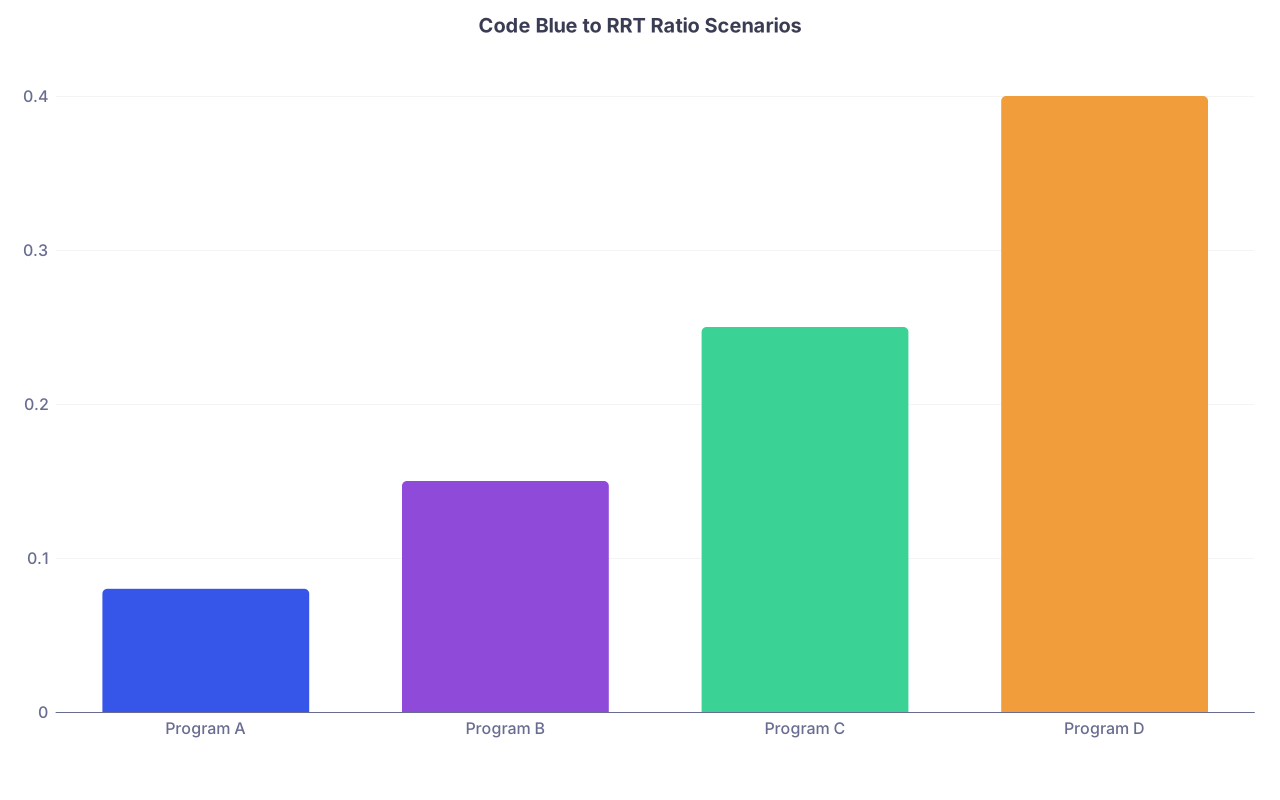
Let me quantify that.
| Category | Value |
|---|---|
| Program A | 0.08 |
| Program B | 0.15 |
| Program C | 0.25 |
| Program D | 0.4 |
Interpretation (Code Blue / RRT):
- Program A: 0.08 → ~1 Code for every 12–13 RRTs (strong prevention culture)
- Program B: 0.15 → ~1 Code for every 7 RRTs (typical, acceptable)
- Program C: 0.25 → ~1 Code for every 4 RRTs (borderline late recognition)
- Program D: 0.40 → ~1 Code for every 2.5 RRTs (red flag for delays)
You want to train in a place closer to Program A or B than D. Not because you should avoid Codes. You need exposure. But because programs with Program D numbers are usually chaotic, understaffed, or both.
What Different Patterns Mean For Your Life On Call
Here is where the numbers get personal.
Scenario 1: High RRT, Low Code Blue
Example: 22 RRTs and 1.5 Codes per 1,000 patient-days.
That is roughly:
- 660 RRTs / year in a 100-bed medicine service
- 45 Codes / year on the floor
For residents, this usually looks like:
- RRT pager going off constantly at night (you feel like you are always running)
- Many RRTs end in stabilization and stay on the floor, or controlled ICU transfer
- Codes still happen, but they are rare enough that each one feels very high stakes
What the data suggests:
- Nursing is comfortable calling early. They “would rather overcall than undercall.”
- There are structured early warning systems (MEWS/NEWS) that are actually used.
- You get tons of repetitions in initial stabilization: oxygen, pressors, noninvasive ventilation, sepsis bundles, rate control, etc.
Resident impact:
- High learning yield for pre-arrest management
- Frequent leadership reps for seniors without constant CPR chaos
- Nights feel busy but not always demoralizing
The downside: you may feel like you are constantly interrupted, and some RRTs feel “unnecessary.” But unnecessary by whose definition? Mortality and Code rates often look better in these settings.
Scenario 2: Low RRT, High Code Blue
Example: 6 RRTs and 2.5 Codes per 1,000 patient-days.
For a similar medicine census:
- 180 RRTs / year
- 75 Codes / year on the floor
This is a very different life:
- Floors are “quiet” until they are not
- Nurses under-call RRTs, rely on “watchful waiting,” or page residents directly instead of triggering teams
- You get a lot of Code experience, but the percentage of salvageable arrests is lower
What the data shows in these programs:
- Higher floor arrest mortality
- More cases that, on chart review, had clear deterioration 4–12 hours before arrest
- Poor standardization of response (who goes where, who leads, who documents)
Resident impact:
- You do get comfortable with ACLS, compressions, and shock decisions
- Emotional fatigue is worse; more unexpected arrests, more “we missed this” debriefs
- You learn a lot of crash management but less of the subtle early signal interpretation
If you hear “we don’t like to call RRTs; our nurses are strong so they just call the intern first,” read that as a systems failure, not a compliment.
Scenario 3: High RRT, High Code Blue
Example: 30 RRTs and 3.0 Codes per 1,000 patient-days.
That is:
- 900+ RRTs / year
- 90+ Codes / year on the floor
There are only two realistic explanations when acuity is controlled:
- You are in a very high-acuity safety net / transplant / onc center with constant borderline-ICU patients scattered everywhere.
- The system is breaking: short staffing, delayed imaging, overwhelmed ICUs refusing transfers, etc.
In these programs, residents:
- Are always on the move. Your “cross-cover list” is RRT triage plus everything else.
- Do both: tons of decompensation work and tons of full arrests.
- See wide variation in team performance: some shifts brilliant, others chaos.
The learning curve is steep. You come out tough and capable. But burnout risk is real.
Scenario 4: Low RRT, Low Code Blue
Example: 7 RRTs and 0.7 Codes per 1,000 patient-days.
Could mean:
- Lower acuity, strong outpatient focus, selective admissions
- Very good ward monitoring and step-down units
- Or under-reporting and under-calling across the board
Check for:
- Case mix: Is this mostly elective post-op, low-risk, short-stay medicine?
- Patient-days: Smaller denominator can make rare events look even rarer.
- Resident anecdotes: “Honestly, we barely see any arrests on the floor.”
Resident impact:
- You may get less real-world resuscitation practice
- Safer nights, less emotional toll
- Need to supplement with simulation, ICU rotations, trauma nights if you want strong acute care skills
How To Actually Interpret Your Program’s Reported Data
Most residents only ever see these numbers on a single-slide in a QI meeting. You should squeeze more juice out of them.
Ask specifically for:
- RRT rate per 1,000 patient-days (ward only)
- Code Blue rate per 1,000 patient-days (ward only, exclude ICU and ED)
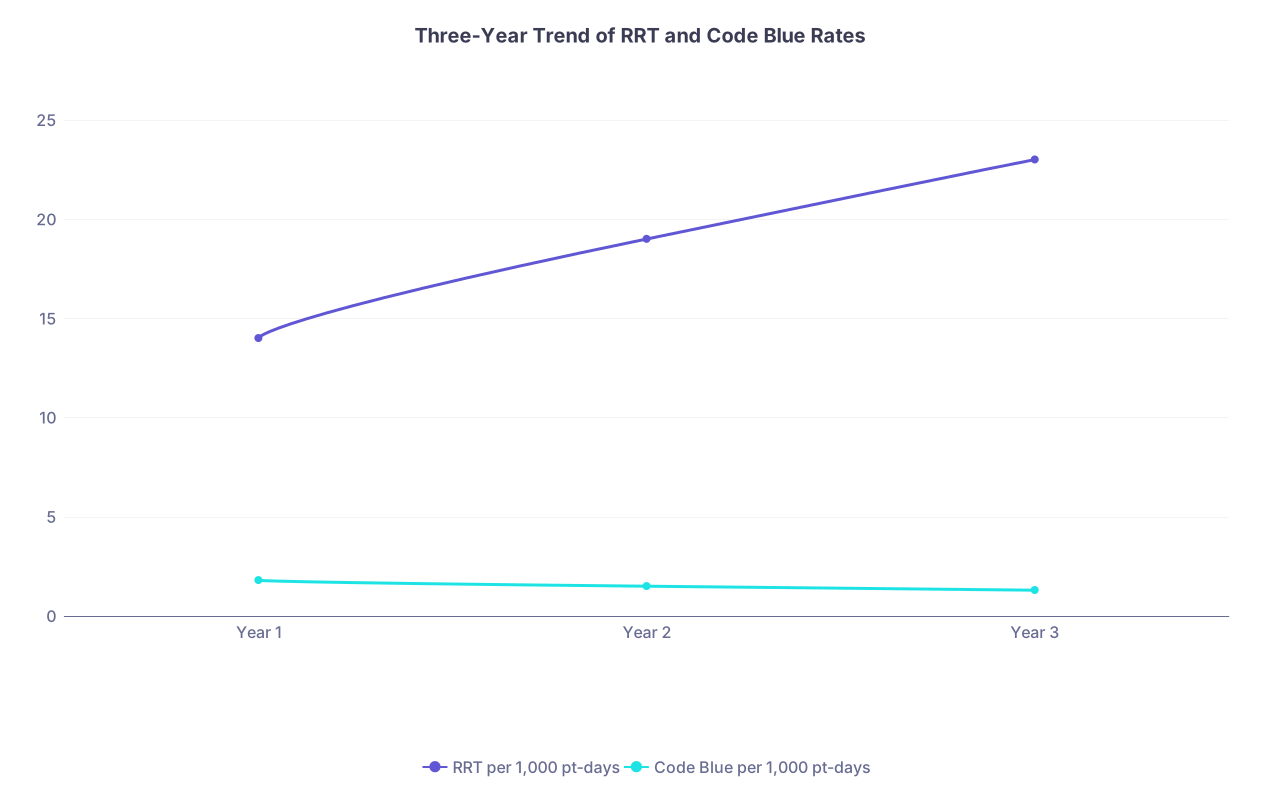
- Trends over the last 3–5 years
- Breakdown by unit (med-surg vs telemetry vs oncology vs step-down)
| Category | RRT per 1,000 pt-days | Code Blue per 1,000 pt-days |
|---|---|---|
| Year 1 | 14 | 1.8 |
| Year 2 | 19 | 1.5 |
| Year 3 | 23 | 1.3 |
What a plot like this tells you:
- RRTs rising from 14 → 23 probably mean earlier recognition and more structured escalation, not that patients suddenly got much sicker.
- Codes dropping from 1.8 → 1.3 with rising RRTs is exactly the signal you want: catching decompensation earlier.
Red flags on trend graphs:
- Flat or falling RRT with rising Codes
- Big jump in Codes after a staffing or EHR change
- Unit-level spikes (one ward that suddenly doubles its Code rate)
This is not just hospital politics. This is where you will spend three years of nights.
How These Numbers Translate To Resident Workload
Let’s make it concrete with back-of-the-envelope math.
Say your medicine service runs at 120 ward patients daily. That is roughly:
- 120 patients × 365 days = 43,800 patient-days per year
Program X (strong RRT culture):
- 20 RRTs / 1,000 pt-days → ~876 RRTs / year
- 1.2 Codes / 1,000 pt-days → ~53 Codes / year
Program Y (low RRT, higher arrest):
- 8 RRTs / 1,000 pt-days → ~350 RRTs / year
- 2.2 Codes / 1,000 pt-days → ~96 Codes / year
Now map that to your call schedule.
Assume:
- Night float or night team covers all RRTs/Code Blues
- 365 night shifts / year (someone always on)
Estimated average per night:
- Program X: ~2.4 RRTs and 0.15 Codes per night
- Program Y: ~1.0 RRT and 0.26 Codes per night
Residents in Program X:
- Run ~2–3 RRTs every night, many of which prevent arrest
- See a Code on ~1 out of every 7 nights on average
Residents in Program Y:
- See fewer RRTs and more “stat” pages that convert to Codes
- See a Code on ~1 out of every 4 nights
Both are intense. But the mix of pre-arrest versus arrest exposure is very different. Your experience of “being on call” will feel different too.
What Residents Should Ask During Interviews and On-Service
You do not have to sit passively while programs wave their hands and say “we have a robust RRT system.” Ask for the actual pattern.
Specific questions that cut through the fluff:
- “What are your RRT and Code Blue rates on the wards, roughly, per 1,000 patient-days?”
- “Have they changed in the last few years? What did you do that shifted them?”
- “Who typically leads RRTs and Codes overnight—residents or attendings?”
- “Do nurses usually call RRTs early, or is there a culture of calling the intern first instead?”
- “How many Codes would a typical PGY-2 on nights see in a month?”
If no one can answer even approximately, that tells you something about how seriously they track and use these metrics.
On your own service, track your exposure
Simple running log on your phone:
- Date, time, RRT vs Code, unit
- Trigger (hypoxia, hypotension, mental status, arrhythmia, etc.)
- Outcome: stabilized on floor vs ICU transfer vs death in event
After a few months, you will see your own pattern:
- Are you mostly responding to borderline cases or true disasters?
- Are there units that constantly call late?
- Are there times of night with clustering (e.g., post-shift-change chaos)?
That mini-dataset is pure gold for your own learning and for any QI project.
What “Good” Looks Like For Resident Training
The best training environments do not necessarily have the lowest Code rates. They have:
- A high enough RRT rate that you see a lot of sick-but-not-dead patients
- A moderate Code rate that gives you real resuscitation reps without destroying the team
- A declining trend in Codes as QI projects and early-warning tools mature
- A clear role for residents as leaders (with backup) in both RRT and Code situations
Qualitatively, you will hear:
- Nurses say “We call RRT early here; no one gets angry.”
- Attendings say “Our Codes went down after we empowered RRT calls.”
- Residents say “I feel supported when I run a Code; there is structure and backup.”
Quantitatively, I like to see, for a general medicine heavy program:
- 15–25 RRTs / 1,000 ward patient-days
- 1.0–1.8 Codes / 1,000 ward patient-days
- Code:RRT ratio somewhere between 1:8 and 1:15
If the numbers are far outside that range, I want a convincing case-mix explanation.
How To Use These Metrics To Survive And Improve Your Call
You do not control the system as an intern. But you can use these numbers to be smart about how you work.
If your program is high-RRT, low-Code:
- Expect frequent pages for borderline vitals. Anticipate patterns (post-op day 1 hypotension, new Afib on oncology, dialysis patients with K 6.0).
- Build structured checklists for each common RRT type so you do not reinvent the wheel at 3 a.m.
- Use these calls to practice calm leadership: one voice, clear tasks, closed-loop communication.
If your program is low-RRT, high-Code:
- Push hard for early RRT activation. Tell nurses explicitly: “If you are worried, please call RRT, not just me.”
- Watch for early warning signs in your sign-out list. Do not be reassured by a single “vitals stable” entry when the nursing note says “RN concerned.”
- After every Code, trace the prior 24 hours in the chart. What could have triggered an earlier response?
If you are in a high-high environment:
- Ruthlessly prioritize. Not every cross-cover page deserves immediate bedside evaluation when you also have an RRT pager. Triage by risk.
- Push for clear escalation protocols: When do you automatically call ICU? When can you rely on step-down?
- Protect your own learning and mental health: debrief with seniors, attend sim sessions, and say out loud when you are overloaded.
Finally, if you are in a low-low environment:
- Seek out ICU, ED, and high-acuity electives
- Take simulation seriously; that may be where much of your resuscitation muscle memory will come from
- Be honest with yourself about your exposure. Numbers do not lie. If you want to be excellent in critical care, ask how you will close that gap.