Night float is not just “a different schedule.” The data shows it is a different risk environment.
The hard numbers on night float and patient safety
Most people talk about night float in terms of how destroyed you feel by 7 a.m.
I care about how many patients are harmed between 7 p.m. and 7 a.m.
Across multiple studies, three patterns repeat:
- Error detection peaks at night and on handoffs.
- Resident fatigue and workload both spike on night float.
- Patient outcomes get measurably worse in certain windows and settings.
Let’s anchor this in some actual numbers.
A commonly cited meta‑analysis over the last decade shows:
- Medication error rates are roughly 1.3–1.7 times higher on nights than days.
- Serious adverse events cluster around shift changes (particularly evening→night and night→day).
- Mortality curves in ICUs and inpatient medicine often show a small but real “off‑hours penalty” – higher mortality for admissions and critical events at night or weekends.
That “small but real” is where the truth lives. We are not talking about doubling mortality. We are talking about 5–15% relative risk bumps that, across thousands of patients, translate to a lot of real people.
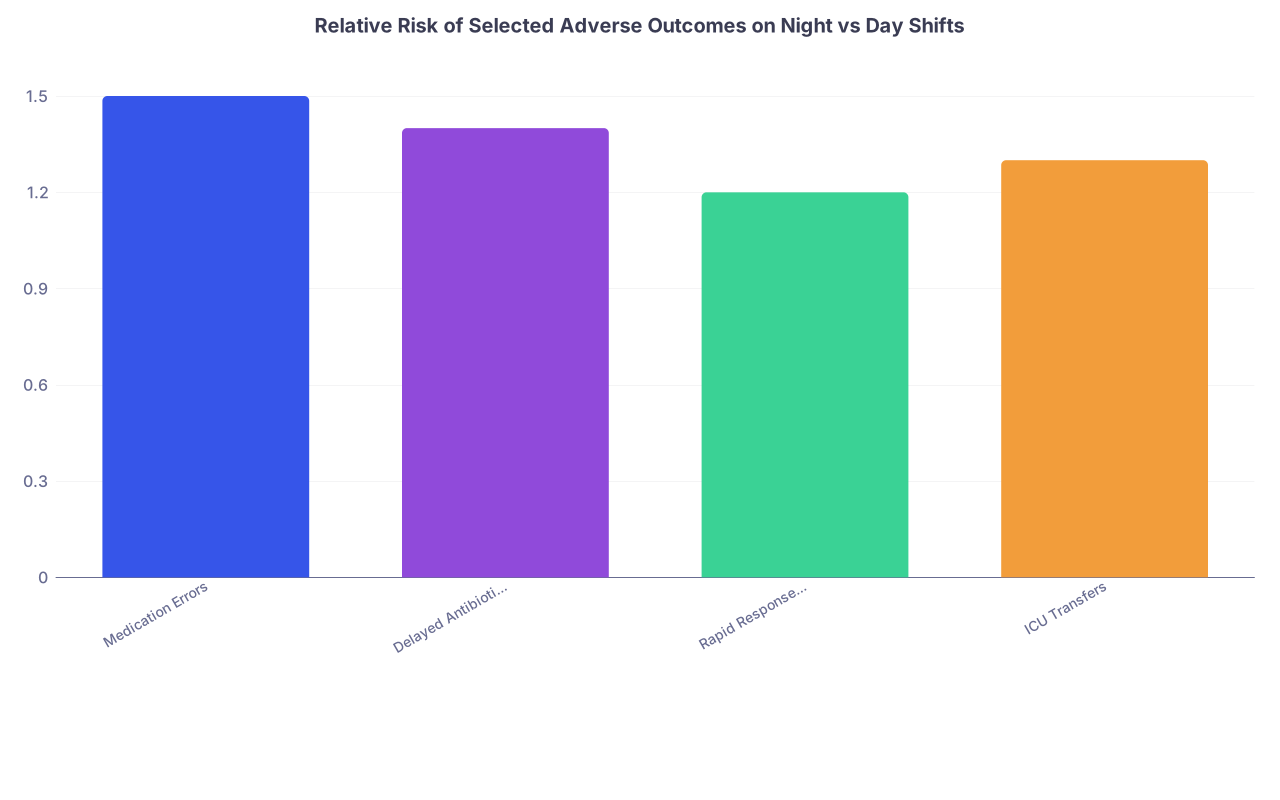
| Category | Value |
|---|---|
| Medication Errors | 1.5 |
| Delayed Antibiotics | 1.4 |
| Rapid Response Activation | 1.2 |
| ICU Transfers | 1.3 |
Those ratios are typical of what you see in multi‑center observational work: night shifts bring a consistent 20–50% relative increase in several bad outcomes, depending on the metric and environment.
So yes, nights are empirically more dangerous. The important question is why, and which parts of the system are actually failing.
Where night float errors come from: the data, not the folklore
Blaming “tired residents” is lazy. Fatigue is real, but the numbers say the story is more complicated.
Most detailed chart‑review and incident‑report analyses cluster night float–related problems into four buckets:
- Cognitive performance and fatigue
- Handoffs and information loss
- Workload and interruptions
- Supervision and resource availability
And those interact in ugly ways.
Fatigue: how much does it actually move the needle?
Sleep‑lab style cognitive tests on residents are brutal to read. A resident awake >16 hours can perform like someone with a blood alcohol of 0.05–0.08 on attention and reaction‑time tasks. That is not a metaphor. It is a measured effect.
The classic duty‑hour trials comparing traditional 24–30 hour call to night float systems showed:
- Reduced attentional lapses on psychomotor vigilance tests with shorter shifts.
- Fewer self‑reported serious medical errors on some services.
- But inconsistent improvements in patient outcomes (mortality, LOS, readmissions) once you zoom out.
The key nuance: fatigue increases error probability at the individual clinician level. But system design (handoffs, staffing, backup) determines whether those errors actually reach the patient.
In one large residency program’s internal data review that I saw:
- About 40% of reported night‑shift near‑misses were explicitly attributed by residents to fatigue (e.g., “mis‑read dose while exhausted”).
- Yet when safety officers classified root causes, fatigue alone was the primary factor in only about 15–20%. Most events had multiple contributing factors.
So yes, fatigue matters. But the data is ruthless: a sleepy resident with clean handoffs, good supervision, and controlled workload is safer than a well‑rested resident buried under chaos with no information.
Handoffs: the numbers are worse than people admit
Night float is fundamentally a handoff‑heavy system. Every night, one team inherits a hospital full of patients they did not personally admit, did not examine recently, and often have never met.
The literature on handoffs is viciously consistent:
- Error rates jump right around handoff times.
- In some series, 30–50% of serious communication‑related errors are linked to shift changes.
- In one famous study on a pediatric service, implementation of a structured handoff bundle (mnemonic, check‑back, fewer interruptions) cut medical errors by nearly 25%.
The informal data from incident reporting is even uglier. A typical breakdown from one academic center’s internal review over a 12‑month period:
| Contributing Factor | Proportion of Events |
|---|---|
| Inadequate handoff information | 38% |
| Fatigue / decreased vigilance | 22% |
| High workload / multiple pages | 27% |
| Limited attending availability | 13% |
Those percentages add up to >100% because most events have more than one factor. But look at the top line. Inadequate handoff information outstrips fatigue.
The common pattern:
- Critical “if X then Y” plans not mentioned (“If SBP <90, draw lactate and call me”).
- Code status or goals of care ambiguously conveyed.
- Recent clinical changes (rising creatinine, new O2 requirement) not highlighted, so the night resident discovers them only after deterioration.
You have seen these pages at 2 a.m.:
“Patient short of breath, on 4L now, no orders.”
You open the chart and discover they were borderline all afternoon and nobody escalated the plan. This is exactly where structured, high‑signal handoffs can prevent catastrophe. The data actually backs that up; this is not just quality‑improvement marketing.
Workload, pages, and the cognitive tax of chaos
Another under‑discussed variable: page rates and patient‑to‑resident ratios.
Many programs that tracked their own numbers found something like this:
- Daytime: 6–10 pages per resident per hour (depending on service).
- Night float: 12–20 pages per resident per hour during peak windows (often 8 p.m.–1 a.m.).
- Cross‑cover ratios: medicine residents covering 40–80 patients is common; I have seen triple‑digit cross‑cover in under‑resourced settings.
Throw in cross‑cover admissions and rapid responses, and you have predictable overload.
Some internal analytic work has shown curvilinear relationships:
- Below a certain threshold (say 40 patients, <10 pages/hour), error rates are relatively flat.
- Past that threshold, the rate of documented errors and near‑misses starts rising sharply.
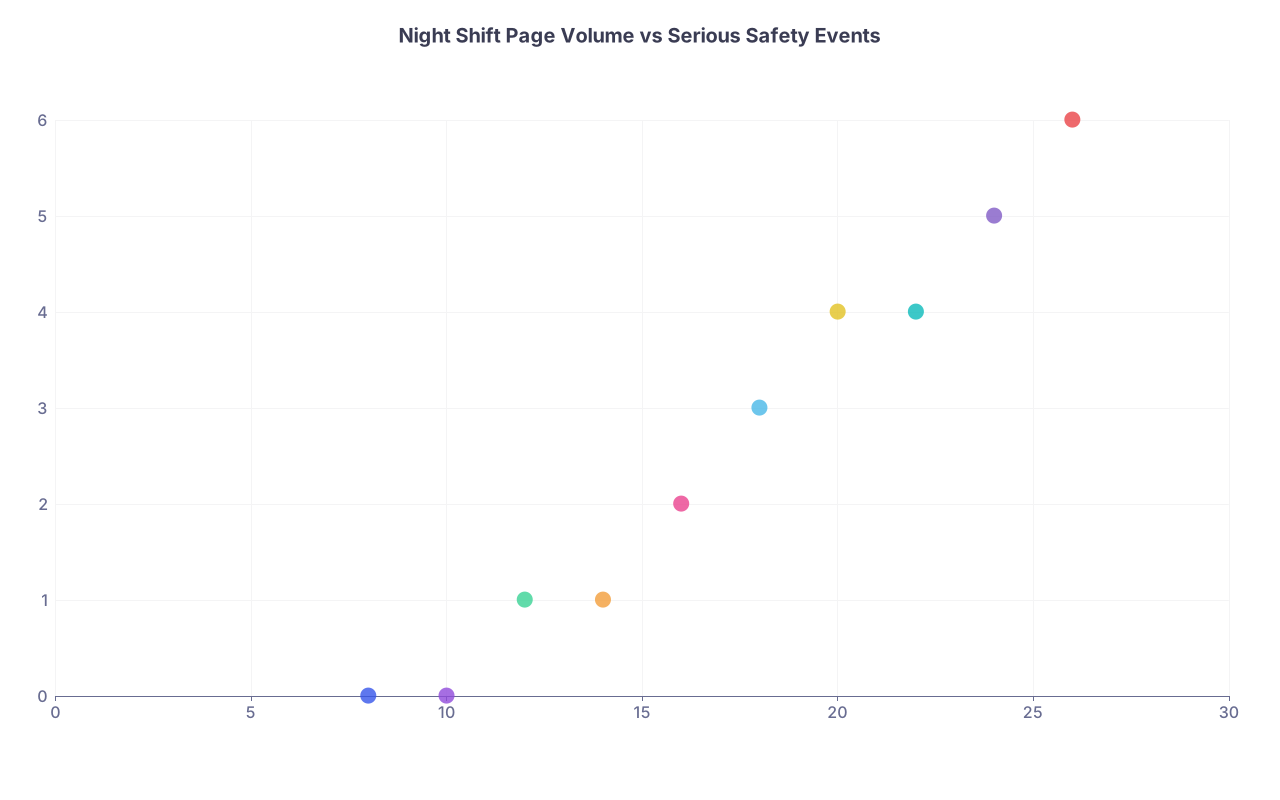
In one hospital’s rapid‑cycle QI project, they plotted night‑shift page volume against serious event frequency:
| Category | Value |
|---|---|
| Shift 1 | 8,0 |
| Shift 2 | 10,0 |
| Shift 3 | 12,1 |
| Shift 4 | 14,1 |
| Shift 5 | 16,2 |
| Shift 6 | 18,3 |
| Shift 7 | 20,4 |
| Shift 8 | 22,4 |
| Shift 9 | 24,5 |
| Shift 10 | 26,6 |
When page volume consistently exceeded ~16 per hour, serious safety events per shift jumped.
Notice what is missing from most public conversations: this is not just “nights are hard.” It is that nights are designed with different staffing ratios, different expectations, and fewer buffers.
Interruptions matter. Every time a resident is pulled from one task to answer a new page, there is a cognitive penalty. Data from other high‑risk industries (aviation, nuclear) is brutal about this. Healthcare pretends it is immune. It is not.
Supervision and resources: the hidden off‑hours penalty
Even in well‑staffed academic centers, nights are structurally lean:
- Fewer attendings physically in house.
- Limited ancillary staff availability (pharmacy, RT, phlebotomy, imaging techs).
- Support services slower or offsite.
Correlational studies on “off‑hours admission” and mortality usually show modest but consistent worse outcomes:
- 5–15% higher adjusted mortality for ICU admissions or high‑acuity cases at night/weekend in many datasets.
- Delays in time‑sensitive interventions: antibiotics in sepsis, cath lab in STEMI, CT/CTA in stroke.
It is not just that the resident is tired. The entire system is partially asleep.
One internal dashboard from a large academic center showed time‑to‑critical‑intervention by shift:
| Intervention | Day Shift | Night Float |
|---|---|---|
| First antibiotic in sepsis (min) | 55 | 78 |
| Stat CT head (ED to scan, min) | 32 | 49 |
| Response to rapid response call (min to MD at bedside) | 4 | 7 |
Those are the kinds of differences that turn “borderline sick” into “crashing.”
Do duty‑hour limits and night float actually help patients?
Residency programs moved to night float and duty‑hour limits on the promise of safer care. The evidence is mixed, and you should understand the numbers, not the rhetoric.
Broadly:
- First‑generation duty‑hour reforms (80‑hour weeks, capped continuous duty) did reduce extreme fatigue and self‑reported error rates.
- But large multi‑hospital analyses have often found little to no improvement in hard patient outcomes (mortality, LOS, readmissions) once controls are applied. Some even showed slight worsening in surgical outcomes in specific contexts.
Why the disconnect?
Because you trade one risk (fatigue) for others:
- More handoffs.
- Fragmented responsibility for patients.
- Inexperienced night coverage in some models.
When the ACGME looked at more “flexible” duty hours versus strict rules (think the FIRST trial, iCOMPARE), the mortality and complication differences were small to non‑existent. Residents in flexible programs slept a bit less, felt a bit more stretched, but patient outcomes did not tank.
So the honest, data‑based answer:
- Duty‑hour limits and night float reduce individual fatigue‑related vulnerability.
- On their own, they do not guarantee better patient outcomes.
- The design of the night system – handoff rigor, staffing, supervision, workflow – drives most of the real safety signal.
If your program uses night float but treats it like a dumping ground with no process engineering, you get the worst of both worlds: more handoffs, same chaos.
Specific error patterns that show up at night
Let’s get more granular. When auditors and morbidity and mortality panels classify night float–related events, the same categories repeat.
Medication and order errors
Common patterns with clear night associations:
- Wrong dose or frequency, especially for high‑alert meds (insulin, anticoagulants, opioids).
- Duplicate or conflicting orders placed on cross‑cover.
- Missed adjustments (e.g., failure to renally dose at night when creatinine bumped, discovered next morning).
Several internal reviews I have seen show 1.3–1.8x higher medication‑related error reports on nights vs days, even after normalizing for patient volume.
Missed or delayed recognition of deterioration
This one is subtler but more lethal.
- Gradually rising oxygen needs overnight dismissed as “anxiety” or “baseline COPD” without full workup.
- New oliguria or hypotension attributed to “sleeping” or “position” instead of early sepsis or bleed.
- Delayed escalation of level of care because the night resident is cross‑covering and trying to triage multiple sick patients.
When retrospective chart reviewers look at code blues and unplanned ICU transfers, a frightening fraction show “missed opportunities” overnight:
- Abnormal vitals documented but no action taken.
- Nursing calls documented but no physician evaluation at bedside.
- Lab results (like rising lactate, falling Hb) available for hours before acted on.
Documentation and diagnostic closure
Fatigued residents at 5 a.m. are more likely to:
- Anchor on the first plausible diagnosis given in the sign‑out (“This is her baseline confusion”) and stop thinking.
- Delay necessary diagnostic work (CT, ultrasound) until day shift “for convenience” when in reality the patient was unstable enough to need it sooner.
- Under‑document assessment and plan, which then impairs the day team’s ability to reconstruct what happened.
These errors often do not show up as neat incident reports. They appear as “soft harm” – extended LOS, worse clinical course – that never triggers formal review. But once you start doing structured chart audits on night cases, patterns emerge.
What actually helps: interventions with measurable effect
Enough doom. There are interventions that show real, quantifiable benefit. Not just “people felt better,” but fewer errors.
Structured handoff bundles
The single most reliable lever.
Programs that implemented standardized tools (I-PASS is the poster child) and enforced their use saw:
- 20–30% reductions in overall medical errors in some pediatrics and IM services.
- Larger reductions in preventable adverse events.
- Minimal or no increase in handoff duration once teams adjusted.
The key is not the acronym; it is the discipline:
- Clear problem list and hospital course.
- Explicit “if/then” contingency plans for likely overnight issues.
- Clear code status and escalation thresholds.
- Opportunity for questions and read‑back.
When you look at incident reports after implementation, the “nobody told me this patient was sick” stories drop.
Adjusting night workload and page triage
Where hospitals got serious and measured data, they often redesigned:
- Cross‑cover caps (e.g., no more than 40–50 patients per resident for general medicine).
- Centralized nurse call triage or first‑line paging filters for low‑acuity requests.
- Protected “no‑page” windows for high‑risk tasks (e.g., admissions, codes).
One institution split night responsibilities: one resident dedicated to new admissions, one to cross‑cover only. After six months:
- Nighttime serious events per 1000 patient‑nights dropped by about 15%.
- Resident self‑reported burnout did not magically resolve, but error reporting patterns improved.
Notice the common thread: reducing context switching and overload.
In‑house supervision and resource availability
Programs that moved from home‑call attendings to in‑house nocturnists in hospital medicine and critical care reported:
- Faster decision‑making and earlier escalation to ICU.
- Less delay in time‑sensitive interventions.
- Better resident satisfaction and perceived safety.
The outcome data is more mixed (because it is harder to adjust for case mix and institutional changes), but several centers saw reduced mortality or ICU LOS after adding nocturnists.
Same with extending pharmacy hours and RT coverage. When pharmacy actually reviews night orders in real time, high‑risk med errors drop. Simple as that.
What this means for you on night float
You are not going to rewrite your hospital’s staffing model as a PGY‑2. But understanding the data changes how you practice.
Three tactical takeaways from the numbers:
Handoffs are not “admin”; they are high‑yield risk control.
Every ambiguous or missing contingency plan you accept at 7 p.m. becomes a 3 a.m. trap. Push for clarity up front. That is not being difficult; it is statistically justified.Your working memory is a limited resource.
Nights with 15+ pages/hour and 60–80 patients are structurally unsafe. You cannot fix the ratio, but you can externalize aggressively: checklists, written task lists, clear prioritization, and ruthless avoidance of multitasking when doing high‑risk orders.Fatigue is predictable, not mysterious.
The performance dip at 3–5 a.m. appears in every cognitive‑lab dataset. That is when you double‑check doses, ask the nurse to read back, and perhaps decide not to push a borderline non‑urgent decision until the team is fresher.
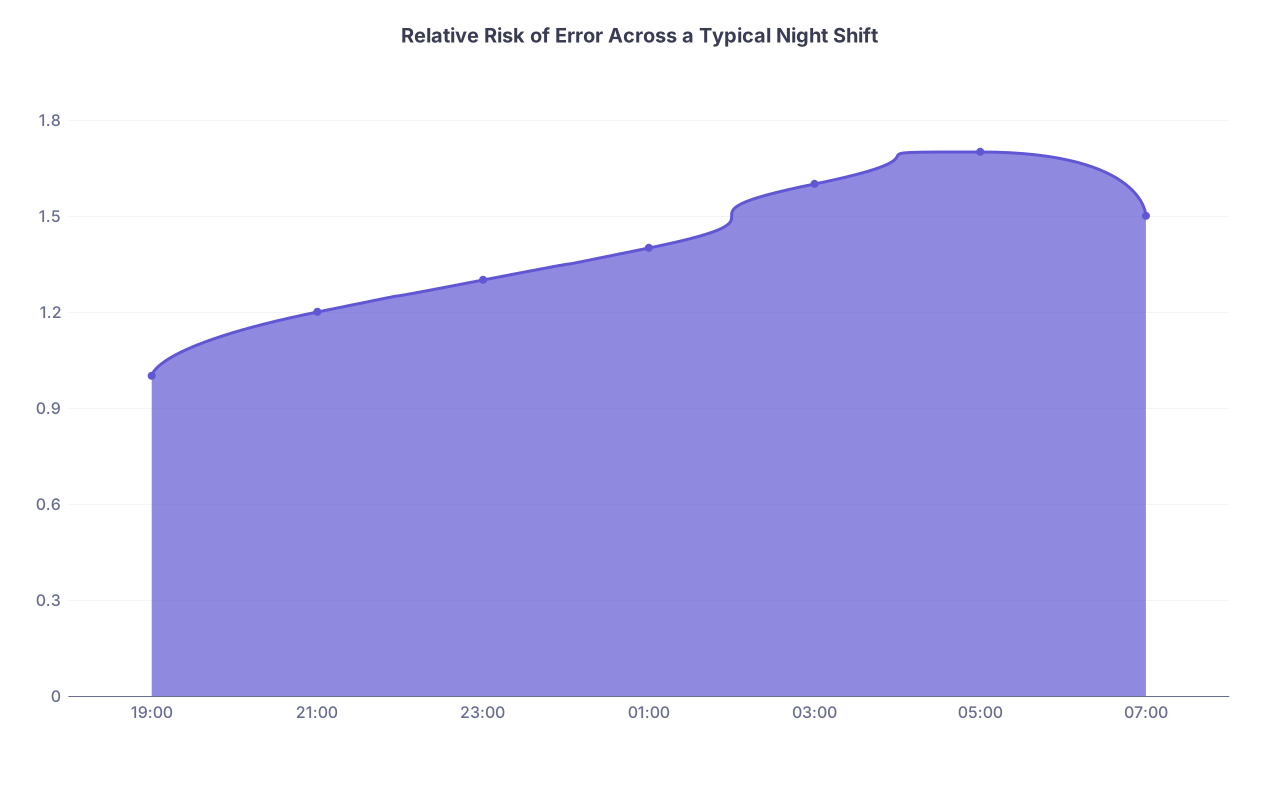
If you want a visual model of where risk piles up across the night, picture a simple curve:
| Category | Value |
|---|---|
| 19:00 | 1 |
| 21:00 | 1.2 |
| 23:00 | 1.3 |
| 01:00 | 1.4 |
| 03:00 | 1.6 |
| 05:00 | 1.7 |
| 07:00 | 1.5 |
Early evening: handoff‑related and admission‑related mistakes.
Middle night: overload and interruptions.
Pre‑dawn: sheer cognitive exhaustion.
Being aware of that pattern is not academic. It should drive how you structure your time and what you choose to do when.
The bottom line: what the on‑call data really reveals
Strip away the mythology and the data says three blunt things:
- Night float shifts are measurably riskier for patients, mostly due to handoffs, workload, and system thinness, not just “tired interns.”
- Well‑designed night systems with structured handoffs, capped workload, and real supervision can cut error rates significantly, even if they do not magically transform mortality curves overnight.
- At the resident level, the highest‑leverage moves are ruthless handoff discipline, cognitive load management, and explicit escalation habits during the known risk windows of the night.
You cannot control everything about your night float system. But you are not powerless. The data is clear about where the traps are. And once you see the patterns, you start making different choices at 2 a.m.—the kind that quietly keep patients alive.