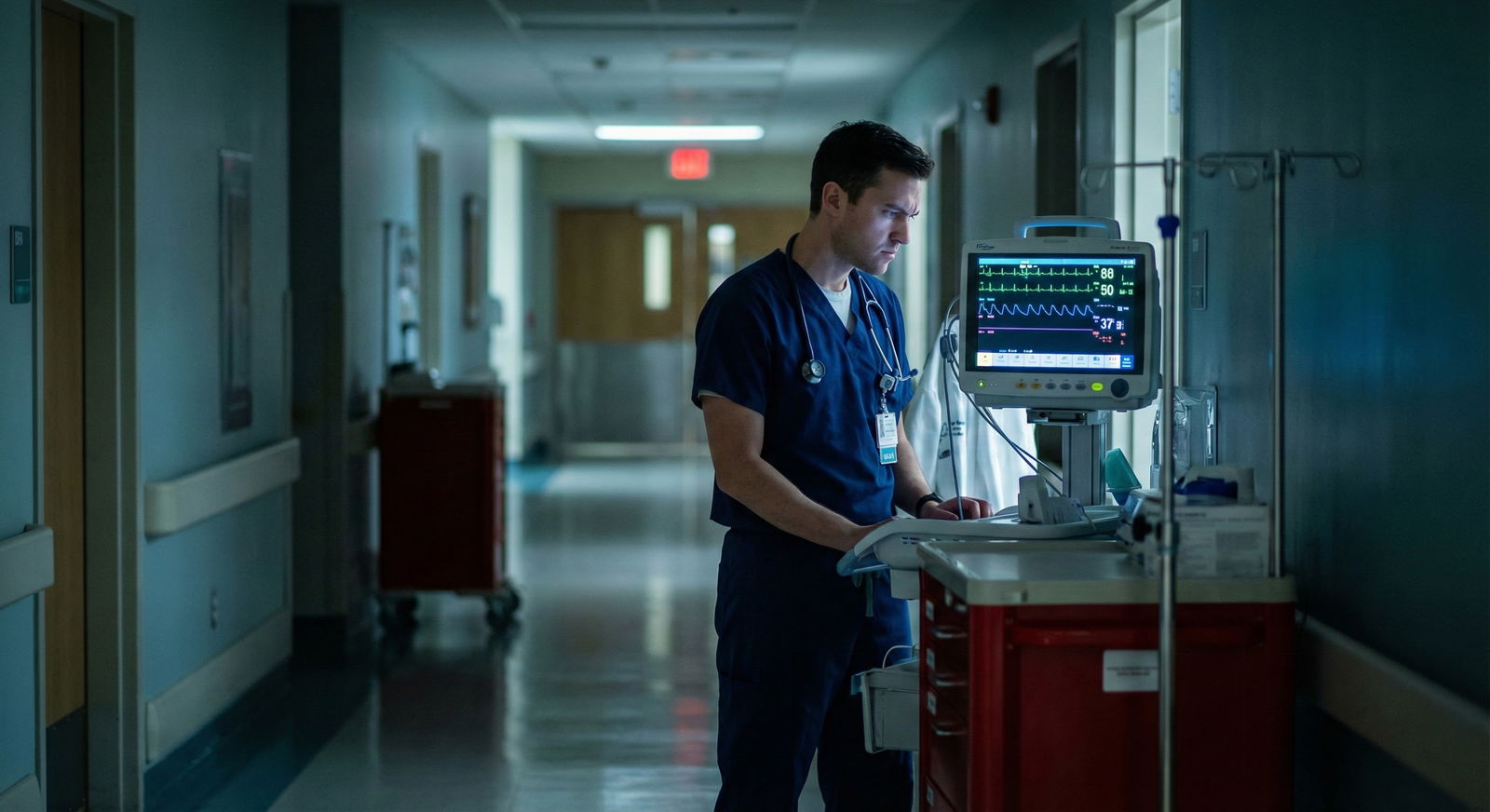
Only 10–15% of ICU monitor alarms are clinically actionable. Yet residents on night shift are exposed to hundreds of them in a single call.
That is the problem in one sentence: overwhelming signal, tiny fraction of real danger. The data show your brain adapts by tuning out the noise. That adaptation protects your sanity—until it misses the one alarm that actually matters.
Let’s quantify what you are up against and what you can do, using numbers instead of vague “be more vigilant” advice.
1. How many alarms are we actually talking about?
Start with scale. Because most people underestimate it badly.
Published studies across ICUs and step-down units report:
- 150–350 monitor alarms per patient per day in high-acuity ICUs
- 80–150 alarms per patient per day on step-down/telemetry units
- 20–80 alarms per patient per day on general floors with telemetry
Take a realistic night shift scenario:
- 20-bed ICU
- 25-bed step-down
- 15-bed general floor with telemetry
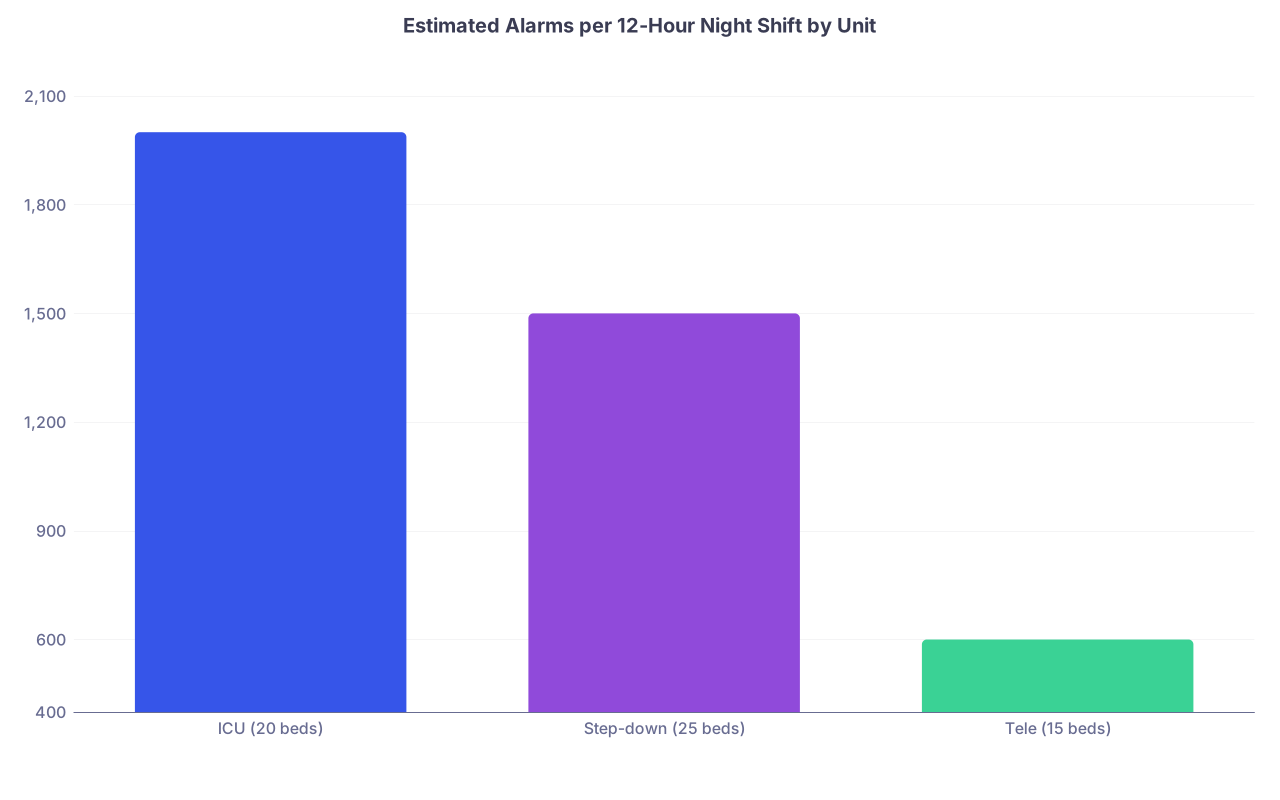
Even with conservative numbers, a night float senior covering those areas is existing in a soundscape of thousands of alerts.
| Category | Value |
|---|---|
| ICU (20 beds) | 2000 |
| Step-down (25 beds) | 1500 |
| Tele (15 beds) | 600 |
That bar chart is still an underestimate. I have seen 1,000+ alarms logged in a single ICU patient over 24 hours when limits are wide and leads keep falling off.
Now overlay clinical relevance:
- Only 5–25% of alarms are usually “clinically relevant” (may require assessment).
- Only 1–10% are truly “actionable” (require an intervention).
So if you hear ~4,000 alarms across areas you cover during a long night, the data say:
- 200–800 may be clinically relevant
- 40–400 may be genuinely actionable
- 3,600+ are essentially noise
You are, quite literally, outnumbered.
2. What is alarm fatigue, quantitatively?
Alarm fatigue is not a feeling. It is a measurable degradation in performance after repeated exposure to non-actionable alarms.
The pattern that research shows:
- Response time increases as the false-positive rate rises.
- Probability of responding at all decreases with repeated false alarms.
- Cognitive load from sorting alarms competes directly with diagnostic thinking and task completion.
In one multisite study, when more than 85% of alarms were false or non-actionable:
- Response time to any given alarm stretched into minutes.
- Staff frequently waited for alarms to repeat before checking.
Your brain is doing a crude Bayesian update: if 9 of the last 10 alarms were nonsense, you unconsciously assign a low prior probability that the current one matters.
Now place this inside your night shift reality:
- You are already sleep-deprived
- You are cross-covering more patients than day teams
- You often lack baseline familiarity with half of them
- You are juggling pages, admissions, cross-cover issues, documentation
That combination is structurally hostile to careful signal detection. This is not personal weakness. It is how human cognition reacts to noisy, low-yield environments.
3. Why night shift multiplies the risk
Night shift is not just “the same medicine, in the dark.” The statistics change.
3.1 Error rates and night work
Meta-analyses across hospitals show:
- Overall clinical error rates are 20–30% higher at night than during the day.
- Serious adverse events cluster in two periods: 02:00–04:00 and 05:00–07:00.
Those are the same hours when your circadian alertness is at its lowest. Now combine that with alarms.
In one telemetry-monitoring study:
- ~70% of lethal arrhythmias occurred at night.
- Response times to alarms were longer at night than during day shifts, even after adjustment for staffing.
That is the collision: increased intrinsic risk + slower response.
3.2 Staffing ratios and the math of divided attention
Let’s run some crude ratios.
Assume at night:
- 1 resident cross-covering 40–70 inpatients
- 2–3 RNs per 10–12 patients, depending on unit
- One telemetry tech watching 20–40 monitors
Now assign alarms.
Say you personally are exposed (directly or via nurse pages) to 150–300 alarms during a 12-hour night. That is:
- 12.5–25 alarms per hour
- Roughly one alarm every 2–5 minutes
While also:
- Admitting new patients
- Writing notes and orders
- Managing cross-cover events
- Checking labs and imaging
- Trying not to miss a sepsis patient in early deterioration
No human sustains high-fidelity vigilance at that density. The false alarm rate drives desensitization.
4. The false alarm problem: sensitivity vs specificity
The core of the alarm fatigue issue is plain: the system is tuned for maximum sensitivity, at the cost of atrocious specificity.
Let me put this in a basic decision table. Imagine a simple cardiac monitor alarm for “tachycardia > 120 bpm.” Over a night, across a monitored unit:
- True events where HR >120 and truly dangerous: maybe 5–10
- Benign or transient tachycardias >120: easily 200+
- Spurious readings from artifacts: another 50–100
| Outcome Type | Approximate Count | Percentage of Alarms |
|---|---|---|
| True dangerous events | 5–10 | 2–4% |
| Benign/transient HR | 200+ | 70–80% |
| Artifacts/noise | 50–100 | 20–25% |
So every time that alarm pops off, the base rate tells you:
- 2–4% chance this is a genuinely dangerous rhythm or deterioration
- 96–98% chance it is not
You can lecture yourself to “treat every alarm as serious.” Your prior probabilities do not care. Over a shift, your behavior will drift toward the statistics.
This is exactly how you end up with:
- Staff silencing alarms longer than recommended
- “Bundling” responses (waiting to enter a room until multiple alarms occur)
- Ignoring alarm tones that have become constant background
From a data standpoint, your brain is optimizing for specificity in an environment that the hardware has optimized for sensitivity. That mismatch is where risk lives.
5. What actually goes wrong: patterns in real events
Ask around after a root cause analysis of a serious night event and you hear eerily similar phrases:
- “That monitor had been beeping all night.”
- “We thought it was just artifact, like earlier.”
- “The alarms were going off constantly; this one did not sound different.”
- “I was in a code in the next room when this alarm fired.”
The literature mirrors those anecdotes.
In one large review of alarm-related deaths:
80–90% involved alarms that did sound but were:
- Silenced
- Turned off
- Ignored
- Missed due to competing noise or task load
Contributing factors commonly documented:
- High alarm burden in the area
- Inappropriately tight or broad parameter limits
- Poor communication about high-risk patients
- Equipment setup errors (misplaced leads, muted volumes)
Night shift magnifies all four.
You walk into sign-out at 6:30 pm, get a list of “sick but stable,” “kind of touchy pressures,” “ignore the HR alarms in 10B, chronic afib.” By 2 am, after hearing that room’s alarm 40 times with no actual instability, your willingness to sprint to that doorway is predictably lower.
The risk is not theoretical. It is baked into the exposure pattern.
6. Practical risk management: what the numbers say actually helps
You are not going to redesign your hospital’s monitor system as a PGY-2 on nights. But you can bend the risk curve with a few targeted, evidence-backed choices.
None of these are motivational posters. They are interventions that studies show reduce alarm load or improve detection.
6.1 Attack unnecessary alarms at the source
Reducing the denominator (total alarms) is the fastest way to reduce fatigue.
The data show that a large fraction of alarms are caused by:
- Poor lead placement or adhesive failure
- Patients ambulating or being turned without pausing or adjusting monitors
- Non-tailored vital sign thresholds
Concrete moves before midnight:
During your first rounds, ask nurses: “Which rooms are driving you crazy with alarms today?”
- Those rooms are almost always artifact- or threshold-driven.
- Spend 30–60 seconds per room reviewing monitor settings with the RN.
Tailor alarm limits for end-stage or chronically abnormal patients.
For example:- Chronic COPD patient with baseline sat 88–90% on home O2
- Default low SpO2 limit of 92% guarantees near-constant alarms
- Adjusting lower limit to 85–86% (with attending approval and policy adherence) removes dozens of non-actionable alarms without increasing real risk.
Studies where units did structured alarm customization:
- Reduced total alarm counts by 30–60%
- Did not increase critical event rates
That is a strong trade-off in your favor.
- Proactively request discontinuation of monitoring that is no longer indicated.
- Step-down patient now stable, on room air, day 5 post-op, but still on continuous SpO2.
- One order to discontinue removes hundreds of meaningless alarms over the next 24 hours.
Yes, you will annoy whoever loves “more monitoring is safer.” But the data do not support that belief when false alarm burden is high.
6.2 Use a simple triage hierarchy for night alarms
Treat alarms like any other triage problem. They are not all equal.
Create a mental three-tier system:
Tier 1: Immediately dangerous or high-pretest probability
- Asystole, ventricular tachycardia, ventricular fibrillation
- Sustained profound desaturation in a high-risk respiratory patient
- MAP < 55 in someone septic or bleeding
These get interrupted, immediate attention. Even if you are in the middle of notes.
Tier 2: Potentially important but often false/benign
- Single runs of nonsustained VT
- Transient desats in known OSA on CPAP
- Mild tachycardia in someone febrile but otherwise stable
These get checked promptly but can be batched with other nearby tasks.
Tier 3: Chronic background or likely artifact
- Occasional tachycardia alarms in chronic afib patient already rate-controlled
- Spurious apnea alarms in a clearly awake, talking patient
These get pattern-based responses (verify at intervals, but do not sprint every time).
This is essentially a prioritization algorithm. It acknowledges that your cognitive bandwidth is finite. The point is not to ignore Tier 3. It is to keep Tier 1 from being buried inside a pile of Tier 3 noise.
6.3 Build “alarm-aware” sign-out on nights
Night risk spikes when you do not know which alarms matter more.
Before you accept sign-out:
Ask for three specific items:
- “Who are the three patients you are most worried about tonight?”
- “For each, what alarm or vital sign change would you want me to respond to immediately?”
- “Which alarms or vitals are noisy/expected and can be de-prioritized?”
Write those down. Not just in your head.
What this does statistically: It raises your prior probability that an alarm in those high-risk patients is meaningful. That cuts through some noise bias.
You will still get flooded. But at 3 am, when both 10B and 6C alarm at once, you have a data-informed hierarchy instead of gut feeling.
6.4 Know your personal failure window and protect it
Everyone has a time window where cognitive performance craters. For most on night rotation, it centers between 03:00 and 05:00.
The research matches what you already feel:
- Reaction times slow
- Working memory drops
- Probability of missing environmental cues increases
That is exactly when alarm fatigue is most dangerous.
So treat those hours as “high-risk mode” and adjust:
- Avoid stacking complex tasks (admission H&Ps, long notes) during 02:30–04:30 if you have flexibility.
- Do a quick focused safety round around 02:00:
- Hit the rooms of your three highest-risk patients
- Review current vitals and trends
- Update your mental model so that each alarm that fires has context
You are not eliminating fatigue. You are tightening control around the worst part of the curve.
7. Team-level strategies you can push for
You are one person in a large system. But residents actually have leverage, especially when you come armed with numbers.
Realistic asks:
Alarm reports from biomed or IT
- Many hospitals can generate unit-level alarm statistics by type, time, and device.
- Having a plot that shows 2,500+ alarms overnight on a 20-bed unit is far more persuasive than “it feels noisy.”
Unit alarm limits review project
- As a QI initiative, work with nurses and attendings to define standard but sensible default limits per patient type.
- Track pre- and post-intervention alarm counts and rapid response/code rates.
Escalation routing sanity checks
- In some places, every minor alarm pages the same resident’s phone.
- You can advocate that certain low-risk alarms stay at the nurse / telemetry tech level with a defined escalation rule (e.g., “if persistent > 5 min, then page resident”).
Education that is not just “be more careful”
- Teach interns and nurses the actual numbers: what fraction of alarms are false, what design flaws exist.
- Normalize talking about alarm fatigue instead of silently blaming individuals after events.
System changes are slow. But data-backed requests get more traction than complaints.
8. Mental framing: this is not about heroism
One trap I see residents fall into: believing that enough personal dedication will override the statistics. That if you care enough, you will hear the right alarm.
The data say otherwise.
You are operating inside:
- Bad base rates (very low true-positive fraction)
- Chronic overload (high alarm counts, too many patients per provider)
- Suboptimal devices (poor specificity, poor differentiation of priority)
- Human biology (circadian lows, fatigue, cognitive limits)
You do not “willpower” your way out of that. You design around it. You reduce the number of alarms that do not matter. You structure your attention where it buys the most risk reduction. You push your unit or program toward better configurations.
That is not cynical. It is the only honest way to protect your patients and yourself.
| Category | Value |
|---|---|
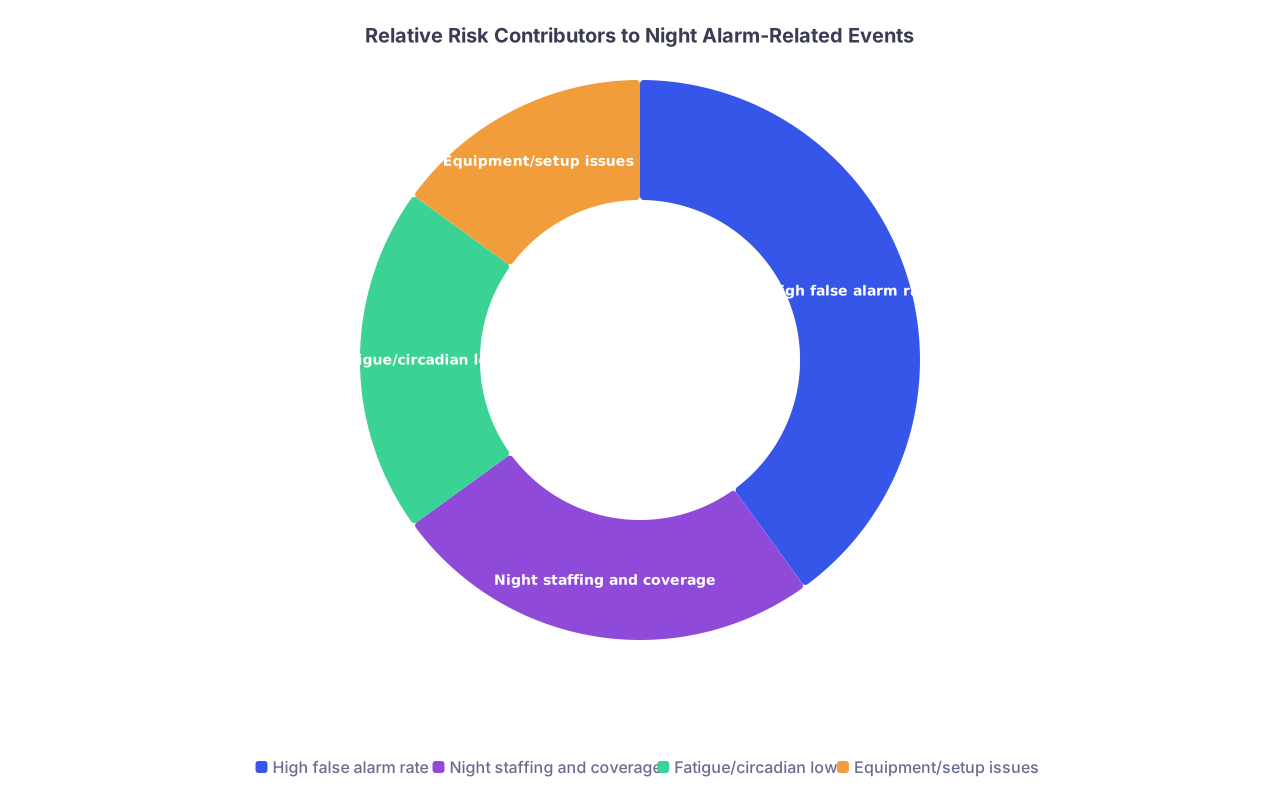
| High false alarm rate | 40 |
| Night staffing and coverage | 25 |
| Fatigue/circadian low | 20 |
| Equipment/setup issues | 15 |

| Step | Description |
|---|---|
| Step 1 | Alarm sounds |
| Step 2 | Immediate check |
| Step 3 | Prioritized response |
| Step 4 | Batch with other tasks |
| Step 5 | Assess cause |
| Step 6 | Intervene |
| Step 7 | Adjust settings or leads |
| Step 8 | Tier 1 criteria? |
| Step 9 | High risk patient? |
| Step 10 | Actionable? |
FAQ (3 questions)
1. Is it ever reasonable to widen alarm limits or turn off certain alarms at night?
Yes, when done thoughtfully and within policy, it can be safer. The data show that customizing alarm thresholds to a patient’s documented baseline reduces total alarms by 30–60% without increasing serious events. For example, lowering the SpO2 alarm limit for a chronic CO2 retainer with baseline sats in the high 80s removes a flood of meaningless alarms while still catching true deterioration. What is not acceptable is ad hoc muting or disabling without documentation or team agreement. The key distinction: deliberate, charted customization versus quiet, undocumented silencing driven by frustration.
2. How do I balance ignoring “junk alarms” with the fear of missing something serious?
Use a structured hierarchy and prior probabilities rather than raw fear. Start by identifying your three highest-risk patients on sign-out and what specific changes would concern the day team. Treat alarms in those patients as high-priority Tier 1–2 and respond immediately or very quickly. For others, identify patterns where alarms have repeatedly been benign (e.g., motion artifacts, known afib with occasional HR spikes) and verify with spot checks rather than sprinting every time. You will still miss some harmless noise—but you sharply improve the chance of catching the rare, truly dangerous event without burning out.
3. What can I actually do as an intern or junior resident to change alarm culture?
Start small and specific. During your first evening rounds, ask nurses which rooms are driving alarm overload and tackle those: check leads, review thresholds, discontinue monitoring that is clearly no longer indicated (with attending approval). Bring actual numbers to your chief or QI committee: estimated alarm counts, times of worst overload, examples where monitoring is misaligned with need. Offer to help with a limited-scope pilot—like standard alarm bundles for one unit or one patient type. You will not fix the entire system in a month, but even a targeted 20–30% reduction in false alarms on your night rotation is a real, measurable impact for you, the nurses, and your patients.
Key points: First, the vast majority of alarms you hear at night—often >90%—are not actionable, and your brain adapts by ignoring them. Second, that adaptation is predictable and dangerous when combined with night staffing, fatigue, and high patient loads. Third, you can bend the risk curve by aggressively shrinking unnecessary alarms, prioritizing high-risk patients, and pushing your unit toward data-driven alarm practices instead of relying on individual heroics.