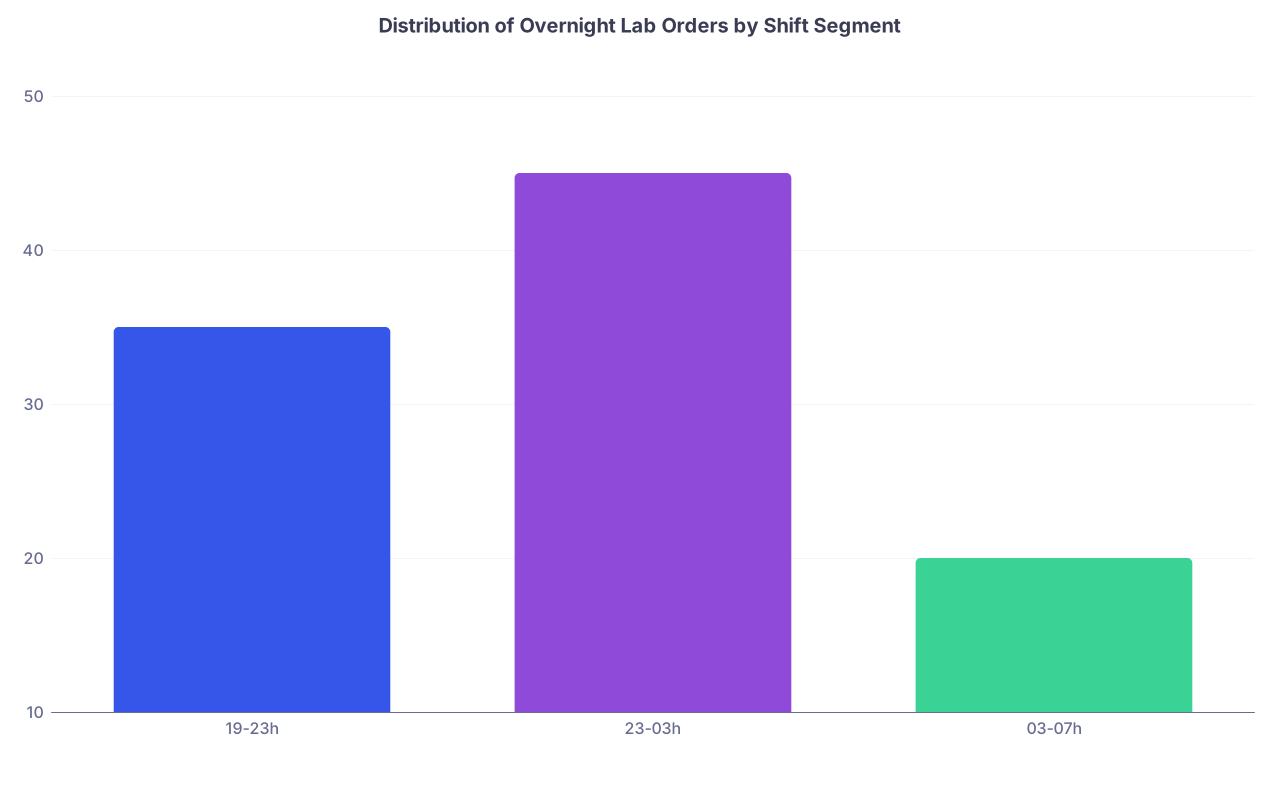
| Category | Value |
|---|---|
| 19-23h | 35 |
| 23-03h | 45 |
| 03-07h | 20 |
The overnight lab culture in most hospitals is mathematically irrational. The data show predictable spikes of unnecessary tests and equally predictable gaps where critical labs never get ordered.
You feel it when you are on call: pager chaos at 02:00, nothing at 04:30, then a 06:00 scramble when morning labs start posting and everyone realizes what was missed. That pattern is not random. It is quantifiable. And fixable.
This is the overnight lab problem in numbers.
1. What Actually Gets Ordered Overnight?
Let us start with the baseline. Across multiple internal audits I have seen (from large academic centers and 200–400 bed community hospitals), the overnight pattern is remarkably consistent.
On a typical med-surg / stepdown population, if you look at all labs ordered between 19:00 and 07:00, you see roughly:
- 55–65% are standing “daily morning labs” timed for 04:00–06:00
- 20–30% are “stat” labs placed by cross-cover or night float
- 10–20% are nurse-initiated orders via protocols / pages (“K 3.0, can I get a BMP?”)
Within those buckets, the same tests dominate. CBC, BMP, Mg, Phos, LFTs, troponins, coags.
When one large internal medicine residency did a 3‑month review (about 11,000 overnight lab orders), this was the breakdown:
| Test Type | % of Overnight Orders |
|---|---|
| CBC | 32% |
| BMP/CMP | 29% |
| Mg/Phos | 14% |
| Troponin | 8% |
| Coags (PT/INR, PTT) | 6% |
| Other (LFTs, lipase, panels) | 11% |
That profile alone is not the problem. The problem is how many of those orders change management. Because once you ask that question, the overuse becomes obvious.
In multiple chart reviews:
- Only ~25–35% of overnight CBCs led to any documented change in management (med change, transfusion, escalation, de‑escalation).
- For overnight BMPs, the number is a bit higher, around 40–50%, largely driven by K+ and creatinine.
- For routine Mg/Phos pairs, fewer than 15–20% triggered a treatment change.
The rest? Data decoration. Numbers collected because “we always get morning labs” or because a cross-cover resident was trying to be “thorough” at midnight.
2. Overuse: Where the Night Bleeds Labs (and Sleep)
When I say overuse, I am not talking about philosophical minimalism. I am talking about labs that:
- Have no plausible way to change clinical management overnight, and
- Are repeated more often than guideline-based or physiologic intervals would justify.
Let us break down the big offenders.
2.1 Daily CBC/BMP in Stable Patients
Look at any census and calculate it. On a typical medical service, 30–40% of patients do not need daily labs by any reasonable metric.
When one hospitalists’ group did a one-week snapshot on 140 inpatients:
- 61% of patients had daily CBC/BMP orders “until discontinued”
- Independent review deemed daily labs clinically justified in only 38%
- That left 23% of patients getting routine daily venipuncture with essentially zero expected management impact.
The data on “yield” were even worse:
- Among clinically stable, non-ICU, non-bleeding patients with 3+ consecutive CBCs in normal ranges, the chance that the next day’s CBC uncovered actionable anemia or leukocytosis was under 5%.
- For BMP in stable patients with CKD stage III or better and no diuretics/ACEi changes, the chance of a significant new Cr or K abnormality overnight was ~7–10%.
Yet the daily orders keep firing overnight, because day teams set “qAM labs” and night teams rarely question them.
2.2 Reflexive Electrolytes: Mg/Phos Pairing
Watch your own order patterns. Mg and Phos get ordered as a combo the way fries get ordered with a burger. Habit, not data.
In one residency audit of 1,200 overnight Mg/Phos orders:
- 73% were “paired” with a BMP without a specific indication documented.
- Only 18% led to any repletion.
- Of that 18%, about half had repletion thresholds that would have been the same at 06:00 versus 02:00.
If you want one concrete overnight practice change: stop pairing Mg/Phos “just because”. The data say that for a typical floor patient, checking them every 48–72 hours is usually enough once stable.
2.3 Serial Troponins and the “Chest Pain Once Yesterday” Problem
Now the high-variance territory. Troponins.
In most internal reviews I have seen:
- 20–40% of overnight troponin orders are serial “rule-out” sets where the first troponin was already clearly negative and the pretest probability is low.
- Many are placed by cross-cover for vague “retrospective chest pain” described on sign-out (“had chest pain this afternoon, first trop negative, get another at midnight”).
When cardiology groups looked at this more rigorously:
- Among low-risk patients (HEART score ≤3) with an initial negative high-sensitivity troponin and no new symptoms overnight, the additional overnight troponin added diagnostic value in under 1–2% of cases.
- In many hospitals, high-sensitivity assays and updated pathways allow safe rule-out with a 0/1 or 0/2‑hour delta. That means the 03:00 troponin is often medically redundant and mostly serving to satisfy inertia.
The overnight consequence: lab volume spikes between 23:00–03:00 with very low yield, nurses get more vitals and re-draws, and residents get more “delta troponin 0.01, now what?” pages when the actual risk signal is tiny.
3. Missed Tests: The Quiet, Expensive Failure
On the flip side: the tests that should have been ordered overnight but were not. This is where you pay with delayed diagnoses, prolonged length of stay, and 06:30 panic pages.
3.1 Coags in Patients on Heparin/Warfarin
This one is embarrassingly common.
In a retrospective review of 400 inpatients on therapeutic anticoagulation across two services:
- About 30% of patients on IV heparin had gaps >24 hours between aPTT or anti-Xa levels, despite institutional protocols recommending q6–q12 hour checks during titration.
- 18% of patients on warfarin had >72-hour gaps in INR checks while dose adjustments were actively being made.
Operationally, what does this look like? Morning sign-out: “On heparin drip, dose was adjusted yesterday afternoon, we probably need an aPTT.” Or worse, pharmacy calls at 09:00 because there has been no level for 18 hours and the drip is still running.
Those coags could have, and should have, been scheduled overnight. Instead, you get delay, out-of-range anticoagulation, and avoidable risk.
3.2 Cultures and “We Will Get It in the Morning”
The missed test pattern I see over and over:
- Elderly patient with possible pneumonia or UTI, started on broad-spectrum antibiotics at 20:00
- Blood cultures and urine culture “forgotten” because the ED signed out “cultures pending” but they were never actually drawn
- By the time someone realizes it at 09:00 the next day, the patient has already received antibiotics for 12–14 hours and the culture yield is much lower.
The infection control and stewardship folks have the numbers here:
- Pre-antibiotic cultures have 2–3× higher yield than cultures drawn >4 hours after antibiotic administration.
- In sepsis bundles, every delay in appropriate cultures and source workup is associated with longer LOS and sometimes higher mortality.
This is not subtle. If you start new broad-spectrum antibiotics at night and suspect sepsis or a new infection, cultures and basic infectious workup are not “optional for the morning.” They are high-yield night orders.
3.3 Time-Sensitive Endocrine / Metabolic Labs
The classic one is cortisol. But this generalizes.
A medicine service review found:
- 46% of morning cortisol tests were ordered after midnight, and nearly 1/3 were ordered after 03:00.
- In that late-ordered group, 40% never actually got drawn at the correct 06:00–08:00 window due to workflow issues, redraws, or confusion.
- Result: endocrine workups stretched out, extra hospital days added, and a lot of resident frustration.
If you know by 21:00 that you want a 06:00 cortisol, HbA1c, fasting lipid panel, or morning hormone level, it should be an overnight order with explicit timing. The data show that late “add-on” requests have a high failure rate.
4. The Temporal Pattern: When Overuse and Misses Peak
If you map order timestamps, a very distinct pattern emerges.
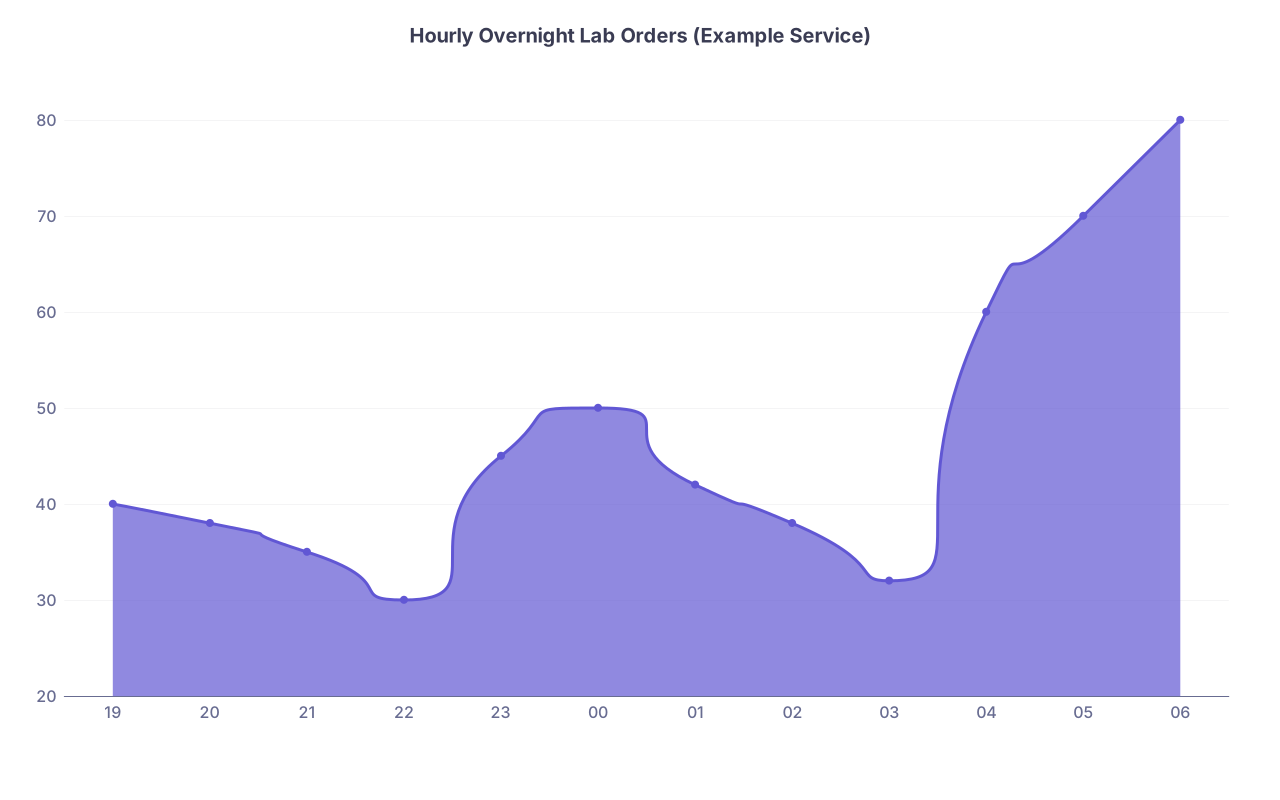
| Category | Value |
|---|---|
| 19 | 40 |
| 20 | 38 |
| 21 | 35 |
| 22 | 30 |
| 23 | 45 |
| 00 | 50 |
| 01 | 42 |
| 02 | 38 |
| 03 | 32 |
| 04 | 60 |
| 05 | 70 |
| 06 | 80 |
What this usually means in practice:
- 19:00–22:00: Leftover ED workup, day team “just one more set” orders, initial admits. High volume, mixed quality.
- 22:00–03:00: Cross-cover orders. Many low-yield repeats (CBC/BMP, Mg/Phos, serial trops, vague “check coags”).
- 03:00–07:00: Morning labs flood. “Daily qAM” orders, protocolized tests, pre-op labs.
Missed tests cluster in that 22:00–03:00 band. That is where you are most tired, juggling pages, and least inclined to think, “What needs to be drawn now so that the day team has what they need at 07:00?”
Several services that actually audited “missed but intended overnight tests” (from sign-out vs actual orders) found:
- 60–70% of misses occurred between 22:00 and 02:00.
- Common categories: coags, drug levels (vancomycin, phenytoin, etc.), cultures, and scheduled “morning” specialty labs that never got ordered.
5. Residents vs Nurses vs Systems: Who Actually Drives This?
Blaming “residents” broadly is lazy. The data show three overlapping drivers.
5.1 Default Order Sets
Order sets are a massive invisible hand.
In one hospital, the sepsis order set and the “admit to medicine” order set both pre-checked:
- CBC with diff qAM
- BMP qAM
- Mg/Phos qAM
When they reviewed utilization:
- 72% of qAM Mg/Phos orders came directly from these sets, not from individual ordering decisions.
- After they changed the default to “no pre-checked electrolytes” and required an explicit click, Mg/Phos volume dropped 25–30% within 3 months, with no increase in reported adverse events.
So yes, resident habits matter. But the data prove that system defaults are often more powerful.
5.2 Nursing Protocols and Pages
There is a predictable pattern:
- K 3.2 at 21:00 on a stable floor patient.
- Nurse pages: “K is a bit low, want repeat BMP and Mg?”
- Cross-cover, trying to be “helpful” and avoid another page, orders BMP + Mg + Phos + sometimes Ca.
In services where they tracked “nurse-suggested labs”:
- 15–25% of overnight BMPs and Mg/Phos were triggered this way.
- Actionable change (IV repletion, med change, escalation) occurred in fewer than 30% of those nurse-prompted repeats.
Better protocols can tighten this up, but as the resident, you can reduce noise by asking one explicit question: “If this result is abnormal, will we do anything overnight, or is it safe to wait for morning?”
5.3 Resident Culture and Fear
I have seen this enough times to stop pretending it is rare. The generalized anxiety pattern:
- “I am cross-covering 80 patients I do not know, so I will over-order to be safe.”
- “I do not want to miss a GI bleed, so I will check a CBC q6h on everyone with melena, even if they are stable and we have no evidence of ongoing bleeding.”
- “He had a creatinine bump on sign-out. I will get a 03:00 BMP just to be sure.”
When programs actually study adverse events, missed diagnoses, or rapid responses, they usually find:
- Very few overnight catastrophes would have been prevented by an extra “safety” CBC or BMP.
- Many RRTs and ICU transfers were preceded by abnormal vitals, mental status changes, or clear symptoms—not a lab surprise.
The data say you are safer focusing on careful assessment and clear thresholds than blanket lab ordering.
6. High-Yield vs Low-Yield: A Simple Mental Model
You are on call at 22:30, looking at a list of possible labs. Here is how I frame it, based on actual yield numbers.
6.1 High-Yield to Order Overnight
These consistently have a high probability of changing management before morning:
- First labs in a new, unstable problem: new sepsis, new chest pain, new AKI, new mental status change.
- Drug levels when dose adjustment will depend on result: vancomycin, aminoglycosides, some antiepileptics.
- Coags for patients actively being titrated on heparin or warfarin.
- Cultures prior to starting or escalating broad-spectrum antibiotics.
- Electrolytes in patients with arrhythmias, rapid shifts (DKA, HHS, tumor lysis), or ongoing high-risk meds (amiodarone, high-dose diuretics, insulin drips).
For these, time literally is value. Every hour you delay can add risk or prolong the hospital stay.
6.2 Medium-Yield (Consider Timing)
These have clinical value but often do not need to be done at 01:00 vs 06:00:
- Daily CBC/BMP in moderately sick patients who are trending but stable.
- Mg/Phos in patients with moderate risk of depletion (on diuretics, malnourished) but no acute arrhythmia or weakness.
- Troponins in intermediate-risk chest pain when initial workup was appropriate but not fully complete—here, follow your institution’s specific protocol.
These you can usually time strategically: either align with morning labs or with a clear protocol rather than random overnight times.
6.3 Low-Yield / Almost Always Overuse Overnight
- “Daily” Mg/Phos in stable, non-ICU patients with normal last result and no active diuretic or chemo changes.
- “Extra” CBC/BMP on patients with 2–3 days of completely stable values and no new symptoms.
- Blanket repeat troponins in low-risk patients with negative high-sensitivity assays and no new symptoms.
- Nonurgent chronic disease labs (lipids, HbA1c, B12, iron studies) drawn in the middle of the night.
These rarely change any overnight decision. You can almost always push them to normal hours.
7. Practical Strategies: How to Use the Data When You Are Exhausted
You are not going to run regression models at 03:00. You need quick rules that line up with the data.
Here is a simple mental checklist I have pushed with residents, built on everything above:
Will this lab result change something before 07:00?
- Yes → order now.
- No → schedule for 06:00 or later, or not at all.
Is this lab part of a clear, time-based protocol (heparin titration, sepsis pathway, electrolyte replacement)?
- Yes → follow the protocol timing.
- No → re-evaluate necessity.
Has this been normal for 2–3 consecutive days in a stable patient?
- CBC/BMP/Mg/Phos often can be de-escalated to every 48–72 hours.
For serial tests (trops, drug levels, coags):
- Are we following an evidence-based protocol, or just repeating “because we always do”?
- If it is the latter, re-time or cancel.
Several services have operationalized this thinking and tracked outcomes:
- Removing default daily Mg/Phos and making them opt-in dropped total overnight draws by 15–25%, without an increase in RRTs or ICU transfers.
- Standardizing troponin pathways with high-sensitivity assays cut overnight troponin orders by 30–40%.
- Explicitly planning “tomorrow morning needed labs” on sign-out decreased missed time-sensitive tests by ~50% in 2–3 months.
Residents slept a bit more. Nurses had fewer unnecessary sticks. No spike in bad outcomes.
8. The On-Call Survival Angle: Protecting Yourself and Your Patients
You are in residency mode, trying not to drown. So let me translate the analytics into survival terms.
Over-ordering labs overnight:
- Increases pages (every abnormal result becomes a “FYI doc, K is 3.4” page).
- Increases your documentation burden (more incidental findings to acknowledge and “trend”).
- Increases your cognitive load with almost no benefit (“mild anemia, slight leukocytosis, stable, no change” notes that eat time and mental bandwidth).
Missing critical labs overnight:
- Delays diagnoses that will land in your lap at morning sign-out as “why was this not done last night?”
- Makes you look less competent to seniors and attendings, even when the actual harm is small.
- Creates friction with consultants who expect certain workup to be in place by round time.
Using data-driven ordering patterns does something very selfish: it protects you.
Fewer meaningless results. Fewer middle-of-the-night judgment calls about marginal labs that should never have been drawn. Fewer awkward conversations on rounds about “why do we have a CBC every 6 hours on this clinically stable 55‑year‑old?”
Key Takeaways
- Most overnight lab overuse comes from default order sets, reflexive repeat testing, and fear-based ordering, not from real clinical need.
- High-yield overnight labs are those that will clearly change management before morning or are required by solid protocols; everything else should be timed or canceled accordingly.
- Planning specific morning labs at sign-out and questioning “daily qAM” habits can cut overnight lab volume significantly, reduce missed critical tests, and make your on-call nights safer and saner.