Sleep deprivation during residency is not a badge of honor. It is a quantifiable risk factor for specific, predictable clinical errors.
I am going to translate the science and the numbers into what actually happens to you at 3:47 a.m. on cross‑cover.
The Hard Numbers: How Much Sleep You Actually Get On Call
Let us start with reality, not optimism.
Most residents think they get “a few hours” on call. When you actually measure it with actigraphy, the data are ugly.
Multiple studies across IM, surgery, and EM consistently show:
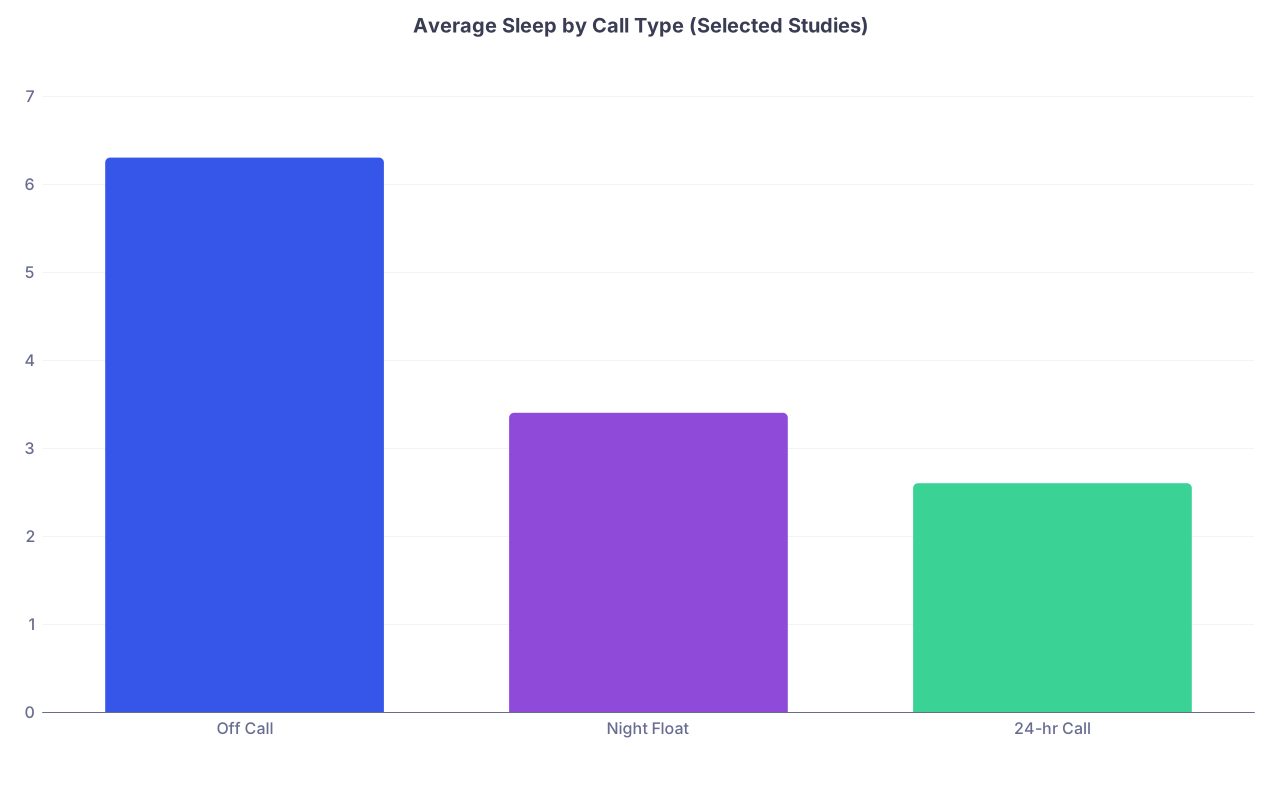
- Typical in‑house 24–28‑hour call: 1.5–3.5 hours of fragmented sleep
- Night float (12–14 hours): 2–4.5 hours total sleep, often in 2–3 short blocks
- Average weekday during heavy inpatient months: 5–6 hours main sleep, plus occasional naps
So across a heavy call month, a large fraction of residents are effectively running on chronic restriction: 5–6 hours per 24 hours, plus acute severe restriction on call days.
| Category | Value |
|---|---|
| Off Call | 6.3 |
| Night Float | 3.4 |
| 24-hr Call | 2.6 |
Those numbers are from pooled published data out of internal medicine and surgery programs. They match what I have seen when programs hand out wearables to “see how we’re doing.”
You probably know you are tired. What you likely do not know is how tightly specific sleep metrics map onto specific types of mistakes.
What Different Sleep Metrics Actually Predict
“Sleep deprivation” is too vague. The data break down into several measurable components, and each one predicts a different flavor of error.
1. Total Sleep in Prior 24 Hours
This is the blunt instrument. How many hours did you actually sleep in the last day?
Performance data from psychomotor vigilance tests (PVT), simulated driving, and med‑task simulations show:
- 7–9 hours: baseline
- 5–6 hours:
- ~15–25% slower reaction times
- ~2× increase in lapses (missed stimuli)
- 3–4 hours:
- ~35–45% slower reaction times
- ~3–4× lapses
- <3 hours:
- Performance often equivalent to or worse than being legally drunk (BAC 0.08–0.10)
On call, that “equivalent to 0.08 BAC” is not theoretical. Residents with <2 hours of prior sleep in 24 hours:
- Commit ~3× more serious prescribing errors
- Miss critical lab abnormalities at ~2–3× the rested rate in controlled chart‑review studies
Those are not small, subtle decrements. They are order‑of‑magnitude changes.
2. Hours Awake Since Last Major Sleep
You know the feeling at 5 p.m. post‑call when the floor nurse says “doctor, quick question”? The data say you are functioning like a liability.
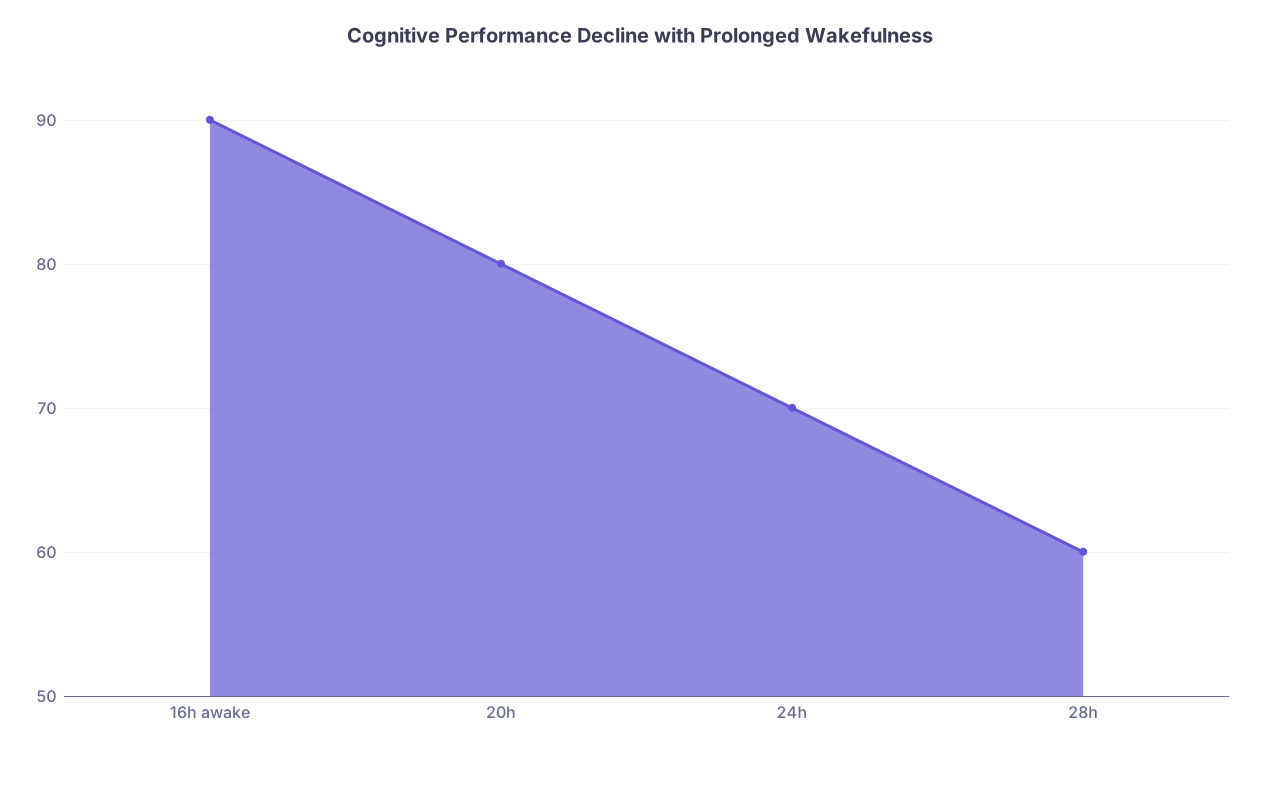
Cognitive performance vs hours awake looks roughly like this:
| Category | Value |
|---|---|
| 16h awake | 90 |
| 20h | 80 |
| 24h | 70 |
| 28h | 60 |
(100 = rested baseline performance)
Common mapping used in sleep research:
- ~17 hours awake ≈ BAC 0.05
- ~24 hours awake ≈ BAC 0.10
Now translate that to call structure.
A “standard” day + 24‑hour call pattern in many programs:
- Wake at 5:30–6:00 a.m.
- In hospital by 6:30–7:00 a.m.
- Still working at 4:00 a.m. next day → 22–23 hours awake
- Sign out and leave by 10–11 a.m. → 28–29 hours awake
At 4 a.m., with ~22 hours awake, your:
- Diagnostic accuracy in simulations drops ~20–30%
- Ability to perform mental math (dosing, rate calculations) falls sharply
- Working memory capacity shrinks (you literally cannot hold as many items in mind)
That translates into real on‑call mistakes.
Concrete examples I have seen more than once:
- Converting mcg to mg wrong at 4 a.m. in a heparin or insulin dose
- Misreading “creatinine 3.4” as “1.4” because your brain autofills expected values
- Forgetting 1 of 3 pending tasks after a rapid response because working memory is saturated
The key metric that predicts these is hours awake, not just “how sleepy you feel.”
3. Consecutive Nights of Restricted Sleep (Sleep Debt)
The data are brutal here. You do not “adapt” to chronic short sleep. You just get worse more slowly.
In the classic Van Dongen study:
- 14 days of 6 hours/night → cognitive performance equivalent to 24–48 hours of continuous wakefulness
- Subjective sleepiness plateaued. Objective performance kept dropping.
Residents on a week of night float or repeated q3–4 call often accumulate:
- 10–20 hour sleep debt over a week
- 30+ hours over a hard rotation
This chronic debt:
- Doubles the rate of minor errors (missed documentation, minor order mistakes)
- Increases major medical error self‑reports by ~1.5–2×
- Raises near‑miss incident reports (wrong patient, near wrong‑site) by similar factors
And you do not notice. The studies are very clear: people are terrible at self‑assessing cognitive impairment from chronic restriction.
You feel “tired but okay.” Your error rate disagrees.
Direct Link: Sleep Loss → Specific On‑Call Clinical Errors
Let’s translate those metrics into what actually goes wrong on the wards and in the ICU.
Medication Errors
Multiple resident‑focused studies converge on similar ratios:
Residents after extended shifts (>24 hours awake) compared to rested:
- ~2× risk of any medication error
- ~3× risk of serious medication error (requiring intervention, causing harm, or near miss caught by another clinician)
Common patterns at 2–5 a.m.:
- Decimal point errors:
- 0.5 → 5
- 50 mcg → 50 mg
- Wrong rate units: mL/hr vs mcg/kg/min confusion
- PRN vs scheduled mix‑ups
- Failure to check renal dosing in AKI (because you do not run the eGFR/CrCl in your head)
There is a clear dose‑response:
Each additional hour awake beyond ~16 hours increases odds of a medication prescribing error by roughly 10–15% in some datasets.
Not linear forever, but the trend is unmistakable.
Diagnostic Errors and Missed Deterioration
When you are sleep‑deprived, you lean far more on heuristics and pattern recognition. That is efficient at baseline. Dangerous when fatigued.
Residents post‑night call show:
- Slower recognition of sepsis and respiratory decompensation (delays of 30–60 minutes in chart‑based analyses)
- Lower accuracy in simulated ECG and CXR interpretation
- Higher rates of anchoring bias (sticking to the first diagnosis)
Translation on call:
- Brushing off a 2 a.m. “patient looks off” call with “give a bolus and recheck in 1 hour” instead of going to examine them → documented delays in escalation
- Missing subtle hypoxia or work of breathing because you over‑weight the “they were fine on rounds” anchor
- Misclassifying chest pain as reflux or anxiety because the EKG looks “basically okay” to a tired brain
The data: one widely cited study found interns working traditional 24‑hour shifts had:
- 36% more serious diagnostic errors vs interns on reduced‑hour schedules
- A measurable increase in ICU transfers from the floor attributed in part to delayed recognition
You can argue about causality, but the correlations line up tightly with sleep metrics.
Fatigue, Procedures, and Technical Skills
There is a myth that motor skills are “spared” by fatigue. The evidence disagrees.
Simulation work on residents (e.g., laparoscopic tasks, central line insertion) shows:
- After 24 hours awake:
- Time to completion ↑ 15–30%
- Error counts (needle passes, vessel punctures, missed steps) ↑ 20–40%
- Fine motor control and bimanual coordination degrade in a pattern very similar to moderate alcohol intoxication
I have watched a perfectly competent PGY‑2 fail three times on a central line at 3:30 a.m. after being up since 5:30 a.m. the prior day. Clear loss of depth perception and planning, not baseline skill.
Typical real‑world consequences on call:
- More arterial punctures during central line attempts
- Poor sterile technique lapses (breaking field because you are inattentive)
- Mis‑siting chest tubes or poor angle on paracentesis/thoracentesis
The data show another ugly detail: error probability spikes dramatically when procedures occur:
- Between 1 a.m. and 5 a.m.
- After >20 hours awake
- After >2 consecutive nights of bad sleep
Those three together are common in residency.
Burnout, Mood, and Decision Thresholds
Not every effect of sleep shows up as a “mistake.” Some show up as how you choose to act.
Chronic sleep restriction:
- Decreases empathy scores in standardized patient encounters
- Increases irritability and negative affect
- Increases risk‑taking in some tasks, and excessive risk aversion in others
On call, that means:
- Snapping at nurses → less likely they will call you for a “soft” concern next time
- Lower tolerance for ambiguity → you might shotgun more tests, admit more marginal patients, or escalate to ICU “just in case”
- Or the opposite: dismissing borderline cases because your bandwidth is gone
From a systems perspective, these shift:
- Admission rates
- ICU consults
- CT/MRI ordering patterns
I have seen services where one exhausted senior on nights consistently created a measurable spike in overnight CT scans. You could literally see his week on the call schedule in the imaging volume line graph.
Where Residents Actually Break: Critical Thresholds
The data suggest several practical “red lines” where risk ramps up fast. These are not perfect cliffs, but they are useful heuristics.
| Metric | Threshold | Typical Risk Pattern |
|---|---|---|
| Total sleep last 24h | < 4 hours | 2–3× med errors, major vigilance lapses |
| Hours awake | > 18 hours | Performance ≈ 0.05–0.08 BAC, slower reaction |
| Consecutive nights < 6h sleep | ≥ 5 nights | Chronic cognitive decline, under‑recognized |
| Circadian low | 2–5 a.m. | Peak lapses, microsleeps, attentional failure |
What I have seen:
- Interns at 3–4 a.m. with <3 hours sleep in 24 hours make “category 1” errors: wrong dose, wrong frequency, missed allergy.
- By 6–8 a.m., after >24 hours awake, “category 2” errors creep in: wrong patient orders, missing major abnormal labs, signing incomplete notes, forgetting crucial follow‑ups.
The problem is not that you are weak. The problem is that you are a human being subjected to quantifiable impairment.
Translating Metrics Into Personal Safeguards
You cannot redesign ACGME duty hours overnight. But you can use the metrics to build guardrails around yourself.
Think in terms of risk tiers.
Tier 1: Moderate fatigue (5–6 hours sleep in last 24h, 16–20 hours awake)
Risk profile:
- Slower, but still largely safe if you are deliberate
- Vulnerable to slips (typos, minor misreads)
Tactics:
- Explicitly double‑check high‑risk orders: anticoagulants, insulin, IV electrolytes
- Use calculators for any weight‑based or renal‑adjusted dosing
- Read back critical values and re‑state them aloud to the nurse (“Potassium 2.7, NOT 3.7”)
Tier 2: High fatigue (3–4 hours sleep, 20–24 hours awake)
Now you are near the BAC 0.08 equivalent zone.
Risk profile:
- Major lapses in vigilance
- Working memory limits – you forget steps
Tactics:
- Offload cognition to systems:
- Write task lists aggressively
- Use checklists for admissions, rapid response, and sign‑out
- For any non‑urgent but complex decisions (e.g., complicated medication reconciliations), delay until rested when possible
- Ask for a second set of eyes from a co‑resident, fellow, or nurse on high‑stakes decisions
Tier 3: Extreme fatigue (<3 hours sleep, >24 hours awake)
You are not “pushing through.” You are at objectively unsafe levels for complex tasks.
Risk profile:
- 2–3× medication error rate
- Serious diagnostic misses more likely
- Near‑miss events spike
Tactics:
- Avoid unnecessary procedures yourself. If there is a rested fellow or attending and this is not a core competency for you yet, consider escalating.
- Be transparent with nurses: “I am post‑call and extremely tired; if anything seems off about my orders, please page me to re‑check.”
- Use maximal structure on sign‑out. This is where balls get dropped.
None of this makes you invincible. It just dampens the predictable error spikes that the data show.
System‑Level Realities: Why This Keeps Happening
You might be thinking: the data are clear, so why are we still doing this?
Some blunt realities:
- Duty‑hour reforms helped, but often just shifted sleep loss around (more nights, more cross‑cover, more handoffs).
- Many programs still have 24+4 or 28‑hour permissible shifts. That is >28 hours awake every time.
- Culture: “everyone before you did it, so you will too” still exists, explicitly or implicitly.
The bitter irony is that hospitals would never allow a pilot to fly with your level of documented impairment. But residents run code blues at BAC‑equivalent levels of sleep loss several times a week during hard rotations.
From a data perspective, the current structure systematically:
- Concentrates maximal fatigue at times of highest physiological vulnerability (2–5 a.m.)
- Assigns high‑risk tasks (codes, cross‑cover decisions) to the most fatigued clinicians (interns, juniors on nights)
- Under‑uses rested senior staff for non‑procedural oversight at those times
You alone cannot fix that. But you can be strategic in how you operate inside it.
A Simple Mental Model: “If This Were Alcohol…”
One practical heuristic I have used when explaining this to residents:
Map your hours awake to an alcohol‑equivalent zone.
- <16 hours awake: Sober
- 16–20 hours awake: 1–2 drinks equivalent
- 20–24 hours awake: 3–5 drinks equivalent
24 hours awake: You would not legally be allowed to drive
Then ask yourself, for any task:
“If I had that many drinks, would I do this alone, or would I ask for backup?”
You would not intubate alone at a BAC of 0.10. Yet you might try it at 5 a.m. after 24 hours awake, telling yourself you are “fine.”
The data say you are lying to yourself.
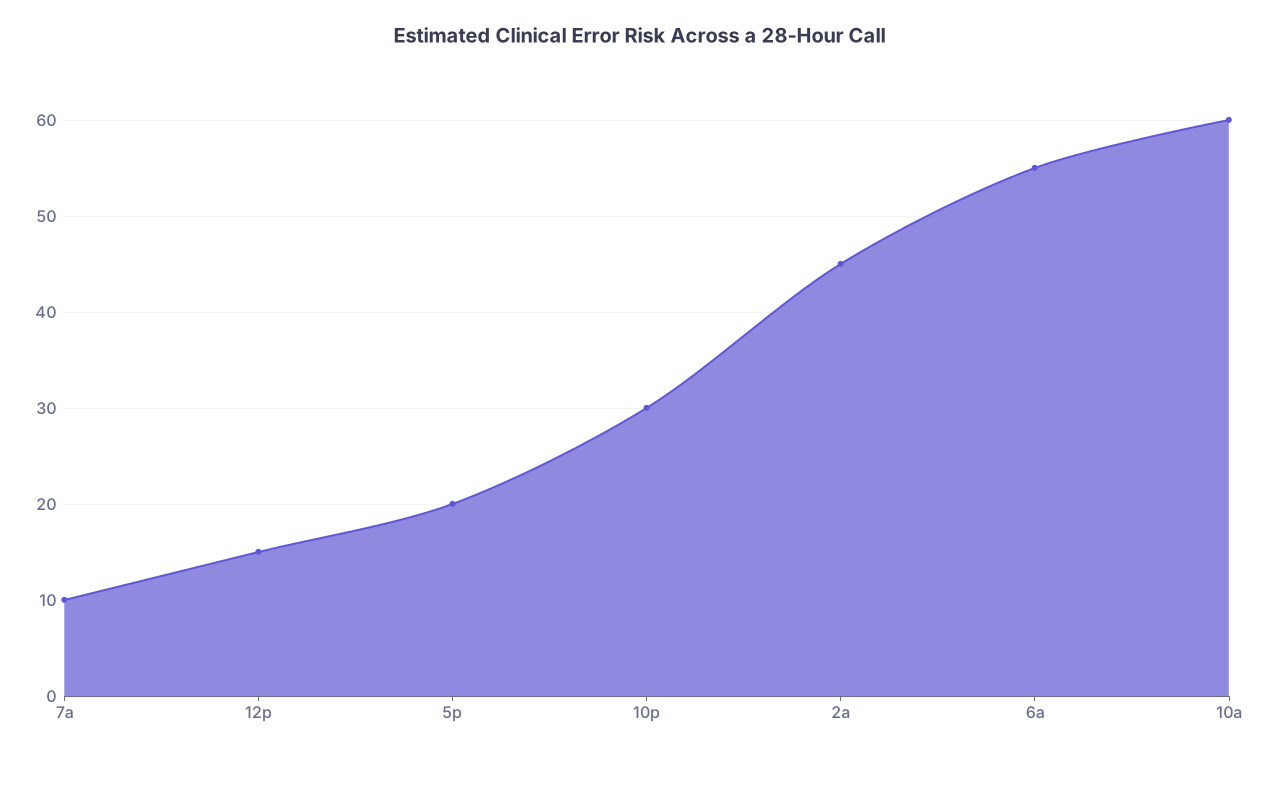
Visualizing the On‑Call Risk Curve
To bring this together, picture a simple risk curve across a 24+4‑hour call.
| Category | Value |
|---|---|
| 7a | 10 |
| 12p | 15 |
| 5p | 20 |
| 10p | 30 |
| 2a | 45 |
| 6a | 55 |
| 10a | 60 |
Let “10” be baseline daytime risk on a normal workday.
What actually happens on call:
- Risk climbs gradually through the daytime as fatigue accumulates.
- Spikes between 2–6 a.m. (circadian low + cumulative wakefulness).
- Stays elevated into the morning when you are still admitting, still writing notes, still ordering.
Those last few hours post‑call are not “just paperwork.” They are a hot zone for high‑impact mistakes in orders, documentation, and follow‑up planning.
If You Remember Nothing Else
Three key takeaways grounded in the data:
- Sleep loss effects are not vague. Specific sleep metrics (hours slept, hours awake, chronic debt) map to specific, predictable clinical errors.
- After ~20–24 hours awake, your impairment is in the same range as moderate intoxication. That is when serious medication and diagnostic errors jump.
- You cannot “toughness” your way out of biology. The only rational play is to respect the risk zones and deliberately build safeguards around the riskiest hours and tasks.
You are not weak when you are tired. You are human. The numbers prove it.