The belief that “you just get used to 28‑hour call” is statistically false. The data say the opposite: long shifts reliably increase errors, near‑misses, needlesticks, and car crashes for residents.
You do not “harden” to sleep loss. Your performance curves down. Predictably. Quantifiably.
Let’s walk through what the numbers actually show about shift length and error rates, and what that means for how you handle call as a resident who wants to survive training without wrecking patients or yourself.
1. What Happens To Your Brain After 16, 24, and 28 Hours
Start with the physiology because it sets the ceiling for performance.
Sleep deprivation is not subtle. Controlled lab data show:
- Being awake 17–19 hours impairs psychomotor performance roughly like a blood alcohol level of 0.05%.
- Being awake 24 hours pushes you to the 0.08–0.10% equivalent range. That is “too drunk to drive” in legal terms.
Residents on call are frequently in that zone.
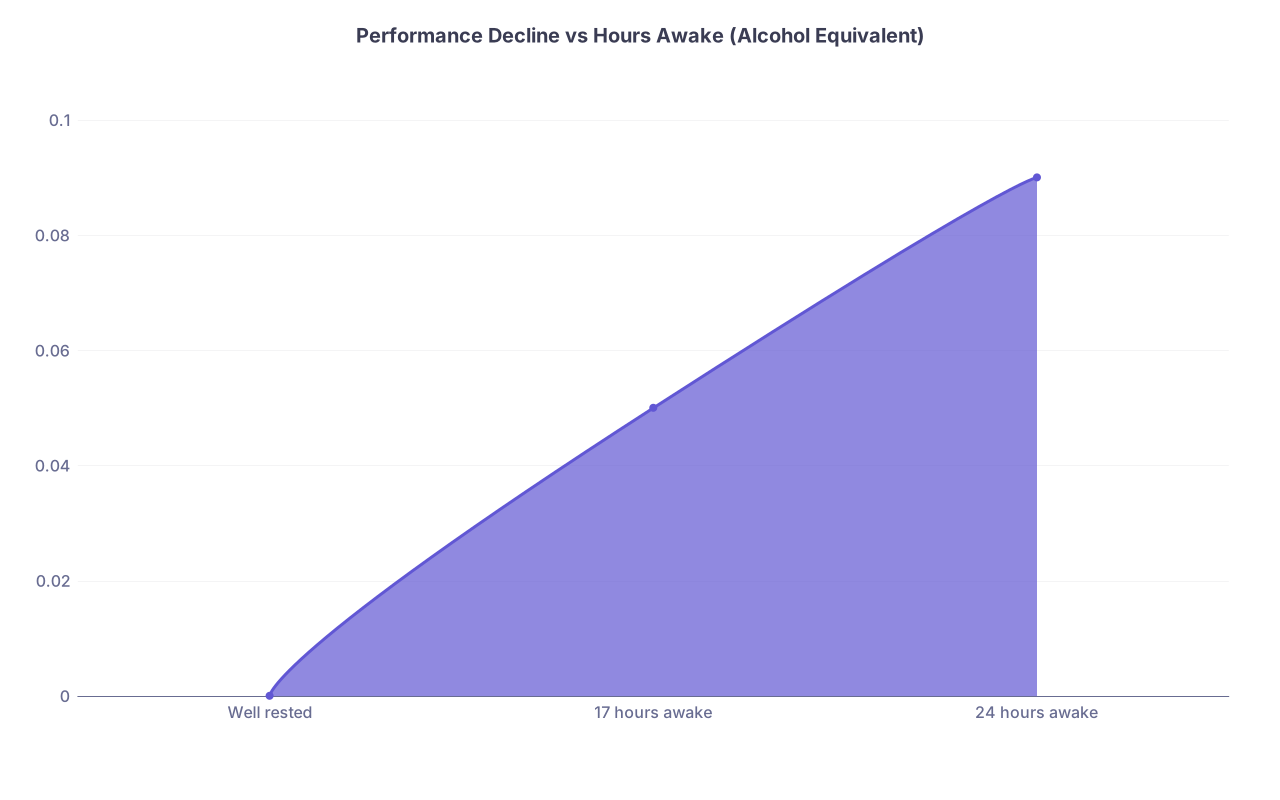
| Category | Value |
|---|---|
| Well rested | 0 |
| 17 hours awake | 0.05 |
| 24 hours awake | 0.09 |
This translates to:
- Slower reaction times (hundreds of milliseconds; enough to miss a run of VT on the monitor).
- Worse working memory (losing the thread of complex sign‑outs).
- Poorer risk assessment (underestimating how sick someone is at 4 AM).
I have watched a resident write a regular‑sliding‑scale insulin order for a DKA patient at 5 AM on hour 25. Not because they were stupid. Because at that cognitive load, the brain reaches for default patterns and stops checking context.
The data tell you: the longer you are continuously awake, the more your brain behaves like it is intoxicated. That is the backdrop for every “on‑call performance” discussion.
2. Hard Numbers: Shift Length and Medical Errors
Now the question you really care about: how much does a 24–30 hour call actually change error rates?
The best‑known numbers come from controlled comparisons of “traditional” extended‑duration shifts (up to 24–30 hours) versus schedules that cap shifts at ~16 hours.
A few anchor findings:
- Residents on extended shifts made about 36% more serious medical errors than on shorter shifts.
- They made about 5.6 times as many serious diagnostic errors in some studies of ICUs and general wards.
- Total errors (including minor) increased by ~20–30% in several analyses.
The exact percentage varies by study, specialty, and measurement method, but the direction does not change: longer shifts mean more errors. Period.
Here is a simplified comparison aggregated from multiple internal medicine and ICU resident studies.
| Shift Type | Relative Rate of Serious Errors | Relative Rate of Diagnostic Errors |
|---|---|---|
| ≤16-hour shifts | 1.0 (baseline) | 1.0 (baseline) |
| 24–30-hour extended call | 1.3–1.5 | 3–6 |
Even if you take the most conservative end:
- A 30% relative increase in serious errors is not trivial. If you normally make 10 such errors per 100 admissions, that becomes 13.
- Diagnostic errors multiplying by 3–6 is brutal. Those are usually the root of “we missed the sepsis” or “we thought it was COPD, it was PE.”
The data are consistent across domains:
- Medication errors: more omitted doses, wrong doses, and incorrect timing on longer shifts.
- Procedural errors: more small but real harms—arterial instead of venous sticks, extra needle passes, line malposition.
- Communication errors: more botched handoffs, missed critical issues, and contradictory orders in the chart.
You may feel like “I’m fine” at 3 AM. The performance metrics say otherwise.
3. Beyond Errors: Near Misses, Needlesticks, and Car Crashes
Errors in patient care are only part of the cost. Your own risk profile gets ugly with long shifts.
Occupational injuries
Residents working extended shifts have shown:
- About twice the rate of percutaneous injuries (needlesticks, sharps) compared with when they are less sleep‑deprived.
- Higher rates of motor vehicle accidents commuting after call.
One well‑publicized figure: residents driving after a 24‑hour shift had roughly a 2.3‑fold increased risk of a car crash and a 5.9‑fold higher risk of a near‑miss.
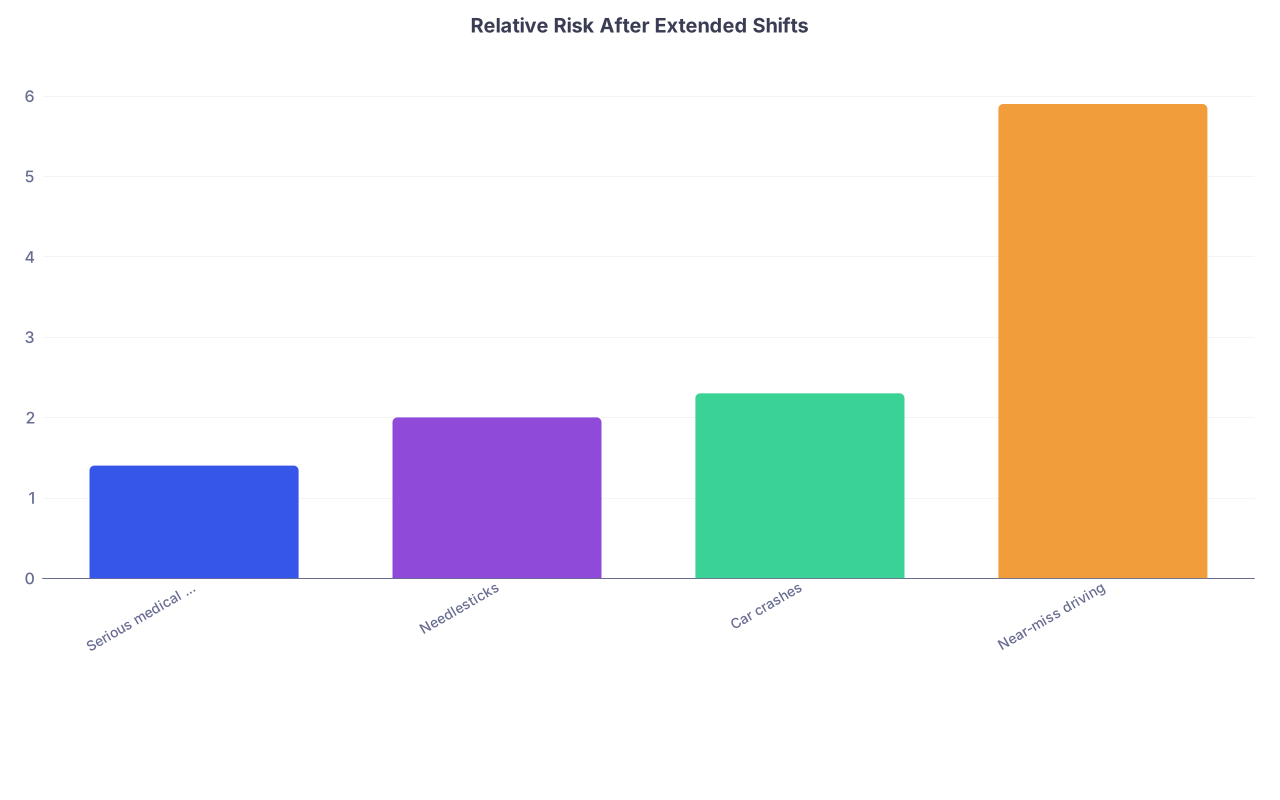
| Category | Value |
|---|---|
| Serious medical errors | 1.4 |
| Needlesticks | 2 |
| Car crashes | 2.3 |
| Near-miss driving | 5.9 |
These are not hypothetical “might happen someday” things. Every program has stories:
- The intern who fell asleep at a stoplight post‑call and got rear‑ended.
- The resident who stuck themselves doing a 3 AM ABG on a patient with hepatitis C.
- The person who nodded off writing notes and woke up to find they had charted the wrong orders on the wrong patient.
The pattern is consistent: sustained wakefulness plus night work plus task density raises your personal risk.
Near misses vs. harm
Residents tend to discount near misses because “nothing bad ultimately happened.” From a data standpoint, near misses are leading indicators. They are the early warning metric that your error system is overloaded.
If your last three nights on call included:
- Almost giving the wrong med but catching it at the last second.
- Almost falling asleep at the wheel but jerking awake.
- Almost missing a sodium of 118 until the nurse called.
That pattern predicts eventual harm unless something changes. The statistics in these studies are essentially the aggregated version of “near miss → event” at scale.
4. 16-Hour Caps, 24-Hour Call, and the Myth of “You’ll Just Do More Handoffs”
You will hear two narratives from attendings and older residents:
- Longer shifts cause errors and are unsafe.
- Shorter shifts cause more handoffs and fragmentation, which are also unsafe.
Both have some truth. The question is which risk dominates, and under what conditions.
What the duty hour data actually show
There have been large multi‑program experiments:
- Traditional schedules with 24–30 hour calls.
- “Short‑call” or night float systems with 12–16 hour maximums.
- Variations by PGY level.
Results are messy but a few patterns show up:
- Resident self‑reported errors and attentional failures decrease with shorter maximum shift length.
- Interns especially report better sleep and less burnout with ≤16‑hour caps.
- Some studies found no major difference in patient mortality or length of stay at the system level, likely because hospitals buffer resident performance with attending oversight, protocols, and nursing competence.
Put differently: when you zoom out to mortality, the hospital ecosystem partially compensates for resident fatigue. When you zoom in on resident performance, the fatigue signal is strong and consistent.
Handoffs vs. exhaustion
Handoffs absolutely create another failure mode: information leakage.
But look at the math. One cognitively intact resident doing two handoffs a day vs. one cognitively impaired resident working 28 straight hours with fewer handoffs is not an even trade.
Realistically, poor handoffs and fatigue compound each other:
- Long shifts: exhausted resident gives a sloppy sign‑out.
- Short shifts: more sign‑outs but each is given by someone less cognitively impaired.
Well‑designed handoff systems (structured templates, checklists, EMR tools) reduce error rates and mitigate that risk. There is no comparable “tool” that can undo the psychomotor impairment of 24 hours awake.
If you are thinking purely in data terms, the controllable variable that moves error rates more reliably is shift length, not handoffs. Handoffs are an engineering problem; 28 hours awake is a physiology wall.
5. Which Errors Spike First as Shifts Get Longer?
Not all mistakes behave the same way over a long call. The data and personal observation line up pretty cleanly on what degrades first.
1. Attention and vigilance errors
Early in the night:
- Missed subtle changes in vitals.
- Ignored trend in urine output or lactate.
- “I saw the result but did not process its significance.”
These are classic attentional lapses and show up even after modest sleep loss.
2. Diagnostic reasoning errors
As hours pile up, higher‑order reasoning crumbles:
- Anchoring harder on the first diagnosis you formed.
- Failure to reframe when a patient is not responding.
- Over‑simplifying complex patients: “It’s just COPD” when they also have heart failure and PE.
Controlled ICU studies found serious diagnostic errors multiplied several‑fold during extended shifts. That maps to the “2 AM floor call for shortness of breath” where you under‑react.
3. Procedural and motor errors
Later into a stretch:
- More failed lumbar puncture attempts.
- Wrong site or wrong side near‑misses (usually caught before skin break, but still).
- Line malpositions and complications rising with fatigue.
You see this in simulation labs: task times increase, error counts go up, and coordination worsens as residents accumulate hours without sleep.
Here is a conceptual comparison of relative error increase with shift length.
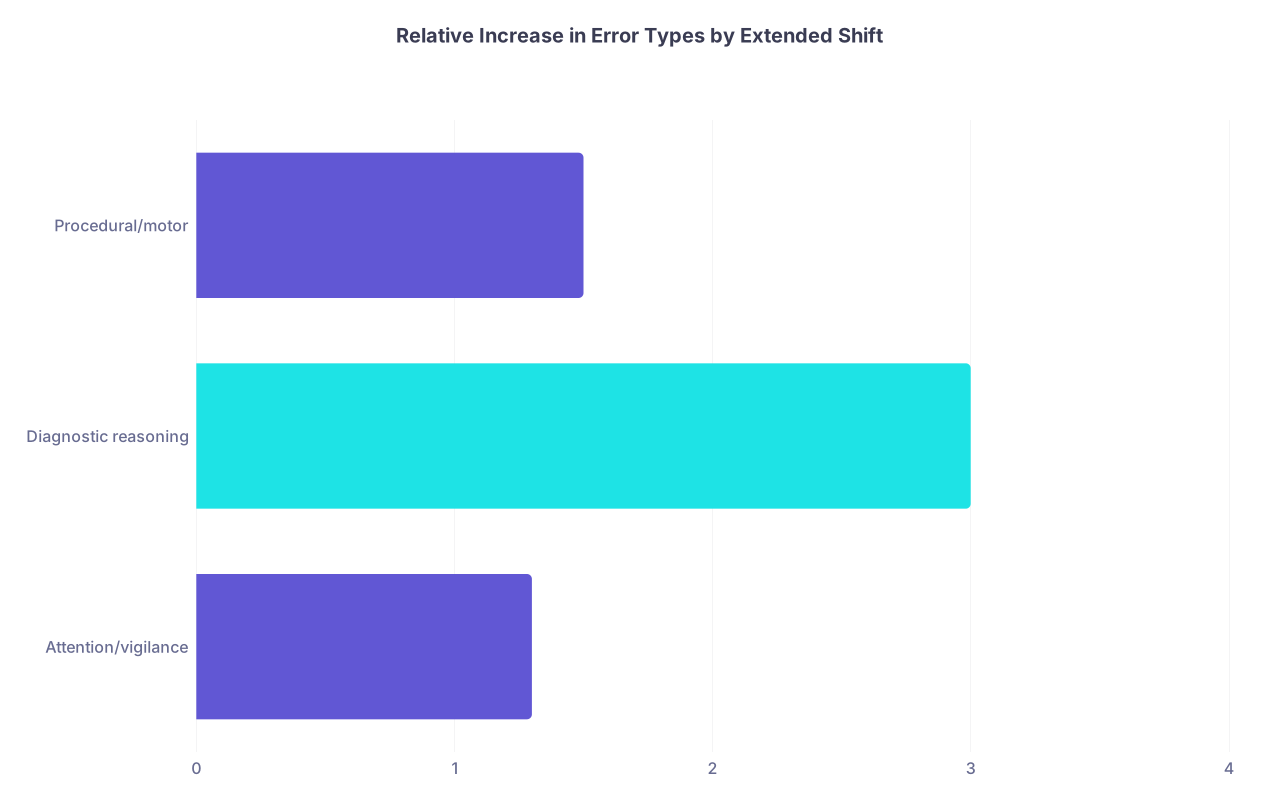
| Category | Value |
|---|---|
| Attention/vigilance | 1.3 |
| Diagnostic reasoning | 3 |
| Procedural/motor | 1.5 |
Diagnostic reasoning takes the hardest hit, quantitatively. That should change what you mistrust in yourself at 4 AM: not your ability to do a suture, but your confidence in the diagnosis guiding the suture.
6. Practical Moves: How Residents Can Use This Data On Call
You probably cannot rewrite your program’s call schedule. But you can use these numbers to adjust how you operate inside those constraints.
Think of this as harm reduction.
1. Load‑shedding decisions after certain hours
After hour 16 or so of being awake, treat your brain as “unreliable hardware” for certain tasks.
Deliberately:
- Avoid making irreversible high‑stakes decisions alone. If you are deciding about thrombolytics, emergent OR, or withdrawing life support at 3 AM, pull an attending or senior in early. The data justify the escalation.
- Use more checklists and order sets late in the shift. Standardization protects against fatigue‑driven slips.
- Double‑check med orders that involve weight‑based or renal dosing. Those are classic fatigue victims.
This is not about weakness. It is about modeling your performance realistically, like you would any other imperfect system.
2. Design your own “personal handoff rules”
Because you know longer shifts spike diagnostic errors, build systems to protect against that:
- For any patient admitted between midnight and 6 AM with an unclear diagnosis, explicitly tag them on your sign‑out as “DX UNSURE – needs fresh brain in AM.”
- Include “worst‑case we might be missing X” in your handoff content. It forces you to articulate alternatives even if you are too tired to fully work them up.

| Step | Description |
|---|---|
| Step 1 | >16 hours awake |
| Step 2 | Call senior or attending |
| Step 3 | Use checklist or order set |
| Step 4 | Tag uncertain cases in sign out |
| Step 5 | High stakes decision |
A simple rule I have seen work: any new sepsis, chest pain, or acute neuro change after hour 20 gets automatic attending notification, regardless of how confident the resident feels.
3. Protect the drive home like it is another patient
The post‑call crash data are brutally clear. You are statistically dangerous behind a wheel after a 24‑hour call.
Treat the commute like a procedure with risk:
- Do not “just power through” a 45‑minute highway drive when you are nodding off at the computer.
- If your hospital has a call‑room nap policy post‑call, use it. Even 60–90 minutes of recovery sleep reduces driving risk.
- If public transit or rideshare exists, the expected value is positive: the cost of an Uber is trivial compared with the expected value of avoiding a crash.
It sounds dramatic, but the odds are not on your side. Residents in crash statistics thought “I’ll be fine” too.
4. Tactical fatigue management during call
You cannot erase sleep debt, but you can manage dips:
- Strategic 20–30 minute naps during low‑volume windows in a call room improve alertness for several hours. This is one of the few interventions with actual performance data behind it.
- Caffeine timing: front‑load in early night hours; avoid large doses near expected end of shift if you want to get any post‑call sleep. Over‑caffeinating at 5 AM usually buys you nothing but palpitations.
- Bright light exposure in the night‑float office can transiently improve alertness, though it can wreck circadian rhythms if abused.
These are small effect‑size interventions. They do not cancel a 30‑hour call. But layered together, they can cut the bottom off the worst performance troughs.
7. Program Design: What Structures Are Statistically Less Bad?
You are not the program director, but understanding the data will make you a sharper advocate when the “we’re redesigning call” email lands in your inbox.
Night float vs 24–30 hour call
Evidence tends to favor:
- Night float systems (with ≤12–16 hour shifts) for reducing individual fatigue and self‑reported errors.
- 24–30 hour call for staffing continuity at the potential cost of higher per‑resident error risk.
Hybrid systems—some day/night float coverage plus limited 24‑hour calls—try to balance these.
A simplified overview of how three typical systems compare on resident‑level metrics:
| Call Structure | Fatigue Level | Error Risk | Handoffs Volume |
|---|---|---|---|
| 24–30 hr traditional | High | High | Low |
| 16 hr max shifts | Moderate | Lower | Moderate |
| 12 hr strict night float | Lower | Lowest | Higher |
From a straight risk‑minimization perspective, shorter shifts win. The downside is continuity and handoff burden, which can be partly engineered away with robust handoff protocols.
Level of training matters
Interns versus seniors are not equivalent.
- Interns: steeper performance degradation, less experience to compensate, more benefit from shorter shifts and strict supervision.
- Seniors: still impaired by sleep loss but may compensate somewhat with pattern recognition and procedural muscle memory.
The uncomfortable truth is that the people with the least reserve (interns) are often the ones pushed onto the front line of extended call. The data argue strongly against this, even if culture resists changing it.
8. Big Picture: What Evidence-Driven Survival Looks Like
Strip away the mythology of “toughing it out” and you are left with a simple model.
- Human cognitive performance follows fairly predictable degradation curves with sleep loss.
- Extended shifts push you into the steep part of those curves.
- Errors, near misses, injuries, and crashes follow in a dose‑dependent fashion.
You cannot fully escape this as a resident. But you are not powerless.
- You can decide when to mistrust your own brain.
- You can structure handoffs and escalation based on where the data say you are most vulnerable.
- You can treat the drive home as a quantifiable risk, not a background inevitability.
The traditional advice that “you’ll adjust” is biologically and statistically wrong. You will adapt psychologically. You will not adapt physiologically. The gap between how fine you feel and how impaired you actually are is where most of the danger lives.
Use the numbers, not your subjective sense, to decide when to slow down, ask for help, and build guardrails.