
It is 2:17 a.m. You finally sat down, food still in a container you have not opened, and your pager goes off three times in 90 seconds. A nurse is paging you “STAT” for Tylenol. Another page has zero clinical details, just “Call back.” The third is a lab critical value that was actually reported 45 minutes ago to someone else.
You feel your blood pressure spike. You are tired, behind on notes, and now you are stuck trying to untangle which page is real, which is noise, and which one you will get blamed for ignoring.
Let me flip this on you. Because on another night, someone else is having that exact reaction to your pages.
On call, your credibility lives or dies on how you page and respond to pages. Residents who never figure this out get quietly labeled: “difficult,” “unreliable,” “doesn’t listen,” “unsafe.” Nobody will say it to your face. They will just stop trusting you. And that will hurt you on evals, recommendations, and team dynamics for years.
Let us walk through the most common paging etiquette mistakes that wreck on‑call credibility, and how to avoid becoming that resident.
Mistake #1: Paging Without Thinking – The “Reflex Page”
The fastest way to get written off by night float, cross‑cover, and consultants is to page like a reflex instead of like a clinician.
I have watched this play out too many times:
Nurse: “The BP is 88/52.”
Intern: immediately pages cross‑cover: “FYI, BP 88/52.”
No context. No trend. No interventions. No plan. Just a hot potato tossed to someone else.
The problem is not that you paged. The problem is that you paged before you thought.
Red flags you are in “reflex page” mode:
- You send pages that could be answered by reading the last note or checking the MAR.
- You page “for parameters” on every patient without ever proposing one.
- You ask questions you could answer in 30 seconds on the EMR.
Here is how that looks from the receiving end: “This person is dumping work on me instead of doing basic thinking.”
How to avoid it
Before you page, force yourself through a 20‑second mental checklist:
Have I checked the EMR?
Recent vitals, last note, labs, meds, allergies. That alone eliminates a shocking number of unnecessary pages.Have I done basic nursing / bedside actions?
For low BP: recheck manually, adjust position, check for pain or bleeding, verify cuff size.
For pain: confirm last dose, nonpharm options, look for breakthrough meds.Do I have a specific question or request?
Do not page with “FYI” unless it truly is documentation only. You should almost always be asking for something clear: evaluate, change order, clarify plan.Do I know how urgent this actually is?
Sorting this wrongly will get you labeled as either dangerous or annoying.
If you cannot answer those four questions, you are paging too fast.
Mistake #2: Mislabeling Urgency – Crying Wolf or Missing Fire
This one destroys credibility faster than anything else: getting the urgency wrong.
Constant “STAT” pages for non‑urgent issues? People stop believing you.
Underplaying real instability? People stop trusting you.
Nurses, residents, and consultants remember who forces them to sprint for nonsense. They also remember who called them “non‑urgent” for a crashing patient.
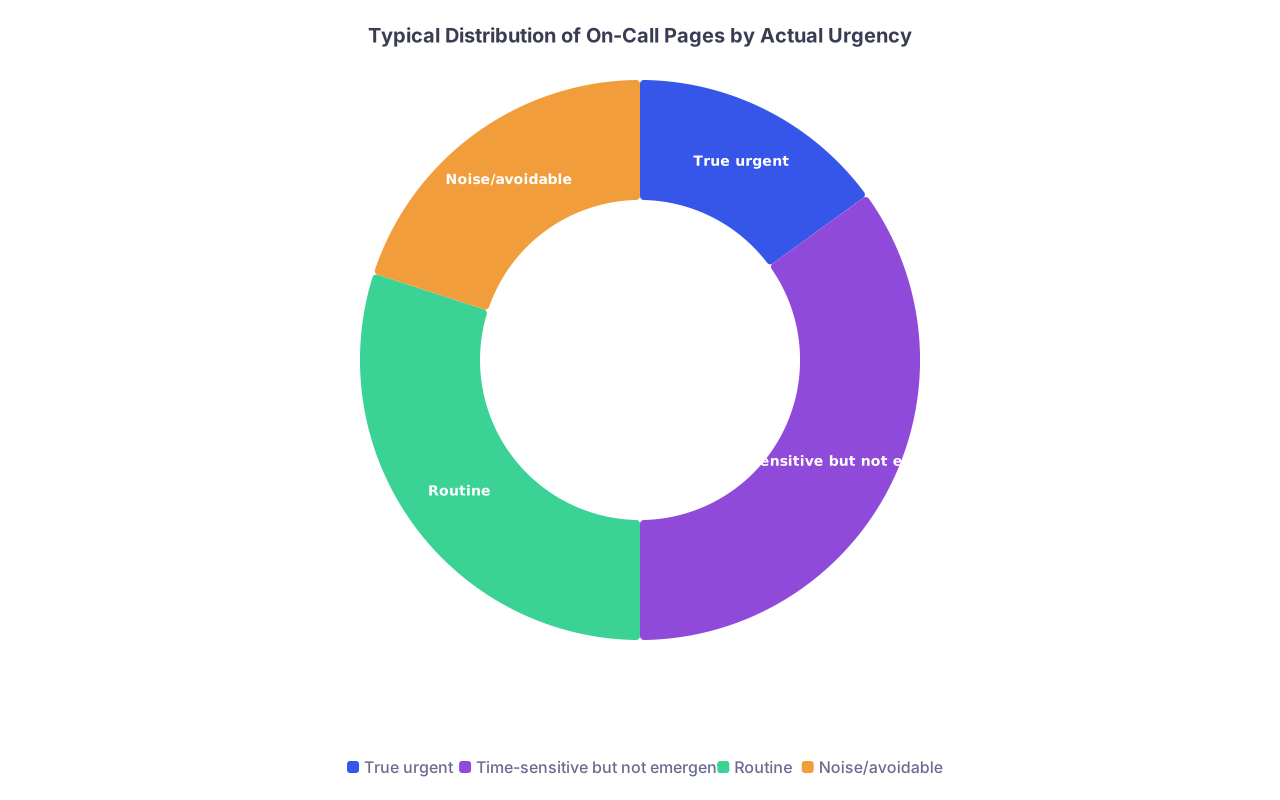
| Category | Value |
|---|---|
| True urgent | 15 |
| Time-sensitive but not emergent | 35 |
| Routine | 30 |
| Noise/avoidable | 20 |
Common bad patterns
- Labeling everything “STAT” to get faster responses.
- Using “when you get a chance” for a MAP of 50 on high‑dose pressors.
- Paging as “urgent” because you are anxious, not because the patient is unstable.
- Not escalating when you clearly should.
A simple urgency framework
You do not need a textbook. Use a three‑tier filter:
Emergent – Page NOW, escalate if no answer
Examples: airway concern, new chest pain with concerning features, acute neuro changes, severe hypotension / tachycardia, active heavy bleeding, anaphylaxis, seizure, new temp in a neutropenic patient.Time‑sensitive (30–60 minutes)
Examples: rising creatinine with no recent labs, new moderate pain uncontrolled by current meds, borderline BP in a fragile patient, new positive blood culture, worsening respiratory status without immediate failure.Routine (can wait >1–2 hours or be batched)
Examples: refill home meds, diet changes, non‑urgent consult clarifications, stable electrolyte abnormalities, discharge planning clarifications.
When the urgency label does not match the clinical picture, your name gets quietly filed in the “doesn’t get it” category.
Say the urgency in the page itself:
“Non‑urgent: please call about dose clarification before 11 p.m.”
“Urgent: new chest pain, please call back now.”
If you under‑call the urgency once and a patient gets hurt, people will remember. Forever.
Mistake #3: Vague, Useless Page Content
“Call 555‑1234 re: Smith”
That is a bad page. I do not care how busy you are.
Or the classic:
“Pt in 415 in pain. Pls call.”
No vitals. No pain scale. No current meds. No allergies. No specifics. Now the on‑call has to dig through the chart just to start the conversation.
You are broadcasting: “My time is more important than yours.”
What a competent page actually includes
You want a tight, high‑yield structure. Something like a micro SBAR. It should usually have:
- Who you are
- Where the patient is (or service they are on)
- Short ID + problem
- Relevant vital / data anchor
- What you are asking for
Example of bad:
“Hi, this is 6W. Can you call about Mr. Jones?”
Example of solid:
“Hi, this is RN on 6W about Mr. Jones in 614, your CHF patient. New O2 requirement from 2 to 4 L for sat 90–92%, mild increased work of breathing, BP 110/68, HR 102. No chest pain. Please call to evaluate.”
That second one tells me:
- This person assessed the patient.
- They looked at the vitals.
- They know why they are paging.
- They are giving me enough to triage priority.
If your pages are consistently missing that level of information, people will avoid working with you.
Mistake #4: Paging the Wrong Person or Service
Another quiet credibility killer: not knowing who actually owns what.
You keep paging cardiology about rate control when the medicine team is primary.
You page the attending directly for tamponade‑level hypotension, skipping the resident.
You page endocrine for insulin adjustments at 3 a.m. that were clearly left to primary.
People notice. They see you as someone who does not understand the system.
Classic errors:
- Paging consultants about issues clearly in primary’s lane at night.
- Paging night float for problems already addressed in a written day plan.
- Paging the wrong specialty because you did not read the latest note or admission reason.
- Paging the cross‑cover intern when there is a code button on the wall.
How to avoid this
At the start of each rotation, actually learn:
- Which service owns what (who manages DVT prophylaxis, electrolytes, insulin, etc.).
- Which consultants want overnight pages and for what.
- How your hospital routes pages (some have call pools, some have specific numbers).
Check the chart before paging:
- Read today’s attending/resident note. Many already include: “Overnight: call only for X, Y, Z.”
- Look at the active consult list and recent consultant notes.
When in doubt, route through the primary or senior:
- “I have X concern; do you want me to page cardiology now or can it wait for day team?”
That question alone prevents half the inappropriate overnight consult pages I see.
- “I have X concern; do you want me to page cardiology now or can it wait for day team?”
Paging the wrong person is not “just a little mistake.” Overnight, it wastes minutes you do not have and tells everyone you did not think.
Mistake #5: Ignoring the Culture of Call‑Backs
You will be judged just as much on how you respond to pages as on how you send them.
Here is the mistake pattern:
- You take 45 minutes to return a page labeled “urgent.”
- You call back irritated, without letting them finish.
- You do not document critical calls that changed management.
- You never close the loop.
People start saying, “He never calls back,” or “She is always rude at night,” or the worst: “I do not feel safe with them on call.”

| Step | Description |
|---|---|
| Step 1 | Receive Page |
| Step 2 | Call back immediately |
| Step 3 | Finish current safe task |
| Step 4 | Call back within set time |
| Step 5 | Summarize and document |
| Step 6 | Escalate to senior or attending |
| Step 7 | Urgent? |
| Step 8 | Issue resolved? |
Reasonable callback behavior
You do not need to be a superhero. You do need to be predictable.
Emergent pages – Stop what you are doing unless you are literally doing CPR or a procedure. Call back now. If tied up in something critical, delegate: “Pager for room 423 – can you please call and say I am in a code and to pull the code button if urgent?”
Time‑sensitive – Call back within 5–15 minutes. Say your plan out loud. Example: “I will put in stat labs and be up in 10 minutes. If BP drops below 90 again, pull the rapid response.”
Routine – Batch them appropriately, but do not sit on them for an hour unless you warned people you would be unavailable briefly.
And document important conversations. That “discussed with RN, will monitor, nurse to call if X” line seems small, until something goes wrong and everyone asks, “What did they say on the phone?”
If multiple nurses or consultants complain that you never call back promptly or you are consistently dismissive, you will get a reputation that sticks.
Mistake #6: Burying the Lead and Talking in Paragraphs
A subtle but painful mistake: you finally call back… and then ramble.
I hear this constantly when a junior calls a consultant:
“Hi, this is the intern on medicine. So this is a 68‑year‑old male who came in yesterday afternoon with shortness of breath and cough and he has a long past medical history of COPD, CHF, diabetes, hypertension, hyperlipidemia, and so he was admitted for… [two minutes later] …and so we were wondering if maybe you could come see him for possible something like an infection or something cardiac.”
By the end, nobody remembers the question.
The fix: lead with why you are calling
First sentence: who you are and what you want.
Then the 3–4 key data points that justify it.
Example with a consultant: “Hi, this is the night float on medicine. I am calling cardiology about Mr. Lopez, 72, in 518, for possible urgent cath for NSTEMI.”
Then you give:
- Brief one‑liner.
- What changed.
- Troponin/EKG/vitals.
- What has already been done.
Same thing when calling a nurse back: “Hi, this is Dr. X calling back for Mr. Smith’s low BP – can you tell me his latest vitals and how he looks at the bedside?”
You are not on rounds. You are on call. Get to the point first. Details after.
Mistake #7: Disrespecting Night Staff and Cross‑Cover
If you want your life on call to be miserable, here is a simple recipe: disrespect nurses and cross‑cover.
Eye‑rolling when they page.
Snapping on the phone.
Making them feel dumb for asking about a potentially dangerous symptom.
Or the more insidious move: selectively answering some nurses’ pages faster than others based on who complains least.
Word spreads. Night nurses talk. Night techs talk. ED staff talk. And your name gets passed around as “the one who is always rude on nights.”
That will come back to you.
What this looks like from their side
Nurses are graded too. They get audited on whether they escalated things appropriately. Many have seen bad outcomes when someone did not page. So yes, some will over‑page. But most of the late‑night pages you get are from someone who is trying not to miss something on their patient.
You can and should push back on unnecessary pages. But you do it like a professional.
Better: “I agree this is not dangerous right now. Let us set clear parameters: if the HR stays under 120, no need to call me overnight; if it goes above that or he becomes symptomatic, please page me right away.”
Worse: “Why are you paging me for this at 3 a.m.? This is nothing.”
Same content, very different impact on your reputation.
Mistake #8: Paging Like It Is 1995 – No Use of Structure or Tools
You already have tools to make paging less chaotic. Most people just do not use them.
At many hospitals, residents and nurses can use structured paging templates, EMR‑linked messaging, or standard SBAR forms. Instead:
- Pages come through as free‑text chaos.
- Different units have completely different styles.
- No one knows what level of detail is expected.
Result: more confusion, more frustrated callbacks, more “Why did you not tell me that?” conversations.
| Aspect | Unstructured Paging | Structured SBAR Paging |
|---|---|---|
| Clarity | Variable, often poor | Consistently higher |
| Time to triage | Longer | Shorter |
| Missed key data | Common | Less frequent |
| Perceived professionalism | Lower | Higher |
| On-call cognitive load | Higher | Lower |
If your hospital offers structured paging or SBAR tools and you ignore them, you are choosing chaos.
Even if there is no formal system, you can create your own:
- Sticky note on computer with your standard page content checklist.
- Shared unit expectation: every page must include room number, vitals if clinical, and clear ask.
- Personal rule: no page goes out without a one‑line reason and a proposed plan if appropriate.
This is the difference between being treated as “yet another frazzled intern” and “one of the few who has it together at night.”
Mistake #9: No Closed‑Loop Communication
You put in the orders. You saw the patient. You adjusted the meds. Then you vanish.
The nurse is left wondering: Did they see him? Did they change anything? Am I supposed to recheck something?
This is where small communication decisions pay off huge.
Closed‑loop examples:
- “I just saw him; I ordered a bolus and labs. Please recheck BP in 30 minutes and page me if still under 90.”
- “Troponin came back flat. No further trending overnight. If he has recurrent pain, page me as urgent.”
- “Consultant agrees this can wait until morning; no new orders now.”
You are drawing a line under the encounter: here is what happened, and here is what should happen next. That reduces unnecessary repeat pages and makes everyone more confident in you.
Mistake #10: Not Learning From Your Worst Paging Nights
Everyone has a night that feels like pure paging hell. You are getting hammered from all sides, you miss a callback or two, someone yells, someone complains.
The real mistake is not the rough night itself. It is never analyzing it.
After a brutal call, you should be asking:
- Which pages were avoidable if I had set better parameters earlier?
- Which consults did I page that really could have waited?
- Where did I over‑call or under‑call urgency?
- Did I batch anything I should not have, or fail to batch things I could have?
The residents who never improve their paging habits stay in survival mode for all of residency. The ones who treat paging as a skill to be mastered become the people everyone wants on nights.
FAQs: Paging Etiquette and On‑Call Credibility
1. How fast do I actually need to return pages?
Emergent pages: as close to immediately as humanly possible. Time‑sensitive: within 5–15 minutes. Routine: 30–60 minutes is usually acceptable, especially if you are in a procedure or code. The key is consistency and communicating when you are temporarily unavailable: “I am in a rapid response; if this is life‑threatening, please pull the code button now; otherwise I will call you back in 15.”
2. What if I am not sure whether something is urgent enough to page immediately?
Default to patient safety, but do not skip thinking. Rapidly check: vitals, mental status, airway/oxygenation, perfusion, acute pain, bleeding, neuro changes. If any of those are concerning, treat as urgent. When in doubt after that quick check, ask your senior: “I have X situation, looks like Y, vitals are Z. Would you want to know now or can it wait 30–60 minutes?”
3. How do I push back on excessive or inappropriate pages without damaging relationships?
Start by acknowledging their concern, then reset expectations. Example: “I appreciate you letting me know. For things like isolated mild tachycardia with stable vitals, you do not need to page overnight unless there are new symptoms. Let us agree that you will only page if HR stays above 120 for more than 30 minutes or the patient feels worse.” You are teaching, not shaming.
4. What should I document after a significant page or phone call?
Any call that changes management, involves a critical value, or deals with potential instability deserves a brief note. Include: time of call, who called and from where, reason, key findings (vitals, symptoms), your assessment, plan, and any return parameters (“nurse to call if…”). It can be three sentences. It protects you and clarifies the plan for everyone.
5. I feel overwhelmed on nights and find myself snapping on the phone. How do I avoid that?
You will have bad moments; the key is pattern, not perfection. A few strategies: pause 2 seconds before speaking, sit down if possible, have 1–2 stock phrases ready (“Tell me briefly what is going on” or “Give me the vitals and how the patient looks”). If you do snap, repair it: “I am sorry I sounded short earlier; it has been a rough night. Thanks for calling about that.” People remember the apology more than the bad moment.
Open your pager log (or EMR inbox) from your last call night. Pick three pages that frustrated you. Rewrite each of them into the clear, structured version you wish you had received, including urgency label and key data. That is your template. Start using it on your very next shift.