
You are on your first real night float. It is 2:47 AM. Your co-intern finally stepped out to grab food. The cross-cover phone is on the desk in front of you, labs are auto-refreshing on the screen, and your heart rate jumps every time you see something turn red.
A potassium of 6.2 just popped up on a patient you barely know. At the same time, a hemoglobin of 6.9 on a different patient. Two “critical lab” pages are already blinking on your pager. Nobody is standing over your shoulder. You feel the urge to “just do something” before you “miss something” and hurt someone.
This is exactly where new interns make their biggest lab-result mistakes.
Let me be very clear: most harm on nights does not come from what you fail to notice. It comes from overreacting to a number without understanding the context. Or from ignoring a number because you are overwhelmed and assume someone else handled it.
Let’s walk through the major pitfalls so you do not join the list of “that case we still talk about during M&M.”
Mistake #1: Treating Every Red Number as an Emergency
The rookie intern response to overnight labs is binary: normal = safe, red = panic.
That mindset is how people get unnecessary treatments, ICU transfers, and cascading complications.
New interns confuse three very different categories:
- Data that is expected and benign
- Data that is abnormal and needs attention, but not at 3 AM
- Data that is truly emergent
If you treat all three like category 3, you will spend the whole night chasing meaningless numbers and miss the one that matters.
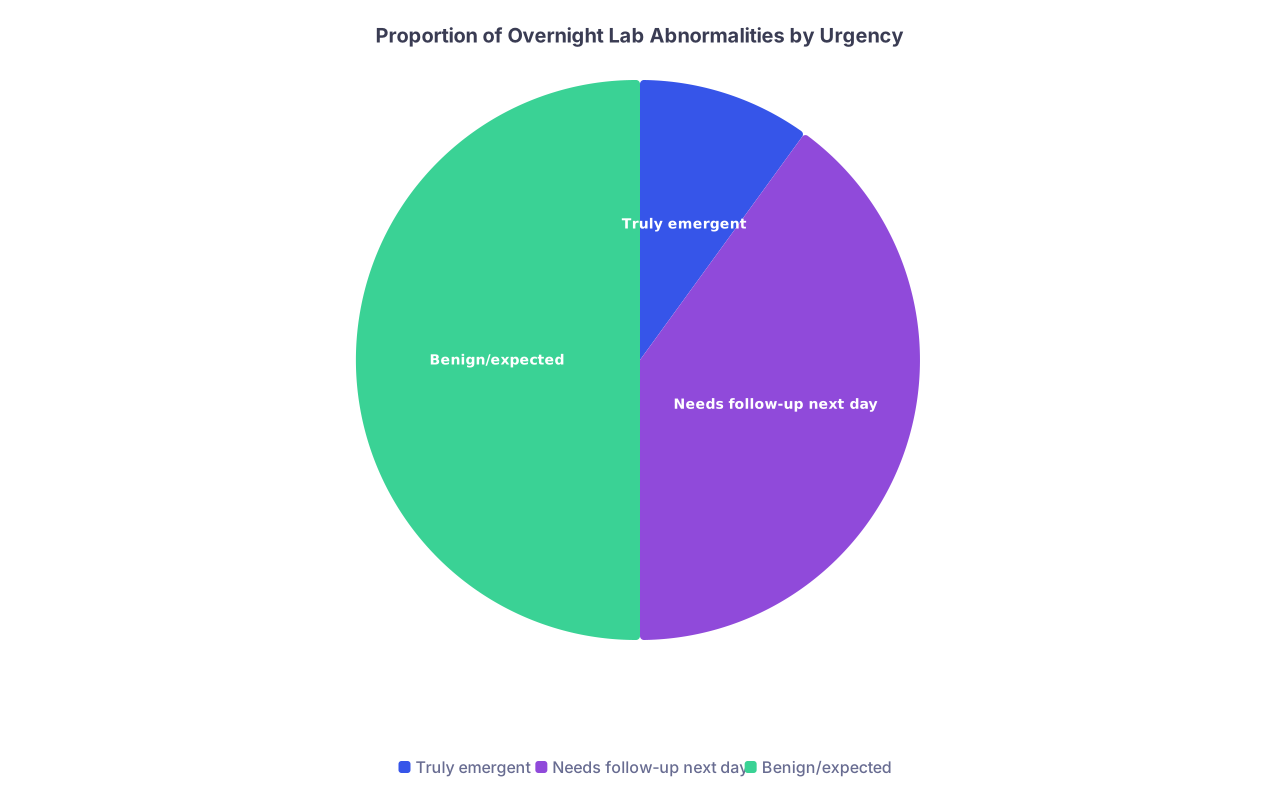
| Category | Value |
|---|---|
| Truly emergent | 10 |
| Needs follow-up next day | 40 |
| Benign/expected | 50 |
Common examples of “abnormal” labs that often do not require immediate action:
- Stable, chronically low hemoglobin in a known cirrhotic or CKD patient who is hemodynamically fine
- Mild hyponatremia (Na 129–134) in a patient with known SIADH, eating and drinking
- Slightly elevated creatinine in a patient on diuretics, but normal urine output and stable vitals
- Mild leukocytosis in a patient on steroids, afebrile and clinically improving
What you must avoid is reflexive treatment: giving transfusions, pushing insulin, ordering stat scans, calling rapid responses—without first asking, “Is this abnormal for this patient, or is this their baseline?”
The antidote: every time you see an abnormal result, you do three things before touching the order screen:
- Check prior values (same day and previous days).
- Check vital signs and nurse notes.
- Check the problem list and attending notes for whether this is chronic/expected.
If the number is stable, the patient looks fine, and it is documented as a chronic issue, then the correct night action might be: document, notify the nurse of the plan, and sign out clearly to the day team.
Do not confuse “I am uncomfortable” with “this is unstable.”
Mistake #2: Acting on Labs Without Seeing or Talking to the Patient
This is the most common dangerous behavior on nights: treating the lab instead of the patient.
You see a potassium of 6.2. Your brain screams, “Hyperkalemia! Cardiac arrest!” You order insulin, D50, calcium, albuterol, Kayexalate, the whole bundle. All from your chair. Without walking into the room.
Then the ECG gets done and the potassium recheck comes back 4.7. The lab was hemolyzed. You just gave insulin and D50 to a normokalemic patient who now has a blood sugar of 420, needs fingersticks every hour, and might get hypoglycemic later.
I have watched this play out in real time.
You must avoid the “chair-only doctor” trap. If you are about to push a medication that could crash someone’s blood pressure, sugar, or mental status, you should at least lay eyes on them.
As a rule: any lab result that is going to trigger a high-impact intervention should prompt at least one of the following before treatment:
- A bedside assessment (even if it is quick: appearance, mental status, vitals)
- A conversation with the nurse: “Is this new? How does the patient look?”
- A verification step (repeat lab, point-of-care test, or review ECG/imaging)
Do not accept the excuse of “I was too busy” for skipping these. That is how bad outcomes end up summarized in one line at M&M.
Mistake #3: Ignoring Trends and Focusing Only on Single Values
New interns have an isolated-lab mindset: they see today’s sodium, hemoglobin, or creatinine as if it exists in a vacuum.
Medicine does not work that way. Trends are often more important than the absolute number.
Let me spell out the mistake pattern:
- You see Hgb 7.3, shrug because your “transfuse threshold is 7,” and move on.
- You do not notice it was 10.5 yesterday. That is an active bleed until proven otherwise.
- You do not check vitals where the heart rate is creeping up and blood pressure is inching down.
- Six hours later, the rapid response is called for hypotension.
Same for creatinine:
- Cr 1.8 in a patient whose baseline is 1.7 is one problem.
- Cr 1.8 in a patient whose baseline is 0.6 and was 1.1 this morning is another story.
And sodium:
- Na 118 in a patient whose sodium has been 118–120 all week, stable and eating, is rarely a middle-of-the-night emergency.
- A drop from Na 135 to 123 in 12 hours, with worsening confusion, absolutely is.
| Parameter | "Reassuring" Pattern | Dangerous Pattern |
|---|---|---|
| Hemoglobin | Stable 7.5 → 7.3 → 7.2 | 10.5 → 8.2 → 7.3 |
| Creatinine | 2.1 → 2.0 → 2.0 | 0.7 → 1.4 → 1.8 |
| Sodium | 120 → 119 → 118 | 138 → 128 → 123 |
| WBC | 13 → 12 → 11 | 7 → 14 → 20 |
Your habit on nights should be: click the “previous results” tab every single time. If you are not looking at the 24–48 hour pattern, you are driving blind.
Mistake #4: Over-ordering Stat Labs and Repeats “Just in Case”
Some interns start to feel that more data equals more safety. So they reflexively order:
- q4h CBCs on a patient with stable post-op anemia
- Serial BMPs overnight on someone with mild AKI who is otherwise stable
- Repeat troponins every 3 hours because the first one was borderline
- Lactate checks “just to be safe” in every febrile patient
That is not diligence. That is noise generation.
You are not just wasting money. You are harming patients:
- More blood draws = iatrogenic anemia, especially in ICU and oncology patients
- More “borderline abnormal” results = more unnecessary interventions and consults
- More stat labels = delayed turn-around time for labs that actually matter
On call, your question for every new lab should be: “Will this result tonight change what I do tonight?” If the honest answer is no, it should usually wait until morning.
The red flags of over-ordering:
- You are ordering labs to feel less anxious, not because you have a concrete plan based on the result.
- You cannot clearly explain to a nurse why it needs to be drawn stat at 3 AM vs 7 AM.
- You are ordering serial tests without any defined endpoint or stopping rule.
Mistake #5: Mismanaging Hyperkalemia and Other “Scary” Electrolytes
Hyperkalemia is where new interns most often overreact or underreact.
Common mistakes:
- Not confirming a hemolyzed or unreliable sample before aggressive treatment
- Forgetting to get or review an ECG before deciding on therapy
- Treating a K of 5.6 in a stable patient on spironolactone like it is 6.8
- Ignoring a K of 6.3 with peaked T waves and calling it “probably hemolyzed”
- Giving insulin+D50 without rechecking blood glucose or planning for follow-up sugar checks
You need a simple, disciplined structure:
-
- Hemolyzed? Draw from a different site.
- Peripheral vs line draw? Prefer peripheral confirmation.
What does the ECG show?
- If there are classic changes (peaked T waves, widened QRS), treat as real and urgent.
What is the clinical context?
- ESRD on dialysis vs new AKI vs massive hemolysis or rhabdo.
What is your clear plan?
- Calcium for membrane stabilization if ECG changes.
- Insulin+D50 and/or albuterol to shift potassium.
- Something to eliminate K (loop diuretic, dialysis, potassium binders depending on context).
- Recheck labs and glucose at defined intervals.
Do not just fire off orders randomly and hope something helps. That is how you generate rebound hypoglycemia at 5 AM on a patient no one is closely monitoring.
The same pattern of error applies to sodium, magnesium, and calcium. Any electrolyte where the correction itself can harm the patient needs a structured plan and clear reassessment steps, not panic ordering.
Mistake #6: Delaying Action on Truly Time-Sensitive Results
Let me flip the script. Sometimes the mistake is the opposite: paralysis, not overreaction.
You see a hemoglobin of 5.8 in a patient admitted for a GI bleed. You tell yourself, “They are sleeping, vitals look okay, I’ll sign this out to the day team.” Or a troponin significantly higher than prior with new chest pain documented in the nurse note; you decide to “wait for the next set” before calling anyone. That delay can be catastrophic.
Common underreaction zones for interns on nights:
- Very low Hgb (<7, especially <6) in anyone with concerning story or unstable vitals
- Rapidly rising troponin with symptoms or ECG changes
- Severe hyponatremia with new confusion, seizures, or severe headache
- Lactate elevation in a septic, hypotensive, or tachycardic patient not yet in the ICU
- AKI with oliguria/anuria and rising K or acidosis
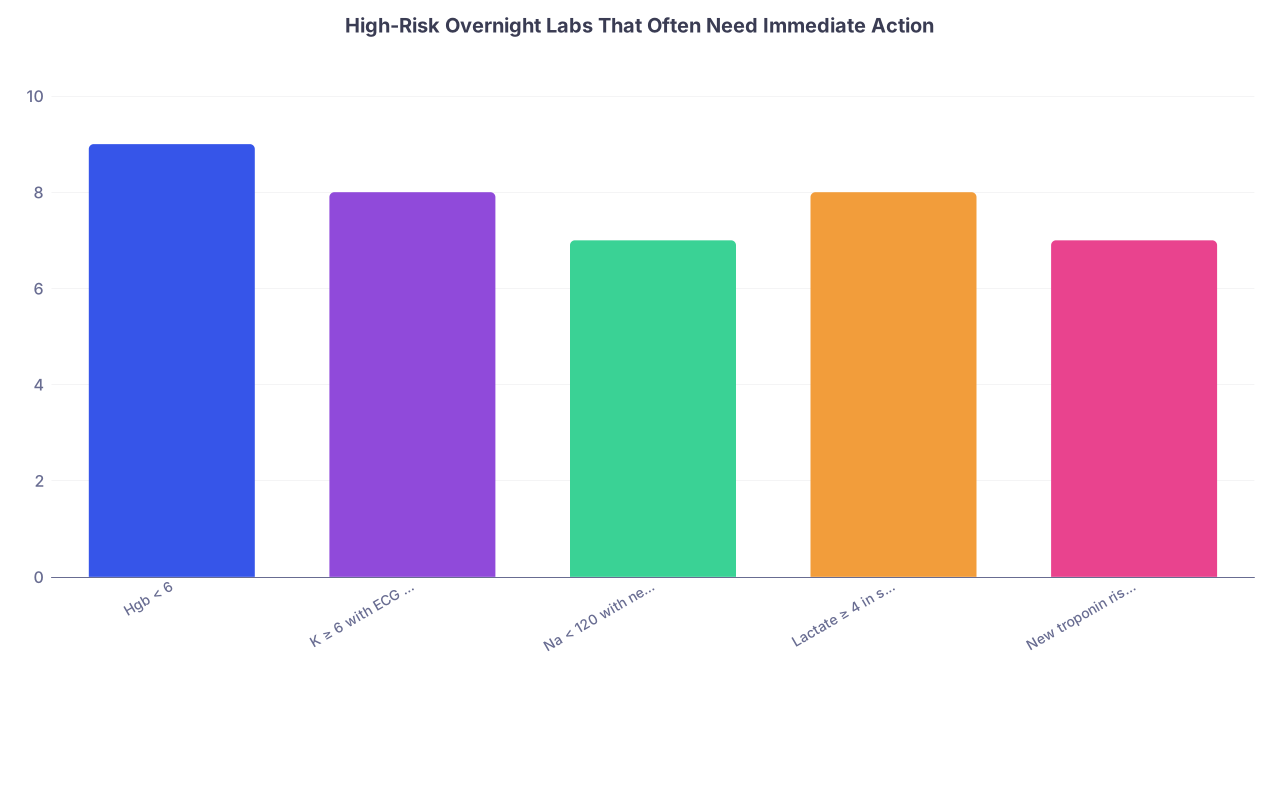
| Category | Value |
|---|---|
| Hgb < 6 | 9 |
| K ≥ 6 with ECG changes | 8 |
| Na < 120 with neuro sx | 7 |
| Lactate ≥ 4 in sepsis | 8 |
| New troponin rise + symptoms | 7 |
Your mental checklist when you see these:
- Does this lab represent an immediate threat to perfusion, oxygen delivery, or cardiac stability?
- Have I checked recent vitals and nursing comments for any deterioration?
- Is there an intervention that, if delayed by 4–6 hours, significantly worsens outcome? (Transfusion, antibiotics, fluids, ICU transfer, emergent dialysis, catheterization, hypertonic saline, etc.)
If the answer is yes, you do not “wait for rounds.” You assess the patient, call your senior, and often call the attending. You would rather be the intern who over-communicated than the one who “did not want to bother anyone.”
Mistake #7: Not Looping In Nurses, Seniors, and Consultants Early
The worst nights are when the intern tries to be a one-person show. You will see this person glued to the computer, silently drowning.
New interns mess up overnight labs by isolating themselves:
- They reorder labs without telling the nurse, so no one actually draws them.
- They decide alone that a patient is “too sick for the floor” but do not call the ICU team until the patient is crashing.
- They get a critical lab dictated over the phone but do not write it down, ask for confirmation, or clarify the units.
- They are embarrassed to page cardiology, nephrology, or heme-onc “this late” when they are clearly out of their depth.
At night, closed-loop communication is not optional. It is survival.
You should make it a reflex:
- When you act on a serious lab, tell the nurse explicitly what you are doing and what changes to watch for.
- When a lab seems really off from prior (troponin, creatinine, Hgb, etc.), verbally confirm it with the lab if the clinical picture does not fit.
- When you are considering stepping up level of care (floor → stepdown/ICU), get your senior involved and call earlier rather than later.
Pride kills on nights. So does silence.
Mistake #8: Forgetting to Document Decisions and Rationale
New interns often do the right thinking at 3 AM, then leave no evidence of it in the chart. That is a problem for two reasons:
- The day team has no idea what happened overnight.
- If something goes wrong, it looks like you ignored the lab or randomly ordered tests.
You do not need a novel. You do need a brief, focused note when any of the following occur:
- You respond to a critical lab with a significant intervention (transfusion, pressors, transfer, invasive procedure).
- You decide to not act on a critical lab because it is chronic and stable, or clearly spurious, or repeated and normal.
- You change the plan of care significantly based on trend interpretation (e.g., escalating sepsis care).
A good 3–5 line note can save you during morning signout and protect the patient from redundant tests or conflicting decisions.
Something like:
“2:15 AM – Critical Hgb 6.1 reported. Chart review shows Hgb 10.2 → 8.0 → 6.1 in past 24h in pt w/ known melena. Pt seen at bedside: pale, HR 112, BP 96/58, mentation intact. Ordered 2 units PRBC, stat type and cross, repeat CBC, started 1L LR bolus, GI fellow paged, senior notified. Plan: monitor vitals q15–30 min, consider ICU transfer depending on response.”
That is the bare minimum of professional practice, not overkill.
Mistake #9: Letting Fatigue and Cognitive Bias Drive Decisions
By 4 AM, your brain is not your friend. You will lean heavily on shortcuts:
- “This patient has always been fine; this new lab is probably nothing.”
- “Labs from this floor are always messy; it is probably an error.”
- “I just dealt with hyperkalemia; this other K of 6.0 is probably hemolyzed too.”
- “I already decided this patient is ‘sick’ so every lab must be bad.”
You will also fall into two opposite traps: anchoring and therapeutic inertia.
Anchoring: you fixate on your first impression (“this is chronic anemia”) and ignore new evidence (vitals changing, stool turning black, Hgb dropping fast).
Inertia: you see worsening trends but keep telling yourself you will “reassess after the next lab,” delaying necessary escalation.
You cannot eliminate fatigue, but you can build simple rules that protect you from your 4 AM brain:
- Any unexpected critical lab? Force yourself to re-check vitals and the last 24 hours of labs before deciding.
- Any “this must be a lab error” thought? Confirm with a repeat or call the lab.
- Any patient who now has two different systems “acting off” (e.g., rising creatinine and new tachypnea, or falling platelets and new confusion)? Strongly consider that something systemic is going on and do a more thorough assessment.
Mistake #10: Terrible Signout Around Overnight Lab Issues
The traps actually start before the night even begins.
You are far more likely to mishandle a 3 AM lab if:
- The day team did not warn you about which patients have “fake scary labs” (e.g., chronically low Hgb, always high troponin in ESRD, stable high lactate in cancer).
- No one told you which pending lab results are expected and which are critical to act on.
- There is no clear transfusion or electrolyte management threshold discussed in signout.
- You never received “if X then Y” rules for high-risk patients (e.g., post-op day 0 spine surgery, fresh GI bleeder, new STEMI, brittle diabetic).
Good signout is lab-specific. It should sound like:
- “This cirrhotic always runs Hgb 7–8, no transfusion unless <7 plus symptoms.”
- “This STEMI patient – if troponin is rising and they have chest pain or ECG changes, page cards fellow immediately.”
- “We are trending lactate on this septic shock patient. If >4 despite fluids and pressors, call ICU fellow right away.”
Your mistake as a new intern is to accept vague signout like “Call if there are any criticals” and not demand more clarity. That is how you get set up for failure.

| Step | Description |
|---|---|
| Step 1 | Abnormal overnight lab |
| Step 2 | Check prior labs and vitals |
| Step 3 | Document and sign out |
| Step 4 | Assess patient or call nurse |
| Step 5 | Plan for AM, non-urgent actions |
| Step 6 | Call senior and consider emergent treatment |
| Step 7 | Trend or isolated? |
| Step 8 | Patient stable? |
FAQs
1. How fast do I need to respond to “critical value” pages?
You should acknowledge the page immediately (within a few minutes), but not every critical lab requires immediate bedside action. The sequence: write down the value, confirm patient identity, quickly check prior labs and vitals, then decide if this needs you physically at the bedside right now. Do not ignore or delay the call because you feel overwhelmed with other tasks.
2. If I think a lab is wrong, can I just ignore it?
No. You can doubt it, but you must verify it. That means repeating the lab (preferably from a different site) or calling the lab to discuss potential collection/processing issues. “I thought it was wrong” without a repeat or some attempt at confirmation will not protect your patient—or you—if the value was actually real.
3. When is it appropriate to transfuse overnight vs wait until morning?
You generally consider transfusion overnight if the hemoglobin is below your institution’s threshold (often around 7) and any of the following are present: active or suspected ongoing bleeding, hemodynamic instability, significant symptoms (chest pain, dyspnea, syncope), or major cardiac disease. Chronically anemic but stable patients, with no active bleeding or symptoms, are usually safe to manage with a day-time transfusion after discussion with the primary team.
4. Should I always get an ECG for hyperkalemia?
If the potassium is at or above 6.0, or if there is a significant acute rise from baseline, or if the patient has kidney failure or is on medications that affect cardiac conduction, you should obtain or carefully review an ECG. Do not start aggressive hyperkalemia therapy without at least attempting to get that information, unless the patient is crashing and you are in a true life-or-death scenario.
5. How do I balance bothering my senior at night with being independent?
If you are asking the question, you should probably call. Situations that demand senior involvement: uncertain need for ICU transfer, unclear management of major electrolyte derangements, unexpectedly low hemoglobin or rapidly rising creatinine, concerning troponin changes, or any lab that might lead to high-risk interventions (pressors, emergent procedures, large transfusions). On-call culture punishes silent failures far more than “unnecessary” calls.
Key points to keep you and your patients safe overnight:
- Never treat a number without context—always look at trends, vitals, and the bedside picture.
- Reserve aggressive, middle-of-the-night interventions for truly time-sensitive problems; everything else can often be watched and handed off with clear documentation.
- Do not do this alone—loop in nurses, seniors, and consultants early when labs and clinical status do not match or when the stakes are high.