
The fastest way to ruin an on‑call night is to accept a sloppy handoff without pushing back.
You are not being “nice” when you nod along to a vague sign‑out. You’re being set up. For missed sepsis. For a 3 a.m. crash. For the attending asking, “Why did no one catch this?”
Let’s walk through the overnight handoff mistakes that quietly load the gun—and how to refuse to be the one holding it when it goes off.
1. Treating Handoff as a Social Ritual Instead of a Clinical Event
Sign‑out is not a vibe check. It’s not “How was your day?” followed by a story and a shrug.
The common mistake: treating evening sign‑out as something to get through rather than the most important 20–40 minutes of your entire call.
Here’s what this looks like in real life:
- Day team scrolling while talking, barely looking at you.
- “Everyone’s stable” as the opening line.
- “Nothing’s going on with them” repeated 15 times.
- You not stopping them when you see a red flag in the chart.
That casual energy is how you end up walking into:
- The “stable” COPD patient with a 20‑point respiratory rate increase since noon.
- The “routine” post‑op with a 2‑point Hgb drop and a heart rate of 120.
- The “no issues” DKA patient whose anion gap quietly reopened.
If handoff feels breezy, you should be suspicious, not relieved.
Do not:
- Let someone speed‑talk through 20 patients while you “trust their gestalt.”
- Accept “doing fine” as a clinical status.
- Allow side conversations, food delivery drama, or Instagram reels during sign‑out.
You are inheriting liability, not just patients.
Switch your mindset: sign‑out is a critical care procedure. It deserves the same focus you give a central line.
2. Accepting “Watch Closely” Without Concrete Triggers
This one burns interns every single year.
The line goes like this: “They were a little borderline this afternoon. Just watch them closely overnight.”
That sentence is a trap.
“Watch closely” without specifics is how you:
- Miss a slow‑burn GI bleed.
- Ignore a MAP drifting down from 75 to 62 to 58.
- Fail to act on increasing oxygen requirements until the patient is in extremis.
You need hard triggers, not vibes.
Ask:
- “What exact change would make you want me to call the attending?”
- “At what blood pressure do you want something done? At what heart rate?”
- “What labs are already concerning but not yet acted on?”
- “Are there vitals or nursing calls you expect to get for this patient?”
Push until you have clear boundaries. For example:
- “If MAP <65 twice despite 1L bolus, call attending.”
- “If they go from 2L to 4L and still sat <92%, call RT and me.”
- “If Hgb drops below 7, transfuse, then page attending.”
If they can’t answer clearly, that patient probably needs to be reassessed now, before the day team disappears.
Do not carry vague “sickish but I didn’t have time to work them up” patients into the night without a plan. That’s how preventable codes happen at 3 a.m.
3. Ignoring the “Ten‑Minute Work Now” List
The biggest overnight disasters usually come from things that should have been fixed at 6:30 p.m. but weren’t.
You know the lines:
- “They’re a little dry, maybe could use some fluids…”
- “They seemed a bit confused earlier, but I think it’s sundowning.”
- “K was 2.9, I put in oral replacement; you can recheck if you want.”
- “They had some chest pain earlier but EKG was ‘reassuring’—I didn’t look at the repeat troponin yet.”
Translation: “I left a landmine; enjoy.”
Here’s the mistake: you just write it down and accept it.
The fix: ruthlessly separate tasks into:
| Task Type | Who Should Own It (If Possible) |
|---|---|
| New or worsening vital sign issues | Day team before sign-out |
| Concerning new lab abnormalities | Day team before sign-out |
| Chest pain or neuro changes | Day team before sign-out |
| Borderline but stable trend watching | Night team with clear triggers |
| Routine renewals (insulin, heparin) | Either, but better day team |
If something can be handled now with 5–10 minutes of effort and will obviously bite you overnight, say it out loud:
“I’m worried this will blow up at 2 a.m. Can we quickly address it before you leave?”
You’re not being difficult. You’re being safe.
Specific examples you should insist get addressed:
- Untreated fever with no cultures or workup.
- New O2 requirement without a chest X‑ray.
- Marginal blood pressure with no fluids ordered and no plan.
- Sliding scale insulin only in a brittle diabetic on high‑dose steroids.
- Home beta‑blocker or anticoagulation still on hold for no clear reason.
If the day team pushes back because “I really have to go,” offer this: “Then I’m going to document that we discussed it and that you felt it was OK to defer. But I’d really prefer we fix it now.” That usually focuses people.
4. Taking “Full Code” at Face Value
You know what’s worse than a code at 3 a.m.?
A code at 3 a.m. on a 96‑year‑old with metastatic cancer whose chart says “Full Code” because nobody had the guts—or time—to have a real conversation.
Handoff mistake: accepting code status as a checkbox instead of a clinical reality.
Red flags:
- “They’re full code, but the family said they never talked about this before.”
- “I didn’t get a chance to address goals of care, but maybe you can overnight?”
- “Palliative was consulted, but nothing finalized yet.”
No. Do not let this slide to “maybe overnight.”
Overnight is the worst time to be initiating a nuanced goals‑of‑care discussion from scratch with a family you’ve never met, in the hallway, while the nurse is bagging the patient.
What you can do:
- Ask directly: “Has anyone actually discussed prognosis and code status in detail?”
- Check for: palliative notes, prior admissions, outpatient notes, POLST/MOST.
- If the story and the code status don’t match, push: “This is someone likely to arrest tonight. We need some form of plan before you go.”
At a minimum, clarify:
- Is this truly “full everything” or are they DNR but OK with escalation to ICU, BiPAP, pressors?
- Are there any existing advance directives not yet scanned into the chart?
- Who is the actual surrogate decision maker, with confirmed contact info?
Don’t wait for the “I thought they would want everything done” defense. That’s how you end up leading a resuscitation that nobody actually wanted.
5. Allowing Handoff to Be Purely Verbal
Residents still do this: “I’ll just tell you about the sick ones.”
That works—until night float changes mid‑week, or a cross‑cover night happens, or you’re off the floor for a rapid response and someone else has to cover your patients.
You need clear written structure, not just “ask me if you have questions.”
Good sign‑out uses a consistent framework. I like a modified I‑PASS style:
- Illness Severity (Stable / Watch / Unstable risk)
- Patient Summary (1–2 line problem‑focused blurb)
- Action List (what needs to be done / watched tonight)
- Situation Awareness (what could go wrong / what to expect)
- Synthesis (you repeat key points back)
The mistake isn’t “not knowing I‑PASS.” The mistake is being OK with random, unstructured brain dumps.
Example of bad sign‑out:
“Mr. Jones is in 512, COPD, came in with SOB, he’s been ok, still on oxygen, might need nebs, nursing will call you if anything.”
Example of safe sign‑out:
“Mr. Jones, 512, severe COPD, admitted with COPD exacerbation, still on 3L O2 (baseline 2L). Illness severity: watch.
Action tonight:
– If O2 needs >4L to keep sats >90%, get VBG and CXR and page me.
– He tends to get tachycardic into 110s with nebs; ok as long as BP >100.
Situation awareness: If he gets drowsier or RR <10, I’d be worried about CO2 retention—call attending early.”
If your program has a sign‑out template, use it. If they don’t, build a minimalist one and stick to it.
And always, always document key “if/then” plans in the chart. Verbal alone doesn’t protect you.
6. Failing to Identify Your True “Active Problems” List
A bloated sign‑out with 20 bullet points per patient is just as dangerous as a minimalist one.
The classic mistake: treating every checkbox as equally important, so the real threats are buried under noise.
You don’t need to know every minor electrolyte repletion from the past 24 hours. You do need to know:
- Who could crash.
- Who might deteriorate.
- Who is “fine unless X happens, then it’s bad.”
Before you accept handoff, force the day team to answer this for every person:
- “Is this patient likely to need me tonight?”
- “If yes, what are the top 1–2 things that might happen?”
- “What have you already done to reduce that risk?”
Anything that doesn’t change your overnight behavior is background, not handoff material.
Use categories in your notes, even if it’s informal:
- “High‑risk overnight” – I should eyeball this patient before midnight.
- “Moderate risk” – Check vitals trends / labs, know the plan.
- “Low risk” – Call me if something weird happens.
You’re triaging attention. Don’t let the chart’s 30 problems list distract you from the 2 that can kill someone tonight.
7. Not Pre‑Reading the Board Before Handoff
Showing up to sign‑out cold is like walking into a code blue and introducing yourself first.
I’ve watched interns sit down at 6:59 p.m. having no idea:
- Who got admitted in the last 2 hours.
- Who went to the ICU.
- Which patient the attending rounded on three times because they “made me nervous.”
So they let the day resident control the narrative completely.
Spend 10–15 minutes before handoff:
- Scan the list.
- Note any new “watch” or “unstable” status.
- Check systems messages: new rapid responses, transfers, ICU bounce‑backs.
- Quickly eyeball vitals and last 6–12 hours of labs on obviously sick patients.
Then, during handoff, you can say things like:
- “I saw their lactate is still 3.8; what’s the plan if it doesn’t come down?”
- “HR’s been in 120s for the past 4 hours—do we have an explanation?”
- “That post‑op creatinine bump—did anyone talk to surgery?”
You catch more nonsense when you’re not hearing it all for the first time.
8. Not Clarifying Who Owns Which Night‑Time Decisions
This one bites cross‑cover frequently.
Scenario you don’t want:
- Nurse calls at 2 a.m.: “Surgery said call medicine about this chest pain; medicine says it’s surgical; attending doesn’t answer; what do you want to do?”
- Or: “ICU said to keep them on the floor but watch closely; now they’re worse; who do I call?”
If it feels fuzzy at 7 p.m., it will be a mess at 3 a.m.
At sign‑out, you should know:
- Who is the primary service and who is consult.
- Who is on call for each involved team.
- What threshold each team wants you to use to wake them.
Ask bluntly whenever there’s shared ownership:
- “If this gets worse, am I calling you, surgery, or ICU first?”
- “Is ICU officially signing off or just ‘watching from distance’?”
- “Are we admitting this to medicine with surgery following, or true co‑management?”
And then write: “Plan per [team]: If X, then call [specific team] first.”
Assumptions are how you get chewed out by both services for either “bothering them” or “not calling sooner.”
9. Trusting That “Orders Are Already In” Without Checking
One of the quieter on‑call disasters is the “phantom plan.” The day team says the right words, but nothing was actually ordered.
You hear:
- “They’re getting q4h labs overnight.”
- “Fluids are running now.”
- “Antibiotics are already broadened.”
- “CT is ordered; they just need to go down.”
Then you get the 2 a.m. call: “There are no active orders.”
Do not trust words alone.
For any high‑stakes plan mentioned at sign‑out:
- Quickly open the chart and confirm orders exist.
- Check timing: are the labs scheduled? Is the fluid rate right? Has imaging been protocolled?
- Verify med start times (tomorrow morning vs. now).
High‑stakes = anything where a delay could change the outcome:
- STAT or urgent imaging
- Antibiotics
- Blood products
- Pressors / fluids
- Neuro checks
- Telemetry
You don’t need to micromanage every Tylenol order. But “I assumed they ordered it” is not an acceptable explanation after a bad outcome.
10. Skipping the “One Last Question” at the End
This is the simplest habit and maybe the most powerful.
Before the day team walks out, ask:
“Who are you most worried about tonight?”
And wait.
Don’t let them shrug. Do not accept “no one really.”
The human brain is annoyingly good at pattern recognition and gut feeling. Day residents often do have a subconscious “uneasy” list, even if they can’t immediately articulate why.
Common answers that come out when you actually ask:
- “I guess that cirrhotic guy in 408… he just doesn’t look right.”
- “The post‑op in 324—surgery said they’re fine, but the tachycardia bothers me.”
- “The septic shock patient is technically stable, but I’m scared they’ll crash.”
That one question often surfaces the real risk that wasn’t fully captured in the formal sign‑out.
Once you have that name, make a plan:
- Look at them yourself before midnight.
- Skim the last 24 hours of notes, labs, and vitals.
- Reassess whether the current plan is actually enough.
That extra 5–10 minutes on the right patient can save your whole night—and possibly their life.
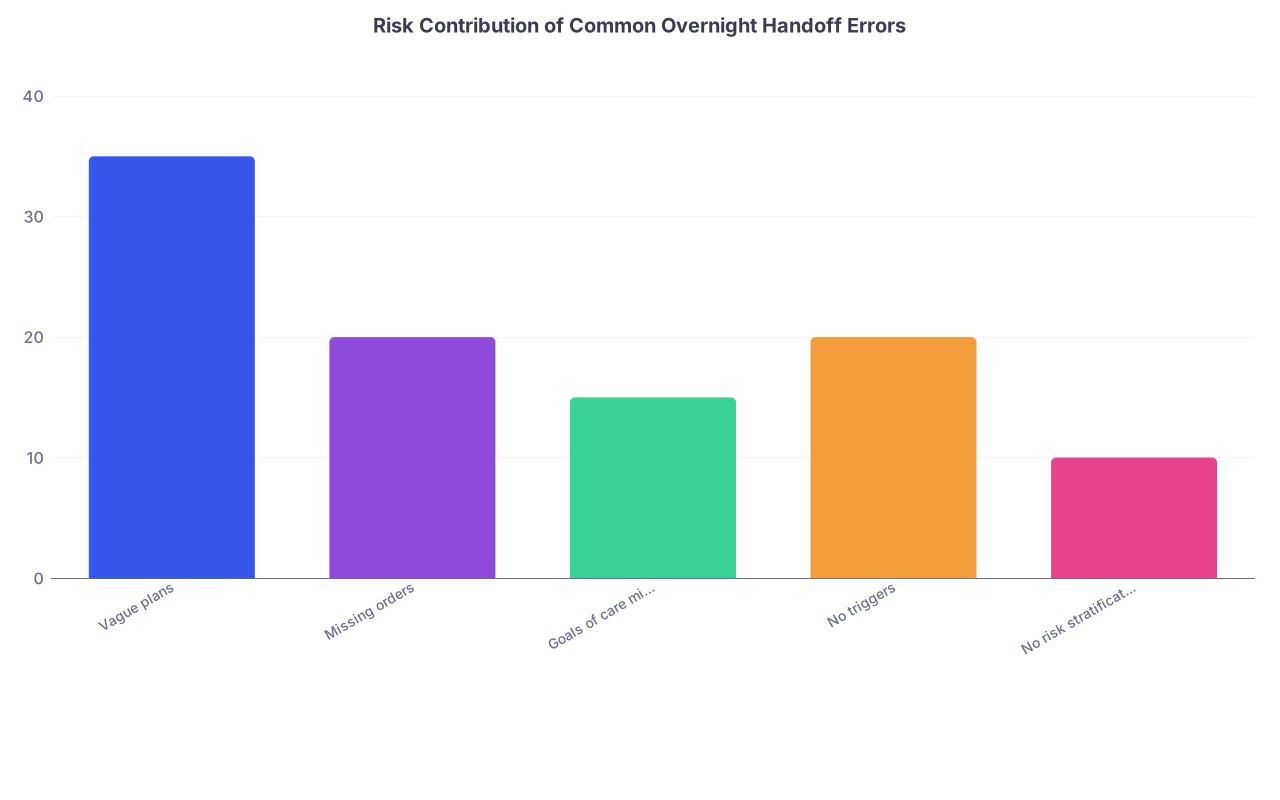
| Category | Value |
|---|---|
| Vague plans | 35 |
| Missing orders | 20 |
| Goals of care mismatch | 15 |
| No triggers | 20 |
| No risk stratification | 10 |
11. Letting Culture Intimidate You Into Silence
The most dangerous overnight handoff mistake is psychological, not logistical.
You know the scene:
- Senior resident is clearly in a rush.
- Everyone’s standing up, half walking toward the door.
- You’re the intern, new or off‑service, feeling slow and stupid for asking “basic” questions.
So you shut up.
You nod. You write half‑understood phrases. You think, “I’ll figure it out later.”
Later = 3 a.m.
“Figure it out” = alone, under pressure, with incomplete information.
You have every right to:
- Say, “Slow down, I need to understand this before you go.”
- Ask, “Can we pause and clarify the plan for this one?”
- Admit, “I’m not comfortable with this vague plan; can we make it more specific?”
The resident who walks out and rolls their eyes because you asked “too many questions” will not be there when things go wrong. You will.
If someone pressures you with, “We don’t have time for this,” reply:
“I get you’re in a rush, but it’s my license and my pager overnight. I’d rather spend 3 minutes now than make a bad call at 3 a.m.”
You’re not being fragile. You’re being responsible.

| Step | Description |
|---|---|
| Step 1 | Start Handoff |
| Step 2 | Review list and vitals first |
| Step 3 | Structured sign out for each patient |
| Step 4 | Clarify triggers and action plan |
| Step 5 | Document brief plan |
| Step 6 | Confirm orders placed |
| Step 7 | Ask who worries day team most |
| Step 8 | Pre round on high risk patients |
| Step 9 | Start overnight call |
| Step 10 | High risk? |
FAQs
1. I’m an intern and my seniors rush through sign‑out. How hard should I push back?
Harder than you think. You don’t need to be rude, but you do need to be firm. Focus on the sickest patients and the ones with active issues. Say, “Before you go, I want to make sure I’m clear on the plan for these 3 patients,” and list them. If they still rush, document their stated plans in the chart so you’re not alone holding undocumented decisions when things turn bad.
2. How do I know which patients I should actually see in person before midnight?
Start with three groups: anyone labeled “watch closely,” anyone the day team calls “borderline but okay,” and anyone identified as “who I’m most worried about tonight.” Then add: fresh admissions with sepsis, DKA, GI bleed, ACS, neuro changes, or unclear diagnosis. Those are worth a quick bedside look to calibrate your anxiety with the chart.
3. What if I realize after sign‑out that an important plan or trigger wasn’t clarified?
Page or call while the day resident is still in the building or reachable. Don’t wait “to see what happens.” Use a specific question: “For Ms. X in 412, what exact BP or O2 change do you want me to use as a trigger to escalate?” Then document the answer in your note or sign‑out. If you can’t reach them and you’re worried, preemptively re‑assess the patient yourself and set your own clear triggers with the attending on call.
Key points to tattoo on your brain:
- Vague handoffs are not “fine”; they’re how preventable overnight disasters happen.
- Always demand concrete triggers, clear ownership, and verified orders—especially for high‑risk patients.
- You’re allowed to slow down sign‑out. The few minutes you “waste” there are nothing compared to the hours—and consequences—of a 3 a.m. disaster you could have seen coming.