
The way many residents handle overnight warfarin doses is dangerous. Not dramatic. Just quietly unsafe.
Warfarin is the classic “I’ll just click something and move on” cross‑cover drug. That mindset will burn you, your patient, and possibly your license. I’ve watched good residents get called into M&M because of one careless 2.5 mg click at 2 a.m.
You’re on call. You’re exhausted. You’re covering 60–100 patients you barely know. And then the page:
“INR is back. Need warfarin dose for tonight.”
This is exactly where people make predictable, repeatable, and avoidable mistakes.
Let’s go through the landmines.
1. Blindly Continuing the Home Warfarin Dose
This is the most common and the most indefensible error: autopilot.
You see: “Home warfarin 5 mg nightly” in the med list and you think, “Okay, just keep 5 mg.” You barely glance at the INR. You definitely don’t scroll far enough to see that the last three INRs were 3.5, 3.8, and 4.1.
I’ve seen this pattern:
- INR today: 3.9
- Resident at 1 a.m.: “Continue home dose”
- Next day: INR 5.2, Hgb down 2 points, melena overnight
The mistake is simple: treating warfarin like lisinopril. It’s not a “home med to resume.” It’s a drug you dose based on today’s numbers and today’s context, not on a med rec sheet from 3 months ago.
Watch for these specific red flags before you even think about copying the home dose:
- New antibiotics (especially TMP‑SMX, metronidazole, fluconazole, amiodarone)
- New poor oral intake / NPO for days
- New liver dysfunction, acute illness, heart failure exacerbation
- Recent falls, trauma, or head strike
- Age >75 and frail, or CrCl limpingly low
If any of those are present, “home dose” is almost always wrong.
Better mental script:
“Home dose is a clue, not a plan.”
2. Dosing Without Looking at the Trend
Another classic: looking at one INR in isolation like it’s a holy number.
Patient’s INR is 2.6. You breathe out and order “warfarin 5 mg” because “hey, therapeutic.”
Except:
- Yesterday: 1.7
- Day before: 1.4
- Day before that: 1.2
You’re not stable. You’re on a steep upward slope. That 2.6 is momentum, not a resting point. Give full dose and you overshoot.
You must look at trend + timing:
- Last 3–5 INR values
- Dates and times drawn
- Timing of warfarin doses relative to those draws
- Any new medications or events each day
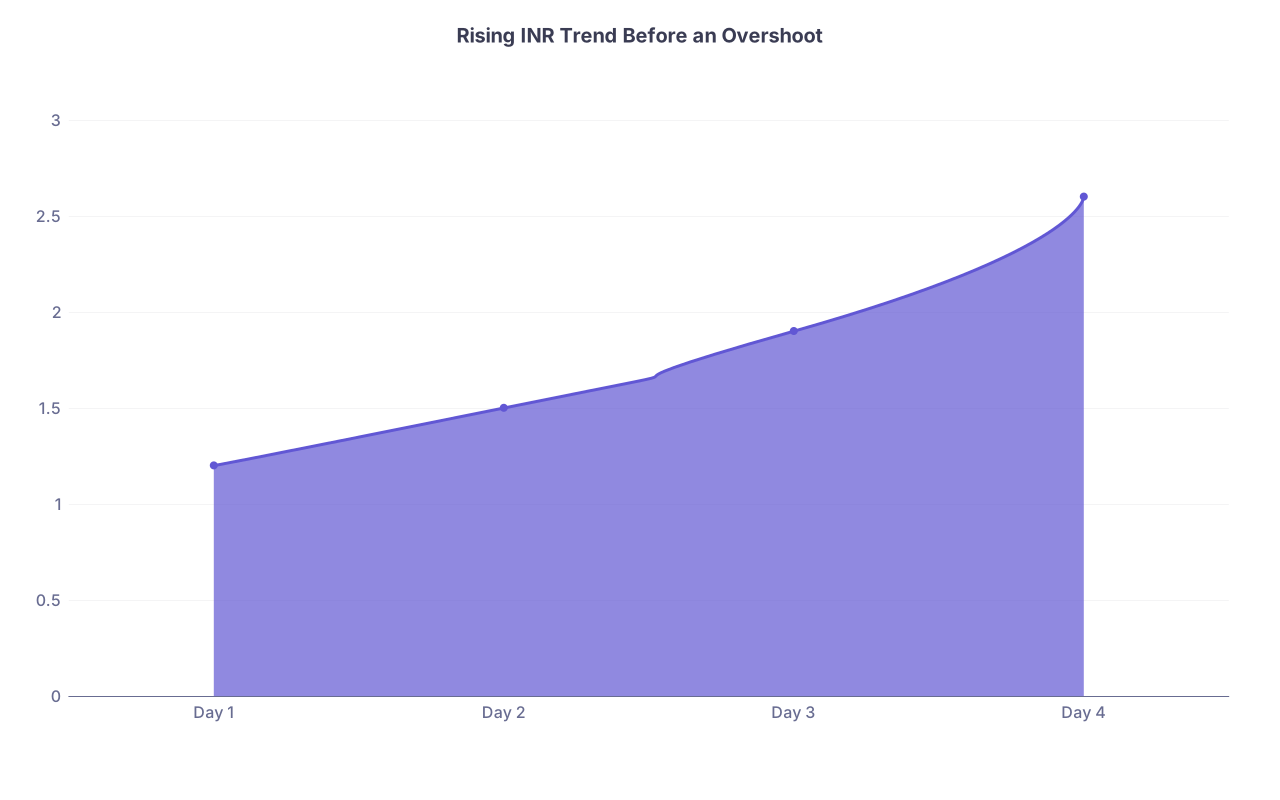
| Category | Value |
|---|---|
| Day 1 | 1.2 |
| Day 2 | 1.5 |
| Day 3 | 1.9 |
| Day 4 | 2.6 |
Therapeutic today doesn’t mean “safe to continue same dose.” It might mean “we’ve finally caught up and should ease off.”
If the INR has just arrived in range after days of being low and multiple “boost” doses, I’ve seen cautious attendings say “give half dose tonight” or “hold tonight, recheck in a.m.” Emulate that mindset, not the intern habit of “therapeutic = do nothing different.”
Practical rule:
Any time the INR moves by more than 0.5 in one day (up or down), slow your hand down before ordering.
3. Ignoring Why the Patient Is on Warfarin at All
This sounds basic, but I’ve seen cross‑cover notes like:
“Warfarin 5 mg tonight as ordered home”
Indication: (blank)
If you don’t know why your patient is taking warfarin, you have no business touching the dose.
The risk/benefit calculation is wildly different between:
- Mechanical mitral valve
- Unprovoked massive PE 2 weeks ago
- Remote AFib in a 92‑year‑old now actively bleeding
- “History of clot” from 15 years ago with no documentation
Your overnight choices change depending on indication:
- Mechanical mitral valve with INR 1.7? I get nervous holding. I’m thinking about bridging, checking for missed doses, and definitely not reflexively stopping.
- Very old AF patient with INR 3.8 and a new fall? I’m leaning toward holding tonight, maybe checking CT head, and talking to the day team about whether they should still be anticoagulated at all.
If the indication isn’t clear in two minutes:
- Read the H&P / cardiology / heme notes
- Check problem list and discharge summaries
- If it’s truly unclear and INR is borderline high: it’s safer to hold one dose than to blindly dose.
Do not be the person who aggressively “corrects” an INR of 1.9 in a palliative 88‑year‑old with recurrent GIB because “goal 2–3.”
4. Treating Every Patient Like They’re Low Risk
Residents often act like thrombotic risk is the same for all warfarin patients. It’s not.
I see three especially dangerous mindsets:
- “INR 1.7, I have to ‘fix’ it tonight no matter what”
- “Holding warfarin is always bad”
- “Bridging is someone else’s problem”
You have to know which patients absolutely cannot be allowed to sit under‑anticoagulated:
- Mechanical mitral valves
- Mechanical aortic valves with additional high‑risk features
- Very recent VTE (within 1 month, especially within 2 weeks)
- Antiphospholipid syndrome with prior arterial thrombosis
| Indication | Overnight Underdose Risk | Overnight Overdose Risk |
|---|---|---|
| Mechanical mitral valve | Very high | Moderate |
| Recent PE (2 weeks) | High | Moderate |
| Chronic AF (stable) | Moderate | Moderate |
| Remote DVT (>1 year) | Low | Higher (if frail/bleeding) |
For low‑risk indications (remote DVT, stable AF with bleeding risk), being at INR 1.7 overnight is not an emergency. For a mechanical valve, that under‑anticoagulation overnight matters.
On the flip side, many residents are terrified to hold warfarin in any setting, so they keep dosing in:
- Acute GI bleeds
- Large traumatic hematomas
- Post‑operative day 1 surgical patients who aren’t supposed to restart yet
That’s how you get called to explain why the postop Hgb dropped from 9 to 6.
Balance is the job. Not dogma.
5. Not Listening to What the INR Is Telling You
A common trap: emotional reaction instead of rational adjustment.
- INR 1.4 → “Way too low! Give double dose!”
- INR 4.5 → “Way too high! Someone messed up! Hold x 2 days, give vitamin K, stop everything forever!”
This knee‑jerk behavior leads to wild oscillation. And yo‑yo dosing is the enemy of control.
Think in patterns:
- Mildly low and drifting up? Small change or no change.
- Mildly low and flat for days on a good oral intake patient? Adjust 5–15% of weekly dose, not 50%.
- Mildly high (3.5) once, after poor PO intake for 2 days? Maybe just hold tonight and that’s it.
And remember: the INR you’re seeing tonight is a product of the last few days, not just last night’s dose. Don’t overcorrect with huge swings for a single outlier value unless bleeding or truly dangerous.
If your warfarin plan tonight is more than 1 step different from what the primary team did yesterday (e.g., primary: 5 mg daily, you: hold x 2 and 10 mg vitamin K), you better have a very clear reason in your note.
6. Disregarding Drug Interactions and Acute Illness
Warfarin is the perfect storm drug: everything interacts with it.
Common overnight misses:
- New metronidazole or fluconazole started on this admission
- TMP‑SMX for a UTI in an older person
- Amiodarone load started 3–4 days ago
- Prolonged NPO / very poor PO intake, especially in a malnourished or frail patient
- Acute hepatitis or congestive hepatopathy (INR creeps up “for free”)
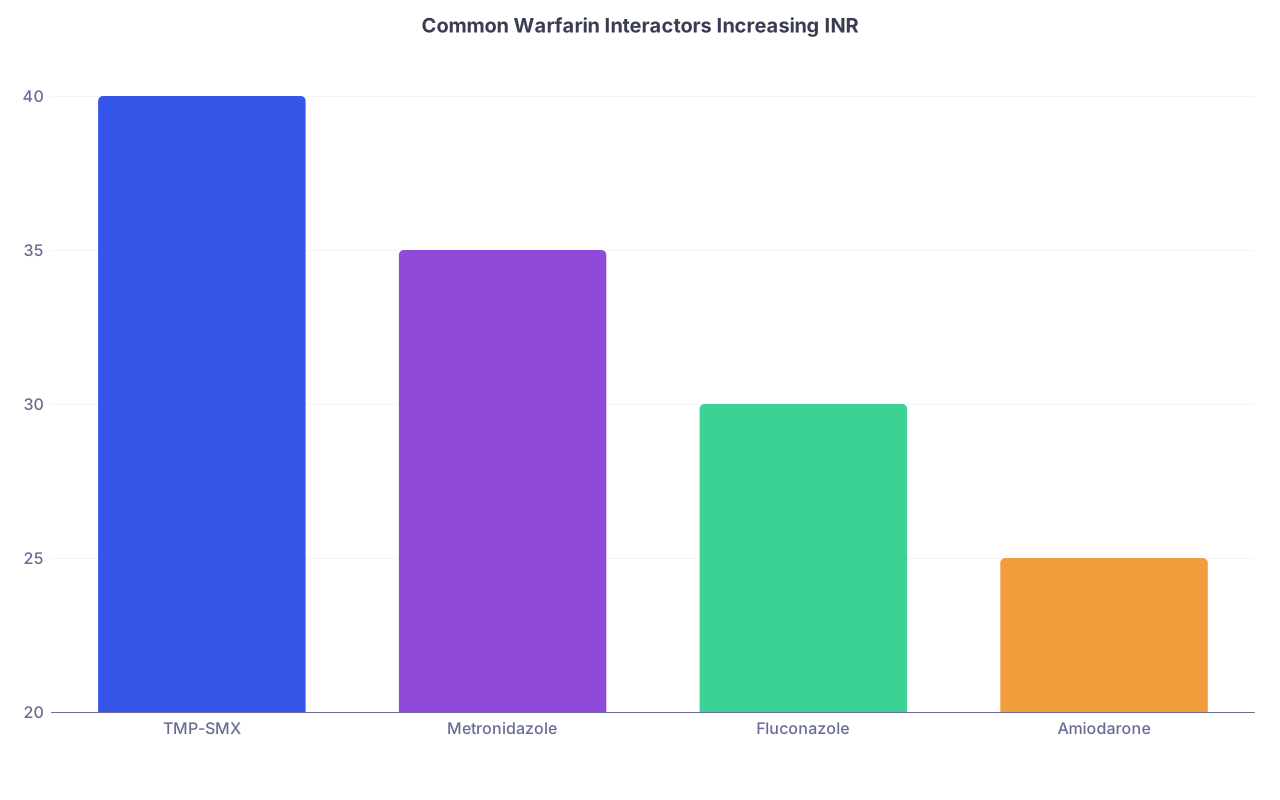
| Category | Value |
|---|---|
| TMP-SMX | 40 |
| Metronidazole | 35 |
| Fluconazole | 30 |
| Amiodarone | 25 |
If you ignore these, you will overdose someone. I’ve seen INRs jump from 2.2 to 4.7 in 48 hours after starting TMP‑SMX while the cross‑cover just kept clicking the same warfarin dose.
Your checklist before ordering:
- Any new antibiotics in the last week?
- Any new antiarrhythmics, antifungals, antiepileptics?
- Is the patient eating anything resembling a normal diet?
- Any new liver issues?
If the answer is “yes” to any of those and the INR is already at goal or slightly high, it is completely reasonable to:
- Hold tonight’s dose, or
- Give a smaller “maintenance” dose and re‑check INR in the morning
Err on the side of not stacking more warfarin on top of a changing interaction picture.
7. Forgetting Renal Function and Age
Warfarin itself is not renally cleared. That trick fools interns. So they think kidney function doesn’t matter.
That’s wrong.
Renal dysfunction and age magnify the impact of:
- Decreased albumin (more free warfarin)
- Reduced vitamin K intake
- Increased sensitivity to dose changes
- Polypharmacy and interactions
The 35‑year‑old with INR 3.3 on 7.5 mg nightly is not the same as the 88‑year‑old with INR 3.3 on 2 mg nightly and CKD stage 4.
For the very old or very renally impaired:
- Lower threshold to hold a dose for INR >3.0
- Lower tolerance for “boosting” low INRs with big jumps
- Higher suspicion that overshooting will produce real bleeding, not just a number on a lab
Do not use the same mental dosing “reflex” across ages. That’s lazy medicine and it shows.
8. Trusting That “The Day Team Already Has a Plan”
This one bites people constantly.
You assume:
- “They must have checked the INR already”
- “The primary team knows them; they set up a titration”
- “Cards/heme is following; I’ll just follow their last order”
You’re on cross‑cover. The legal and ethical responsibility at 2 a.m. is yours, not “cards from two days ago.”
I’ve seen:
- Old orders lingering after the indication resolved (e.g., provoked DVT 9 months ago, still on warfarin because “no one stopped it”)
- A heme note from last week with a detailed titration plan that no one actually followed
- A cardiology recommendation for goal INR 2.5–3.5 being ignored because some resident “standard goal 2–3’d” it
You must re‑check:
- Current indication and target range
- Most recent specialist recommendations
- Whether today’s plan makes sense today, given new events (bleeding, surgery, etc.)
If you find a huge mismatch between specialist recommendation and current practice, do not just blindly keep ordering. Leave a clear note for the day team and, for high‑risk situations, page the on‑call fellow.
9. Writing a Warfarin Order Without a Warfarin Plan
Huge mistake: dropping a dose and walking away without:
- Documenting your rationale
- Scheduling the next INR
- Clarifying when to notify if INR crosses thresholds
- Considering bridging in high‑risk patients with subtherapeutic INR
Too many cross‑cover notes read:
“INR 1.7. Gave warfarin 5 mg tonight.” That’s it.
That’s not a plan. That’s a shrug.
Your overnight note should look more like:
- “INR 1.7 today (from 1.6 yesterday, 1.5 day before) on warfarin 5 mg nightly, stable AFib, no recent clot. Will give 6 mg tonight (20% increase) and re‑check INR in a.m. If INR still <2.0 tomorrow, day team to consider small weekly dose adjustment.”
Or, for high INR:
- “INR 4.1 today (from 3.5, 2.9) on 3 mg nightly; poor PO intake x 3 days, no bleeding, AFib. Will hold tonight’s warfarin, re‑check INR in a.m. If INR remains >4.5 or any bleeding, day team to discuss vitamin K and longer hold.”
And you should be ordering the next INR explicitly, not assuming someone else will.

| Step | Description |
|---|---|
| Step 1 | Page about warfarin dose |
| Step 2 | Check indication and target |
| Step 3 | Review last 3-5 INRs |
| Step 4 | Check meds and interactions |
| Step 5 | Consider same or slightly lower dose |
| Step 6 | Hold or reduce dose, assess bleeding |
| Step 7 | Small dose adjustment or one-time boost |
| Step 8 | Order next INR and document plan |
| Step 9 | INR in range and stable? |
Build a predictable workflow. It saves you when you’re tired.
10. Panicking Instead of Pausing
The single biggest meta‑error: treating every warfarin page like a code.
You do not need to order within 30 seconds. The nurse would much rather you say, “Give me 5–10 minutes to review the chart,” than get a reckless dose in 10 seconds.
Overnight, cognitive bandwidth is trash. You’re juggling consults, admissions, cross‑cover fires. That’s exactly when you must force a 60‑second pause before you touch warfarin:
Your 60‑second script:
- Why is this patient on warfarin?
- What’s the trend of the last 3–5 INRs?
- Any new meds or bleeding events?
- How high‑risk is this indication (mechanical valve, recent VTE, etc.)?
- What did the day team do yesterday and why?
If you can’t answer those in under 2–3 minutes for a complex case, you’re allowed to briefly:
- Hold a single dose in a bleeding‑prone, high‑INR, or unclear indication case
- Place a clear note: “Held due to unclear indication/bleeding risk; please clarify anticoagulation plan in a.m.”
- For mechanical valves or very recent VTE with low INR, consider calling the on‑call fellow rather than winging it
Quick Reference: Safer Overnight Warfarin Mindset
This is the difference between getting through residency clean and ending up as a case discussion in noon conference.
| Dangerous Habit | Safer Alternative |
|---|---|
| Copying home dose | Dose based on current INR + trend + context |
| Looking at a single INR | Always review last 3–5 INRs |
| Ignoring indication | Confirm why warfarin is used and target range |
| Overreacting to small INR shifts | Make small, proportional adjustments |
| Forgetting interactions | Review new meds, PO status, liver function |
| Assuming day team has a perfect plan | Re‑evaluate plan nightly for high‑risk patients |
| Ordering without a documented plan | Write dose + rationale + next INR + contingencies |
FAQs
1. If the INR is perfectly in range and stable, can I just continue the same dose overnight?
Usually yes, if several things are true: the indication is clear and unchanged, the last few INRs are stable, there are no new meds or acute issues, and the day team hasn’t documented a specific titration plan. The mistake is assuming stability when you haven’t checked for new interactions, poor intake, or recent dose changes. Verify, then continue.
2. When should I be calling a fellow or attending overnight about warfarin?
Call for: mechanical valves with subtherapeutic INR, very recent VTE with INR falling, any INR >4–5 with active or high‑risk bleeding, or confusing cases where indication/target is unclear and the patient is unstable. Don’t page for every INR 2.8 vs 3.0, but don’t “tough it out” alone on the true danger cases either.
3. How aggressive should I be treating an INR above 4 if there’s no bleeding?
Do not reflexively slam vitamin K for every INR >4 without bleeding. For many stable patients, holding 1–2 warfarin doses and re‑checking is enough. Vitamin K makes re‑anticoagulation harder and slower, which is a problem in high‑risk thrombotic patients. The bigger the bleeding risk and the higher the thrombotic risk, the more nuanced this becomes—when in doubt on a borderline case, discuss with the day team in your note rather than making huge unilateral moves.
4. Is it safer to just “hold warfarin overnight” whenever I’m unsure?
Safer for some patients, dangerous for others. For frail, bleeding‑prone patients with borderline high INR or unclear indication, holding one dose is often the safest overnight move. For mechanical valve patients or very recent VTE with low INR, “just holding” can be the wrong call. Your decision should always integrate indication, INR trend, and risk, not just your anxiety level. If you’re truly stuck on a high‑risk case, escalate rather than guess.
Key points: don’t click a warfarin dose without knowing the indication and seeing the INR trend, don’t ignore new meds or acute illness, and never order a dose without leaving a clear, rational plan behind. That’s how you survive cross‑cover without leaving a trail of quiet anticoagulation disasters.