
Most residents handle ‘something’s off’ nursing calls backwards. They wing it, improvise, and hope nothing crashes. That is how you miss the early spiral.
You need a script. Not to sound robotic. To be systematic under pressure when you are tired, half‑informed, and covering 60+ patients who are not really “yours.”
This is that script.
This is a simple, repeatable escalation checklist for those vague but dangerous calls:
“Hey doc, can you come look at Mr. X? He just doesn’t look right.”
Every time you hear that, your brain should snap into a protocol. Not panic. Not annoyance. Protocol.
Below is the structure I teach interns and juniors: the 5‑Step ‘Something’s Off’ Escalation Checklist. Use it exactly as written for 1 month and watch your survival curve improve.
The 5‑Step ‘Something’s Off’ Escalation Checklist
Here is the skeleton. I will break each step down next.
Stabilize on the phone (30–60 seconds):
- Make sure they are not crashing.
- Give immediate orders if needed.
Remote triage + pre‑chart review (2–3 minutes):
- Quick SBAR on the phone.
- Speed‑review vitals, trends, code status, and main problems.
At the bedside: structured assessment (5–10 minutes):
- Use a stripped‑down ABCDE + targeted exam.
- Get your own data, do not trust the last set of vitals.
Decide the escalation lane:
- Ward‑manageable vs. urgent help vs. rapid response/code.
- Call early, not heroically late.
Close the loop:
- Orders, documentation, and communication so the ball does not get dropped at 4 a.m.
That is it. Five beats. Once this becomes muscle memory, you will feel less scattered and miss fewer pre‑codes.
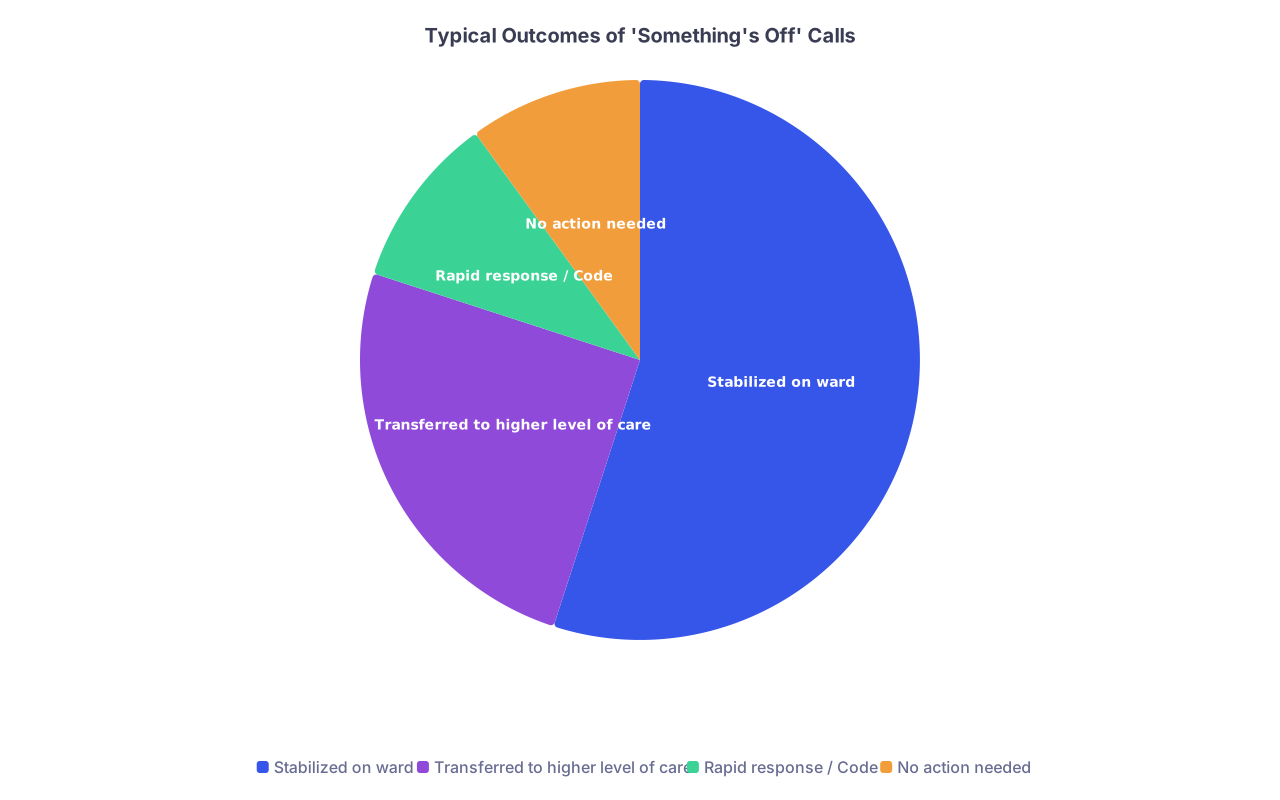
| Category | Value |
|---|---|
| Stabilized on ward | 55 |
| Transferred to higher level of care | 25 |
| Rapid response / Code | 10 |
| No action needed | 10 |
Step 1: Stabilize On The Phone (30–60 Seconds)
The first mistake residents make is chatting about the story while the nurse is hinting that the patient looks terrible.
Your first job: detect a silent emergency before you even open the chart.
When the nurse calls with “something’s off,” your response should follow this pattern:
“OK. Before anything else, can you tell me:
- Current vitals?
- Oxygen requirement?
- Mental status compared to baseline?
- Urine output trend / last void?
- Any new chest pain, shortness of breath, or bleeding?”
Then, based on that:
1A. If clearly unstable – upgrade now
If you hear any of these, do not be polite, do not negotiate:
- Systolic BP < 90 (or MAP < 65) and symptomatic
- New O2 need ≥ 6 L NC or sudden jump from 2 → 5 L
- New confusion / unresponsiveness compared to prior note
- RR > 30 or gasping
- Sustained HR > 140 with symptoms, or HR < 40
- Nurse says: “They look like they are going to code”
You say something like:
“Call a rapid response now. I am on my way. Put them on a non‑rebreather 15 L, get a full set of vitals, and start an IV if they do not have one.”
Then you run. Not walk.
1B. If not clearly crashing – give immediate, safe orders
If the patient is breathing, talking, and vitals are not in full disaster mode, you buy yourself 5–10 minutes with simple, low‑risk orders:
Examples:
- “Please recheck a full set of vitals now and in 15 minutes.”
- “Get a fingerstick glucose.”
- “Switch pulse ox probe if the waveform looks bad.”
- “Put them on 2 L nasal cannula while I review the chart.”
- “Get a STAT EKG and troponin if chest pain / new dyspnea.”
This “stabilize on phone” step prevents two stupid outcomes:
- Patient crashes while you leisurely scroll through the chart.
- Nurse sits doing nothing because you did not give any immediate direction.
Step 2: Remote Triage + Pre‑Chart Review (2–3 Minutes)
Now you have bought yourself a couple of minutes. Use them with discipline.
Tell the nurse:
“I am going to open the chart now. Stay by the patient. I will be there in about 5 minutes unless things change. If they deteriorate at all, call rapid.”
Then you do a 2‑minute chart recon. Not a deep dive. You are looking for anchors:
2A. SBAR information from the nurse
Ask for a structured, quick SBAR if they have not already provided it:
- S (Situation): “What exactly made you call now?”
- B (Background): “What are they here for? ICU downgrade? Post‑op? Sepsis?”
- A (Assessment): “What is your concern – breathing, blood pressure, mental status, pain?”
- R (Recommendation): “What are you worried this might be?”
That last question is gold. Experienced nurses will tell you: “I am worried this is sepsis.” Or “This feels like a PE.” Take that seriously.
2B. Rapid chart scan
You are scanning, not studying:
Problem list / admission diagnosis
- CHF? COPD? Sepsis? Post‑op day what?
- ICU downgrade last 24–48 hours? (High risk to boomerang.)
Latest vitals trend (12–24 hours)
- Is this a new tachycardia or ongoing?
- Any creeping tachypnea that everyone ignored?
- Blood pressures trending down but “still technically normal”?
Code status and goals of care
- Full vs DNR vs comfort – changes escalation decisions.
- If DNR/DNI but not comfort, you still treat aggressively.
Labs and imaging last 24 hours
- Lactate, creatinine, troponin, WBC, Hgb, electrolytes.
- Any pending cultures or abnormal imaging that explains today.
Medications
- On opioids? Benzos? New beta‑blocker? Diuresed heavily?
- On insulin or sulfonylureas (hypoglycemia risk)?
- Anticoagulation (if bleeding is even vaguely on the table)?
If, during this review, you realize: “This could go bad quickly” (e.g., neutropenic, septic, recent bleed, high‑risk post‑op), mentally upgrade them a level. You will have a much lower threshold to escalate from the bedside.

| Step | Description |
|---|---|
| Step 1 | Nurse says something off |
| Step 2 | Phone stabilization |
| Step 3 | Call rapid response |
| Step 4 | Remote triage and chart review |
| Step 5 | Bedside ABCDE assessment |
| Step 6 | Orders and monitor |
| Step 7 | Call senior or ICU |
| Step 8 | Document and handoff |
| Step 9 | Unstable now |
| Step 10 | High risk findings |
Step 3: At The Bedside – A Stripped‑Down ABCDE
Now you are at the door. Do not start by lecturing about the pager burden or asking for the seventh time what happened.
You start with how sick do they look right now.
3A. The “doorway 10‑second scan”
From the doorway:
- Talking or not? Full sentences vs one‑word vs no response.
- Working to breathe? Accessory muscles, tripoding, retractions?
- Skin: pale, gray, diaphoretic, mottled, cyanotic?
- Lines / monitors: On oxygen? Heart rhythm? Running fluids/pressors?
If you are instantly uncomfortable with what you see, grab the nearest set of hands and start ABCs. You can always call rapid from the room.
3B. Structured ABCDE
Run this like a checklist. Literally the same order every time.
A – Airway
- Talking normally → airway intact.
- Hoarse, gurgling, stridor, snoring, cannot clear secretions → airway threatened.
- Simple moves: jaw thrust, head tilt (if no concern for c‑spine), suction, sit them up.
This is one of the few times you should immediately say to the nurse:
“Call a rapid response. I am worried about the airway.”
B – Breathing
- Respiratory rate you count for 15–30 seconds.
- Work of breathing, accessory muscle use, wheeze, crackles, absent breath sounds.
- SpO₂ with a good waveform (if not, fix the probe first).
- Check O2 source, tubing, connections.
Immediate interventions you can order or do:
- Upright positioning.
- Increase O2; consider non‑rebreather if they look bad.
- Nebs for wheezing.
- ABG/VBG if CO₂ retention or acidosis is possible.
- STAT CXR if concern for pneumonia, edema, pneumothorax.
If they are tachypneic > 30, hypoxic on ≥ 6 L, or tiring out:
You should be thinking rapid response + possible ICU.
C – Circulation
- Palpate radial pulse: thready, bounding, regular?
- HR, BP (repeat manually if the number does not fit the picture).
- Cap refill, extremity temperature, jugular venous pressure if you can see it.
- Look at IV sites and urine bag: output? blood? nothing for 8+ hours?
Quick moves:
- Bolus vs diuresis based on the picture.
- EKG for new arrhythmia or chest pain.
- Fingerstick glucose now if any change in mental status.
- Consider STAT labs: CBC, BMP, lactate, troponin, coags, type and screen if bleeding.
D – Disability (neuro)
- AVPU: Alert / responds to Voice / responds to Pain / Unresponsive.
- Orientation (person, place, time).
- Pupils, gross motor strength in all extremities, new facial droop, speech changes.
- Look at med list – recent opioids, sedatives, insulin, stroke risk?
Interventions:
- If you suspect opioid effect: narcan.
- If hypoglycemia: IV dextrose.
- If focal neuro deficit or acute stroke window: activate stroke protocol.
E – Exposure / Everything else
- Look for obvious sources: bleeding under the patient, hematoma, swelling.
- Check abdomen for distension, rigidity, rebound.
- Look at surgical sites, lines, drains.
By the end of 5–10 minutes, you should be able to answer:
- Is this airway/breathing problem primarily?
- Is this circulatory (shock, arrhythmia, bleed)?
- Is this neuro (stroke, seizure, med effect, delirium)?
- Is this metabolic/infectious?
- How likely is this to deteriorate in the next 30–60 minutes?
If you cannot answer that, you need help. Which leads to escalation.
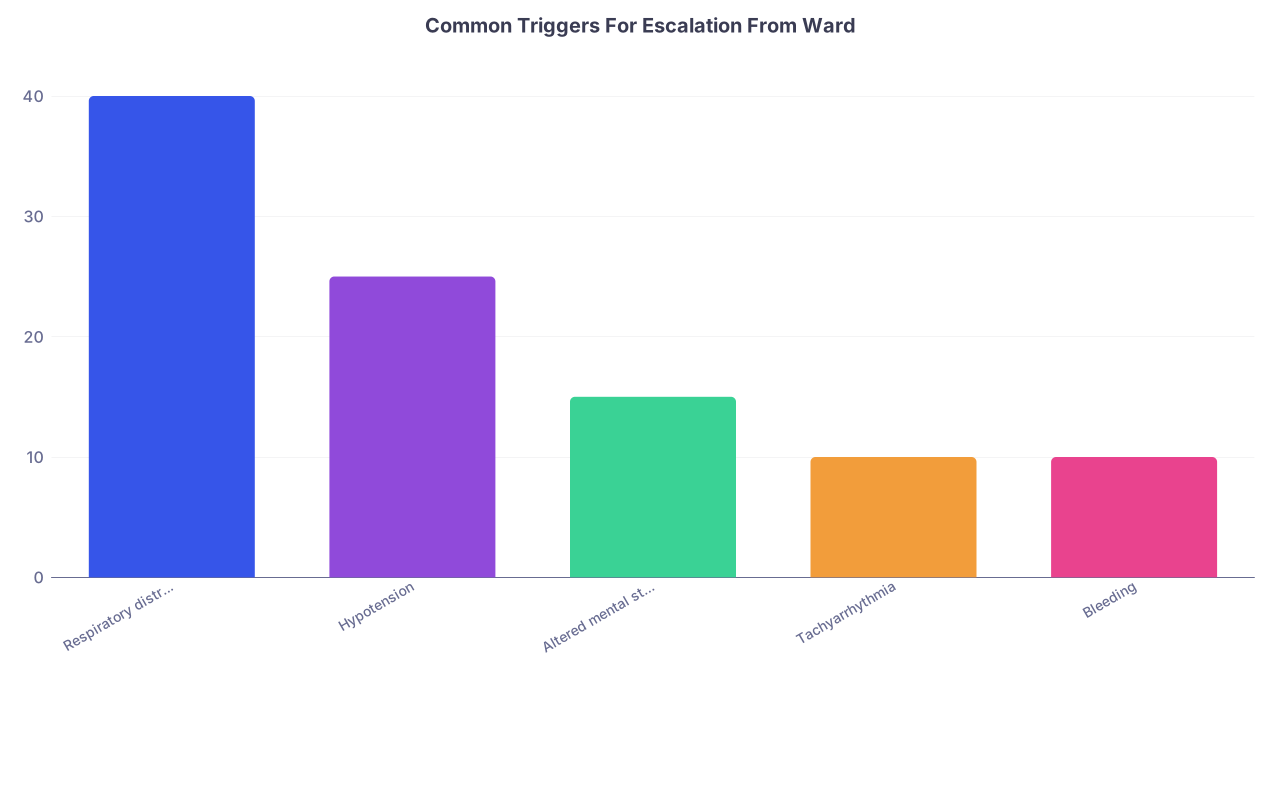
| Category | Value |
|---|---|
| Respiratory distress | 40 |
| Hypotension | 25 |
| Altered mental status | 15 |
| Tachyarrhythmia | 10 |
| Bleeding | 10 |
Step 4: Choose The Escalation Lane – Ward vs Rapid vs ICU/Senior
Residents get into trouble not because they miss that something is wrong, but because they misjudge how wrong and how fast it can go bad.
Use this simple categorization in your head:
Lane 1: Ward‑manageable – but watch like a hawk
Features:
- Vitals mildly abnormal but stable trend.
- No major respiratory distress or hypotension.
- Mental status slightly off but easily explained (sleep meds, resolving delirium, baseline dementia).
- You have a plausible working diagnosis and a clear plan.
Example:
- HR 110, RR 22, BP 115/70, O2 2 L → 94%. Mild dyspnea in known CHF. You give IV Lasix, up‑titrate O2 a bit, order CXR, labs, next vitals in 1 hour, and you are comfortable with this.
You:
- Place targeted orders.
- Set a specific reassessment window: “Recheck vitals and call me in 1 hour with an update, sooner if worse.”
- Consider low‑threshold consult to daytime team in your note: “Will need team to reassess need for stepdown in AM.”
Lane 2: Needs urgent help – senior / ICU / specialty
This is the gray zone where they are not crashing yet, but you would be stupid to sit on it alone.
Think:
- O2 needs creeping up, RR high 20s–30s.
- BP borderline (MAP 60–65) but patient looks OK.
- Lactate elevated, early sepsis picture.
- New atrial fibrillation with RVR that is not controlling easily.
- Worsening mental status with unclear cause.
Here your checklist:
- Do immediate stabilizing measures (fluids, O2, rate control, labs, imaging).
- Then call someone:
- Your senior resident.
- ICU fellow or triage (depending on your hospital’s setup).
- Relevant service (e.g., neurology for possible stroke, cardiology for unstable arrhythmia).
Your script might sound like:
“I am at the bedside of Mr. X, a 68‑year‑old with pneumonia, now on 6 L with RR 30 and increasing work of breathing. BP 100/60, HR 120. I am concerned he may need a higher level of care. I have ordered ABG, CXR, labs, and started a fluid bolus. Can you come evaluate for possible transfer to stepdown/ICU?”
You escalate before the rapid. That is good medicine.
Lane 3: Rapid response / code now
You do not “wait and see” in these scenarios:
- Airway threatened (cannot protect, stridor, nearly unresponsive).
- SpO₂ < 90% on ≥ 6 L NC or on non‑rebreather and they still look bad.
- Sustained hypotension with signs of poor perfusion (altered, cold, mottled, chest pain).
- New unresponsiveness, seizure, or focal neuro deficit concerning for stroke with compromised airway or ABCs.
- Sustained VT/VF, unstable arrhythmia, chest pain with EKG changes and hemodynamic instability.
Your move:
“Call a rapid response right now. I will start ABCs; please bring the crash cart.”
You will never get in trouble for calling a rapid too early. You will absolutely get grilled for calling it too late.
Step 5: Close The Loop – Orders, Documentation, Handoff
The last place residents blow it is after the adrenaline fades. They fix the problem, but they leave a mess for the next person and the patient drifts back into trouble.
Close the loop in three domains:
5A. Orders that match your concern
Do not just place a random “CBC, BMP, CXR” order set.
Tie your orders to your suspected problem:
Possible sepsis:
- Blood cultures, lactate, CXR, UA, broad‑spectrum antibiotics, fluid bolus, repeat lactate if high.
- Vitals q1h × 4–6 hours.
Acute HF exacerbation:
- IV diuretic with a real dose, strict I/Os, daily weights, VBG/ABG if hypercapnia possible, consider CXR.
- Vitals q2–4h; low threshold for ICU if O2 needs climb.
New delirium / AMS:
- Glucose, ABG/VBG, CT head if stroke/bleed risk, med review, infection workup.
- Sitters, non‑pharm delirium measures, avoid extra sedatives, clear reorientation strategies.
Make sure you add repeated vitals at a frequency that matches your anxiety. Do not leave a borderline‑sick patient on q4h vitals overnight.
5B. Minimal but sharp documentation
Your note can be short, but it cannot be vague.
Template you can basically reuse:
- Why you were called.
- Brief relevant history.
- Focused exam findings.
- Key vitals and tests.
- Assessment (1–3 likely possibilities).
- Plan, including escalation threshold.
Example:
“Called by RN for concern that patient looks more short of breath.
72‑year‑old with HFrEF and pneumonia, previously stable on 2 L NC.
At bedside: RR 26, SpO₂ 91% on 4 L, HR 110, BP 118/70, afebrile. Mild increased work of breathing, bibasilar crackles, no wheeze. No chest pain, mentation unchanged.
Likely mild volume overload on background pneumonia; low concern for PE or acute coronary syndrome at this time.
Plan: IV lasix 40 mg once, CXR, BMP, troponin, EKG, strict I/O, vitals q2h × 6 hours. RN to call if RR > 30, SpO₂ < 90% on ≥ 6 L, SBP < 90, or any acute change in mental status. Will sign out to day team to reassess need for stepdown if O2 > 4 L persists.”
That last sentence about when to call you again? That is how you prevent “we were not sure if we should bother you” disasters.
5C. Handoff and sign‑out
If the call happened near shift change:
- Verbally sign out the event and your concern level.
- Put it in your written sign‑out under “Active Issues” with explicit “watch for X, do Y if it happens.”
This is how you avoid the classic 7 a.m. chaos:
“Patient decompensated at 5 a.m., no one told the day team, and now no one knows what happened.”
A One‑Page Escalation Checklist You Can Memorize
Here is the whole thing compressed into something you can keep on your brain or a card in your pocket.
When you hear “something’s off”:
On the phone (30–60 seconds)
- Current vitals, O2 requirement, mental status, last urine, new pain/bleeding.
- If unstable → “Call rapid, I am coming.”
- If not unstable → give immediate orders: repeat vitals, glucose, O2, EKG as indicated.
Remote triage (2–3 minutes)
- Ask SBAR.
- Scan: diagnosis, vitals trend, code status, recent labs/imaging, meds.
- Decide if high‑risk category (ICU downgrade, sepsis, major comorbidities).
At bedside (5–10 minutes)
- Doorway impression: how sick do they look?
- ABCDE: airway, breathing, circulation, disability, exposure.
- Repeat vitals yourself if necessary.
Escalation lane
- Ward‑manageable → orders + tighten monitoring + define “call back if…” triggers.
- Gray zone → stabilize then call senior/ICU/specialty.
- Crashing or threatened airway/breathing/circulation → rapid response/code.
Close the loop
- Orders that match the problem + increased vitals frequency.
- Short, focused note with explicit thresholds for escalation.
- Handoff active issue to next team if near shift change.
That is your on‑call survival framework. Use it ruthlessly. It will feel slower at first, then it will become reflex.
| Category | Red Flag (Rapid / ICU Now) | Yellow Flag (Watch Closely) |
|---|---|---|
| Oxygen / Breathing | SpO₂ < 90% on ≥ 6 L or NRB, RR > 30 | New O₂ 2–4 L, RR 22–28 |
| Blood Pressure / Perf | SBP < 90 or MAP < 65 with symptoms | MAP 60–65 but mentation OK |
| Mental Status | New unresponsiveness, seizure | New confusion but arousable |
| Heart Rate / Rhythm | Unstable VT, HR > 150 with hypotension | New AF RVR 110–130 but stable |
| Bleeding | Active massive bleed, Hgb drop + shock | Slow drop in Hgb, stable vitals |
FAQs
1. What if the nurse sounds calm but I am worried, or sounds panicked but vitals look fine?
You respond to both. If the nurse is calm but your chart review screams high risk (e.g., neutropenic, hypotensive trend, new oxygen need), you go sooner and escalate faster. If the nurse sounds panicked but the picture at bedside is relatively stable, you still take their concern seriously, but you may land in the “ward‑manageable” lane with tight monitoring. Noise from the phone never overrides real‑time bedside assessment, but it should always shape how quickly you get there.
2. How do I balance being “overcalling” rapid responses with not missing decompensations?
Err on the side of safety early in training. You will quickly learn what your institution considers reasonable. The line is not “did you call too many rapids,” it is “did you let a clearly unstable patient sit without full resources.” If you are torn, stabilize what you can, call your senior, and be transparent: “I am leaning toward rapid for X and Y reasons, do you agree?” Over time, that judgment sharpens, but erring conservative while you are learning is not a weakness.
3. What if I cannot figure out what is wrong after full assessment?
Then your job is to stabilize and escalate, not to heroically guess the final diagnosis. Airway, breathing, circulation, glucose, temperature, analgesia, basic labs, and imaging if obvious. Once you have done the basics, call your senior or ICU and say exactly that: “I have done ABC, they are still not right, and I do not know why.” That is professional, not incompetent. The dangerous resident is the one who pretends they understand what they do not.
4. How do I keep from getting emotionally numb or annoyed by frequent ‘something’s off’ calls?
You do not treat every call as a code, but you also do not roll your eyes. The mental trick is to view each call as screening for the 1 in 10 that is actually bad. Most will be minor. Fine. You still run your 5‑step checklist quickly. Over time, it becomes fast and automatic. The more structured your approach, the less emotional bandwidth it costs, and the less you resent the pager. You are not reacting; you are executing a protocol.
Key points:
- Treat every “something’s off” call as a standardized process: stabilize on phone, rapid chart scan, bedside ABCDE, pick escalation lane, close the loop.
- You will not get punished for calling for help early; you will get punished for false confidence and late recognition.
- Write your thresholds down, say them out loud to the nurse, and document them. That is how you keep patients – and yourself – out of trouble.