The idea that you must have a CT scan before you can do anything for overnight neuro changes is dangerous nonsense.
You often will not get immediate imaging. CT is down, contrast shortage, scanner occupied with a trauma, tech off-site, or the attending radiologist wants to batch reads. Meanwhile, you are the one at the bedside, and the nurse is saying, “The patient is just not acting right.” If you freeze, that patient pays the price.
This is a playbook for what to do when neurology changes and CT is not immediately available. Stepwise. Ruthless about priorities. Focused on what actually changes management at 2:37 a.m.
Step 1: Stabilize First, Don’t Chase the CT
You do not need a CT to secure an airway or to treat hypoglycemia. You need a brain, hands, and a little discipline.
A. ABCs before diagnosis
Walk in the room with a simple internal script:
Airway
- Is the patient talking in full sentences?
- Gurgling respirations? Snoring? Stridor?
- Vomit or blood in the mouth?
- GCS ≤ 8, loss of gag, or poor handling of secretions = potential airway now, not after imaging.
- If you are worried: call anesthesia / ICU early. Document your concern.
Breathing
- RR, work of breathing, oxygen saturation.
- Look at the chest. Equal rise? Accessory muscles?
- ABG or VBG if they look bad or CO2 retention is on the table (COPD, opiates, oversedation).
Circulation
- Heart rate, blood pressure, cap refill.
- Check the monitor; do not trust the last vitals from two hours ago.
- New neuro deficit with MAP 45? Fix the pressure while you work up the rest.
You can completely blow a case by skipping ABCs and obsessing over “stroke vs seizure vs delirium.” Fix what kills fast, then refine.
Step 2: Prove It’s Not Something Treatable in 60 Seconds
You should have a hardwired “neuro change rule‑out” mini–algorithm that you run before you start deep-diving imaging.
The 4 Fast Checks
Fingerstick glucose
- Order from the door: “Grab a bedside glucose now.”
- Treat <60 aggressively (hospital protocols vary, but think 25–50 g IV dextrose).
- If the nurse “already checked it” an hour ago, recheck. I have seen people miss hypoglycemia because the nurse relied on an earlier value.
Vital signs and oxygenation
- Look yourself. Not just in the chart.
- Low O2, high CO2, or fever can explain a lot of confusion and agitation.
Medication/sedation review
- Open MAR (medication administration record).
- Look for:
- Recent opioids, benzos, antipsychotics
- New gabapentin, pregabalin, baclofen
- Nightly “sleep aids” (especially in the elderly)
- Ask: “Did anything get given in the last 1–2 hours?”
Quick orientation + mental status
- “What’s your name? Where are you? What month is it? Why are you here?”
- Can they follow a one-step command? A two-step?
- This gives you a baseline for trending.
At this stage, your goal is not a full NIHSS. Your goal is to rapidly catch:
- Hypoglycemia
- Hypoxia
- Oversedation / polypharmacy
- Obvious delirium in a fragile, septic patient
You can fix all of those without a CT.
Step 3: Categorize the Neuro Change – This Controls Everything
You need a mental bucket system. Not five pages of neurology. Three buckets.
Bucket 1: Mild / Possibly Delirium
Features:
- Fluctuating attention
- Disorientation but no new focal deficits
- Pulling at lines, talking nonsense, but moves all extremities symmetrically
- Chronic dementia history or a big precipitant (infection, surgery, ICU stay, new meds)
These patients can still be sick, but they do not require the same urgency as an acute focal deficit. CT may still be useful but is rarely “stat life-or-death” in this context.
Bucket 2: New Focal Deficit (Stroke / ICH Concern)
Features:
- New unilateral weakness, facial droop, aphasia, hemineglect
- Sudden vision loss, double vision, trouble with balance
- Clear “last known well” time from chart / family
- Abrupt onset
This is the group where you treat absence of imaging as an emergency to solve, not a minor inconvenience. CT (and likely CTA) is time-sensitive. Your job is to activate the system even if the scanner is logistically delayed.
Bucket 3: Depressed Consciousness / Coma / Seizure
Features:
- GCS dropped
- Not following commands
- Gaze deviation, posturing
- Active seizure or post-ictal unresponsiveness
- Concern for status epilepticus or non-convulsive status
These can be structural (bleed, large stroke, herniation), toxic-metabolic (Na 110, glucose 20), or seizure-related.
You treat this bucket like an ICU event. CT helps, but airway, seizures, and metabolic derangements kill first.
Step 4: Run a Focused Neuro Exam That Works Without Imaging
You do not need a neurologist-level exam; you need a reproducible one that picks up major red flags quickly.
The Core Bedside Neuro Exam (5–7 minutes)
Level of consciousness
- Alert, voice responsive, pain responsive, unresponsive.
- GCS if needed, but do not waste time with perfect scoring under pressure. Just document.
Speech and language
- “What is this?” (point to watch, pen).
- “Repeat after me: The sky is blue.”
- Ask them to follow one-step and two-step commands (e.g., “Open your eyes and squeeze my hand.”).
Cranial nerves (fast version)
- Pupils: equal? reactive?
- Eye movements: do they track you? Any gaze deviation?
- Face: smile, show teeth, raise eyebrows – symmetric or droop?
- Swallow: cough with water sip? Gurgly voice?
Motor
- Lift both arms and hold for 10 seconds (drift?).
- Lift both legs for 5 seconds.
- Tone: flaccid, spastic, rigid?
- Any spontaneous movement or response to pain?
Sensation
- Light touch in all four limbs (enough to pick up gross asymmetry).
Cerebellar (if cooperative)
- Finger-to-nose.
- Heel-to-shin.
- Check for truncal ataxia (sitting balance).
Meningeal signs (if indicated)
- Neck stiffness if fever, headache, or meningitis suspected.
Document this cleanly and concisely. On call, clarity beats elegance.
Step 5: Decide What You Can Do Now Without CT
Here is where people choke. They see an abnormal neuro exam and think, “Need CT.” True but incomplete. There are several high‑impact moves you can make before imaging, depending on the bucket.
| Bucket Type | Priority Actions Without CT |
|---|---|
| Mild / Possible Delirium | Labs, meds review, reorient, treat causes |
| New Focal Deficit | Call stroke team, labs, BP mgmt, NPO |
| Coma / Seizure / Status | Airway, benzos, labs, empiric treatment |
A. For Suspected Delirium (Bucket 1)
Action steps:
- Order essential labs:
- CBC, BMP, LFTs, ammonia (if relevant), UA, cultures if febrile
- Drug levels if appropriate (e.g., valproate, phenytoin)
- Check infection sources:
- Lines, Foley, wounds, lungs, urine
- Stop or reduce deliriogenic meds:
- Cancel PRN benzos, sedative hypnotics.
- Reconsider anticholinergics and high-dose opioids.
- Address environment:
- Turn on lights in the day, off at night.
- Get hearing aids, glasses if they use them.
- Ask nursing for sitter / telesitter if danger to self.
- Avoid knee-jerk haloperidol for every agitated patient. Use it if they are unsafe and non-redirectable, but fix the underlying issue.
You can do all of that while CT is pending or unavailable. None of it requires imaging.
B. For New Focal Deficit (Bucket 2)
Now infrastructure matters. You must act like CT is running 10 minutes behind you, not leading you.
Call the right people early
- Activate your stroke code if your institution uses one.
- Page neurology / stroke fellow and your senior or attending with:
- Age, baseline, last-known-well, key deficit, vitals.
- If you are in a small hospital: call the telestroke service if available.
Lock down NPO and aspiration risk
- Make the patient NPO immediately.
- Ask nursing not to give PO meds until swallow evaluated.
- Elevate head of bed to 30 degrees.
Control blood pressure based on scenario
- If you suspect ischemic stroke and there is some chance of thrombolysis (within time window and likely candidate), you do not slam BP aggressively.
- If hypertensive emergency or concern for ICH (e.g., BP 230/120, headache, vomiting, very decreased LOC), you may cautiously lower BP per protocol while waiting for imaging, in tight coordination with neurology/ICU.
Grab essential labs and lines
- Point-of-care INR if on warfarin/bleeding risk.
- PT/INR, PTT, CBC, BMP, troponin if stroke protocol requires.
- Two large-bore IVs if you suspect they may need thrombolytics or ICU transfer.
Document time and progression
- “Last known well” time, symptom onset, and any change during your assessment.
- If deficits improve or worsen while you are waiting, update the team.
You still want CT as fast as you can get it. But if the scanner is logjammed, you are already doing the things that will matter for eventual stroke therapy.
Step 6: Handle Coma, Seizure, and “They Won’t Wake Up”
This is where people panic. You do not have to. You need a rigid sequence.

| Step | Description |
|---|---|
| Step 1 | Find patient unresponsive |
| Step 2 | Check ABCs |
| Step 3 | Fingerstick glucose |
| Step 4 | Give IV dextrose |
| Step 5 | Assess for seizure |
| Step 6 | Give benzodiazepine |
| Step 7 | Draw stat labs and ABG |
| Step 8 | Contact ICU and Neurology |
| Step 9 | Glucose low |
| Step 10 | Active seizure |
A. Core sequence (you can memorize this)
ABCs and glucose (again)
- Airway protected?
- Respirations adequate?
- Glucose checked and treated?
Check pupils and basic brainstem function
- Pupils equal or blown/unilateral?
- Corneal reflex, gag if safe to check.
- Response to painful stimulus (nail bed, trapezius pinch – pick one and be consistent).
Rule out obvious tox / sedation
- Recent meds. Any PCA pump? Any sedation bolus?
- Look for naloxone opportunity:
- If there is a real possibility of opioid overdose, give naloxone. Do not delay because you are “worried about withdrawal.” Dead patients do not withdraw.
Consider seizure and status
- Look for subtle signs:
- Nystagmus, tongue biting, rhythmic eye deviation.
- Facial or limb twitching, eyelid flutter.
- If strongly suspicious of ongoing seizure or status (even non-convulsive) and:
- They are not protecting the airway: get anesthesia/ICU now.
- They likely need benzodiazepines and loading with antiepileptics.
- You do not need CT to give lorazepam for status epilepticus.
- Look for subtle signs:
Labs and ICU-level consultation
- Stat:
- CBC, BMP, magnesium, calcium
- ABG or VBG
- Toxicology screen if relevant
- If sodium is 110, the CT is not going to fix that. Hypertonic saline will.
- Call ICU early if they are not protecting airway or need continuous infusions.
- Stat:
Step 7: When CT is Not Immediately Available – Work the Problem
This is the core of your question. Scanner down, tech not in-house, or they are backed up with trauma. Here is how you stay useful instead of just waiting.
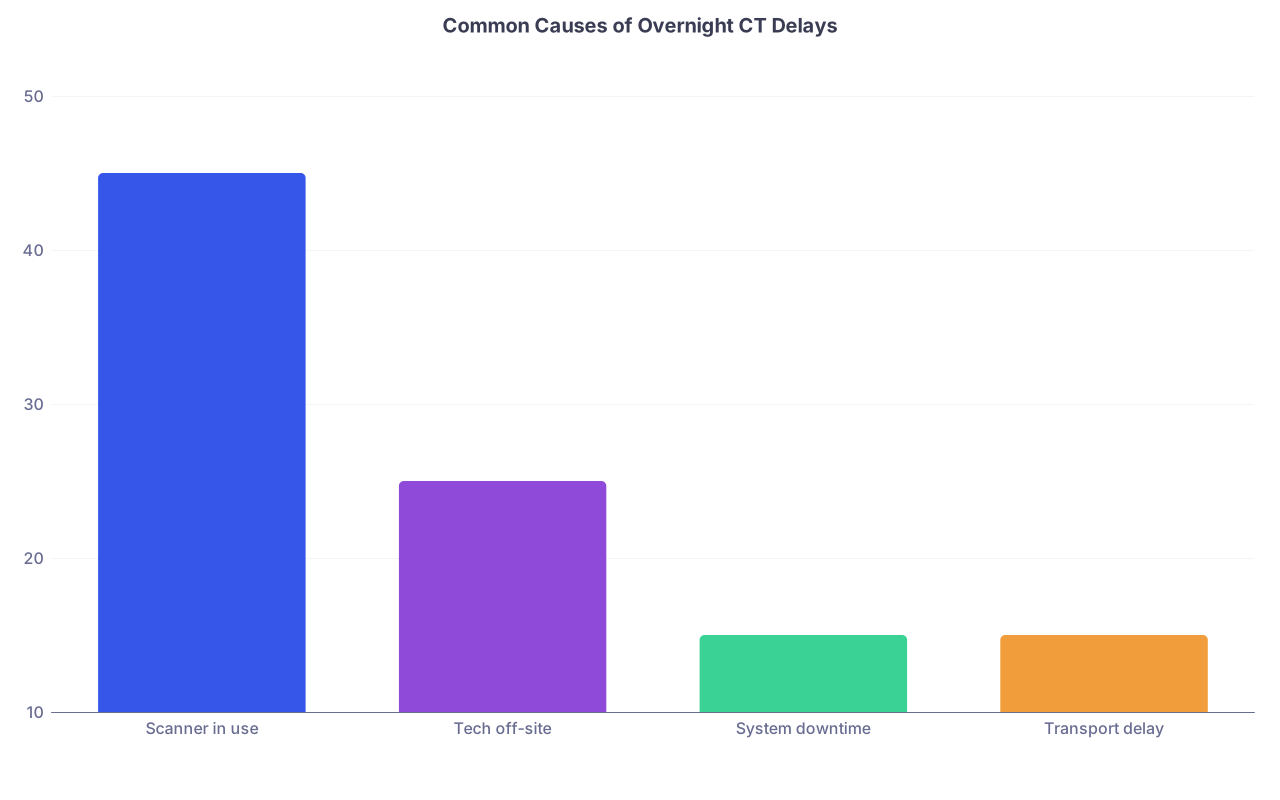
| Category | Value |
|---|---|
| Scanner in use | 45 |
| Tech off-site | 25 |
| System downtime | 15 |
| Transport delay | 15 |
A. Clarify exactly what the delay is
Do not accept “CT is down” at face value.
Ask:
- Is the scanner physically broken, or is the tech not here?
- ETA for availability?
- Are emergent scans still possible, or is it totally out?
If there is any path to emergent imaging for a high-risk patient (bucket 2 or 3), escalate:
- Call the CT tech supervisor.
- Call radiology resident / attending.
- Call your own attending and say clearly: “We have a suspected acute stroke / herniation / ICH and CT is blocked because X. I think this patient cannot safely wait.”
B. Use portable tools while you wait
You are not completely blind without CT.
Options:
- Portable chest X-ray if respiratory status is concerning.
- Point-of-care ultrasound (POCUS):
- Cardiac: grossly assess EF, pericardial effusion, volume status.
- Lungs: pneumothorax, pulmonary edema.
- Not brain, obviously, but can argue for differentials (e.g., shock vs neurologic).
- ECG: arrhythmias, ischemia that may cause confusion or syncope.
All of this can sharpen your thinking and help you stabilize while imaging catches up.
C. Decide who absolutely cannot wait
Some patients truly cannot sit around for an hour while CT reboots. You do not need perfection; you need “too sick to wait.”
Red flags:
- Rapidly declining LOC.
- Signs of herniation: unilateral blown pupil, Cushing triad (bradycardia, hypertension, irregular respirations), posturing.
- Refractory seizures or status epilepticus.
- New dense hemiplegia with severe headache and vomiting (classic ICH picture).
These patients demand:
- Immediate neurology / neurosurgery / ICU involvement.
- Transport to an alternate scanner (if you have multiple sites) or even transfer to another hospital if downtime is prolonged and they are a neurosurgical emergency.
D. Workup everything else while you push for imaging
While CT logistics get sorted:
- Draw and send all necessary labs.
- Start empiric treatment where indicated:
- Suspected meningitis with fever and neck stiffness? Broad-spectrum antibiotics and antivirals after blood cultures, do not sit on this waiting for CT unless there is a specific contraindication to LP that you really suspect.
- Suspected Wernicke in malnourished / alcoholic patient with confusion and ataxia? Give thiamine IV.
- Update family about what is going on and what you are doing. It buys goodwill and clarity.
Step 8: Communicate Like You Have a Plan (Because You Do)
Nurses and families panic when they hear “CT is down.” You need a sentence or two that shows you are moving.
For the nurse:
- “CT is delayed, but I have checked airway, breathing, and circulation, and I do not see signs of herniation right now. I have ordered stat labs and paged neurology. Let us recheck vitals every 15 minutes, and you call me immediately if the GCS drops or pupils change.”
For family:
- “The CT scanner is not immediately available, but we are not simply waiting. We have done X, Y, Z, and I am in touch with neurology and radiology. If we see any signs of rapid worsening, we will escalate to get imaging or transfer sooner.”
You are not selling certainty. You are selling the fact that you are actively working the problem.
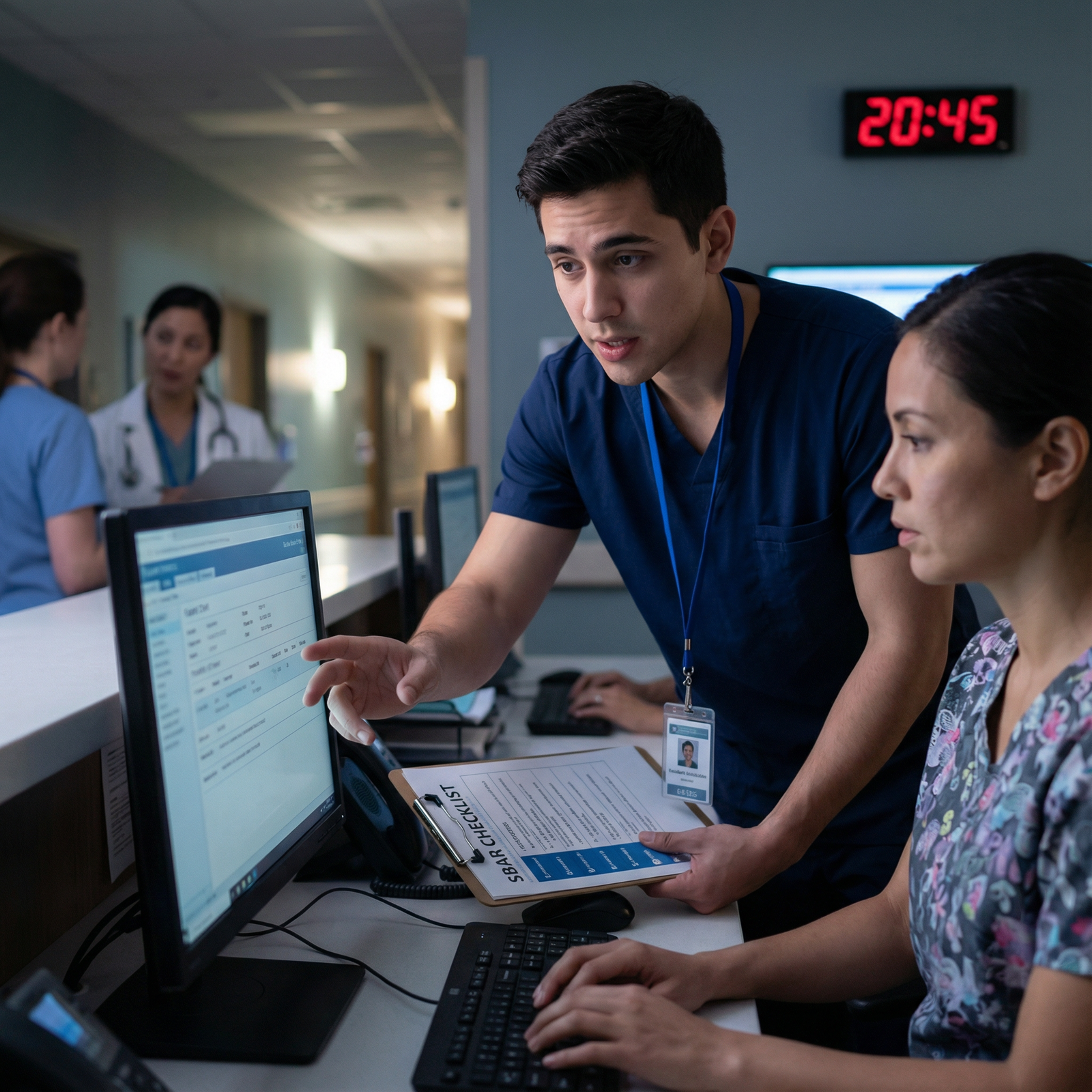
Step 9: Build Yourself a One-Page Overnight Neuro Checklist
If you are smart, you do this on a sticky note or your phone notes and use it on call until it is muscle memory.
Your checklist might look like:
- ABCs + Fingerstick glucose
- Vitals and mental status – brief orientation, follow commands?
- Quick neuro exam – pupils, face, limbs, speech.
- Bucket – delirium vs focal vs coma/seizure.
- Immediate orders
- NPO if concern for stroke.
- Labs: CBC, BMP, ABG/VBG, others tailored.
- CXR, ECG if indicated.
- Call – neurology, stroke team, ICU, attending as appropriate.
- CT status
- ETA, backup options, need for escalation?
- Reassess and document – any change, new red flags.
Use it on every call until you stop needing to look at it. That alone prevents stupid misses.
FAQ (Exactly 3 Questions)
1. When is it acceptable to not push hard for emergent CT in a neuro change?
If the change clearly fits a delirium picture without focal deficits, in a patient with a strong non-neurologic precipitant (e.g., septic elder with UTI, on opioids and benzos, vitals stable, symmetric exam), you can reasonably order a non-urgent CT instead of a stat scan. You still document your reasoning. But new focal deficits, rapidly worsening consciousness, or signs of herniation are not negotiable; those demand maximum effort for emergent imaging, including escalation and transfer if necessary.
2. Should I ever give thrombolytics before a CT if I am absolutely certain it is ischemic stroke?
No. That is how careers end and patients die. You do not give thrombolytics without neuroimaging that excludes hemorrhage. Your role when CT is delayed is to:
- Recognize the stroke fast.
- Activate the stroke pathway.
- Get labs and lines ready.
- Control blood pressure within agreed parameters.
- Push the system to get CT (or transfer) as early as humanly possible.
But you do not tPA blindly.
3. How often should I recheck a patient with a neuro change while waiting for imaging?
For any patient in bucket 2 (new focal deficit) or bucket 3 (depressed consciousness / seizure), I would aim for every 15 minutes reassessment of vitals and a very brief neuro check (LOC, pupils, motor symmetry) until they are clearly stable and imaged, unless ICU is already assuming that role. You can lengthen the interval for a milder delirium case once you have ruled out immediate threats, but you still want at least hourly checks for an acutely altered inpatient overnight.
Open your call bag or your notes app right now and write down your own 8-step “overnight neuro change” checklist based on this. Next shift, when the nurse calls with “He is just acting off,” you will not stall waiting for CT. You will already know your first ten moves.