
The way most residents handle call pages is broken. People “just respond as they come,” then wonder why they feel fried, behind, and constantly unsafe. You do not have a time problem. You have a triage problem.
Let’s fix that.
You need a clear, repeatable triage system for pages. Not vibes. Not “I think this sounds bad.” A system. So that at 3:17 a.m., when three phones, two chat messages, and an overhead call hit you at once, you are not guessing. You are executing.
This is the stepwise system I teach interns and junior residents. It works on medicine, surgery, OB, peds, psych—anywhere you get hammered with calls.
The Core Rule: Every Page Goes Through the Same Three Filters
You are going to run every page through three filters, in order:
- Is someone dying?
- Is someone about to get worse if I delay?
- Is this logistics or non-urgent?
That sounds obvious. It is not how people behave at 2 a.m.
The mistake I see: resident hears “blood pressure 90/60” and sprints, but ignores “patient seems more confused” because it sounds soft. Or spends 20 minutes doing a med rec while a septic patient sits unaddressed.
Your job is not to be nice and responsive. Your job is to reliably put your attention on the right patient at the right time.
Here is the stepwise protocol.
Step 1: Standardize How You Receive and Log Pages
If you do not control your intake, you will lose the night before you start.
1. One Inbox, Not Four
On call you will get:
- Pager beeps
- Phone calls
- Chat messages (Epic Secure Chat, Vocera, WhatsApp groups, etc.)
- Overhead emergency calls
The default is chaos. Fix it.
Protocol:
- Keep one physical “triage sheet” for the shift:
- A folded piece of paper in your pocket, or
- A simple note on your phone (if allowed by policy; no PHI)
- Every page gets:
- Time
- Room/bed
- Nurse/station
- One-line reason
- Priority (you will assign this in Step 2)
- If your EHR chat supports “star” or “flag,” use that in parallel. But don’t rely only on software. At 4 a.m., paper wins.
You are building your queue. You cannot prioritize what you cannot see.
2. Force a Standard Incoming Script
The number one time-waster is unclear pages:
“Hey doc, just calling about Mr. Jones.”
Dead on arrival. You cannot triage that.
You are going to train nurses and colleagues (yes, you) to give you a standard blurb. Use something like SBAR Lite:
- S: “This is RN Kim on 6W, room 624.”
- B: “History of CHF, here for pneumonia.”
- A: “Now has BP 78/40, MAP 52, tachy 120, mentation worse.”
- R: “I am worried about sepsis / hypotension.”
If the caller does not volunteer that, you ask:
“Tell me: who is the patient, what are the vitals, and what is your specific concern?”
You are not being picky. You are gathering data for triage.
Step 2: The 5-Level Page Triage Scale
Stop thinking in binary “urgent vs not urgent.” It is too crude.
Use a 5-level scale and write the level 1–5 next to each page on your triage sheet.
| Level | Label | Response Goal |
|---|---|---|
| 1 | Code-level | Drop everything now |
| 2 | Unstable | Go now (within 5–10m) |
| 3 | Time-sensitive | Address within 30–60m |
| 4 | Routine | Within a few hours |
| 5 | Administrative | Batch later |
Let us unpack exactly what belongs where.
Level 1 – Code-Level Emergencies
You run or are already on the way.
Examples:
- Overhead “Code Blue,” “Code Stroke,” “Code STEMI” where you are responsible
- Nurse: “Patient not responsive, no pulse / agonal respirations.”
- Massive hemorrhage: “Bright red blood, saturating pads / sheets in minutes.”
- Anaphylaxis: “Facial swelling, wheezing, SBP 70.”
Response:
- Do not finish your note. Do not finish your sandwich. Go.
- If you are already at another Level 1, call backup:
- “I am at a Code Blue in 5W. Can someone respond to a hypotensive patient in 4E, room 432?”
Level 2 – Unstable / Potential to Crash
These are pre-codes. They do not have a team overhead yet, but they are on the cliff edge.
Examples:
- Sustained SBP < 90 with change in mental status or new tachycardia
- New O2 requirement jump: 2L → 6L, or > 50% FiO2 increase
- Chest pain with concerning features: diaphoresis, hypotension, EKG change reported
- New focal neuro deficit: “Sudden weakness, face droop, slurred speech”
- Sepsis red flags:
- RR > 30
- MAP < 65
- Lactate > 4 reported by nurse
Response:
- You go see the patient within 5–10 minutes, ideally sooner.
- If you have a Level 1 at the same time:
- You go to the Code.
- You explicitly assign the unstable patient to someone: senior, cross-cover, rapid response team.
Level 3 – Time-Sensitive But Stable
These will not die in the next 10 minutes, but delay of hours is bad medicine or unsafe.
Examples:
- New fever in neutropenic patient or post-op day 1–2
- Possible GI bleed but stable vitals: “Melena, Hgb drop from 9 to 7.8, HR 100, BP 120/70”
- Uncontrolled pain: “8/10 despite PRN doses”
- New moderate confusion or agitation in an otherwise stable patient
- Insulin question in type 1 diabetic (“no insulin ordered”)
Response:
- Aim to address within 30–60 minutes.
- These are your “after I deal with the unstable” tasks.
- You can often start management over the phone:
- “Please get a set of vitals, CBC, BMP, lactate, blood cultures. I will be there within 30 minutes.”
Level 4 – Routine Clinical
Legitimate clinical issues that can safely wait.
Examples:
- Refill PRN order: sleep aid, stool softener, mild nausea
- Non-urgent lab follow-up: “Hgb dropped from 12 to 10.5 but vitals ok”
- Chronic symptom questions: “Mild chronic back pain; current regimen ok but wants something more”
- Clarifying diet / activity order in a stable patient
Response:
- Address in batches every 1–2 hours when you have a lull.
- If it is quick to fix in the EHR without going to bedside, do it from your workstation. Efficiency matters.
Level 5 – Purely Administrative / FYI
These are lowest priority unless they hide something more serious.
Examples:
- “Family at bedside wants update” and patient is stable
- “Pharmacy says non-formulary, please choose alternative” in a non-critical situation
- “Patient asking about discharge timeline tomorrow”
- “FYI: Morning potassium was 3.8; no action needed”
Response:
- Batch these. Do them last, usually just before or after your next round of notes.
- If something sounds more serious beneath the admin language (“family concerned about new confusion”), you up-triage to Level 3.
Step 3: The 30-Second Phone Triage Script
You should be classifying the page into Level 1–5 within 30 seconds of answering. That only happens if you have a script.
Here is the basic template:
Identify
- “This is Dr. X, night float for medicine. Who is the patient and what room?”
Clarify urgency
- “Can you give me the latest vitals and what is worrying you most right now?”
Key data points based on complaint
- Chest pain? Ask: duration, character, vitals, telemetry changes.
- SOB? Ask: O2 device/flow, current saturation, work of breathing.
- Mental status change? Ask: baseline, how abrupt, vitals, glucose.
Assign a level (quietly, in your head or written)
- You are thinking: “Is this 1, 2, 3, 4, or 5?”
Give an explicit plan and time
- “This sounds urgent. I am coming now.” (Level 1–2)
- “I will place initial orders and be there within 30 minutes.” (Level 3)
- “I will take care of this by around midnight.” (Level 4–5)
This last step is not just courtesy. It prevents repeated pages because the nurse has no idea when you are coming.
Step 4: Maintain a Live Queue and Reprioritize Ruthlessly
Call nights break people not because of the workload, but because they keep losing the thread. They cannot remember what is pending.
Your triage sheet is your lifeline.
How to Structure Your Sheet
Make three columns:
- Left: Time + Room + Name
- Middle: One-line issue
- Right: Level (1–5) + Status (Pending / In progress / Done)
As new pages come in:
- Add them to the bottom.
- Assign Level 1–5.
- Regularly (every 30–60 minutes) rewrite the active list on a new line or fresh section:
- Top: all Level 1–2 (hopefully none sitting around)
- Below: next 2–3 Level 3 tasks
- Then: batched Level 4–5
This rewriting looks like extra work. It is not. It is how you keep your working memory from melting down at 3 a.m.
Step 5: Handle Multiple Simultaneous Crises
The nightmare scenario: three scary pages at once. Here is how you sort it out without panicking.
Example:
- Page A: “Room 412 – SBP 78/40, new confusion, febrile.”
- Page B: “Room 530 – chest pain, diaphoretic, telemetry shows ST changes.”
- Page C: “Room 601 – oxygen sat 84% on 4L, working to breathe, RR 32.”
You are one person. You must be systematic.
Immediately decide preliminary levels over the phone
- A: Very likely septic shock → Level 2 (maybe Level 1 if peri-arrest)
- B: Possible MI with instability → Level 2
- C: Respiratory failure → Level 2
Pick your first destination based on two things:
- Who is closest to arrest?
- Who has resources already there (RRT, ICU team, senior resident)?
Often respiratory failure or unmonitored hypotension goes first.
Activate resources as you move
- Walking to C? Call charge nurse: “Please call rapid response to 530 chest pain with ST changes.”
- Ask operator to overhead RRT for 412 if threshold met.
At bedside, treat and hand off clearly
- Stabilize the worst patient to a safe-ish place:
- ABCs, fluids, pressors started or at least IVs and stat labs drawn.
- Then explicitly say:
- “I am going now to see the chest pain in 530. Call RRT again if BP drops below 80 or mental status worsens.”
- Stabilize the worst patient to a safe-ish place:
You are managing systems, not just bodies. That is how you survive the truly bad nights.
Visual: How Your Time Actually Gets Spent on a Busy Night
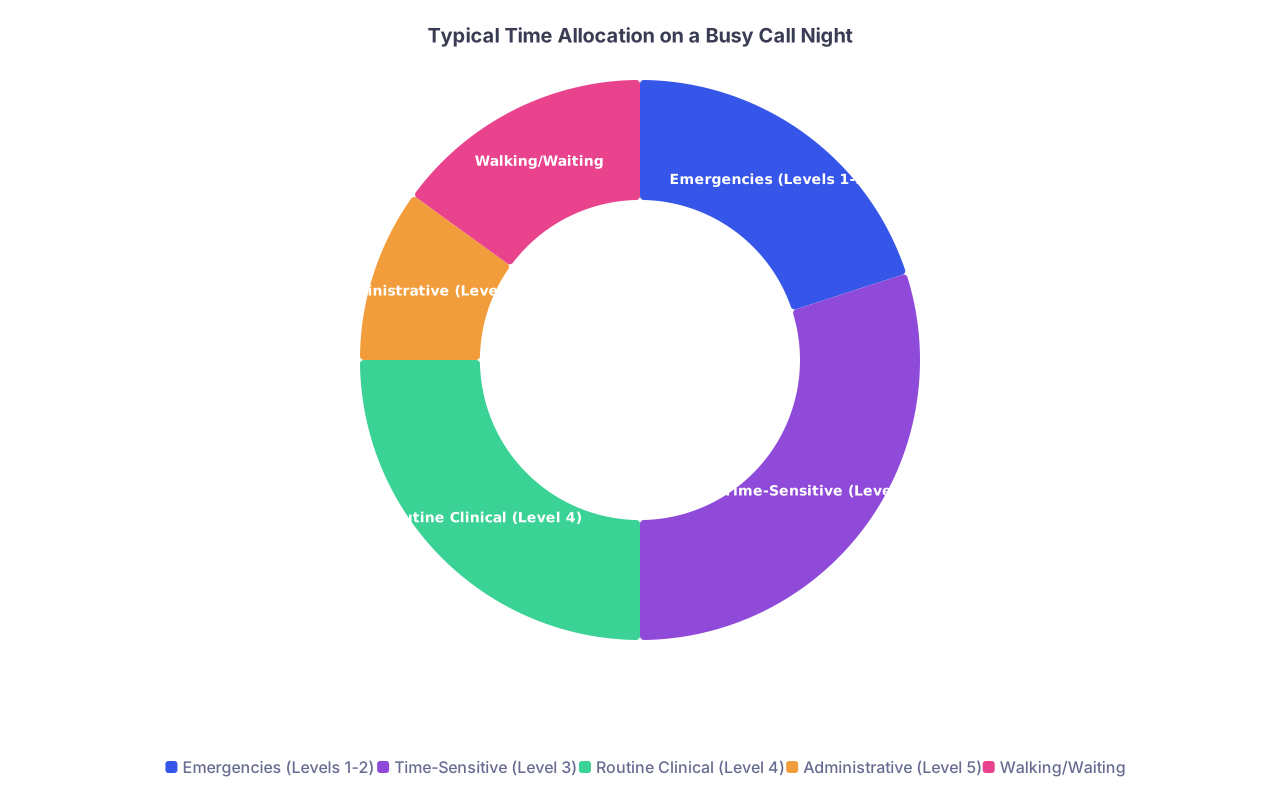
| Category | Value |
|---|---|
| Emergencies (Levels 1-2) | 20 |
| Time-Sensitive (Level 3) | 30 |
| Routine Clinical (Level 4) | 25 |
| Administrative (Level 5) | 10 |
| Walking/Waiting | 15 |
The trick is not eliminating admin work. You cannot. The trick is pushing Level 4–5 to predictable batched windows, so they do not cannibalize your Level 2–3 time.
Step 6: Pre-Emptive Work to Cut Pages in Half
The best triage system still loses if you get 70 pages a night for nonsense. You cannot fix everything, but you can slash a surprising amount.
1. Write “Page-Safe” Admission and Post-Op Orders
Pages often reflect incomplete plans, not needy nurses.
Look at what you are paged for repeatedly:
- No bowel regimen
- No nausea plan
- No sleep meds
- No pain ladder
- No hypoglycemia protocol
Fix them up front.
Example admission order set for a general medicine patient:
- Bowel: “Senna 1 tab qHS, + PRN bisacodyl suppository for no BM in 48h.”
- Nausea: “Ondansetron 4 mg IV/PO q6h PRN nausea/vomiting.”
- Pain: Step-wise:
- “Tylenol 650 mg q6h PRN mild pain”
- “Oxycodone 5 mg q4h PRN moderate pain”
- “Hydromorphone 0.2 mg IV q3h PRN breakthrough”
- Sleep: “Melatonin 3 mg qHS PRN insomnia.”
You will cut a large chunk of “can you order something for…” pages.
2. Pre-Brief Nursing on High-Risk Patients
During sign-out or early in the night, identify your landmines:
- Borderline hypotensive septic patient
- Post-op day 0 with borderline urine output
- DKA patient on insulin drip
- Fresh GI bleed
Quickly talk to the bedside nurse:
“Ms. X in 512 is my worry tonight. If her MAP drops below 65 or mental status changes, page me immediately. I would rather hear early.”
You will get better pages (with vitals, specific concerns) and fewer panicked calls.
Step 7: How to Say “No” or “Not Now” Without Burning Bridges
You cannot survive call if you treat every request like a command.
You must learn polite but firm deferral.
Scripts That Work
Scenario: You are at a Level 2 septic patient, and someone calls for a routine bowel regimen.
Response:
“I am currently in the room with an unstable patient whose blood pressure is very low. I will add the bowel regimen as soon as I step out, within the next hour.”
Key elements:
- State you are with an unstable or critical patient (people understand).
- Give a time frame.
- Follow through.
Scenario: Family wants lengthy update on a stable patient while you have a queue.
“I want to give you a proper update, not a rushed one. I am managing a few urgent issues right now. I will return within about two hours, or I will ask the day team to do a thorough update on rounds in the morning.”
You are not their full-time concierge. Set boundaries early.
Step 8: Use Simple Mental Checklists at the Bedside
When you finally get to the room, you must be fast and structured. Otherwise you waste the benefit of good triage by flailing at the bedside.
For any Level 1–2 patient, run a mini ABCDE:
- A – Airway: Talking? Gurgling? Stridor?
- B – Breathing: RR, work of breathing, accessory muscles, O2 sat, auscultation.
- C – Circulation: HR, BP, cap refill, skin temp, pulses, IV access.
- D – Disability: GCS / AVPU, pupils, glucose.
- E – Expose/Everything else: Look for bleeding, rash, distension; check foley/drains.
You do not need to be elegant. You need to be systematic.

| Step | Description |
|---|---|
| Step 1 | Receive Page |
| Step 2 | Get ID and Vitals |
| Step 3 | Level 1 Code |
| Step 4 | Level 2 Unstable |
| Step 5 | Level 3 Time sensitive |
| Step 6 | Level 4 Routine |
| Step 7 | Level 5 Admin |
| Step 8 | Go now |
| Step 9 | Within 30-60 min |
| Step 10 | Batch in 1-2 hr |
| Step 11 | Life threat? |
| Step 12 | Unstable vitals or acute neuro change? |
| Step 13 | Could worsen if delayed? |
| Step 14 | Clinical vs Admin? |
That is the flow you should be mentally running every time.
Step 9: Protect Your Brain from Decision Fatigue
Call nights are not just physically hard. They are cognitively brutal. Hundreds of micro-decisions. If you do not offload some of that, your triage will decay by 3–4 a.m.
Concrete tactics:
Default orders and phrases
- Build smartphrases/macros in your EHR for common issues:
- “Hypotension initial orders”
- “Fever workup neutropenic”
- “Chest pain workup”
- Build smartphrases/macros in your EHR for common issues:
Use “if/then” orders when appropriate
- “If SBP < 90, give 500 mL LR bolus and page MD.”
- “If glucose < 70, give 25 g D50 and page.”
Do mini debriefs with yourself every 2–3 hours
- “Who are my sickest 3 patients right now?”
- “What are the 3 most time-sensitive tasks I have not done yet?”
- Rewrite your triage sheet accordingly.
You are managing your bandwidth, not just your time.
Step 10: Debrief and Adjust Your System After Each Call
The first few nights, your system will be clunky. That is fine. The mistake is never iterating.
After call, when you are less fried (post-nap, not pre):
- Spend 10 minutes with your triage sheets.
- Ask:
- “What kind of page did I get the most?”
- “What did I get paged for that I could have prevented with better orders?”
- “Where did I overreact and run to something that could have waited?”
- “Where did I underreact or delay something that should have been Level 2–3?”
Make one or two specific changes for next time:
- Add a new default order set.
- Update your personal “urgent vs not urgent” mental library.
- Tweak your phone script prompts.
That is how you stop feeling like call is random punishment and start feeling like a professional managing a complex shift.
Example: A Realistic 20-Minute Window on Call
Let me walk you through how this triage system plays out in real time.
You are a PGY-1 on night float medicine. It is 23:10.
23:10 – Page 1
“6W, room 612, Mr. H. BP 82/50, HR 118, febrile 38.9, more sleepy.”- You ask: “O2 sat? Urine output? Baseline mental status?”
- Sat 95% on 2L, urine low since afternoon, normally alert but now drowsy.
- You label: Level 2 – Unstable probable septic shock.
- You say: “I am coming now. Hang another liter of LR if not already running. Put him on continuous pulse ox and get a full set of vitals.”
23:12 – Page 2 (while you walk)
“5E, room 507, Ms. S. Post-op day 1 colectomy. 8/10 pain, maxed PRN oxycodone, still uncomfortable.”- You quickly ask: “Vitals stable? Any other concerning symptoms?”
- Vitals normal, passing gas, no chest pain, no SOB.
- You label: Level 3 – Time-sensitive pain control, but not emergent.
- You respond: “I am headed to an unstable patient. I will place a one-time IV dose and some additional step-wise options, then I will come see her within the hour.”
23:15 – At bedside 612
- You run ABCDE, confirm sepsis picture.
- You place orders:
- 30 mL/kg fluid if not already done.
- Broad-spectrum antibiotics stat.
- Lactate, cultures, CBC, CMP.
- You call senior: “I think this guy is tipping into septic shock. MAP low despite fluids; might need pressors in ICU.”
23:22 – While finishing orders
Page 3: “4W, room 420, Mr. T. Can he get something to help him sleep?”- Vitals stable, you confirm there are no sleep meds.
- You label: Level 4 – Routine.
- You say: “I will add something, but it may be closer to midnight; I am with an unstable patient now.”
23:25 – ICU accepts 612
You give a quick sign-out to ICU.
On walk back to workstation, you:
- Write on triage sheet:
- 507 – pain – Level 3 – not seen.
- 420 – sleep – Level 4 – not done.
- Write on triage sheet:
23:30 – Back at workstation
- First, close the loop on the Level 3 pain patient:
- Write orders for hydromorphone IV PRN, reassess parameters.
- Go see her briefly, reassess abdomen, ensure no red flags.
- Then, during a lull, handle Level 4 sleep request with standard melatonin or similar.
- First, close the loop on the Level 3 pain patient:
No one died. No one felt ignored without explanation. You controlled your attention instead of letting the pages control you.
A Simple Mental Model To Carry Forward
When the night starts to blur, remember this:
- Red – Might die: Level 1–2. You drop everything.
- Yellow – Could harm the patient or their care if you delay too long: Level 3. You schedule them soon.
- Green – Can wait without harm: Level 4–5. You batch them.
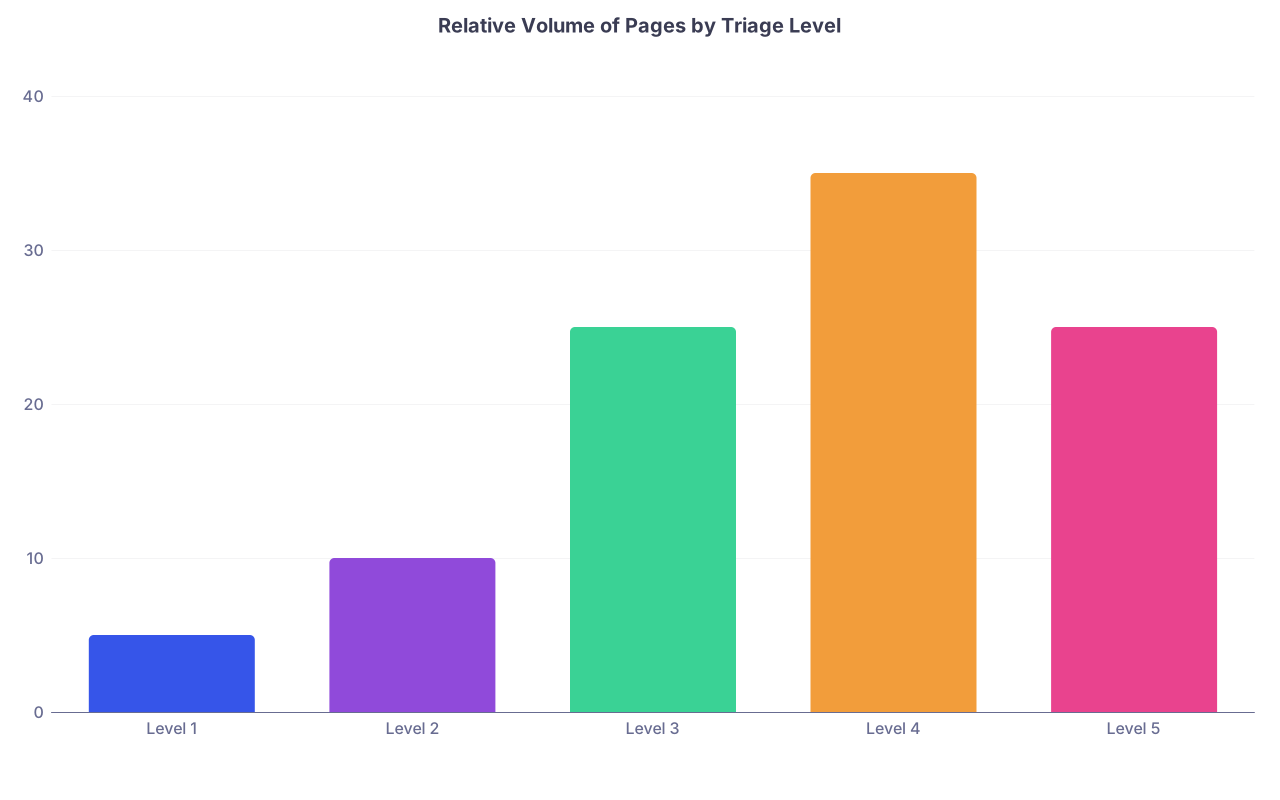
| Category | Value |
|---|---|
| Level 1 | 5 |
| Level 2 | 10 |
| Level 3 | 25 |
| Level 4 | 35 |
| Level 5 | 25 |
Most nights, your volume looks like this. If you treat every green like red, you will burn out and miss the real reds.
Final Thoughts
On-call survival is not about heroics. It is about cold, disciplined triage.
You have three takeaways:
- Run every page through a fixed 5-level system. Decide in 30 seconds: 1, 2, 3, 4, or 5. Then act accordingly.
- Write and use a physical triage queue. Time, room, issue, level, status. Rebuild it every few hours to keep your brain clear.
- Slash preventable pages with better orders and clear communication. Page-safe order sets and explicit “I am with an unstable patient; I will do X by Y time” will save you more energy than any time-management hack.
You will still have brutal nights. But you will not be overwhelmed by pages. You will be running a system. Not letting the system run you.