
The way most interns handle overnight hypotension is unsafe, inefficient, and completely fixable.
You do not need magical clinical intuition at 3 a.m. You need a tight, repeatable algorithm you can run in the same order every time, even when you are exhausted and three pages behind.
This is that algorithm.
1. First Rule: Do Not Treat Numbers in Isolation
If you remember nothing else, remember this: treat patients, not vitals. Hypotension plus an asymptomatic, stable patient at baseline is a different planet from hypotension plus altered mental status and cold clammy skin.
When you get paged:
“Hey doc, FYI, BP is 82/48 on Mr. Jones in 412.”
Your brain should automatically run this checklist:
- Is this real?
- Is this new?
- Is this dangerous right now?
- What is the likely cause?
- What is my immediate stabilization step?
- What is my diagnostic step?
- What is my definitive management or escalation step?
You will cycle through these in under 5–10 minutes for most routine calls. Let’s break them down into something you can actually use tonight.
2. Step Zero: Before You Leave Your Chair
You do not always need to sprint to the bedside instantly. But you do need to triage quickly.
The second the page hits, do this:
Ask the nurse on the phone five questions (in this order):
- “How does the patient look?” (awake, oriented, speaking, pale, sweaty, confused)
- “What are the other vitals?” (HR, RR, SpO₂, temp, last BP)
- “Is this a change from their baseline tonight?”
- “Any new symptoms?” (chest pain, shortness of breath, abdominal pain, bleeding, dizziness, confusion)
- “Any interventions already done?” (rechecked cuff, position change, fluids held, medications given)
Open the chart before walking:
- Diagnosis / reason for admission
- Code status
- Last 6–12 hours of vitals and I/O
- Recent labs (Hgb, creatinine, lactate, troponin, BNP, etc.)
- Med list: especially antihypertensives, opioids, diuretics, sedatives, vasodilators
Decide: immediate bedside vs. 5-minute walk
- Go now (run, if needed) if:
- SBP < 80 and symptomatic (altered, chest pain, SOB, oliguria, mottled)
- HR > 120 with hypotension
- New hypoxia or change in mental status
- Massive bleed or sepsis concern
- Can walk but do not dawdle if:
- SBP 80–90 but asymptomatic and similar to prior
- Patient is chronically low (e.g., EF 15 %, SBP 90 baseline) and nurse just anxious
- Go now (run, if needed) if:
If your gut says “sketchy,” go see them. Nobody ever got in trouble for seeing a hypotensive patient too early.
3. At the Bedside: A 60–90 Second Assessment
You are now in the room. Do not stare at the monitor first. Look at the patient.
A. Quick visual scan
- Are they:
- Awake and speaking full sentences?
- Pale, sweaty, or mottled?
- Using accessory muscles to breathe?
- Confused or slow to respond?
If they look bad, your threshold for calling help and escalating goes way down.
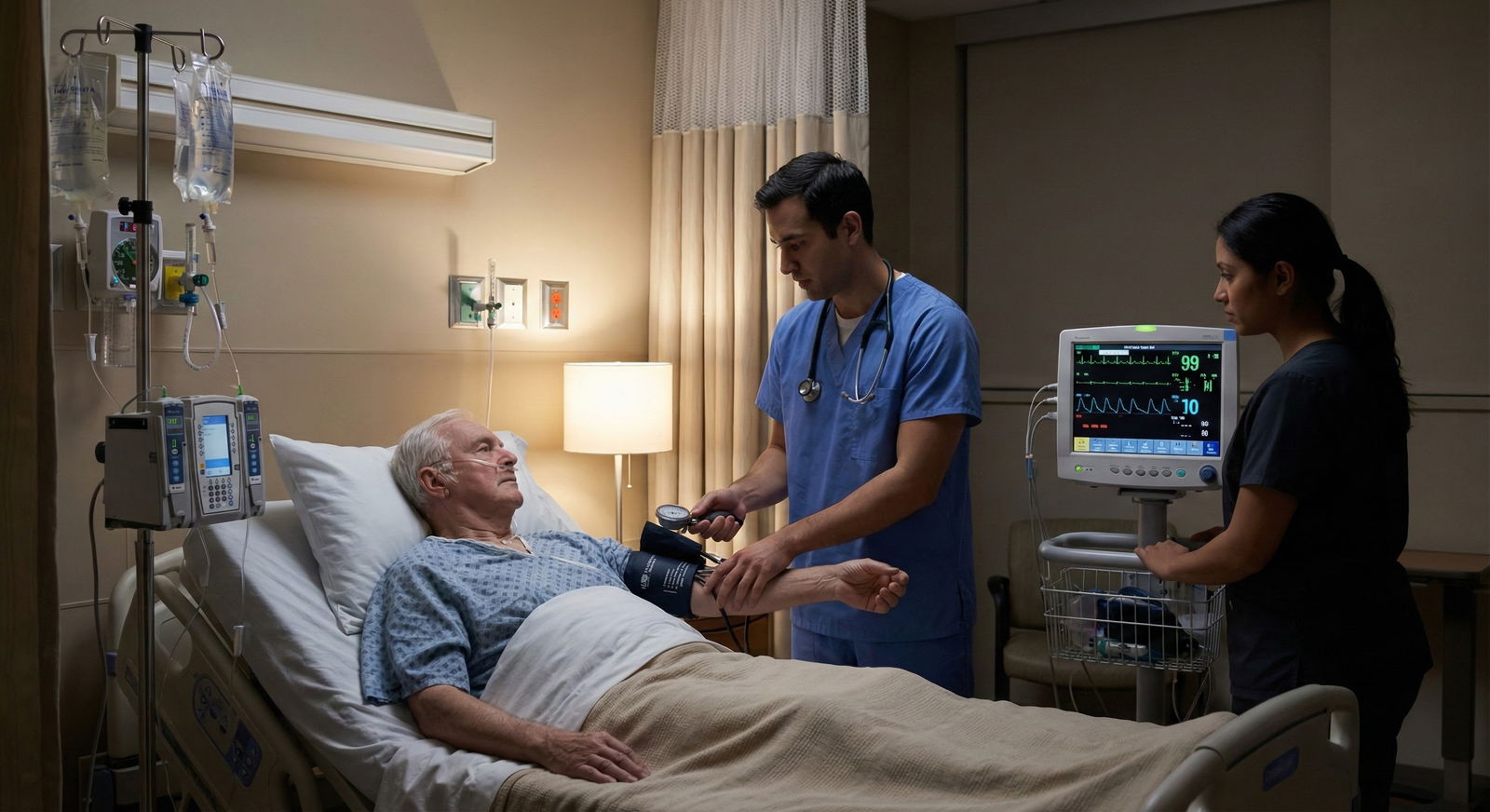
B. Confirm the blood pressure
Bad BPs are often bad measurements. Fix that first.
Ask the nurse: “Let’s recheck this together.”
- Ensure:
- Correct cuff size
- Cuff at heart level
- Patient not moving or talking
- Try:
- Manual BP if the machine is suspicious
- Different arm if one arm is always off
You should get in the habit of:
- Not accepting a single machine reading as gospel
- Documenting in your note: “BP repeated manually: 94/60”
C. Focused “ABCs plus perfusion” exam
You are not doing a full H&P. You are doing a targeted shock screen.
- Airway
- Can they talk clearly? Any gurgling, stridor, or snoring?
- Breathing
- RR, work of breathing, wheezes/rales, asymmetry, tracheal deviation
- SpO₂, how much O₂ they are on (room air vs 6 L NC vs non-rebreather)
- Circulation
- HR and rhythm (palpate pulse, not just monitor)
- Jugular venous distention or flat neck veins
- Extremity temperature: warm and flushed vs cold and clammy
- Capillary refill, peripheral pulses
- Check for bleeding: surgical sites, drains, melena/hematochezia, hematuria
- Check for edema, signs of volume overload
- Mental status
- Oriented? Able to answer accurately?
- Any new confusion or agitation?
At the same time, ask 3–4 targeted questions:
- “Any chest pain, pressure, or heaviness?”
- “Any trouble breathing or feeling short of breath?”
- “Any abdominal pain, nausea, or vomiting?”
- “Dizziness, lightheadedness, or feeling like you might pass out?”
Your exam plus a 10-second history will usually push you toward one of a few broad categories.
4. Classify the Hypotension: Which Bucket Are You In?
Every overnight hypotensive episode falls into a small list of common causes. You do not need to know everything. You need to quickly assign a working category and act.
Use HR, exam, context, and history to guide you.
Bucket 1: Hypovolemic (Bleeding or Volume Depletion)
Clues:
- Tachycardic, hypotensive
- Cool extremities, delayed cap refill
- Flat neck veins, dry mucous membranes
- Recent:
- Surgery
- GI bleed
- Large diuresis
- Diarrhea/vomiting
- Poor PO intake or NPO without adequate fluids
- Drops in Hgb, rising BUN/Cr
Bucket 2: Distributive (Sepsis, Anaphylaxis, Neurogenic)
Clues:
- Warm extremities early, wide pulse pressure
- Fever or hypothermia, tachycardia
- Suspected infection: pneumonia, UTI, wounds, catheters
- New rash, wheezes, airway swelling (anaphylaxis)
- Spinal cord injury or high spinal anesthesia (neurogenic)
Bucket 3: Cardiogenic (Pump Failure, MI, Arrhythmia)
Clues:
- Tachycardia or bradycardia
- JVD, pulmonary crackles, S3, edema
- Chest pain, dyspnea, orthopnea
- Known low EF, CAD, valve disease
- Arrhythmias: AF with RVR, VT, heart block
- Troponin up, BNP up, EKG changes
Bucket 4: Obstructive (PE, Tension Pneumo, Tamponade)
Clues:
- Sudden onset SOB or chest pain
- Hypoxia out of proportion to exam
- Unilateral decreased breath sounds, tracheal shift
- JVD with clear lungs, muffled heart sounds
- High-risk: cancer, DVT, immobility, central lines
Bucket 5: Medication-Induced / Iatrogenic
Clues:
- New or changed:
- Antihypertensives (labetalol, hydralazine, ACEi, ARB, CCB)
- Diuretics
- Opioids, benzodiazepines
- Nitrates, sildenafil
- Sedation for procedures
- “BP was fine before meds, then dropped after”
Bucket 6: “Soft, chronic” hypotension
Clues:
- Long-standing SBP 80–100 documented for days
- No symptoms, good mentation and urine output
- Advanced heart failure, cirrhosis, autonomic dysfunction
- On midodrine, fludrocortisone, etc.
This last bucket is where interns overreact. Chronically low, asymptomatic patients do not need knee-jerk boluses and STAT transfers every time.
5. Immediate Stabilization: What You Do in the First 5–10 Minutes
Now we get to actual actions, not hand-waving. This is where most on-call residents fail by either doing nothing or doing everything blindly.
Universal first moves (for SBP < 90 or MAP < 65)
Do these for almost everyone who is not clearly “chronically low and totally fine.”
Call for help early if the patient looks sick
- “Can you come see this patient?” to your senior
- If your hospital has RRT/MET and the patient is unstable: call them
Positioning
- Lay patient flat or slight Trendelenburg
- Raise legs if no contraindication (leg raise can act as a passive fluid challenge)
Oxygen
- Put on nasal cannula 2–4 L if any respiratory distress, hypoxia, or sick appearance
- Aim SpO₂ ≥ 92 % (adjust for COPD patients per baseline)
IV access
- Ensure at least one working IV, preferably two (18–20 gauge)
- If IV is questionable, have nursing replace it now
Hold the offenders
- Tell nurse: “Hold all antihypertensives and diuretics for now”
- Hold sedatives and opioids if possible until reassessed
The fluid decision
For hypotension, everyone wants to slam in fluids. Bad habit in certain patients. You need a quick rational approach.
Ask:
- Does this patient look volume depleted or septic with warm extremities?
→ They probably need fluids. - Does this patient have clear lungs, flat neck veins, dry mucous membranes?
→ They definitely need fluids. - Does this patient have JVD, crackles, EF 15%, and massive edema?
→ They may not tolerate fluids. Go slow or avoid.
Standard approach for most non-cardiac, non-ESRD patients:
- Start with: 500 mL IV bolus of:
- Lactated Ringer’s or
- Normal saline
- Reassess BP, HR, mental status, and lungs in 10–15 minutes
- If improved and still soft, can repeat another 500 mL and reassess
In heart failure / ESRD / severe aortic stenosis:
- Consider:
- Smaller bolus: 250 mL
- Or consult senior / ICU before fluids if they already look overloaded
- Document your reasoning: “Given EF 10 %, trial cautious 250 mL LR with close reassessment.”
Do not give liters blindly. Bolus, reassess, repeat if appropriate.
6. Orders You Should Place Almost Every Time
You have stabilized or are in the process of stabilizing. Now, basic diagnostics.
| Order Set | Typical Components |
|---|---|
| Labs | CBC, BMP, lactate, LFTs if indicated |
| Sepsis | Blood cultures x2, UA, cultures from suspected source |
| Cardiac | Troponin, BNP, EKG, consider CXR |
| Fluids | 250–500 mL bolus, then reassess |
Baseline labs (unless this is obviously spurious / chronic and stable)
- CBC – check for anemia, leukocytosis
- BMP – renal function, electrolytes
- Lactate – if sepsis or poor perfusion suspected
- Coags and type & screen – if bleeding suspected
- Venous blood gas – if very sick; pH, CO₂, lactate (if not already)
Cardiac evaluation
Get these if any chest pain, dyspnea, history of CAD/CHF, arrhythmia, or just if you are unsure and the patient looks unwell:
- EKG (do not skip this)
- Troponin
- BNP (if undifferentiated dyspnea or CHF suspicion)
- CXR – if pulmonary edema, pneumonia, or effusion suspected
Infectious workup
If sepsis is in the differential (fever, leukocytosis, source, lactate up, tachycardia):
- Blood cultures x 2
- Urinalysis and urine culture
- CXR
- Source-specific:
- Wound cultures
- Sputum cultures if productive cough / intubated
Imaging for specific concerns
Do not order CTs just because someone is hypotensive. But if red flags:
- Suspected PE: CTA chest (if stable enough), D-dimer rarely helpful inpatient
- Suspected intraabdominal catastrophe: CT abdomen/pelvis
- Suspected bleed: CT head (neuro), CT abdomen/pelvis (GI, post-op), etc., after discussion with senior
You are not expected to manage massive PE or RUPTURED AAA alone at 3 a.m. You are expected to recognize and call higher levels of care fast.
7. Decision Branches by Common Scenario
Let me give you actual patterns you will see, with what to do.

| Step | Description |
|---|---|
| Step 1 | Page for low BP |
| Step 2 | Call nurse for details |
| Step 3 | Go to bedside |
| Step 4 | Call senior or RRT |
| Step 5 | Focused exam and repeat BP |
| Step 6 | Hypovolemic - Give fluids |
| Step 7 | Septic - Fluids and cultures |
| Step 8 | Cardiogenic - Cautious fluids, EKG, BNP |
| Step 9 | Medication - Hold meds, observe |
| Step 10 | Reassess and decide floor vs ICU |
| Step 11 | Symptomatic or SBP less than 80 |
| Step 12 | Likely cause |
Scenario 1: “Post-op patient, BP 82/50, HR 118”
- Looks pale, slightly diaphoretic, surgical drain with more output than prior
- Likely bucket: hypovolemic hemorrhagic
Immediate steps:
- Repeat BP manually, place on O₂
- Assess surgical site and drains for bleeding
- Start 500–1000 mL LR bolus
- Send STAT: CBC, type & screen, coags
- Call:
- Your senior
- Surgical team if they are the primary
- Prepare for:
- Possible transfusion
- Possible imaging or return to OR
This is not a wait-and-see for 4 hours.
Scenario 2: “Elderly pneumonia patient, BP 86/52, HR 110, T 38.9”
- Warm extremities, tachypneic, new confusion
- Likely bucket: septic distributive
Immediate steps:
- Repeat BP; put on O₂; start 1–2 L LR or NS in 500 mL boluses
- Draw lactate, CBC, CMP, blood cultures, UA, CXR
- If cultures not already done and antibiotics not started, start broad-spectrum per local protocol
- Call your senior early:
- “I think this is sepsis with hypotension; we might need ICU if no response to fluids.”
- If MAP remains < 65 after 30 mL/kg fluid or patient looks bad:
- ICU consult for vasopressors
- They belong in a monitored setting
Scenario 3: “HFrEF 20% patient, SBP 78/40, HR 90, crackles, on 2 L O₂”
- JVD, leg edema, dyspneic, cool extremities
- Likely bucket: cardiogenic shock
Do not hammer with fluids.
Steps:
- Gentle 250 mL trial at most, if any reason to suspect relative hypovolemia (recent over-diuresis)
- EKG, troponin, BNP, CXR, labs
- Call:
- Senior resident
- ICU / cardiology stat
- Discuss:
- Inotropes / vasopressors
- Noninvasive ventilation if pulmonary edema
- This patient likely needs ICU; your job is fast recognition, not heroic floor management.
Scenario 4: “Post-op knee replacement, SBP 78/42 after IV hydromorphone”
- Sleepy but arousable, warm extremities, RR 8–10
- Likely bucket: medication-induced (opioid) +/- hypovolemia
Steps:
- Stimulate, ensure airway is patent
- Give O₂, place on continuous pulse ox
- Consider 250–500 mL fluid bolus if volume down
- If RR < 8 or apneic or difficult to arouse:
- Give naloxone (start 0.04 mg IV, titrate)
- Call RRT if concern for respiratory failure
- Hold further opioids, adjust pain regimen
- Document and write explicit parameters for further opioids
Scenario 5: “Chronic liver patient, SBP 88/54 for last week, asymptomatic”
- Awake, comfortable, making urine, baseline MAP ~60
- Likely bucket: chronic low pressure
Steps:
- Confirm this is truly chronic by checking prior days
- Ask patient: “Do you feel lightheaded or different?” If no:
- You may:
- Do nothing except hold new antihypertensives
- Ask day team to reassess MAP targets
- Communicate clearly in your sign-out: “SBP 80–90, asymptomatic, chronic per chart.”
Do not write endless “NS 1 L bolus PRN SBP < 90” on these patients. That is how you flood them overnight.
8. When to Escalate: RRT vs ICU vs Attending
You are not a hero for “handling it alone.” You are reckless if you avoid calling for help when needed.
Call RRT / MET immediately if:
- Persistent SBP < 80 or MAP < 60 with any of:
- Altered mental status
- New O₂ requirement > 4 L or rapid escalation
- RR > 30 or < 8
- HR > 130 or < 40
- Chest pain concerning for ACS
- Signs of stroke
- Active major bleed
Call ICU for:
- Hypotension requiring or likely to require vasopressors
- Unclear shock state not responding to initial fluids
- Any patient you feel cannot be safely managed on the floor with ward nurse ratio
Call your attending (or at least senior) when:
- You are about to:
- Start or escalate vasopressors
- Transfer to ICU
- Activate massive transfusion
- Change code status acutely
- Or when:
- The situation feels beyond your experience or comfort. Trust that feeling.
You will never be punished for calling sooner. You will get crushed if you sit on a crashing patient for hours.
9. Targeted Algorithms for the Commonest Causes
Let me give you two clean protocols you can almost run by muscle memory.
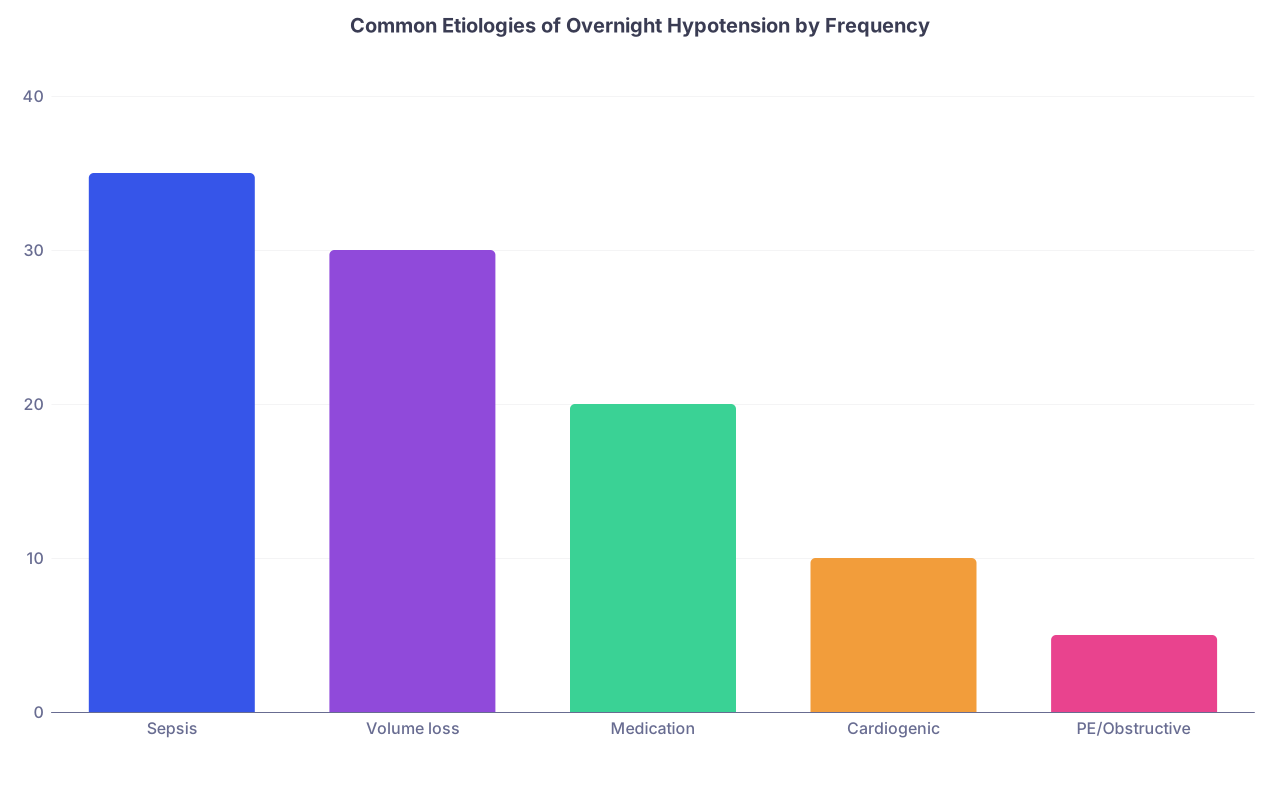
| Category | Value |
|---|---|
| Sepsis | 35 |
| Volume loss | 30 |
| Medication | 20 |
| Cardiogenic | 10 |
| PE/Obstructive | 5 |
A. Sepsis + Hypotension Overnight: 10-Step Protocol
- Confirm hypotension with repeat BP.
- Assess ABCs; put on O₂ if any distress or SpO₂ < 92 %.
- Establish or confirm IV access, at least two lines.
- Start fluid resuscitation: 30 mL/kg crystalloid (in 500–1000 mL boluses).
- Send labs: CBC, CMP, lactate, blood cultures x 2, UA, CXR.
- Start broad-spectrum antibiotics within 1 hour (use your hospital’s protocol).
- Reassess after each liter of fluid: BP, HR, RR, mental status, lungs.
- If MAP still < 65 after fluids or lactate rising: call ICU for vasopressors.
- Document a focused note: “Sepsis with hypotension, initial bolus x, cultures drawn, antibiotics given.”
- Sign out clearly to day team and ICU if transferred.
B. Post-op / GI Bleed + Hypotension Overnight: 10-Step Protocol
- Confirm hypotension and check HR.
- Quick bleeding check: drains, dressings, stool, emesis, abdominal girth.
- Put on O₂, ensure IV access (large bore if possible).
- Send labs STAT: CBC, type & screen, coags, BMP.
- Give fluid bolus 500–1000 mL crystalloid while setting up blood.
- If Hgb low or active bleeding: prepare PRBCs per protocol, consider massive transfusion.
- Call surgical team or GI early if this is their patient.
- Consider imaging (CT, ultrasound) only after initial stabilization and with consultant input.
- Monitor vitals q5–15 minutes until stable.
- Strongly consider ICU transfer depending on rate of blood loss and hemodynamics.
10. Documentation and Orders That Prevent Future 3 a.m. Nightmares
Good overnight work is not just resuscitation. It is also prevention.
Write a brief, focused note
Something like:
“RN notified of SBP 82/48 at 0200. On arrival, patient awake, oriented, BP 86/52 repeat, HR 110, RR 22, SpO₂ 95 % RA. Exam: warm extremities, no JVD, clear lungs, mild suprapubic tenderness. Suspect sepsis from UTI. Given 1 L LR bolus, BP improved to 102/62, HR 96. Labs: CBC, CMP, lactate, blood cultures, UA sent. Started ceftriaxone 1 g IV. Will monitor vitals q2h x 6 hours. Discussed with senior resident; will call ICU if recurrent hypotension or lactate elevated.”
This kind of note proves you had a plan and reassessed.
Place sane “hold” and parameter orders
- For antihypertensives:
- “Hold if SBP < 100 or MAP < 65.”
- For diuretics:
- “Hold if SBP < 100, MAP < 65, or creatinine rising.”
- For opioids:
- “Hold if RR < 10 or patient difficult to arouse.”
You can prevent a lot of overnight hypotension by fixing ridiculous day-team orders that say, “Continue home lisinopril 40 mg BID” in a sepsis admission.
Set monitoring frequency
After a hypotensive episode, do not leave vitals at q8h.
- Reasonable:
- q1–2h vitals for at least 4–6 hours
- Telemetry if arrhythmia suspected
- Write it explicitly:
- “Increase vitals to q2h for next 6h, notify MD for SBP < 90, HR > 120, RR > 30.”
11. Building Your Personal “Overnight Hypotension” Reflex
You do not want to recreate this algorithm from scratch at 3 a.m. every time. Build shortcuts.

Make yourself a 1-page pocket cheat sheet
Front:
- Stepwise approach:
- Confirm BP
- ABCs + mental status
- Look for bleeding, sepsis, cardiogenic, meds
- Fluids yes/no decision based on exam
- Basic labs and imaging
Back:
- Dosing reminders:
- Typical fluid bolus volumes
- Naloxone starting dose
- Sepsis fluid resuscitation target
- Phone numbers:
- ICU
- RRT/MET
- On-call surgery, cardiology, GI
Train yourself to always ask “What bucket?”
Every hypotension call:
- “Is this hypovolemic, distributive, cardiogenic, obstructive, meds, or chronic low?”
- Say it in your head. Then act accordingly.
Over time, you stop panicking and start pattern matching.
12. Final Thoughts: What Actually Matters
Overnight hypotension management is not about memorizing every rare cause. It is about being systematic and decisive when everyone else is half-asleep.
Key points:
Always see the patient and repeat the BP before you panic.
Bad machine readings and over-tight cuffs have wasted more resident hours than almost anything else.Classify into a shock bucket and treat the category, not just the number.
Hypovolemic, distributive, cardiogenic, obstructive, meds, or chronic. Once you know the bucket, the next step is usually obvious.Stabilize quickly, call for help early, and document your thinking.
Bolus thoughtfully, start the right workup, and loop in seniors/ICU before the patient truly crashes.
You do not need to be brilliant to handle overnight hypotension safely. You just need a clear, repeatable algorithm and the discipline to run it every time.