The most dangerous seconds in medicine are when everyone is staring at a breathless patient and nobody is taking charge. Do not be that resident.
You do not need the full diagnosis to keep a dyspneic patient alive. You need a simple, brutal, fast framework that works at 2 a.m. when labs are pending, radiology is backed up, and the nurse is asking, “Doctor, what do you want to do?”
This is that framework.
The Only Question That Matters First: “Safe Airway and Breathing… or Not?”
When your pager goes off for “patient short of breath,” you are not going to solve the differential on the way there. You are going to decide one thing:
Is this patient in immediate life-threatening respiratory failure or not?
Think in two tracks:
- Crashing / potentially crashing – you manage physiology and buy time
- Stable(ish) – you manage diagnosis and fine-tune
Step 0: Before You Enter the Room
As you walk (fast) to the room, get data from the nurse on the phone or at the door:
- “What are the vitals?” (HR, BP, RR, SpO₂, temp)
- “Mental status?” (awake, confused, obtunded)
- “What started this? Sudden? Gradual?”
- “Baseline oxygen? New?”
- “Any chest pain? Wheeze? Stridor? Hemoptysis?”
If they say things like:
- “Sat 78% on nonrebreather”
- “RR 40 and they can’t finish a sentence”
- “Mentation is worse, very drowsy”
You are in track 1: emergent respiratory failure. Shift into resus mode before you even cross the threshold.
Step 1: The 30-Second Doorway Assessment (Decide If They Are Crashing)
At the door, do not touch anything yet.
Scan:
Work of breathing
- Can they speak in full sentences?
- Accessory muscles? Tripoding? Paradoxical breathing?
- Silent chest (severe asthma/COPD or fatigue)? Bad sign.
Mental status
- Alert and anxious vs drowsy, confused, agitated, combative.
Color and perfusion
- Cyanosis, diaphoresis, cool extremities, mottling.
Monitors
- RR (ignore if clearly wrong but check waveform if available)
- SpO₂ and waveform quality
- HR and BP
If you see any of the following, treat as immediate threat:
- RR > 30 or < 8 with poor effort
- SpO₂ < 90% despite high-flow O₂
- Can only speak 1–2 words at a time
- ALOC: drowsy, difficult to arouse, confused new
- Systolic BP < 90 or MAP < 65
- Stridor, inability to manage secretions
- Silent chest with severe distress
This is not “watch and wait.” This is act now.
Step 2: Airway–Breathing–Circulation, For Real, Not As a Slogan
You know ABC. You just need a call-night version that you can actually run.
A – Airway
Ask yourself: Can they protect their airway, yes or no?
- Look for:
- Gurgling, inability to clear secretions
- Stridor or high-pitched noise
- Drooling, inability to handle oral secretions
- GCS ≤ 8–9 or near-unconscious
If “no” or “not sure and getting worse”:
- Call for help out loud:
- “I need respiratory here now.”
- “Call anesthesia or airway team stat.”
- “Call rapid response / code team.”
- Prepare for intubation:
- Suction at bedside
- Bag-valve-mask (BVM) with reservoir ready
- Two large-bore IVs (or IO if needed)
- Do not wait to see if they “perk up.”
If airway is patent and they can talk, move quickly to breathing.
B – Breathing: The Rapid Framework
You are trying to answer three questions:
- How bad is gas exchange right now?
- Is this likely oxygen failure (hypoxemic), pump failure (hypercapnic), or both?
- What temporizing support can I start in the next 5 minutes?
Immediate actions (no excuses):
- Put them on a monitor (if not already).
- Apply oxygen:
- If sat < 92% or unknown: start with nasal cannula 4–6 L or simple mask 6–10 L
- If very distressed: nonrebreather 15 L
- Get:
- Stat ABG or VBG (depending on institutional norms)
- Stat CXR (portable)
- ECG
- Fingerstick glucose
- Ask the nurse:
- “Do we have a recent weight?” (for diuretics)
- “Allergies?” (for meds you will push)
Then focus exam like a sniper, not a textbook.
Step 3: The 90-Second Targeted Exam – “Is It One of the Big Six?”
Do not start reciting full ROS. Look for Big Six killers that present with dyspnea:
- Flash pulmonary edema / decompensated heart failure
- COPD/asthma exacerbation
- Pneumonia / sepsis
- Acute coronary syndrome (ACS)
- Pulmonary embolism
- Pneumothorax (tension or large)
What you check, quickly:
General
- Position (tripod, orthopnea, unable to lie flat)
- Anxiety vs exhaustion
Lungs
- Wheeze vs crackles vs decreased breath sounds
- Asymmetry: one side almost absent? Think pneumothorax, large effusion
- Stridor (upper airway)
Heart
- Rate, rhythm, new murmurs?
- JVD / elevated neck veins?
Extremities
- Pitting edema (HF)
- Unilateral leg swelling, tenderness (PE clue)
- Cool, mottled, delayed cap refill (shock)
Skin
- Urticaria / angioedema (anaphylaxis)
- Fever, rigors (infection)
You are not trying to be perfect. You are trying to categorize.
Step 4: Categorize the Pattern – “Bucket Diagnosis” in Minutes
Here is the practical truth: during a call, you rarely get a neat label like “non-STEMI with acute decompensated HFrEF.” You get patterns.
Think in buckets. Then treat the bucket.

Bucket 1: Wet and Hypertensive – Acute Pulmonary Edema
Pattern:
- Severe dyspnea, orthopnea, pink frothy sputum sometimes
- Hypertension common (SBP > 160)
- Crackles, maybe wheeze (“cardiac asthma”)
- Peripheral edema, JVD
- CXR: vascular congestion, Kerley B lines, effusions (when available)
Immediate actions:
- Oxygen – NRB 15 L or HFNC if available.
- NIPPV (BiPAP) if:
- RR > 25, severe distress, OR
- Hypercapnia in COPD+HF overlap
- No contraindications (vomiting, facial trauma, inability to protect airway)
- Vasodilate and offload:
- Nitroglycerin SL 0.4 mg q5 min x 3 if BP allows
- For high BP (e.g., SBP > 160): start IV nitroglycerin infusion per protocol
- Diurese:
- IV furosemide – usually 40–80 mg IV (or equal to or greater than home oral dose)
- Call ICU early if:
- Requiring escalating NIPPV
- Persistent hypoxia, hypotension, or altered mental status
Bucket 2: Tight and Wheezy – Obstructive (Asthma/COPD) Exacerbation
Pattern:
- Audible wheeze or “silent chest” in severe fatigue
- Prolonged expiratory phase, accessory muscle use
- Often history of asthma/COPD, recent infection, or trigger
- May be normotensive or slightly hypertensive from anxiety
Immediate actions:
- Oxygen – target SpO₂ 88–92% in COPD, 94–98% in asthma/normal.
- Bronchodilators:
- Nebulized albuterol + ipratropium back-to-back or continuous
- Systemic steroids:
- IV methylprednisolone (e.g., 60–125 mg) or PO prednisone 40–60 mg if able to swallow
- Consider NIPPV (BiPAP) if:
- Moderate–severe distress
- Hypercapnia on gas
- Not obtunded, can protect airway
- Red flags – call ICU / attend early:
- Rising CO₂, worsening mental status
- Silent chest with minimal airflow
- Exhaustion, inability to speak, diaphoresis
Bucket 3: Hot and Hypoxic – Pneumonia / Sepsis
Pattern:
- Fever, chills, productive cough, pleuritic chest pain
- Tachycardia, tachypnea, potentially hypotension
- Rales or focal findings on exam
- CXR: consolidation, infiltrates (once it arrives)
Immediate actions:
- Oxygen to maintain SpO₂ > 92% (or per patient-specific targets).
- Cultures and labs:
- Blood cultures, lactate, CBC, CMP
- Respiratory viral panel if indicated
- Antibiotics within 1 hour if sepsis suspected:
- Follow hospital CAP/HAP/VAP pathway
- Fluids if hypotensive:
- 30 mL/kg crystalloid if septic shock, adjust for HF/CKD
- If MAP stays low despite fluids, start vasopressors (usually ICU-level).
Bucket 4: The “Clutching Chest” or Equivocal – ACS / Ischemia
Pattern:
- Dyspnea ± chest discomfort, pressure, or atypical pain
- Risk factors: CAD, DM, CKD, age, etc.
- ECG changes, elevated troponin (when back)
Immediate actions:
- Oxygen only if SpO₂ < 90% (avoid unnecessary hyperoxia in ACS).
- ECG stat, repeat q15–30 min if pain persists.
- Aspirin 325 mg chewed (if no allergy, no clear contraindication).
- Nitroglycerin SL if:
- No hypotension
- No RV infarct (suspect with inferior MI + clear lungs + hypotension)
- Get cardiology on board early with concerning ECG or troponin pattern.
Bucket 5: Sudden and Scary – Pulmonary Embolism
Pattern:
- Sudden dyspnea, pleuritic chest pain, tachycardia
- May have syncope, hypotension, or shock
- Risk: recent surgery, immobility, cancer, OCPs, prior VTE
- CXR often normal or nonspecific
Immediate actions:
- Oxygen to keep SpO₂ > 92%.
- ECG – sinus tach, S1Q3T3, new RV strain patterns maybe.
- Bedside echo if you or someone can do it:
- RV dilation/strain, high RVSP, septal bowing
- If high suspicion + hemodynamic instability and no obvious alternative:
- Discuss empiric anticoagulation (e.g., IV heparin) with attending.
- Consider thrombolysis for massive PE with hypotension, in coordination with ICU and cardiology / pulmonary.
- Confirmatory imaging (CTPA or V/Q) as able, but do not let a crashing patient die waiting.
Bucket 6: Sudden Unilateral – Pneumothorax
Pattern:
- Acute dyspnea, pleuritic pain
- One side with markedly reduced or absent breath sounds
- Hyperresonant to percussion (if you have time to percuss)
- Severe hypoxia and hypotension? Think tension pneumothorax.
Immediate actions:
- If tension pneumothorax suspected (unstable):
- Do not wait for CXR.
- Needle decompression or immediate chest tube by someone trained.
- Call for help now.
- If stable but suspicious:
- Stat CXR
- Consult whoever does chest tubes (ED, surgery, pulm, etc.)
Step 5: Start Treatment Before You Have the Name
Most residents lose time because they think they need a “final” diagnosis before acting. Wrong.
You need a reasonable bucket and a safety net.
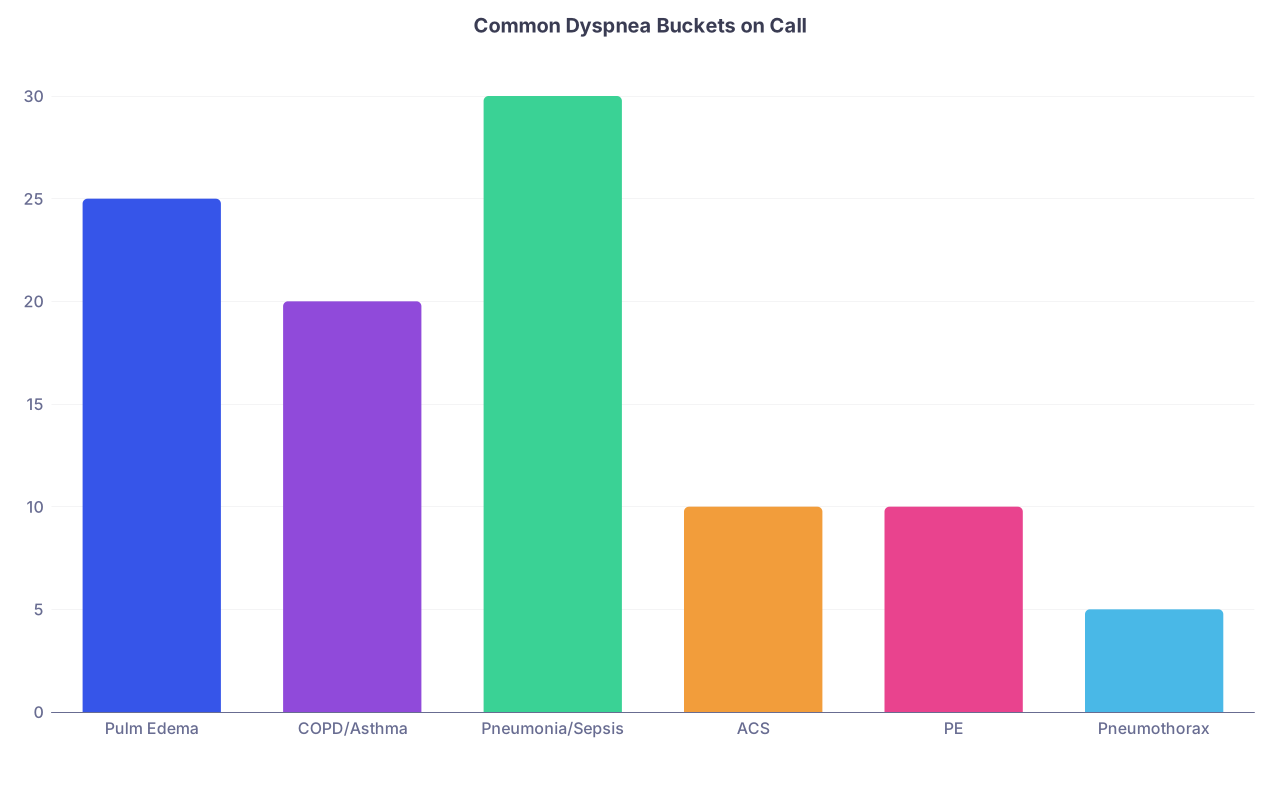
| Category | Value |
|---|---|
| Pulm Edema | 25 |
| COPD/Asthma | 20 |
| Pneumonia/Sepsis | 30 |
| ACS | 10 |
| PE | 10 |
| Pneumothorax | 5 |
(Percentages illustrative, but the message is clear: a few patterns dominate.)
The “2-Minute Orders” Template
Once you have your bucket, place time-sensitive orders fast:
- Monitoring and access:
- Continuous pulse oximetry
- Telemetry if not already
- 2 large-bore IVs
- Basic labs:
- CBC, CMP
- ABG/VBG with lactate
- Troponin, BNP if suspected cardiac
- D-dimer only if low–mod risk for PE and it will change management
- Imaging:
- Portable CXR
- CT chest/CTPA if indicated and patient stable enough to go
- Treat the bucket:
- Pulmonary edema → O₂ + NIPPV + nitroglycerin + furosemide
- COPD/asthma → O₂ + duonebs + steroids ± NIPPV
- Pneumonia/sepsis → O₂ + antibiotics + fluids
- ACS → O₂ if needed + ECG + ASA + consider nitro
- PE → O₂ + anticoagulation if high suspicion and low bleeding risk
- Pneumothorax → emergent decompress if tension suspected
Then you circle back and refine.
Step 6: Use Noninvasive Ventilation and HFNC Wisely
You will live or die by your ability to call NIPPV and HFNC correctly.
NIPPV (BiPAP/CPAP) – When It Is Your Best Friend
Effective for:
- COPD exacerbation with hypercapnia (very strong evidence)
- Cardiogenic pulmonary edema (CPAP/BiPAP both work)
- Sometimes in obesity hypoventilation, neuromuscular weakness, etc.
Contraindications / caution:
- Cannot protect airway
- Shock with hemodynamic instability
- Facial trauma, recent GI surgery, active vomiting
- Poor mask tolerance / agitation without ability to safely sedate
If you think they need NIPPV:
- Do not waste time. Call respiratory therapy, specify:
- “BiPAP for COPD exacerbation, start 10/5, titrate, target CO₂ improvement.”
- Stay in the room for the first 10–15 minutes to ensure they are tolerating it and improving.
HFNC – The Oxygen “Bridge”
High-flow nasal cannula:
- Great for hypoxemic respiratory failure (e.g., pneumonia)
- Patient can still talk, eat, cough
- Less claustrophobic than NIPPV
- Not a solution for severe hypercapnia or absent respiratory effort
Use HFNC when:
- They fail simple O₂ but are not obviously needing immediate intubation
- You need time for antibiotics, diuretics, or other therapy to start working
If the patient on HFNC looks worse after 30–60 minutes, do not linger. Escalate.
Step 7: Know When to Call for Backup (Early, Not Late)
The biggest mistake junior residents make on nights is waiting too long to call.
You should escalate to your senior / attending / ICU if:
- You are even thinking “this might need intubation”
- NIPPV/HFNC is maxed and sats or mental status are not improving
- The patient is hypotensive and unstable despite initial fluid or vasopressor attempts
- You suspect massive PE, tension pneumothorax, anaphylaxis, or airway obstruction
- Your gut says, “If I leave this room, something bad will happen”
I have never once seen someone yelled at for calling early about a truly sick patient. I have absolutely seen people get burned for waiting.

| Step | Description |
|---|---|
| Step 1 | Dyspnea page |
| Step 2 | Call rapid or ICU team |
| Step 3 | ABC, O2, NIPPV/intubation |
| Step 4 | Doorway assessment |
| Step 5 | Targeted exam |
| Step 6 | Start bucket treatment |
| Step 7 | Refine workup and disposition |
| Step 8 | Crashing? |
| Step 9 | Identify bucket |
| Step 10 | Improving? |
Step 8: What You Document (So You Look Like You Knew What You Were Doing)
On-call notes for acute dyspnea should be short and sharp. You are busy. But future you, the day team, and risk management will care.
Key elements:
Initial condition:
- “Called to bedside for acute dyspnea. On arrival: RR 32, HR 118, BP 178/92, SpO₂ 84% on 6 L NC, speaking in 2–3 word phrases, using accessory muscles.”
Focused exam and impression:
- “Lungs with bilateral crackles up to mid-lung, +JVD, 2+ pitting edema. Suspect acute decompensated HF with pulmonary edema.”
Actions and response:
- “Escalated O₂ to NRB 15 L then BiPAP 12/6, IV nitroglycerin titrated to 40 mcg/min, IV furosemide 80 mg. After 20 minutes, RR improved to 24, SpO₂ 95% on BiPAP, BP 150/88.”
Workup ordered:
- “Stat CXR, ABG, ECG, troponin, BNP, BMP, CBC. ICU consulted for possible transfer.”
Plan and disposition:
- “Continue BiPAP, nitro drip per protocol, strict I/O, q1h vitals. Handoff to ICU attending and night float completed.”
You are telling a story: “They were sick. I recognized it fast. I did X, they responded Y. I escalated appropriately.”
Step 9: Building Your Own Mental Rapid-Response Script
You should not be inventing your approach at 3 a.m. You should be running a script you have already rehearsed.
Here is a simple one you can memorize and actually say out loud to yourself walking to the room:
- “Vitals, mental status, can they talk?”
- “Oxygen on. Monitor on. IV access.”
- “Is this crashing airway/breathing? If yes, call for help and manage ABCs.”
- “Listen: wet? wheezy? unilateral? silent? fever?”
- “Which bucket: HF, COPD/asthma, pneumonia/sepsis, ACS, PE, pneumo?”
- “Start bucket treatment now. Order tests to prove me wrong.”
- “Is this getting better in the next 15–30 minutes? If not, escalate.”
That is it. That is the core.
| Bucket | Key Clues | First-Line Actions |
|---|---|---|
| Pulm Edema | Wet, hypertensive, crackles | O₂, NIPPV, nitro, IV diuretics |
| COPD/Asthma | Wheeze, prolonged expiration | O₂, nebs, steroids, consider NIPPV |
| Pneumonia/Sepsis | Fever, cough, focal rales | O₂, antibiotics, fluids |
| ACS | Chest discomfort, risk factors | ECG, ASA, O₂ if hypoxic, nitro if appropriate |
| PE | Sudden dyspnea, pleuritic pain | O₂, anticoag, CT/echo, consider thrombolysis |
| Pneumothorax | Sudden unilateral findings | O₂, decompress if tension, chest tube consult |
Step 10: Advanced Moves That Separate a Good Resident From a Great One
Once you are comfortable with the basics, there are a few extra levers you can learn to pull.
1. Bedside Ultrasound
If your program lets you, get comfortable with:
Lung ultrasound:
- B-lines (pulmonary edema)
- Consolidation with dynamic air bronchograms (pneumonia)
- Absent lung sliding + barcode sign (pneumothorax)
Cardiac ultrasound:
- RV size and function (PE, pulmonary HTN)
- Global LV squeeze (cardiogenic vs septic shock)
- Pericardial effusion with tamponade signs
You can change management faster than waiting 45 minutes for a radiology read.
2. Using VBG/ABG Smartly
A single gas tells you:
- pH and CO₂ – is this hypoventilation / hypercapnia?
- Lactate – shock or sepsis severity
- PaO₂ (on ABG) – severity of hypoxemia
Examples:
- pH 7.22, pCO₂ 80, COPD exacerbation: push NIPPV hard and watch mental status like a hawk.
- pH 7.45, pCO₂ 25, pO₂ 55 on high O₂: severe V/Q mismatch or shunt (ARDS, PE, pneumonia) – probably hypoxemic failure, not ventilatory.
3. Preventing the Second Crash
Once initial crisis is over, do not walk away without:
- Setting vital sign parameters (when to call you)
- Scheduling reassessment (e.g., “I will be back in 30 minutes”)
- Ensuring PRN meds are in:
- Additional nebs
- Extra diuretic options
- Fever control

Quick Case Walkthroughs (So You Can Hear the Script in Your Head)
Case 1: The “I Just Can’t Breathe” HF Patient
- Called for: “70-year-old, SOB, sats 82% on 6 L.”
- On arrival: RR 34, BP 198/104, HR 112, SpO₂ 82% on 6 L, pink frothy sputum, crackles to mid-lung, pitting edema.
What you do:
- NRB 15 L → BiPAP 12/6 with RT
- IV nitro drip, start 20–40 mcg/min, titrate up as BP tolerates
- IV furosemide 80 mg
- Stat CXR, ABG, ECG, troponin, BNP
- Call ICU early
You have not waited for CXR to treat. Because you do not need it to know this is flash pulmonary edema.
Case 2: The “Anxious Wheezer” COPD Exacerbation
- Called for: “58-year-old COPD, more SOB, sat 88% on 2 L (baseline 1–2 L).”
- On arrival: RR 26, HR 104, BP 138/82, SpO₂ 88% on 2 L, speaks full sentences but wheezing audible.
What you do:
- O₂ to 3–4 L NC, target SpO₂ 88–92%
- Nebs: albuterol + ipratropium x 3 back-to-back
- IV methylpred 60–80 mg
- VBG: check CO₂ trend
- If still very tight, consider BiPAP and watch for fatigue or CO₂ rise
You are not blasting them with 100% O₂ to “make the number pretty” and then wondering why CO₂ jumps to 90.
Case 3: The “Looks Fine, Suddenly Crashes” Suspected PE
- Called for: “45-year-old with cancer, sudden SOB and chest pain.”
- On arrival: RR 30, HR 126, BP 92/60, SpO₂ 88% on 15 L NRB, looks terrified, clear lungs, maybe mild right leg swelling.
What you do:
- Recognize high-probability massive PE
- O₂ / NRB → consider HFNC
- Stat ABG, lactate, ECG, bedside echo if possible (RV strain?)
- Call ICU, attending, possibly rapid response
- Start weight-based heparin bolus and drip if no contraindication and your attending agrees
- Prepare for thrombolysis or mechanical intervention if confirmed and still unstable
You are not ordering a D-dimer. That ship has sailed.
Summary: What You Actually Need To Remember
Cut through the noise. On call, for undifferentiated dyspnea, focus on:
- Decide in 30 seconds if they are crashing. If yes, it is ABC + call for help, not “I will come back after I check the computer.”
- Sort into a bucket and treat the bucket. Wet (HF), wheezy (COPD/asthma), hot (pneumonia/sepsis), chest pain (ACS), sudden and scary (PE), unilateral (pneumothorax). Start therapy; confirm later.
- Escalate early when your gut says “this can go bad.” Use NIPPV and HFNC aggressively but wisely, and do not be shy about calling ICU, your senior, or anesthesia.
You are not trying to be clever. You are trying to keep people alive at 2 a.m. This framework will do that.