
The way most residents “wing it” with agitated patients on night shift is unsafe, inefficient, and a liability for everyone in the room.
You cannot improvise your way through a 3 a.m. hallway standoff. You need a protocol. Something you can run on autopilot when your brain is fried, the covering attending is at home, and security is 10 minutes away.
This is that protocol: a five‑step, repeatable de‑escalation sequence built specifically for nights. You can use it on medicine, psych, ED, surgery, wherever patients get confused, pissed off, drunk, delirious, or all three.
I am not giving you theory. This is the stuff that actually works when:
- The 76‑year‑old with delirium is trying to climb over the bedrails.
- The young guy brought in by police is screaming about leaving AMA.
- The post‑op patient is swinging at the nurse pulling the Foley.
- The intoxicated patient is threatening to “take everyone out” if not given more pain meds.
You will not fix every situation without meds or restraints. That fantasy gets people hurt. But you can massively reduce violence, injuries, and codes gray if you run a clear protocol every single time.
Let’s build it.
The 5‑Step Night‑Shift De‑Escalation Protocol
Here is the structure you will use:
- Scene Safety and Setup
- Fast Medical Check for Reversible Causes
- Verbal De‑Escalation Script
- Environmental and Behavioral Adjustments
- Medication and Restraints – Controlled, Not Panicked
You move forward stepwise. You can loop between steps 2–4 as needed. You jump straight to step 5 only when there is immediate danger.
| Step | Primary Goal | Timeframe |
|---|---|---|
| 1 | Keep everyone physically safe | First 30–60 seconds |
| 2 | Rule out / treat medical causes | First 5–10 minutes |
| 3 | Calm with words and tone | Ongoing |
| 4 | Fix environment and triggers | First 10–20 minutes |
| 5 | Use meds/restraints safely | Only if needed |
Step 1: Scene Safety and Setup
De‑escalation starts before you say a word. If the scene is chaos, your words are noise.
1.1 Do a 10‑Second Safety Scan
As you arrive, quickly assess:
- Is there an immediate weapon / object risk?
- IV poles in hand, thrown chairs, metal tray stands, glass items, scissors on the bedside table.
- Is anyone cornered?
- Nurse trapped between bed and wall, security standing too close.
- Is this agitated or actively violent?
- Yelling, pacing, pulling lines → agitated.
- Punching, kicking, attempting to choke or throw objects at people → violent.
If it is already violent, you are not doing solo de‑escalation. You are doing controlled takedown with security and meds. Do not be a hero.
1.2 Establish Positioning
You want:
- You about 1.5–2 arm lengths from the patient, angled slightly (not straight on).
- Clear exit route behind you. Do not get trapped between bed and wall.
- Team roles quickly defined:
- One person speaks (usually you).
- One person stands by the door (safety / runner).
- Others step back and stay quiet unless needed.
Fast script to the room:
“I will talk. Everyone else, please step back and keep some space. I want to keep this calm.”
This alone lowers the temperature. Too many voices = escalation.
1.3 Remove Obvious Triggers
Quick, simple moves:
- Ask visitors who are amplifying the chaos to step out:
“I need to speak with him one‑on‑one to get this under control. I will update you right after.” - Have staff that the patient is yelling at swap out with neutral staff.
- Lower the TV volume, close unnecessary alarms, stop nonessential procedures.
You are trying to remove fuel from the fire before you start talking.
Step 2: Fast Medical Check for Reversible Causes
Treat the reason first when possible. You will not “talk down” severe hypoxia or acute alcohol withdrawal.
Your job in the first 5–10 minutes is to rapidly answer: Is this primarily psychiatric/behavioral or primarily medical? Often it is both, but you must clear the worst medical triggers.
2.1 Look for Red‑Flag Medical Triggers
Run a quick mental checklist:
- Hypoxia / hypercapnia – COPD, pneumonia, opioids.
- Hypoglycemia / hyperglycemia – confused, sweaty, altered.
- Delirium – elderly, infection, new meds, post‑op.
- Withdrawal – alcohol, benzos, opioids.
- Acute pain – inadequately treated post‑op or trauma pain.
- Head injury / stroke / seizure – new neuro deficits, unequal pupils, AMS.
While you are speaking, quietly signal to nursing:
- “Can we get vitals and O2 sat now?”
- “Please do a fingerstick.”
- “Check when they last got pain meds and what.”
2.2 The 30‑Second Medical Assessment You Can Do While De‑Escalating
As you talk, you are also scanning:
- Are they diaphoretic, pale, gasping, cyanotic?
- Is speech slurred from intoxication vs aphasic?
- Any obvious focal deficits with simple commands?
- Are they pulling at specific painful sites?
If you get anything concerning:
- Low sat, hypotension, glucose disaster, focal neuro → call for help early.
- Fix what you can immediately: oxygen on, dextrose if indicated, pain meds (appropriate), fluids.
You do not need a complete H&P. You need to rule out “this will kill them” versus “this is behavioral/psychiatric.” Once those boxes are checked, you lean into verbal de‑escalation.
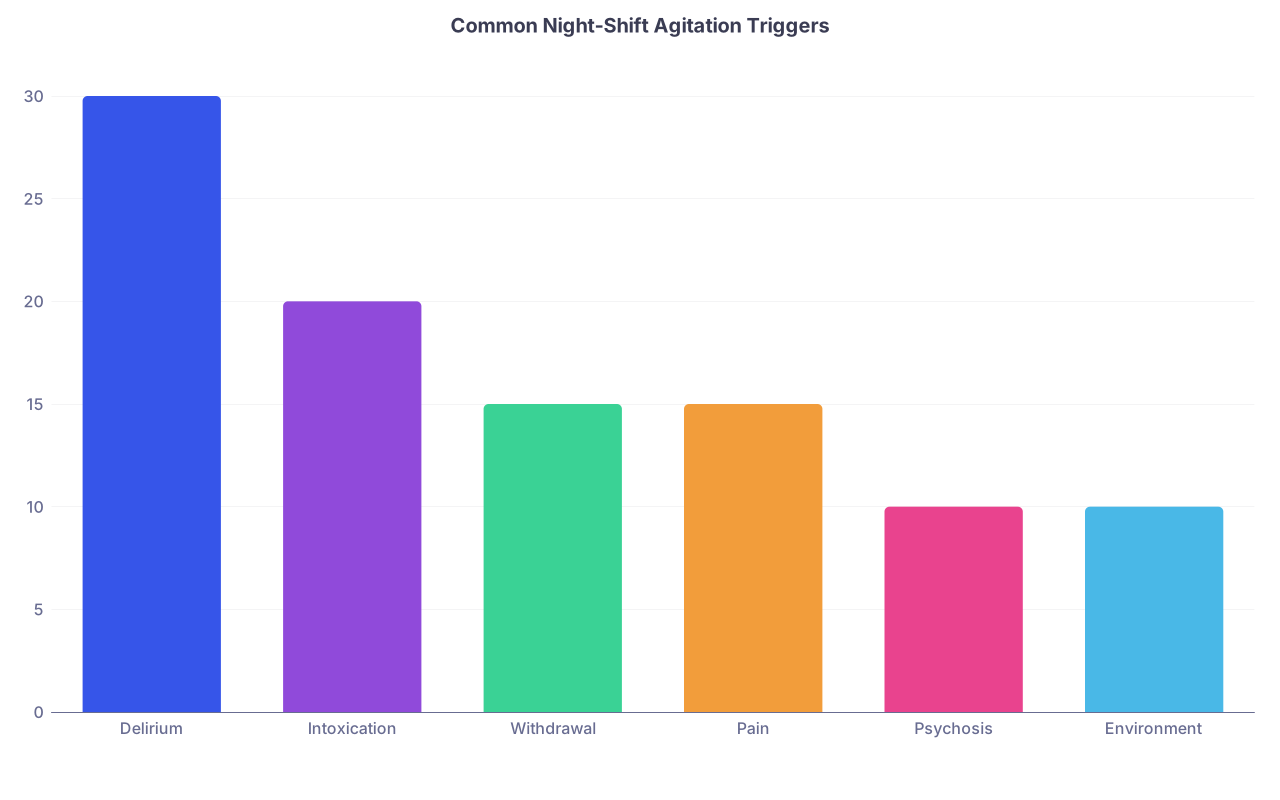
| Category | Value |
|---|---|
| Delirium | 30 |
| Intoxication | 20 |
| Withdrawal | 15 |
| Pain | 15 |
| Psychosis | 10 |
| Environment | 10 |
Step 3: Verbal De‑Escalation Script That Actually Works
This is where many residents fall apart. They start arguing. Explaining. Correcting. You do not win a shouting match with someone who is agitated at 3 a.m.
You need a simple, repeatable script.
3.1 Set Your Voice and Body Language First
Rules:
- Volume slightly lower than theirs, steady, not whispering.
- Tone: neutral, not pleading, not authoritarian bark.
- Hands visible, open, at your sides or lightly on a clipboard.
- No sudden movements. No pointing. No folded arms.
You are projecting: “I’m not here to fight. I’m in control of myself. I can help you get what you need.”
3.2 Start With a Grounding Opener
Avoid: “You need to calm down.” That phrase alone has started fights.
Use something like:
- “You look really upset. I want to understand what is going on.”
- “I can see this is not working for you right now. Let us figure this out.”
You are naming the emotion and signaling you are not their enemy.
3.3 Use the Three‑Part De‑Escalation Loop
You will repeat this loop multiple times:
- Name and reflect the concern
- State clear boundaries
- Offer a specific, realistic next step
Concrete example:
Patient: “You people are torturing me. I am leaving now. Get out of my way.”
You:
- “You feel like no one is listening and you just want out of here.”
- “I cannot let you leave right this second while you are this upset, because I am worried you will get hurt.”
- “Here is what I can do right now: I can step outside for 2 minutes, let you breathe, and then we will talk about what you need to feel safe or whether going home is possible.”
Another:
Patient: “Give me more Dilaudid or I’m going to flip this bed.”
You:
- “You are in a lot of pain and you feel like nothing we are doing is touching it.”
- “I cannot give more Dilaudid right now; it is not safe with your breathing.”
- “What I can do: I can give you [alternative], and we can add [non‑opioid] and reposition you. If that is not enough in 30 minutes, I will come back and reassess.”
Notice what you are not doing:
- Arguing about the facts (“No we are not torturing you.”).
- Threatening back (“If you flip that bed, we will call security.”).
- Making fake promises (“We will get you home soon” when that is impossible).
3.4 Key Language Patterns That Help
Use:
- “I” statements: “I want to keep you safe” vs “You need to…”
- “Right now”: anchors it in the present.
- Simple, concrete choices: “Would you rather sit in the chair or lie in bed while we talk?”
Avoid:
- Medical jargon or complex explanations.
- Sarcasm, jokes at their expense, eye‑rolling.
- Commands stacked in a row (“Stop yelling, sit down, let go of that”).
3.5 Know Your Hard Lines and Say Them Clearly
There are non‑negotiables: physical violence, weapons, imminent danger.
You must be able to say, plainly:
- “If you keep trying to hit staff, we will have to give you medication and use restraints to keep everyone safe. I would rather not do that. Work with me so we do not reach that point.”
Say it calmly. Once. Maybe twice. Then you follow through. Empty threats undermine every future de‑escalation attempt.
Step 4: Environmental and Behavioral Adjustments
Words alone are not enough if the environment is screaming “threat.”
Night shift is awful for this. Bright lights, overhead pages, beeping monitors, loud hallway conversations. Fix what you can in 5–10 minutes.
4.1 Reduce Sensory Overload
You cannot rebuild the hospital, but you can:
- Dim lights if medically safe.
- Silence non‑critical alarms and move noisy pumps away from the patient’s head.
- Close the door or curtain to block hallway chaos.
- Get extra staff to stop hovering at the door unless they are needed.
This especially matters in:
- Delirium.
- Dementia.
- ICU psychosis.
- Autism spectrum or sensory‑sensitive patients.
4.2 Address Basic Physiologic Needs
Many “behavioral” issues vanish when you fix basics:
- Are they hungry or thirsty (and allowed PO)?
- Do they need to urinate or defecate but feel embarrassed to ask?
- Are they freezing under a thin sheet?
- Are lines/tubes physically painful or pulling?
Ask bluntly:
- “Are you in pain, or is something just really uncomfortable right now?”
- “Is anything pinching, pulling, or making it hard to move?”
Tweak:
- Extra blanket or cooling.
- Repositioning with pillows.
- Check Foley, IV sites, NG tubes for obvious torture devices.
4.3 Adjust Staff Behavior
Sometimes the environment problem is…your team.
Common screwups I see:
- Two nurses arguing about the patient within earshot.
- Security standing arms crossed, staring, like nightclub bouncers.
- A resident loudly explaining how “crazy” the patient is outside the room.
Fix it:
- Move nonessential conversations away.
- Ask security to step back but stay available.
- Keep the room population small: 2–3 max, unless physical intervention is happening.
4.4 Give the Patient a Small Sense of Control
Agitation is often a control issue. You can offer bite‑sized control without blowing safety.
Examples:
- “Do you want your head of bed higher or lower?”
- “Do you prefer I stand here or over there?”
- “Do you want to call your family after we get you feeling a little less worked up, or would you rather wait until morning?”
None of this costs you anything. It buys trust.

Step 5: Medication and Restraints – Controlled, Not Panicked
If you handle steps 1–4 well, you will use fewer meds and restraints. But you will still need them sometimes. The mistake is not using them; the mistake is using them chaotically, late, or dangerously.
5.1 Decide Early: Is This Headed for Physical Intervention?
You watch for:
- Rapid escalation despite clear boundaries.
- Increasing threats or actual attempts at harm.
- Evidence they cannot process your words (severe psychosis, delirium, intoxication).
If yes, you quietly:
- Alert security and charge nurse early: “I think we are going to need backup here. Not this second, but soon.”
- Notify your senior or attending if that is protocol.
Better to have security outside the door and not use them than the opposite.
5.2 Use Medications With a Plan, Not as a Reflex
General principles (you must adapt to your hospital and attending preferences):
Match the drug to the likely cause:
- Delirium: usually low‑dose antipsychotic (e.g., haloperidol), careful with benzos unless alcohol/benzo withdrawal.
- Alcohol withdrawal: benzodiazepines first‑line.
- Primary psychosis: antipsychotics; consider adjunctive benzo.
- Severe anxiety without psychosis: lower‑dose benzo or non‑benzo sedative options.
Route matters:
- If they will take PO, start there. Orally disintegrating tablets can be gold.
- If not, IM is often safer than chasing IV access during agitation.
Tell them what you are doing when possible:
“I think medication will help your brain slow down so you feel less panicked. I would prefer to give it as a pill. If that is not possible and you stay this upset, we may have to give an injection instead. I would rather do this together.”
Do not lie and say “vitamin” or “just something to relax you” if you are giving antipsychotic sedation. You can describe its effect simply without labeling it like a package insert.
5.3 Physical Restraints: How to Do It Safely
Physical restraints are a last resort, but sometimes necessary to prevent immediate harm.
Non‑negotiable rules:
- Never apply restraints alone. You need a coordinated team (usually 4–5 people + 1 leader).
- Use clear commands before touching:
- Leader: “We do not want to hold you down. But we will if you keep trying to hit. Last chance – can you keep your hands to yourself?”
- If they do not comply and the decision is made:
- One person per limb, plus one at the head, move in together on a clear verbal cue.
- Quickly secure soft restraints and get out of striking range.
- Immediately check airway, breathing, circulation, and positioning.
And then:
- Reassess frequently. Restraints are not “set and forget.”
- Document why you used them (specific behaviors, failed attempts at de‑escalation).
- Start planning how to reduce and remove them as soon as it is safe.
Use the same calm tone after restraints:
“We are keeping your arms and legs secured right now because you were trying to hit staff. As soon as you can show us you will not do that, we will start taking these off.”
No shaming. No gloating. Just matter‑of‑fact.
Putting It Together: A Night‑Shift Scenario Walkthrough
Let me show you how this actually runs in real time.
Scenario:
2:30 a.m., medicine floor. You get a call:
“Room 514 is trying to get out of bed and hit the nurse. He’s yelling that he is going home. Can you come now?”
Minute 0–1: Scene Safety
You walk in. Middle‑aged man, post‑op day 1 from bowel surgery, sweating, partially out of bed, IV pole swinging.
- You stand near the door, angled, exit path clear.
- You say to the small crowd:
“Everyone step back please. I will talk to him. One nurse stay with me, others outside the door.”
You remove the metal tray stand. Ask the PCA lingering near his feet to move.
Minute 1–3: Quick Medical Check
You glance at monitor: tachycardic, borderline hypertensive, O2 sat 92%.
You quietly tell the nurse:
- “Let us get a full set of vitals and a fingerstick now.”
- “When did he last get pain meds?”
You notice he is grimacing and clutching his abdomen. You suspect pain plus possible early withdrawal (you scan his history, see heavy alcohol use).
Minute 3–6: Verbal De‑Escalation Loop
You step closer, hands visible.
You: “You look miserable and done with this. Tell me what is the worst part right now.”
Him: “You people are cutting me open and then leave me to rot here. I am leaving.”
You:
- “You feel like we did surgery and then abandoned you. That is terrifying.”
- “I cannot let you walk out right now while you are this upset and right after surgery. You could rip everything open and bleed badly.”
- “Here is what I can do in the next 10 minutes: get you something stronger for pain, get this room quieter, and see if there is anything we can do to make this more bearable. Then we talk again about what happens in the morning.”
You repeat this kind of loop a couple of times, listening for his real concern. It turns out he is terrified of withdrawal and “dying like my brother.”
You now have real leverage:
“I hear you. We will treat your withdrawal symptoms aggressively. Let us start that now so this does not spiral.”
Minute 6–15: Environment + Orders
You:
- Ask for lights to be dimmed and TV off.
- Get visitors (who were arguing with staff) to step out briefly.
- Write orders:
- Adequate pain relief, respecting safety.
- CIWA protocol or similar for withdrawal with benzos.
- Labs if needed, maybe a stat ethanol level depending on context.
All while circling back every few minutes, reinforcing:
- “I told you I would get the pain med – it is coming.”
- “I told you I would make it quieter – see, we closed the door.”
He starts to settle. Still irritable, but not climbing out of bed, not striking. No restraints, no takedown, no code gray.
If instead he escalated to true violence, you already:
- Have security nearby (you asked early).
- Have orders ready for IM meds.
- Have a team to apply restraints safely.
Same protocol. Just progressed to step 5.

| Step | Description |
|---|---|
| Step 1 | Patient agitated |
| Step 2 | Step 1 - Safety scan |
| Step 3 | Step 2 - Fast medical check |
| Step 4 | Step 3 - Verbal de-escalation |
| Step 5 | Step 4 - Environment tweaks |
| Step 6 | Continue monitoring |
| Step 7 | Step 5 - Meds and restraints |
| Step 8 | Still dangerous |
How To Make This Protocol Automatic
You are on nights. Your brain is sludge. You will not remember a 20‑point algorithm. You need muscle memory.
Here is how you build it:
- Write the five steps on a small card and tape it to your badge or put it in your pocket.
- On the next three agitation calls, before you enter the room, say the five steps to yourself silently.
- After each event, on your way back to the workroom, ask yourself:
- Did I secure the scene before talking?
- Did I do a medical check or skip it?
- Did I actually use the three‑part verbal loop: reflect – boundary – offer?
- Ask a nurse you trust:
- “What did I do just now that helped? What made it worse?”
- They will tell you quickly where your tone or body language went off.
You do this a dozen times, and it becomes reflex. You stop improvising. You start running a protocol.
Final Takeaways
- De‑escalation is a skill, not a personality trait. You do not need to be “naturally calm.” You need a simple, repeatable sequence you can run on no sleep.
- Always move in order: safety → medical check → words → environment → meds/restraints. Skipping straight to meds or arguments is how people get hurt and lawsuits get written.
- Clarity beats cleverness. Plain language, visible boundaries, and small, concrete offers will calm more patients than any long speech or fancy psych jargon.
Use this on your next night shift. Refine it with your own phrases. But keep the structure. The structure is what keeps everyone breathing.