
Most residents under-treat status asthmaticus at 2 a.m. and realize it 3 hours too late.
Let me be blunt. If you treat a crashing asthma patient like a routine exacerbation, you will watch them tire out in front of you. Status asthmaticus is not a “more nebulizers” problem. It is a “fix the physiology fast or intubate” problem.
This is your overnight escalation playbook. You are tired. staffing is thin. The attending is at home. You still need a clear, ruthless pathway in your head.
1. Recognizing Status Asthmaticus Before It Wrecks You
Status asthmaticus is not just “bad asthma.” It is failure of standard therapy with impending or actual respiratory failure.
If you remember nothing else: ignore the wheeze and look at work of breathing, mental status, and CO₂.
You are dealing with status when you see:
- Severe dyspnea: speaks in single words or not at all
- Accessory muscle use, paradoxical abdominal movement
- Tachypnea often > 30 (but may drop as they fatigue, which is worse)
- Tachycardia > 120, often agitated, diaphoretic
- Peak flows < 40% predicted or personal best (if you can get one)
- Minimal response to initial SABA + steroids in the ED or floor
- Silent chest or very quiet breath sounds = tiny tidal volumes, not improvement
- Hypoxia (SpO₂ < 90% on high flow O₂) OR normal sats with scary work of breathing
- Rising or high-normal EtCO₂ (if monitored) or VBG/ABG showing rising PaCO₂
The “silent chest” is not reassuring. The calm, drowsy asthmatic who “looks more comfortable” after working hard for hours should make you sweat. They may be tiring, hypercapnic, and minutes from respiratory arrest.
If they are on the floor, status asthmaticus is an automatic “this patient needs higher level of care” situation. No debate. You want step-down or ICU.
2. Your First 15 Minutes: Immediate Actions and Order Set
You do not “wait and see” with this patient. You move.
Here is the baseline bundle that should be happening within minutes, not an hour.
A. Bedside Assessment: 60–120 seconds
Walk in and do a mini-ABC:
- Airway: talking? complete sentences vs words? any stridor?
- Breathing: RR, use of accessory muscles, retractions, paradoxical breathing, audible wheeze or near-silent chest, single-word speech
- Circulation: HR, BP, cap refill, mental status (anxious vs confused vs drowsy), cool/clammy
Get a nurse in the room now. You will need help.
B. Immediate monitoring & lines
- Continuous pulse oximetry
- Cardiac monitor
- Noninvasive blood pressure cycling frequently
- IV access: at least one good bore (18–20G), two is better
Stat labs:
- VBG or ABG (depending on unit norms)
- BMP, CBC
- Mg level, sometimes lactate if shocky or severely ill
Do not wait for labs to treat.
3. Core Medical Therapy: How Aggressive Is “Aggressive”?
You escalate in layers, not one thing at a time. Status asthmaticus needs multiple simultaneous therapies.
3.1 Bronchodilators: Maximize Early
Short-acting β₂-agonist (SABA) – continuous is better in true status
Typical adult regimen (adjust per institutional protocol):
- Albuterol continuous neb: 10–15 mg/hour via nebulizer setup
OR - Intermittent nebs: 2.5–5 mg q20min for 3 doses, then q1–2h
On the floor, continuous nebs may not be possible—another reason they belong in step-down/ICU.
- Albuterol continuous neb: 10–15 mg/hour via nebulizer setup
Anticholinergic
- Ipratropium 0.5 mg neb q20min × 3, then q4–6h
Combined duoneb early is standard in severe attacks.
- Ipratropium 0.5 mg neb q20min × 3, then q4–6h
Systemic steroids – do not delay, do not under-dose
- IV methylprednisolone 60–125 mg IV once, then 40–60 mg IV q6–8h
OR - IV hydrocortisone 100 mg IV q8h
Oral prednisone 40–60 mg is okay in milder cases, but in status you want IV and no GI absorption issues.
- IV methylprednisolone 60–125 mg IV once, then 40–60 mg IV q6–8h
Magnesium sulfate – you should think about this early, not as a last gasp
- 2 g IV over 20–30 minutes (some use 2–4 g; 2 g is standard in many protocols)
Side effects: hypotension, flushing. Monitor BP.
- 2 g IV over 20–30 minutes (some use 2–4 g; 2 g is standard in many protocols)
If you are still on the fence about Mg in severe status, you are behind. If the patient is in real status, they should basically get a Mg bolus.
4. Oxygen and Ventilatory Support: The Real Danger Zone
Hypoxia kills, but in asthma CO₂ and dynamic hyperinflation kill faster.
4.1 Oxygen targets
Do not flood them with 100% oxygen forever. Overshooting is not the main problem, but:
- Initial goal: SpO₂ ≥ 92–94%
- Use nasal cannula or face mask
- Avoid unnecessary high-flow NRB for mild desats; but in clear distress with low sats, NRB is fine as a bridge while you think.
4.2 Noninvasive ventilation (BiPAP) – powerful but not for everyone
BiPAP can be extremely helpful in severe asthma if the patient is:
- Conscious, cooperative
- Protecting airway, able to handle secretions
- Hemodynamically stable
- Still moving decent air, not crashing in front of you
Typical starting settings (varies by institution):
- IPAP: 10–15 cm H₂O
- EPAP: 3–5 cm H₂O
- FiO₂ titrate to sats ≥ 92–94%
You are using BiPAP mainly to decrease work of breathing and improve ventilation, not to “recruit” as in COPD or CHF.
Red flags where BiPAP is a bad idea:
- Altered mental status
- Agitation to the point of ripping mask off
- Copious secretions, inability to clear
- Severe hemodynamic instability
- Imminent arrest appearance: “pre-code look”
If you are even slightly worried they may fail BiPAP, you need to start thinking about intubation before you try it, not after it fails.
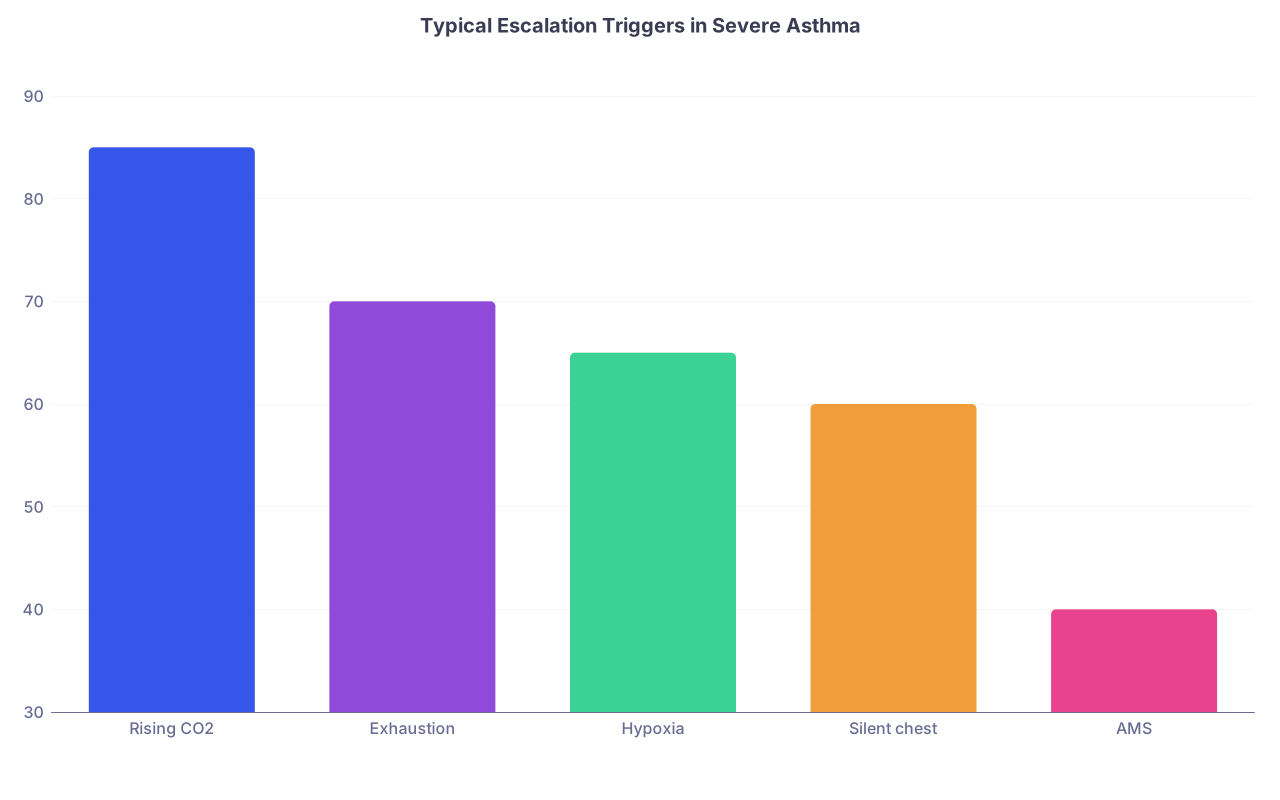
| Category | Value |
|---|---|
| Rising CO2 | 85 |
| Exhaustion | 70 |
| Hypoxia | 65 |
| Silent chest | 60 |
| AMS | 40 |
5. Escalation Pathway: When to Move Up the Ladder
You need a mental flowchart for escalation. Here is the streamlined version.
Step 1: Initial resuscitation (first 30–60 minutes)
You have:
- High-dose SABA (continuous or frequent)
- Ipratropium scheduled
- IV steroids on board
- IV magnesium given or infusing
- Oxygen titrated
- Close monitoring, NPO, IV fluids started
Reassess every 10–15 minutes. Not “once an hour.”
Ask yourself:
- RR better or worse?
- Work of breathing decreasing or unchanged?
- Mental status stable?
- Able to speak more words?
- Saturations stable on same or less O₂?
- If you have VBG/ABG: is CO₂ stable or climbing? pH falling?
If they are not clearly improving after 30–60 minutes of aggressive therapy, this is status asthmaticus that is not responding. You escalate.
Step 2: Consult and level of care
Actions you take now:
- Call the ICU or step-down attending / fellow. Spell it out:
“Severe asthma, continuous nebs + ipratropium + IV steroids + Mg, still RR 32, speaking 1–2 words, VBG CO₂ 60 from 48 an hour ago. I am worried they are tiring and will need NIV or intubation.” - Request transfer to higher level of care if not already in monitored unit.
- Notify your own attending: do not wait until 5 a.m. This is worth a 2 a.m. phone call.
Level of care rule of thumb:
- Floor is wrong for: continuous nebs, need for VBG/ABG trending, signs of fatigue, or any BiPAP
- Step-down/ICU for: any BiPAP, rising CO₂, mental status changes, hypotension, impending intubation
Step 3: Think about adjuncts and pitfalls
There is a temptation to throw random meds at them without a plan. You need to know what is real and what is fluff.
Reasonable adjuncts in refractory cases (usually ICU-level):
- IV ketamine as a bronchodilator and sedative in very severe cases, especially if moving toward intubation or on NIV struggling with anxiety. Often infusion at 0.5–1 mg/kg/hr after a bolus. This is not something you casually start on the floor at 3 a.m. without critical care support.
- Heliox (80:20 or 70:30 helium:oxygen mix) in some centers to reduce airway resistance. Niche, protocol-dependent, typically ICU or respiratory therapy–driven.
Things that are usually not first-line or are often used poorly:
- Theophylline / aminophylline: largely outdated, narrow therapeutic window, lots of side effects. If your ICU uses it in refractory cases, follow their protocol; do not freelance-dose it overnight as a PGY-1.
- Antibiotics “just in case”: asthma is usually not bacterial. Fever, infiltrate, productive sputum? Sure, but do not reflexively cover everyone.
- Sedatives on the floor: benzos for “anxiety” in a pre-failure asthmatic can be a disaster. Sedation without airway control in a tiring patient is how you intubate in extremis—or miss the window entirely.
6. Intubation in Status Asthmaticus: When and How
This is the part that scares residents. It should. Intubating status asthmaticus is high-risk. But postponing it until they arrest is worse.
6.1 When to intubate: the red lines
You do not wait for a perfect ABG. You intubate for clinical failure:
- Altered mental status: confusion, drowsiness, inability to follow commands
- Rising PaCO₂ with acidosis: pH trending down (e.g., 7.30 → 7.20) with CO₂ climbing despite maximum therapy
- Refractory hypoxia: SpO₂ persistently < 90% despite high FiO₂ and aggressive therapy
- Exhaustion: RR dropping from 34 to 20 with same or worse CO₂, paradoxical breathing, patient too tired to speak, head-bobbing
- Imminent arrest: bradycardia, severe hypotension, gasping respirations, agonal breathing
If you see two or more of these together, stop pretending more nebs will fix it. Call anesthesia / ICU immediately.
6.2 Pre-intubation planning (this is where residents either shine or drown)
Avoid the classic errors:
- Huge tidal volumes
- Fast respiratory rates
- No thought to dynamic hyperinflation
- Paralysis without adequate sedation
- No preparation for post-intubation hypotension
Ventilator strategy in severe asthma is essentially:
- Low tidal volumes (6–8 mL/kg ideal body weight, often closer to 6)
- Low respiratory rates (8–10 breaths/min)
- Prolonged expiratory time (I:E ratio like 1:3 or 1:4)
- Accept permissive hypercapnia as long as pH stays > 7.15–7.20 and hemodynamics tolerate
Intubation sedation choices often used (ICU/anesthesia teams lead, but you should understand):
- Ketamine is favored: bronchodilator + hemodynamically friendlier than propofol for many
- Paralysis may be necessary initially (e.g., rocuronium), but these patients will fight the vent. Plan ongoing sedation and analgesia.
Post-intubation, these patients often drop their BP because:
- Positive pressure ventilation reduces venous return
- They are often volume-depleted
- Dynamic hyperinflation can cause auto-PEEP and pseudo-tamponade physiology
You counter this with:
- Adequate IV fluids
- Careful titration of PEEP, RR, and tidal volume
- Close hemodynamic monitoring, potential pressors in ICU if needed
You, as the on-call resident, do not need to solo-manage the ventilator settings, but you do need to speak the language and recognize the risk.

| Step | Description |
|---|---|
| Step 1 | Severe asthma on floor or ED |
| Step 2 | Initial bundle - SABA, ipratropium, IV steroids, Mg, O2 |
| Step 3 | Continue therapy, monitor closely |
| Step 4 | Call ICU/step down, consider BiPAP |
| Step 5 | Trial BiPAP with close monitoring |
| Step 6 | Prepare for intubation - call anesthesia/ICU |
| Step 7 | Admit to ICU/step down, frequent reassess |
| Step 8 | Intubated in ICU, lung protective strategy |
| Step 9 | Improving in 30-60 min? |
| Step 10 | Signs of fatigue or rising CO2? |
| Step 11 | BiPAP success? |
7. Monitoring, Reassessment, and Documentation: The Unsexy Part That Saves You
Status asthmaticus is dynamic. It changes hour to hour. You cannot write one note and disappear.
7.1 Monitoring parameters you actually track
At minimum:
- Vital signs q15–30 min early, then q1h once more stable
- Continuous pulse oximetry
- Your own bedside reassessment: RR, accessory muscle use, speech, mental status
For more severe cases / ICU-level:
- Serial VBG / ABG: watching PaCO₂ trend and pH
- Peak flow, if feasible and safe, to trend obstruction objectively
Pay attention to trend, not single numbers. A PaCO₂ from 38 to 50 with patient still awake and anxious is different from 50 to 65 with a now-drowsy patient.
7.2 Documentation that proves you knew what you were doing
Yes, medicolegal. But also handoff safety and continuity.
Your notes need to show:
- Severity: “Speaking 1–2 word phrases, RR 32, use of sternocleidomastoid and accessory muscles, moderate intercostal retractions.”
- Therapies: exact doses and timing—continuous nebs started at X, Mg sulfate 2 g IV at Y time, etc.
- Reassessment: “After 30 minutes of continuous nebs and Mg, RR remained 30–32, still single words, VBG pH 7.30, CO₂ 58 from 52 earlier.”
- Escalation decisions: “Discussed with ICU fellow at 02:30, plan to transfer to ICU; anesthesia aware for possible intubation.”
If there is a bad outcome, this kind of documentation shows that you were not asleep at the wheel.
8. Practical Overnight Considerations No One Teaches You
This is the gritty part.
8.1 Dealing with nursing, respiratory, and bed limitations
You will hear:
- “We do not have a continuous neb pump available.”
- “No ICU bed right now; they are on diversion.”
- “Respiratory is covering three codes; they will be up when they can.”
You are not powerless.
- If you cannot do continuous nebs, stack intermittent nebs aggressively (q20min × 3, then q1h) while you push for a higher level of care.
- If ICU bed is delayed, insist on temporary placement in step-down, PACU, ED hallway—anywhere with higher monitoring and rapid respiratory support. Use the phrase “I am concerned about imminent respiratory failure.”
- Get respiratory therapy in the room early for assessment, setup, and their read on BiPAP vs intubation risk.
8.2 Anxiety vs impending failure
Asthmatics are often anxious. Hyperventilating. Panicked. It is hard not to label it “anxiety attack.”
Here is the difference:
- Pure anxiety: good air movement, sats normal, able to speak full sentences, no accessory muscles, normal CO₂ on VBG
- Status asthmaticus: poor airflow, retractions, limited speech, prolonged expiratory phase, rising CO₂
If you are giving benzos without having proven good ventilation, you are doing it backward. First treat the airway. If after improvement they remain anxious and tachypneic, small doses of anxiolytics might be reasonable—with caution.
8.3 Chest pain and “normal” CXR
You will get CXRs that look clean. That does not mean benign. Asthma does not need infiltrates.
Watch for:
- Pneumomediastinum or small pneumothoraces from barotrauma, especially in severe attacks or after intubation
- Hyperinflated lungs with flattened diaphragms—just reinforces the physiology problem
Do not chase a non-existent pneumonia in a clear asthma picture just to feel like you did something.
| Trigger | Your Next Action |
|---|---|
| No improvement at 30–60 min | Call ICU/step-down, consider NIV |
| Rising CO₂ on VBG/ABG | Discuss with ICU, prepare for intubation |
| New confusion/drowsiness | Call attending + ICU, intubation likely |
| Persistent hypoxia on O₂ | ICU transfer, consider NIV/intubation |
| Silent chest + exhaustion | Treat as pre-arrest, intubate early |
9. Handoffs and Following Through
You might start this at 1 a.m. The day team inherits at 7 a.m. Do not dump a “sick but stable I guess” without context.
Your sign-out should include:
- Where the patient started: “Came in speaking single words, RR 34, needed NRB, VBG 7.28/62.”
- What you did: continuous nebs, Mg, BiPAP vs ward-level care, calls made, ICU transfer.
- Current status: “Now RR 22, talking in short sentences, VBG 7.34/55; still on q2h nebs and 2 L NC, in step-down.”
- Unresolved questions: “If VBG drifts back up or work of breathing worsens, they need ICU and possible intubation.”
If the patient is still in that gray zone where they could fatigue, you say that explicitly. Not “doing okay.” You say: “High risk of decompensation; low threshold for ICU and intubation.”
FAQ: Managing Status Asthmaticus Overnight
1. How fast should I expect steroids and magnesium to work in status asthmaticus?
Steroids are not immediate; clinically meaningful benefit is usually hours, not minutes. You give them early to change the trajectory, not to bail you out in the next 10 minutes. Magnesium can have bronchodilatory effects within 15–30 minutes, but it is an adjunct, not a magic fix. If someone is crashing, you do not “wait for the Mg to kick in” while ignoring BiPAP or intubation.
2. Should I get an ABG or is a VBG enough overnight?
For most cases, a VBG is fine to track trends in CO₂ and pH. Venous CO₂ runs slightly higher than arterial but tracks changes well. In very unstable patients where you need precise PaO₂ and PaCO₂, or before/after intubation, an ABG is better. What matters more than ABG vs VBG is that you repeat it when the clinical picture changes, not 6 hours later.
3. When exactly should I start BiPAP in severe asthma?
Start BiPAP when you have severe work of breathing, high RR, and impending fatigue but the patient is still awake, cooperative, and able to protect their airway. They should be in a monitored setting with staff comfortable managing NIV. If they are confused, obtunded, or too agitated to tolerate the mask, you skip to intubation discussions instead of forcing BiPAP.
4. Are continuous nebulizers really better than frequent intermittent nebs?
In true status asthmaticus, yes, continuous nebs provide more steady bronchodilation and are commonly used in EDs and ICUs. On the floor where continuous setups may not exist, frequent intermittent nebs (q20min × 3 then q1h) are an acceptable bridge while you escalate care. The key is not to leave a severe patient on q4h nebs and hope for the best.
5. How do I distinguish a panic attack from severe asthma in a known asthmatic at night?
Do a focused exam and, if needed, a VBG. Panic: normal air movement, clear lungs, no wheeze or mild, no retractions, normal or low CO₂, often respiratory alkalosis. Status: diminished airflow, prolonged expiration, use of accessory muscles, trouble speaking, often normal or elevated CO₂. If in doubt, treat as asthma first; bronchodilators are safer than benzos in a patient who might be ventilatory-compromised.
6. What are the biggest mistakes residents make with status asthmaticus overnight?
Three stand out. First, underestimating severity and leaving a crashing patient on the floor with standard nebs and delayed consulting. Second, over-ventilating intubated asthmatics with high RR and tidal volumes, causing dynamic hyperinflation and hypotension. Third, giving sedatives for “anxiety” without securing the airway in a tiring patient. Your job is to recognize red flags early, escalate decisively, and never rely on a single intervention to fix a failing physiology.
Key points to take with you: recognize status asthmaticus early by work of breathing, mental status, and CO₂, not just wheeze. Escalate in layers—aggressive bronchodilation, steroids, magnesium, oxygen, then NIV or intubation when clinical failure appears. And overnight, do not be shy about calling ICU or anesthesia; the only real mistake is waiting until the patient arrests to admit how sick they were.