
You are post‑call minus six hours. It is 2:37 AM. You just sat down after dealing with a confused GI bleeder when the pager goes off again:
“4W – Potassium 6.7, repeat pending, patient stable, please advise.”
No EKG yet. Nurse wants to know, “Do I give Kayexalate or something?” Lab is already queuing up the “critical value call” script. You are the only resident in-house covering 30–40 patients. This is where people either flail or execute.
Let me walk you through how to execute. Precisely. Every time.
1. First Filter: Is This Real Hyperkalemia or Lab Trash?
Half of “critical” overnight potassiums are noise. Your first job is to separate artifact from danger quickly without dismissing something that will kill a patient in their sleep.
Step 1: Look at the number in context
Before you call anyone back, open the chart. Check:
- Today’s K and trend for the past 24–48 hours
- Creatinine and BUN (AKI/CKD context)
- Bicarbonate / CO₂ (metabolic acidosis makes true hyperK more likely)
- Recent meds: ACEi/ARB, spironolactone, TMP‑SMX, heparin, tacrolimus, NSAIDs, beta blockers, K supplements
- Recent K result time and value
If K was 4.2 this afternoon and now 7.0 with a normal creatinine and the patient looks clinically well in the notes, think artifact until proven otherwise. If they have ESRD with K 5.8–6.0 all week and now 6.8, that is more likely real.
Step 2: Scan for pseudohyperkalemia clues
Common causes:
- Hemolyzed sample (often flagged in the lab comment; color-coded sometimes)
- Difficult blood draw, small fragile veins
- Tourniquet on too long, patient fist‑pumping
- Very high platelets (>1,000K) or WBC (>100K) causing “in vitro” K leak
If the lab calls you and says, “Sample hemolyzed,” you already know your move: repeat from a clean peripheral draw, stat.
Step 3: Decide on immediate action vs confirmatory test
Ask yourself two questions:
- Is the K ≥ 6.5 OR any EKG change reported?
- Is the patient high-risk (ESRD, DKA, massive tissue breakdown, recent missed dialysis)?
If yes to either: you treat now and confirm in parallel. You do not wait. If K is 5.8–6.2, no risk factors, no EKG changes, vitals stable, you can generally afford to repeat before going nuclear.
Here is the mental triage I use:
| Scenario | First Move |
|---|---|
| K 5.5–5.9, asymptomatic, normal kidney function | Repeat K, check meds, no emergent therapy |
| K 6.0–6.4, asymptomatic, stable CKD | Repeat stat, get EKG, likely start shift + binder |
| K ≥ 6.5 OR any EKG changes at K ≥ 6.0 | Treat immediately + call for help + repeat K |
| Any K elevation in ESRD missed dialysis with weakness or palpitations | Treat and call nephrology early |
2. The “Overnight Hyperkalemia Script”: What You Do in the First 5 Minutes
You are on the phone with the nurse. Do not start by talking about Kayexalate. Start with:
- “I see a K of 6.7. Is the patient with you now?”
- Get current vitals and tele status.
- Ask: “Any chest pain, palpitations, shortness of breath, weakness, numbness, or feeling like passing out?”
- Order STAT EKG and STAT repeat BMP right away.
Now you commit to a protocol.
The 3 primary goals
- Stabilize the heart (membrane stabilization)
- Move K into cells (shift)
- Clear K from the body (removal)
You will not always need all three, but you must consider them all.
3. Step 1 – Stabilize the Myocardium (When Indicated)
This is the part people hesitate on. Do not.
Indications for IV calcium:
- ANY EKG change consistent with hyperkalemia:
- Peaked, narrow T waves
- Widened QRS
- PR prolongation
- Loss of P waves
- Sine‑wave pattern
- Suspected severe hyperkalemia (K ≥ 6.5) in a high-risk patient, especially if you do not yet have an EKG but the story screams danger (ESRD missed dialysis + weakness, for example)
Choice of agent:
- Calcium gluconate 10% 1 g IV over 5–10 minutes (often given via peripheral line)
- If they have a central line and you are worried about crashing arrhythmia: calcium chloride 1 g IV over 5–10 minutes (more elemental calcium, more caustic)
On the floor overnight, most of the time you will choose calcium gluconate. It is safer peripherally.
Practical details:
- Onset: 1–3 minutes
- Duration: about 30–60 minutes
- If EKG remains abnormal after 5–10 minutes, you can repeat dose (often once or twice)
You are not fixing potassium when you give calcium. You are buying time. Think of it as putting a helmet on the myocardium while you do the real work.
4. Step 2 – Shift Potassium into Cells: What Actually Fixes the Number Overnight
Here is where you do most of the floor‑level work. You have three major tools: insulin + dextrose, beta agonist, and sometimes bicarbonate.
4.1 Insulin + Dextrose – Your Workhorse
This is the single most effective fast intervention you have on the floor.
Standard regimen (adult, non‑DKA):
- Regular insulin 10 units IV bolus
- Dextrose 25 g IV (D50 50 mL) if blood glucose < 250 mg/dL
If glucose is high (e.g., 300s in a DKA patient), you can give insulin alone and hold the dextrose or give less. Do not blindly give a full D50 to someone whose sugar is already 450.
Key practical points:
- Onset: 15–30 minutes
- Peak effect: about 30–60 minutes
- Duration: 2–4 hours
- Expected K drop: roughly 0.6–1.0 mEq/L, sometimes more
You must pair this with:
- Bedside glucose check before giving
- Q30–60 minute glucose checks for at least 2–3 hours (or more in CKD/ESRD)
- Lower insulin dose (5 units) in very small, frail, or older patients with CKD and baseline low insulin requirements
Hypoglycemia is a real problem. I have seen patients crash to 30–40 mg/dL because someone ordered “10 units IV + D50” on a 92‑year‑old with K 6.1 and glucose 80, then never rechecked.
4.2 Beta‑agonists – Adjunct, Not Standalone
Albuterol can drive K into cells via beta‑2 stimulation. The dose is much higher than for asthma.
Typical regimen:
- Nebulized albuterol 10–20 mg over 10–20 minutes (this is about 4–8 standard neb ampules)
Clinical effect:
- Onset: 30 minutes
- Duration: 2–4 hours
- K drop: 0.3–0.6 mEq/L alone, additive with insulin
Problems:
- Tachycardia, jitteriness
- Less effective in patients on beta blockers
- Not a substitute for insulin + dextrose; use as an add‑on when K is very high or EKG changes persist
4.3 IV Bicarbonate – Niche Use Only
IV sodium bicarbonate helps only in specific scenarios:
- True metabolic acidosis (HCO₃ ≤ 18–20)
- Especially in DKA or lactic acidosis with concurrent hyperkalemia
It has little effect on K in patients with normal pH and bicarb.
Common regimen:
- 50 mEq sodium bicarbonate IV over 10–15 min
- Or bicarbonate infusion if they are acidemic and volume tolerant (e.g., D5W with 3 amps bicarb over several hours)
Do not expect dramatic K change from bicarb alone. It is an add‑on move when the patient is acidotic. It is not your front‑line therapy for hyperK in someone with normal CO₂.
5. Step 3 – Remove Potassium from the Body: Beyond the Quick Fix
The shifts wear off. If you do not actually clear K, the patient rebounds. A lot of overnight management fails because residents stop after insulin + calcium and walk away.
You have three real options on the floor: loop diuretics, GI binders, and dialysis.
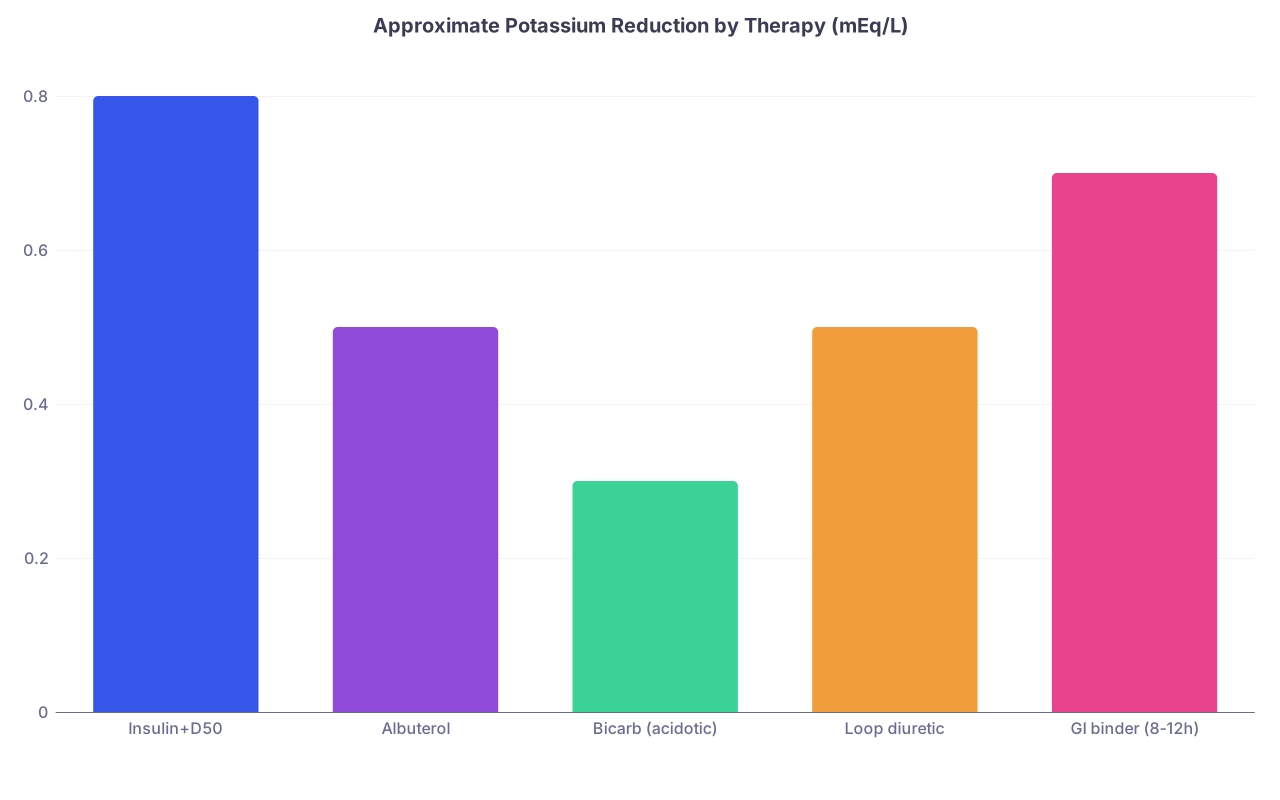
| Category | Value |
|---|---|
| Insulin+D50 | 0.8 |
| Albuterol | 0.5 |
| Bicarb (acidotic) | 0.3 |
| Loop diuretic | 0.5 |
| GI binder (8-12h) | 0.7 |
Numbers are rough ranges. The point is the relative magnitude.
5.1 Loop diuretics – If they can make urine
If the patient is volume overloaded and still making urine, this is ideal.
Typical overnight order:
- Furosemide 20–40 mg IV, titrate higher if chronic user or significant CKD
- Target: brisk diuresis, monitor output and BP
Who benefits:
- CHF with volume overload
- CKD with some residual renal function
- HyperK after blood transfusion in a reasonably euvolemic person
Who does not:
- Anuric ESRD patients
- Profound hypotension
Loops are simple and actually clear K from the body via the kidneys. Use them.
5.2 Potassium binders – Slow, but often needed
Here is where the confusion lives. There are three main agents you see:
- Sodium polystyrene sulfonate (SPS, “Kayexalate”)
- Patiromer (Veltassa)
- Sodium zirconium cyclosilicate (Lokelma)
For overnight emergencies:
- These do not fix the immediate problem. Their onset is hours.
- They are for prevention of rebound and longer‑term control.
SPS (Kayexalate):
- Old, cheap, controversial
- Onset: 4–6 hours, effect uncertain; associated (rarely but seriously) with colonic necrosis, especially with sorbitol
- I treat it as a “maybe” medication, not something I rush to order in a fragile post‑op gut
Newer agents (provided your hospital has them and protocol allows):
- Patiromer and Lokelma have better safety profiles and more predictable K lowering
- Still not acute rescue therapies; they are step 2–3 once the acute event is controlled
Bottom line: overnight for a K of 6.8 with EKG changes, your priority is insulin, calcium, albuterol, diuretics, and maybe dialysis. Binders are for the trailing edge, not the front edge.
5.3 Dialysis – The real definitive therapy
Indications for urgent dialysis in hyperkalemia:
- K ≥ 6.5 persistent despite medical therapy
- Any severe EKG changes + CKD 4–5 / ESRD
- Anuria or severe oliguria and hyperkalemia
- HyperK with severe acidosis, volume overload, or uremic symptoms in someone already on dialysis or clearly near that threshold
On the floor at 3 AM, this means:
- Call nephrology early when you see K 6.5+ in a patient with low GFR or ESRD. Do not wait to see if “maybe it will go down.”
- Document clearly: K level, EKG findings, therapies given, and that nephrology was notified.
Does every K 6.5 in a dialysis patient mean emergent HD? No. Over‑dialyzing every minor excursion is bad medicine. But missing one true dangerous case is worse.
6. Putting It Together: A Practical Night‑Shift Algorithm
Here is the real‑life sequence I expect a solid resident to follow.

| Step | Description |
|---|---|
| Step 1 | Pager - K elevated |
| Step 2 | Open chart - review trend, creat, meds |
| Step 3 | Call nurse - vitals, symptoms |
| Step 4 | Order stat EKG and repeat BMP |
| Step 5 | Give IV calcium |
| Step 6 | Insulin + D50 +/- albuterol |
| Step 7 | Repeat K, monitor, adjust meds |
| Step 8 | Consider loop diuretic |
| Step 9 | Consider GI binder |
| Step 10 | Call nephrology for dialysis |
| Step 11 | Monitor K and glucose q2-4h |
| Step 12 | K >= 6.5 or EKG changes? |
| Step 13 | K 6.0-6.4 with risk factors? |
| Step 14 | ESRD or AKI with poor urine? |
That is the core. The nuance is in choosing when you fall into the “Yes” branches.
7. Floor‑Level Nuances They Do Not Teach Well
Let me go through the parts that trip people up.
7.1 When you do NOT need to panic
- K 5.5–5.9 in stable CKD 3–4, asymptomatic, normal EKG
- Slight bump from 4.8 to 5.5 after starting ACE inhibitor in a stable patient
- Single hemolyzed sample with no corroborating story
What you do here:
- Repeat K in the morning or in 4–6 hours
- Adjust diet, meds (ACEi/ARB, spironolactone dose, TMP‑SMX)
- Educate the day team via sign‑out
No midnight insulin, no frantic calls, no needless calcium.
7.2 When you absolutely should not be reassured
- ESRD patient who missed dialysis with K 6.0+ and any weakness, palpitations, or new nausea
- K 6.5+ with QT or QRS changes, regardless of whether they “feel fine”
- Rapid jump: K 4.3 at 15:00, now 6.8 at 23:00 with AKI from sepsis or contrast
This is where I see under‑reaction. The EKG can look “almost normal” until it does not, then they arrest.
7.3 Telemetry and location: can they stay on the floor?
Rules of thumb:
Floor with tele is fine if:
- Post‑treatment K is back < 6.0
- No significant EKG changes or all resolved after calcium + shifts
- Stable vitals, good mental status
- Ability to get repeat labs and q1–2 hr glucose checks
Consider upgrading (step‑down/ICU) if:
- Persistent K ≥ 6.0 with underlying risk factors and ongoing shifts needed
- Recurrent significant EKG changes
- Hemodynamic fragility, sepsis, or need for frequent blood monitoring
- You are planning urgent dialysis and they are not already in a monitored chair/unit
Do not be shy about moving them if you are planning to throw repeated insulin boluses at a frail patient. That is not “routine floor care.”
7.4 Documentation and sign‑out
This is where you protect yourself and help your team:
In your overnight note or cross‑cover note, include:
- Time and values of K (initial and repeats)
- EKG findings explicitly: “No EKG changes consistent with hyperkalemia” or “Peaked T waves V2–V4, QRS 110 ms”
- Therapies: calcium (dose, timing), insulin + D50, albuterol, diuretics, binders
- Consults placed (nephrology, ICU)
- Clear follow‑up plan: “Recheck BMP at 06:00, if K > 5.8 consider repeat insulin 5 units IV; day team to reassess need for chronic binder / dialysis”
And in your morning sign‑out, say one sentence that matters: “Bed 412A had real hyperK last night—K 6.9 down to 5.5 after insulin and calcium, EKG OK, repeat BMP at 10:00 not yet back. Needs nephrology input today.”
8. Example Cases: How This Works at 3 AM
Case 1: Pseudohyperkalemia on a frail floor patient
85‑year‑old woman, K reported 6.3. Earlier K was 4.4. Creatinine unchanged at 0.9. Nurse says blood draw was “hard, tiny vein, took a long time.” No CKD history, no ACEi, no ARB, no spironolactone.
You:
- Call nurse, vitals fine, patient asymptomatic.
- EKG ordered: completely normal.
- Lab report: “hemolysis moderate.”
You order:
- Repeat stat BMP with a careful peripheral draw
- No insulin, no calcium, no binder
New K = 4.9. You document “likely pseudohyperkalemia from hemolysis,” adjust nothing, sign out calmly.
Case 2: Real danger in an ESRD patient
60‑year‑old ESRD on TTS schedule. It is Wednesday night, missed Tuesday’s session. Overnight K comes back 6.8. Nurse says patient feels “weak, some nausea, HR 105, BP 150/80,” on tele with “some peaked Ts” per monitor tech.
You:
- Call nurse, confirm symptoms.
- Order stat EKG and repeat BMP.
- Without waiting for repeat, order:
- Calcium gluconate 1 g IV now
- Regular insulin 10 units IV + D50 25 g IV
- Albuterol 10 mg neb
- Place stat nephrology page: “ESRD, missed dialysis, K 6.8 w/ EKG changes, after calcium and shifts—urgent HD tonight vs first case.”
Repeat K 1 hour later: 5.7, EKG improved. Nephrologist arranges early morning dialysis. Patient goes to HD unit at 06:30. No code, no drama.
9. Quick Reference: Orders You Should Have Memorized
You do not want to be looking this up in a panic every time. These are the default adult orders that should live in your head, then tailored per patient.
| Intervention | Typical Order |
|---|---|
| Cardiac stabilization | Calcium gluconate 10% 1 g IV over 5–10 min, repeat once if needed |
| Shift - Insulin | Regular insulin 10 units IV bolus (consider 5 units in frail/CKD) |
| Shift - Dextrose | D50 50 mL IV (25 g) with insulin if glucose < 250 mg/dL |
| Shift - Beta agonist | Albuterol 10–20 mg nebulized over 10–20 min |
| Renal excretion | Furosemide 20–40 mg IV, adjust by prior dose/renal function |
| Lab follow‑up | Repeat BMP and Mg in 1–2 hours; fingersticks q30–60 min for 2–3 hours |
You still individualize. But this is the spine.
FAQ (exactly 6 questions)
1. At what potassium level should I start treatment without waiting for a repeat value?
Treat immediately (at least start shifts and calcium) if K is reported ≥ 6.5 in a patient with CKD/ESRD or AKI, or if there are any EKG changes consistent with hyperkalemia at K ≥ 6.0. In those scenarios, order a repeat BMP, but do not delay therapy waiting for it. In lower‑risk patients with K 6.0–6.4 and a normal EKG, you can usually afford to confirm first while prepping meds.
2. Do I always need to give IV calcium for K ≥ 6.5?
Not always, but you should have a low threshold. Absolute indication is EKG change. For a K ≥ 6.5 in a high‑risk patient where EKG is delayed or ambiguous, I will often give calcium once while I get better data. For a stable patient with K 6.5, normal EKG, good renal function, and no symptoms, you can reasonably prioritize insulin + diuretics while watching the monitor. That said, I would rather see calcium used too often than withheld when it is clearly indicated.
3. How often should I recheck potassium after giving insulin and other therapies?
In true hyperkalemia that you actively treat, repeat BMP within 1–2 hours after initial therapy. That gives enough time for shifts to show. If initial K was very high (≥ 6.5) or you had significant EKG changes, plan serial BMPs every 2–4 hours until you are back in a safe range and not actively intervening. Glucose should be checked more frequently: every 30–60 minutes for at least 2–3 hours after IV insulin.
4. Is Kayexalate still acceptable for overnight hyperkalemia management?
Sodium polystyrene sulfonate (Kayexalate) still appears on many order sets, but it is a poor emergency drug. It has delayed onset, unpredictable efficacy, and a small but very real risk of colonic necrosis, especially with sorbitol or in post‑op gut. I consider it only if newer binders are not available and the patient is stable after acute shifts. I do not use it as primary therapy for dangerous hyperkalemia. For true emergencies, focus on insulin, calcium, beta agonists, diuretics, and dialysis.
5. What if the patient is already hypoglycemic or very low‑normal – can I still use insulin?
Yes, but adjust. Give dextrose first (e.g., D50 50 mL or even 100 mL in some cases), then a reduced insulin dose (5 units IV) with very close glucose monitoring. In someone whose glucose is 70–90 and frail with CKD, you might even do 25 mL D50, recheck sugar, and then a smaller insulin bolus. The goal is to move K without crashing their glucose into the 30s; err on the side of more frequent fingersticks.
6. When should I escalate to ICU or step‑down for a hyperkalemia patient?
Escalate if you need repeated insulin boluses or infusions to keep K in range, if they have persistent or recurrent EKG changes, if they are hemodynamically unstable, or if they require urgent dialysis and are not on a monitored unit. Also escalate when nursing ratios and monitoring capability on your current floor are clearly inadequate for the level of intervention you are planning (q15–30 min vitals, frequent labs, multiple IV meds). If you are uncomfortable managing them on the floor, you are probably right.
Key points to walk away with:
- Treat real hyperkalemia fast and systematically: stabilize the heart, shift K, then remove K.
- Differentiate pseudohyperkalemia from true danger by trend, context, hemolysis, and EKG, not just the lab printout.
- Do not stop after insulin and a single lab recheck—plan for rebound, document clearly, and hand off a precise follow‑up plan to the day team.