
You will mismanage a diabetic crisis at 3 AM if you rely on medical school buzzwords instead of a clear mental algorithm.
Let me break this down specifically, the way you actually think when you are cross-covering 60 patients, two nurses are calling you, and the lab just paged “critical glucose >900.”
1. The Real-Life Scenario: What It Looks Like at 3 AM
Here is what you are actually dealing with:
- Nurse: “Doctor, Mr. X is very confused, breathing fast, fingerstick just says ‘HIGH’.”
- Next call: “Lab called—CO2 is 8, anion gap 26, potassium 5.8.”
- Meanwhile, you vaguely remember: DKA is acidotic, HHS is not. DKA = ketones. HHS = hyperosmolar. But the patient looks terrible and you do not have time to debate pathophysiology.
You need a fast, ruthless framework:
- Recognize it is a hyperglycemic emergency.
- Decide: DKA, HHS, or mixed picture.
- Start fluids, insulin, electrolytes in the right order.
- Avoid the two things that will actually kill them on your watch: cerebral edema and arrhythmias from K shifts.
We are going to build a mental model that functions under pressure. Not something you recite on rounds to look smart. Something you can run half-asleep.
2. Core Diagnostic Differences: DKA vs HHS in One View
Here is the comparison you need in your head.
| Feature | DKA | HHS |
|---|---|---|
| Typical patient | Type 1 (but not always) | Type 2 (usually older) |
| Onset | Hours to 1–2 days | Days to weeks |
| Glucose | Usually 250–600 mg/dL | Often >600 mg/dL |
| pH (arterial/venous) | <7.30 | >7.30 (mild or no acidosis) |
| Bicarbonate | <18 mEq/L | >18 mEq/L |
| Anion gap | Elevated | Often normal or mildly ↑ |
| Ketones | Positive (serum/urine) | Minimal/absent (small + sometimes) |
| Effective osmolality | Variable, may be ↑ | Usually >320 mOsm/kg |
| Neurologic status | Variable; coma less common | Prominent AMS, stupor, coma |
| Mortality | Lower (5% or less) | Higher (can be 10–20%) |
The punchline: real patients do not read the textbook. Mixed DKA/HHS is common. You must be comfortable treating both processes at once.
3. Pathophysiology that Actually Matters at the Bedside
You do not need to recite every step of lipolysis and gluconeogenesis. But you must understand what is killing the patient.
DKA: Acid plus volume depletion
- Absolute or near-absolute insulin deficiency.
- Unchecked lipolysis → ketone production (β-hydroxybutyrate, acetoacetate) → metabolic acidosis.
- Acidosis + hyperglycemia + osmotic diuresis → dehydration, K shifts, shock.
Why you care:
- The acidosis is what drives K out of cells → fake “normal” or high serum K but total body K is low.
- Rapid correction of acidosis with insulin drives K back into cells and can drop K catastrophically unless you replace it.
- Mental status in DKA can be affected by acidosis and hyperosmolarity, but coma is less classic than in HHS.
HHS: Osmotic disaster
- Relative insulin deficiency. Enough insulin to prevent massive ketogenesis, but not enough to suppress hepatic glucose output or allow adequate peripheral utilization.
- Severe hyperglycemia → profound osmotic diuresis → massive free water loss.
- Effective osmolality can be extreme (often >320–350, sometimes >380 mOsm/kg).
Why you care:
- The osmotic shift dehydrates neurons. This is what gives you stupor, seizures, coma.
- Rapid correction of osmolality, especially with hypotonic fluids or overly aggressive insulin/glucose drop, can cause cerebral edema or osmotic demyelination–type syndromes.
- These patients are very old and sick. Cardiovascularly fragile. Many have underlying infection, MI, stroke as the precipitant.
Think of it this way:
- DKA: acid and K will kill them if you are sloppy.
- HHS: sodium, osmolality, and fluid shifts will kill them if you are sloppy.
4. Step 1 Under Pressure: Recognize the Pattern in 60 Seconds
Here is the “on-the-phone” algorithm.
You get a call: “Diabetic patient, confused, glucose unreadable.”
Mandatory immediate questions:
- Are they hypotensive or in respiratory distress?
- If yes → “Call rapid response / code stroke / get them to higher level now.” You can sort out DKA vs HHS on the move.
- What is the mental status baseline vs now?
- Vital signs: HR, BP, RR, temp, O2 sat.
- Any Kussmaul respirations (deep, rapid)?
- What labs are back: BMP, VBG, serum ketones, serum osmolality if available, lactate?
On exam in the room:
- Look: Kussmaul breathing? Dehydrated tongue? Hypotension? Focal neuro deficits (think stroke precipitating HHS)?
- Smell: fruity breath (not perfect, but helpful).
- Fingerstick: if “HIGH” or >400, assume hyperglycemic crisis until proven otherwise.
You need three lab concepts burned in your brain:
Acid-base status
- VBG pH. Do not wait for ABG unless there is a respiratory concern.
- Bicarb from BMP.
- Anion gap = Na – (Cl + HCO₃).
Ketones
- Serum β-hydroxybutyrate if your lab offers it quickly.
- Urine ketones are fine as a surrogate if that is all you have, but they lag and miss β-OHB dominance.
Osmolality
- Effective serum osmolality ≈ 2[Na] + glucose/18
(Ignore BUN for “effective” osmolality because urea is freely permeable.)
- Effective serum osmolality ≈ 2[Na] + glucose/18
Now categorize, loosely:
Looks like DKA:
- pH <7.30, bicarb <18, anion gap ↑, ketones present.
- Glucose usually >250 but not necessarily >600.
Looks like HHS:
- Glucose usually >600.
- Effective osmolality usually >320.
- Minimal acidosis (pH >7.30, bicarb >18).
- More dramatic neurologic impairment.
Mixed:
- Glucose sky-high (often >600).
- Osmolality high.
- Clear anion gap metabolic acidosis and ketones.
If you are in doubt: treat the acidosis and the hyperosmolarity in a controlled, gradual way. Do not get hung up on purist classification in the first 30 minutes.
5. Initial Management Priorities: Same Skeleton, Different Emphasis
Here is the common framework for both DKA and HHS:
- ABCs and hemodynamics.
- Fluids.
- Potassium and other electrolytes.
- Insulin.
- Identify and treat the trigger (infection, MI, nonadherence, steroids, SGLT2 inhibitors, pancreatitis, etc.).
5.1 Fluids: You Start Here. Always.
These patients are dry. For HHS, they are desert.
Rough typical deficits:
- DKA: 3–6 L.
- HHS: 8–12 L.
Your default starting order:
If not hypotensive and no severe cardiac compromise:
- 0.9% NaCl (normal saline) at 15–20 mL/kg in the first hour
(roughly 1–1.5 L in a typical adult).
- 0.9% NaCl (normal saline) at 15–20 mL/kg in the first hour
If hypotensive / in shock:
- Rapid boluses of 0.9% NaCl (1 L at a time, reassess, consider ICU, pressors).
After the first 1–2 hours, you decide between:
- Continue NS vs switch to 0.45% NaCl (half-normal) based on corrected sodium and hemodynamics.
Corrected sodium = measured Na + 1.6 × ((glucose – 100) / 100)
- If corrected Na is low or normal → keep NS.
- If corrected Na is high → move to 0.45% NaCl.
Key nuance for HHS:
- You must not drop the effective osmolality too fast. Aim for glucose fall of about 50–75 mg/dL per hour. Overaggressive fluids + insulin can crash it faster than you realize.
6. Potassium: The Part People Screw Up
More patients will code from K errors than from “insulin too slow.”
Before any insulin drip goes up, you know the potassium.
Guideline-level, but translated for reality:
K <3.3 mEq/L
- This is dangerous.
- Hold insulin.
- Start aggressive K replacement (e.g., 20–30 mEq KCl in each liter of fluid, often via central line if you are going >10 mEq/h peripherally).
- Recheck K every 1–2 hours until >3.3, then start insulin.
K 3.3–5.2 mEq/L
- Start insulin.
- Add 20–30 mEq KCl to each liter of IV fluid to keep serum K in the 4–5 range.
K >5.2 mEq/L
- Start insulin but do not give K yet.
- Recheck K every 2 hours. It will fall with insulin and fluid resuscitation.
Do not trust a single hemolyzed K in a crashing DKA. If the number does not match the clinical picture, redraw it fast.
7. Insulin Therapy: Not a Race, but You Need Discipline
For both DKA and HHS, regular insulin IV is the workhorse.
Typical regimen:
- Bolus: 0.1 units/kg IV (some protocols skip bolus and just start infusion).
- Infusion: 0.1 units/kg/hour IV.
Your goal:
- Decrease plasma glucose by 50–75 mg/dL per hour.
Faster than that is not “better.” It is dangerous.
Adjusting insulin
- If glucose does not drop by at least ~50 mg/dL in the first hour:
- Double the infusion rate (to 0.14 units/kg/hr, or per your hospital protocol).
Once:
- DKA: anion gap is closing and glucose approaches 200.
- HHS: glucose approaches 250–300 and osmolality is improving.
Then:
- Decrease insulin infusion to 0.02–0.05 units/kg/hr.
- Start dextrose-containing fluid (D5 0.45% NaCl typically) to prevent hypoglycemia while continuing to clear ketones / close gap.
Key point residents miss:
- In DKA, you are treating the ketosis/acidosis, not the glucose alone.
Stopping insulin because “glucose is 180” when the gap is still wide is how you get rebound DKA.
8. DKA vs HHS: Management Nuances You Cannot Ignore
The broad strokes are similar, but a few distinctions matter.
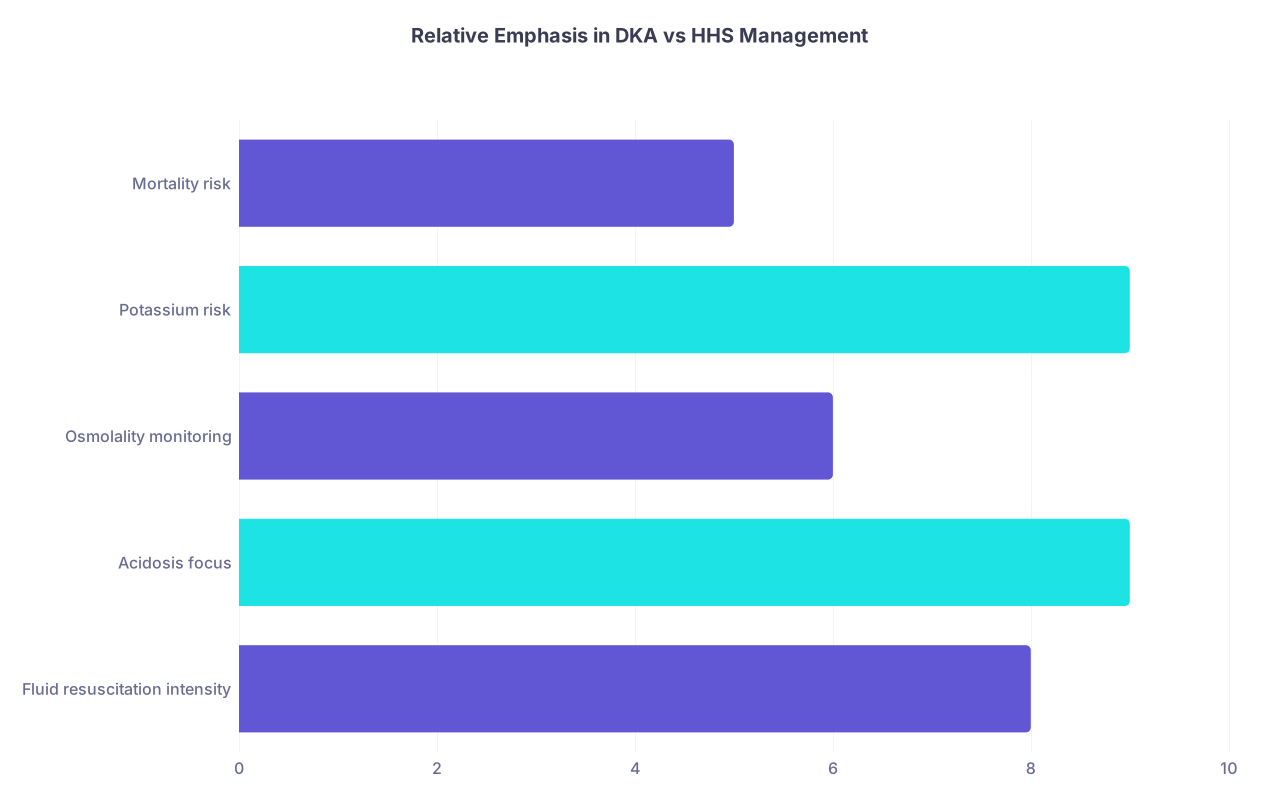
| Category | Value |
|---|---|
| Fluid resuscitation intensity | 8 |
| Acidosis focus | 9 |
| Osmolality monitoring | 6 |
| Potassium risk | 9 |
| Mortality risk | 5 |
Interpretation: both are intense, but DKA is acidosis/K heavy, HHS is fluid/osmolality heavy, and HHS carries higher mortality.
8.1 DKA specifics
- Aim: Close anion gap, correct acidosis, then transition to SQ insulin.
- You often see young, type 1 patients → fewer comorbidities but higher risk for cerebral edema (explosive corrections, especially in kids and young adults).
- Bicarb:
- Almost always avoid.
- Consider only if pH <6.9 and patient is hemodynamically unstable, arrhythmias, or refractory hyperkalemia. Even then, do it grudgingly.
Transition to SQ insulin:
- Criteria (roughly):
- Able to eat or at least safe to switch.
- Anion gap closed (or nearly).
- Bicarb improving (>18).
- Patient clinically better.
- Overlap: give long-acting SQ insulin 2 hours before stopping IV insulin. Otherwise you will recreate DKA on the floor.
8.2 HHS specifics
- Aim: Correct hyperosmolar state gradually. Glucose and osmolality must come down in a controlled way.
- Fluids even more central. You can start with NS but will usually need LARGE volumes over 24 hours.
- Insulin requirement: typically lower total doses compared with DKA. They often correct nicely with fluid + modest insulin.
Neurologic status:
- Monitor mental status closely.
- If the patient goes from comatose to suddenly “normal” in 2 hours, you probably dropped osmolality too fast. That is not good.
If osmolality is extremely high (>350–380), I mentally tap the brakes:
- More cautious insulin rate.
- Check Na and osmolality every 2–4 hours.
- Avoid rapid shifts in sodium (>8–10 mEq/L in 24 hours) while you are also moving glucose.
9. Mixed DKA–HHS: What to Do When It is Messy
You will see patients with:
- Glucose 900
- Osmolality 340
- pH 7.12
- Bicarb 10
- Anion gap 28
- Positive ketones
This is not DKA vs HHS. It is both.
Your approach:
- Treat as DKA in terms of acidosis and insulin goals.
- Treat as HHS in terms of osmolality and fluid caution.
So:
- Start fluids as above, but be more conservative with insulin uptitration to avoid overshooting the glucose drop too quickly.
- Monitor Na correction and osmolality more aggressively than you might for a typical, younger DKA patient.
- ICU-level care is often appropriate given the dual insults.
10. Lab Targets and Monitoring: What You Actually Re-Order
Here is the working monitoring plan that makes sense on call.
| Test | Frequency (typical) | Comment |
|---|---|---|
| Fingerstick glucose | Every hour initially | Can space to q2h when stable |
| BMP (Na, K, CO₂, BUN) | Every 2–4 hours | More frequent if K unstable |
| VBG (pH, HCO₃) | Every 2–4 hours | Stop once gap closed / stable |
| Serum ketones (if used) | Every 4–6 hours | Not mandatory everywhere |
| Serum osmolality | Every 4 hours in HHS/severe | Especially when osmolality >320 |
You do not need every number memorized. You need the sequence: stabilize, fluids, K, insulin, reassess.
13. Practical Orders You Can Actually Enter
Here is what a reasonable initial order set might look like for an average adult with DKA (adapt to your protocol):
Fluids (assuming no cardiogenic shock):
- 0.9% NaCl 1 L IV over 1 hour, then 250–500 mL/hr (adjust by BP, urine output, lung exam).
Insulin:
- Regular insulin 0.1 units/kg IV bolus (optional per protocol).
- Then regular insulin infusion at 0.1 units/kg/hr IV.
Electrolytes:
- If K 3.3–5.2:
- Add 20–30 mEq KCl to each liter of fluid.
- Magnesium: if Mg <1.8, replace (e.g., 2 g IV).
Monitoring:
- Fingerstick glucose q1h.
- BMP q2–4h.
- VBG q4h.
- NPO until stable.
And do not forget:
- Telemetry.
- DVT prophylaxis.
- Sliding scale insulin is irrelevant until you are transitioning off infusion.
14. What Changes When This is an Old, Frail HHS Patient?
In HHS with a 78-year-old with CHF and CKD:
Fluids:
- Still start NS, but more cautiously. Maybe 500–1000 mL first hour with close monitoring, then adjust. Watch lungs.
- You may need a central line, low-dose pressors, maybe ICU right away.
Insulin:
- You can start at 0.05–0.1 units/kg/hr, but you will likely get a nice glucose drop with smaller doses once volume improves.
- You are more worried about overcorrection and cerebral edema than in young DKA.
Labs:
- Add frequent osmolality and sodium checks.
- Expect comorbid triggers: sepsis, MI, stroke. Get troponin, EKG, CT brain as indicated.
Disposition:
- Do not kid yourself. Most HHS patients need ICU or step-down, especially with AMS.
15. Summary: What You Must Walk Into Every Night Shift Remembering
DKA vs HHS distinction is nice for attendings; for you, the priority is correcting volume, potassium, acidosis, and osmolality in the right order. Do not delay treatment while obsessing about perfect classification.
Insulin waits for potassium. In DKA you treat the acidosis (anion gap) more than the raw glucose; in HHS you fear the osmolality shifts more than the absolute number.
Fast, structured thinking saves you: ABCs, fluids, K, insulin, monitor, and hunt relentlessly for the trigger. If you can run that sequence under pressure, you will handle overnight diabetes crises safely and without drama.