The most dangerous thing you can do on an acute stroke page is move fast without thinking.
You are not there to “hold the pager” until neurology shows up. You are there to buy brain time. That means you need a mental framework for those first 10–15 minutes that is sharper than “activate stroke protocol and hope.”
Let me break this down specifically.
1. Your Job on a Stroke Page (Before Neuro Sets Foot in the Room)
You are not the stroke neurologist. You are the on-call resident who has three non‑negotiable jobs:
- Make sure the right emergency is being treated
- Protect the airway and hemodynamics
- Preserve the option for reperfusion (tPA / TNK and thrombectomy)
Everything else is noise in the first few minutes.
You are not there to:
- Give a neuro exam worthy of a fellowship interview
- Decide whether to thrombolyse entirely on your own (in most centers)
- Argue about door‑to‑needle subtleties with ED nurses while your patient is hypoxic
You are there to:
- Catch the strokes that are actually sepsis, sugar, or post‑ictal states
- Prevent the avoidable disasters: aspiration, hypotension, delay to CT, missing a bleed on anticoagulation
Think of it like trauma: your job is the primary survey and immediate stabilization, not the definitive fixation of every fracture.
2. The Mental Script: What You Do in the First 5–10 Minutes
I want you to walk into the room with one clean script in your head. Not a 40‑step checklist you never remember. A short, ruthless sequence.
Step 0: Page comes in
Before you even hit the elevator:
- Ask (or look) for:
- Last known well (LKW) time
- Glucose
- Vital signs
- Anticoagulants / antiplatelets
- Any seizure activity reported
If the stroke page is to CT, go to CT. If to ED room, go there. Do not decide “I’ll review the chart thoroughly first” while the patient lies unfocused in a hallway.
Step 1: Look at the patient, not the chart
You walk in and immediately answer three questions in your head:
- Is this patient protecting their airway?
- Are they perfusing their brain (BP, HR, rhythm)?
- Do they look like a stroke at all?
You can do this in 15–20 seconds.
- Airway: talking? gurgling? snoring? large emesis? copious secretions?
- Breathing: RR, work of breathing, O2 saturation
- Circulation: quick BP read, mental note of skin perfusion, any obviously crashing vitals
If they are not protecting airway, your script changes: this is now an airway case with neurological findings, not a pure stroke case.
Step 2: Finger‑stick glucose and vitals are non‑negotiable
Do not assume the ED nurse “already did it” if you do not see the numbers. Hypoglycemia can look almost exactly like hemiparesis and dysarthria. Hyperglycemia is common but does not change the emergent pathway in the first minute (you are not insulin‑dripping someone before CT).
You want, fast:
- Glucose
- BP
- HR / rhythm on monitor
- O2 sat
If glucose is low, treat that first. You do not “lose time for stroke” by reversing a metabolic coma.
3. Is This Actually Stroke? Your Quick-and-Dirty Stroke Mimic Filter
Stroke pages pull in a large number of mimics. You will look smarter and be more useful if your brain runs a parallel process:
“Does this really behave like an acute focal vascular event?”
You are not trying to do a neurology fellowship exam. You’re doing a 90‑second partition:
- Vascular pattern vs scattered
- Abrupt onset vs waxing/waning
- Isolated focal deficit vs global encephalopathy
Here is the mental table I carry:
| Pattern/Clue | Think More Like Stroke | Think More Like Mimic |
|---|---|---|
| Onset | Sudden, exact time | Gradual, over hours–days |
| Deficits | Focal, lateralized | Diffuse, symmetric, fluctuating |
| Consciousness at onset | Preserved or slightly altered | Markedly decreased / agitated |
| Seizure activity | Rare (except cortical strokes) | Common in first presentation |
| Fever, hypotension | Less typical | Suggests sepsis/metabolic |
| Blood glucose | Normal–high | Very low/high with global symptoms |
| Prior similar episodes | TIA history | Migraine, functional, seizure |
Some classic mimics you should actively look for:
- Post‑ictal paralysis (Todd’s)
- History: witnessed seizure, tongue bite, incontinence
- Exam: confusion out of proportion to focal deficit
- Hypoglycemia
- Weird neuro findings with diaphoresis, tachycardia, altered LOC
- Complex migraine
- Younger patient, positive visual phenomena, prior similar episodes
- Sepsis/metabolic encephalopathy
- Fever, hypotension, asterixis, global confusion, multifocal myoclonus
Does that mean you cancel the stroke code because the patient is confused and febrile? No. But you should be telling neuro on the phone: “This looks more like septic encephalopathy with some focal findings than a slam‑dunk large vessel stroke.”
They will respect you more for that nuance.
4. Focused Neuro Exam: Enough to Matter, Fast Enough to Preserve Time
Nobody expects you to compute an NIHSS in your head on the fly while the CT gantry is spinning. They do expect you to walk neuro through approximations that actually matter:
- Level of consciousness: alert, drowsy, obtunded
- Language: aphasia vs dysarthria vs normal
- Facial symmetry: obvious droop?
- Motor: can they lift both arms against gravity? both legs?
- Visual fields: gross cut vs intact
- Gaze: forced deviation?
- Neglect: ignoring one side?
In practice, something like this:
- “Patient is awake but not following complex commands, seems aphasic, not dysarthric. Right facial droop. Right arm drifts to the bed, right leg weak but can lift briefly. Left side full strength by my exam.”
That tells neuro a lot: left MCA syndrome with moderate severity, likely cortical involvement.
Do not recite: “NIHSS is 12 but I am not sure about extinction.” Tell them what the patient can and cannot do in plain language.
If you have 20 seconds and an open CT scanner, you do this in the scanner, not back in the room. Time in bed is brain lost.
5. Imaging and Labs: Your Role is to Anticipate, Not Order Everything
In most systems, stroke pathways are pre‑built. But I’ve seen too many residents either:
- Stand around assuming “stroke protocol” covers everything
- Or order a battery of nonsense labs that do nothing for acute care
You want to know what truly matters in the first 30–60 minutes.
Imaging
Baseline minimum in an acute stroke code:
- Non‑contrast head CT: rule out hemorrhage, major early infarct signs
- CTA head and neck: look for large vessel occlusion (LVO) amenable to thrombectomy
- Sometimes CT perfusion: varies by center and time window
Your job:
- Make sure the patient gets to CT now. Not after the EKG prints.
- Make sure lines, O2, monitors are portable and not slowing the transfer.
- Communicate to CT tech: “This is a stroke code, CT then CTA head/neck — neuro is on the way.”
If the nurse asks, “Should we wait for consent for contrast allergy?” the answer is no. True anaphylaxis history is rare. If genuine concern, you alert radiology and neuro; you do not casually cancel CTA on a stroke.
Labs
Almost every stroke protocol includes:
- CBC
- BMP (Na, Cr esp. if contrast, but CT/CTA will usually proceed before BMP is back)
- Coags (PT/INR, PTT)
- Type and screen in some centers
- Troponin, EKG (for AFib, concurrent cardiac ischemia)
What actually changes immediate decision‑making for thrombolysis:
- Glucose (now, not from the lab)
- Coags if patient is on warfarin or had recent DOAC dose and your institution cares about INR before tPA
- Platelet count if known thrombocytopenia or hematologic disease
Everything else (lipids, A1c, TSH, etc.) is decoration for later.
6. Hemodynamics: How Not to Sabotage the Brain Before Neuro Arrives
New interns love to “normalize” vitals. Stroke patients often live or die by how aggressively somebody tried to normalize them.
You need a different mindset: permissive…but not reckless.
Blood Pressure
Ischemic stroke before tPA / thrombectomy:
- Do not drop blood pressure aggressively. The brain is perfusing through partially blocked pipes.
- Most guidelines: tolerate up to ~220/120 before intervention, unless there is another compelling reason (aortic dissection, active MI, hypertensive emergency with encephalopathy, etc.).
Ischemic stroke candidates for tPA/TNK:
- Typically need BP < 185/110 prior to infusion.
Hemorrhagic stroke (once CT confirms):
- Often target systolic 140–160 depending on institution and type/location of bleed.
Your role before neuro:
- Do not reflexively push IV labetalol because the systolic is 190 in a suspected ischemic stroke.
- Do not start an aggressive nitro drip without talking to someone who knows cerebral perfusion.
- If BP is very low (e.g., systolic < 100) in suspected stroke, that is an emergency: support perfusion with fluids, vasopressors if needed, and urgently loop in neuro/ICU.
If you are going to treat, keep it measured:
- Small doses of IV labetalol (10–20 mg) or nicardipine drip titrated slowly are common; just do not slam them blindly.
Oxygenation
You want:
- O2 sat ≥ 94%.
- Avoid both hypoxia and hyperoxia (no need for 100% NRB if sat is 98% on room air).
Silent killer: aspiration. A hemiplegic, drowsy patient with dysphagia who gets a cup of water from a well‑meaning family member can end up with aspiration pneumonia that derails recovery.
You can be the one who says clearly: “No oral intake, nothing by mouth, until swallow is formally evaluated.”
7. Airway and Consciousness: When This Becomes an Airway Case First
This is where residents freeze. You are staring at a clear stroke. Then the patient starts vomiting, gurgling, O2 sat drops. Now what?
You cannot “wait for neuro to intubate.” This is your arena.
Red flags you cannot ignore:
- GCS trending down (8 or less, or rapidly declining)
- Copious secretions, repeated emesis, inability to protect airway
- Stridor, labored breathing, hypoventilation
- Recurrent seizures or status epilepticus
Stroke patients are high‑risk intubations: loss of autoregulation, potential high ICP, hemodynamic vulnerability. But delaying for 20–30 minutes is worse.
Some practical points:
- Pre‑oxygenate aggressively.
- Choose induction and paralytic agents that do not tank BP uncontrollably. Many centers prefer etomidate or ketamine over big propofol doses in tenuous stroke patients.
- Think about the head: neutral position, avoid jugular venous obstruction.
And say the obvious out loud to the room: “We are losing airway; this patient needs to be intubated now.” It refocuses the team.
8. Anticoagulation, Antiplatelets, and tPA: What You Need To Have Ready
You are not the final word on tPA/TNK. But you must be ready with the key facts when neuro calls or arrives.
Have answers to these, without digging through 40 notes:
- Exact or best‑estimate last known well
- Any use of:
- Warfarin (and last INR if known)
- DOACs (apixaban, rivaroxaban, dabigatran, edoxaban) – last dose and kidney function if you have it
- Heparin infusion / LMWH dose
- Dual antiplatelet therapy (aspirin + clopidogrel / ticagrelor)
- Any recent surgery, major trauma, GI bleed, intracranial hemorrhage, known aneurysm or AVM
Neuro will ask you these within the first two minutes. If you can answer half of them clearly, you have already saved time.
You should also understand the basic logic:
- tPA / TNK is aimed at ischemic stroke within a time window (generally ≤ 4.5 hours in most protocols, with many nuances).
- Large vessel occlusion on CTA pushes towards thrombectomy, sometimes even when tPA window is borderline or exceeded.
- Anticoagulants and recent major bleeding tilt towards not giving thrombolysis or exploring reversal—complex, but not your solo decision.
What is absolutely your job: do not start or stop anticoagulation or antiplatelets on impulse. Do not give aspirin “for the heart” before imaging in an acute focal neuro deficit. Wait until hemorrhage is excluded.
9. Communication: What You Actually Say to Neuro, ED, and Family
You will be judged heavily on how you talk in those first calls. The content matters more than the tone, but both count.
Calling neuro (or stroke fellow) from the ED or CT
They do not need a full intern novel. Do it like this:
- “We have a stroke code on a 72‑year‑old male with history of AFib on apixaban. LKW 45 minutes ago at home. Now with left facial droop, left arm and leg weakness, and expressive aphasia. SBP 175, HR 90 in AFib, sat 96% RA, glucose 132. Non‑contrast CT done, no bleed per prelim read; CTA is running now. No recent surgeries or known bleeding history that I can find.”
That is better than: “Stroke code in CT, neuro exam looks abnormal, CT negative.”
You are giving pattern, timing, anticoagulation status, vitals, and imaging status. That is the level that makes you look like an adult in the room.
Talking to ED staff
Your job is not to micromanage nurses. It is to set clinical priorities. For example:
- “No oral intake; high risk for aspiration.”
- “Let us get them to CT first; EKG can wait until after imaging unless there is chest pain or severe arrhythmia.”
- “Let’s keep the head of bed at 30 degrees, avoid large swings in BP until neuro evaluates.”
Those small phrases help the team move in one direction.
Talking to family in the first minutes
You do not promise outcomes or treatments. You focus on expectations:
- “We are concerned about a possible stroke. Our immediate priority is brain imaging to see if there is a clot or a bleed. The stroke team is on their way. Some treatments are very time‑sensitive, so you may see us moving quickly. If you know exactly when they were last seen normal, that information is extremely important right now.”
Do not launch into the tPA risk‑benefit speech on your own unless it is your institutional role and you are comfortable. Loop neuro in early for that.
10. After the Acute Phase: What You Can Do While Neuro Plans the Next Moves
Once neuro is involved and the emergent decisions are being made, your role shifts slightly:
- Stabilize the rest of the body so the brain can recover.
- Anticipate common complications.
- Protect the patient from iatrogenic harm.
Things you can and should think about:
- Fever control: Fever worsens neurologic injury. Treat fevers, look for infection sources, but do not drown them in broad‑spectrum antibiotics for a single spike.
- Blood glucose: Avoid extreme highs and lows. Many centers target moderate control (140–180), not strict ICU 80–110 levels.
- DVT prophylaxis: For non‑hemorrhagic strokes not getting immediate procedures, you will hear neuro’s preference (often mechanical initially, then pharmacologic). For hemorrhagic stroke, timing is more nuanced and neuro‑critical care–driven.
- Swallow evaluation: Make sure a formal swallow screen happens before diet advancement. Your single sentence “Keep NPO except medications crushed in puree after swallow eval” can prevent a whole aspiration pneumonia saga.
You also need to think disposition:
- Is this an ICU patient (large stroke, hemodynamic instability, need for close neuro checks)?
- Step‑down / stroke unit?
- Telemetry for atrial fibrillation and rhythm monitoring?
Do not assume neuro will arrange everything; in many hospitals, you as the admitting team coordinate with them.
11. A Simple Flow You Can Memorize
If you like algorithms, here is a clean mental one. Not the glossy laminated card, but something your brain can carry.

| Step | Description |
|---|---|
| Step 1 | Stroke Page |
| Step 2 | Check LKW, vitals, glucose en route |
| Step 3 | Initial look - airway, breathing, circulation |
| Step 4 | Resuscitate, consider intubation, call ICU and neuro |
| Step 5 | Rapid focused neuro exam |
| Step 6 | To CT for noncontrast +/- CTA |
| Step 7 | Call neuro with concise summary |
| Step 8 | Manage BP, reverse anticoag if needed, ICU/neurosurg |
| Step 9 | Assess tPA/TNK and thrombectomy eligibility with neuro |
| Step 10 | Supportive care, admit with neuro plan |
| Step 11 | CT shows hemorrhage? |
That is it. It covers 90% of what you will actually do.
12. Common Pitfalls I See Residents Make (And How to Avoid Them)
Let me be blunt. These are the mistakes that make you dangerous on stroke pages.
Treating the number, not the brain
- Panicking at a SBP of 190 in a clear ischemic stroke and dropping it to 110 in 10 minutes. You just de‑perfused the penumbra.
Ignoring airway risk in the “stable” stroke
- Drowsy, bulbar symptoms, obvious dysphagia, but no formal NPO order. Six hours later: aspiration, ICU transfer.
Delaying CT for paperwork or “med rec”
- You do not need a full medication reconciliation before the patient gets a non‑contrast head CT. Move the body, then refine the story.
Over‑complicating your exam and under‑reporting the essentials
- Telling neuro: “NIHSS maybe 9 or 11; I’m unsure about ocular fields.” Instead, say: “Dense right arm weakness, mild leg weakness, expressive aphasia, gaze roughly midline.”
Forgetting that time window is not everything
- Patient with LKW 5 hours ago but with clear LVO on CTA might still be a thrombectomy candidate. Do not mentally write them off because “they are outside tPA window.”
Not checking sugar early
- Running full stroke code on a patient who snaps back to baseline after D50 is not a badge of honor.
13. A Quick Visual: Where Your Time Actually Goes
Most residents feel like “stroke codes take forever.” In reality, the critical path is compact if you focus.
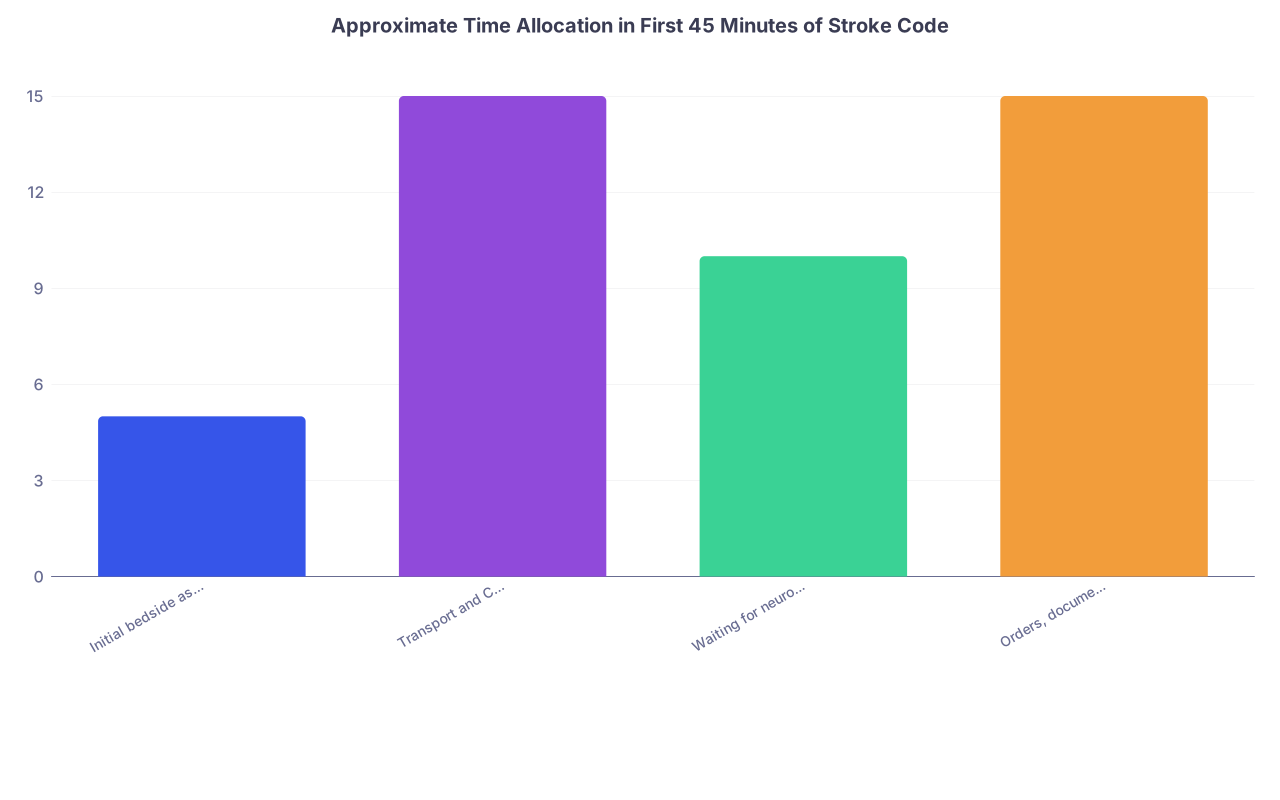
| Category | Value |
|---|---|
| Initial bedside assessment | 5 |
| Transport and CT/CTA imaging | 15 |
| Waiting for neuro & imaging reads | 10 |
| Orders, documentation, calls | 15 |
Your impact is highest in the first 20 minutes. That is when your decisions (or indecision) change outcomes.
14. How To Practice This Before You Are Alone at 2 a.m.
Nobody gets good at this by reading one article. But you can cheat time a bit.
Some practical ways:
- On your next few stroke pages as a junior, consciously run the script: airway–BP–glucose–pattern of deficit–time–anticoagulation history. Say it in your head as you walk.
- After each one, take 2 minutes and write one sentence in a notebook: “What did I miss or hesitate on?” You will see patterns quickly.
- Ask neuro fellows to talk through one case after it is over: “You thrombolysed this one but not the patient last night—why?” You will learn more from those 5‑minute debriefs than from a 60‑slide lecture.
And keep one clear goal: when that stroke pager goes off and you are the only resident on the floor, you are not just a messenger. You are the one person in the building whose calm, structured thinking can prevent permanent disability.
Key points to remember:
- Your first responsibilities are airway, hemodynamics, glucose, and rapid CT—not heroic neuro exams or perfect NIHSS scores.
- Preserve options: do nothing that delays imaging, hides a hemorrhage, or wrecks cerebral perfusion before neuro weighs in.
- Communicate like an adult: concise pattern, timing, anticoagulation status, vitals, and imaging summary will make you the most useful person on that stroke page long before the specialist arrives.