
You are on night float. It is 2:17 a.m. You have 18 cross-cover patients, 4 active admissions, and a nurse just paged: “Hi, this is 6 West. Your patient Mr. Lee is more short of breath, now needing 4 L nasal cannula, was on room air earlier. Vitals stable for now. Can you come take a look?”
This is where people either earn trust or lose it. The worst thing you can do is treat “new oxygen requirement” as a simple “increase the liters and move on” task. That is how you miss a PE, a flash pulmonary edema, or a brewing septic shock.
Let me walk you through how to run this in a way that is safe, efficient, and repeatable at 3 p.m. or 3 a.m.
1. First filter: Is this an emergency?
You have 10–30 seconds on the phone to decide whether you are walking or running.
Ask the nurse immediately. Do not accept “vitals are okay” as an answer.
You want:
- Exact vitals: HR, BP, RR, SpO₂, temp.
- Current O₂ device and flow.
- Mental status: “Is he more confused, hard to arouse, agitated?”
- Work of breathing: “Is he using accessory muscles? Can he talk in full sentences?”
- Trend: “What was his O₂ requirement and saturation earlier today?”
If any of these are present, treat it as urgent and go now:
- SpO₂ < 88–90% despite ≥ 4 L NC (non-COPD) or ≥ 2–3 L above baseline in a COPD patient.
- RR ≥ 28–30 or clearly labored breathing.
- New confusion, agitation, or somnolence.
- SBP < 90 or MAP < 65, or tachycardia > 120.
- Chest pain or acute distress.
Say directly: “Increase his O₂ to [x] L now while I walk over. If his SpO₂ is still under 90% or he looks worse, call the RRT.”
You are not being dramatic. You are buying time.
If the patient is 92% on 1 L, calm, RR 18, BP normal, awake and appropriate? You still see them, just not sprinting. But do not delay beyond 20–30 minutes; hypoxia is not a “sign out till morning” issue.
2. Micro-triage: What kind of patient is this?
Before you go to the room, open the chart. Two minutes of chart review will sharpen your differential and your plan.
Scan:
- Diagnosis/problem list:
- Pneumonia, CHF, COPD, ILD, COVID, PE, post-op day, cancer, sepsis.
- Baseline status:
- On room air at home? CPAP/BiPAP at night? Home O₂ 2–3 L?
- Today’s course:
- Any RRTs earlier? Diuresis or fluids given? Any new fevers?
- Labs/imaging last 24–48 hours:
- CBC, BMP, ABG/VBG, BNP, troponin, CXR, CT chest if present.
- Code status / goals of care:
- Full code vs DNR/DNI vs comfort-focused.
I mentally sort them into buckets:
- Hypoxic respiratory failure on top of an obvious lung problem (pneumonia, COPD, ILD).
- Possible volume issue (CHF, fluid overload, renal failure).
- Possible hemodynamic/sepsis problem.
- Post-op or immobilized with PE risk.
- Wildcard: no clear reason yet, concerning for decompensation.
This is not perfect, but it changes what I look for when I walk in.
3. Bedside assessment: what you actually do in the room
You walk in. Do not let yourself get sucked into the computer. Look at the patient first.
A. General impression (15–30 seconds)
- Position: Sitting up, tripod, lying flat?
- Distress: Can they speak in full sentences? One-word answers? Grunting?
- Mental status: Alert, oriented, drowsy, confused, agitated?
If this looks bad—tripoding, single-word speech, diaphoretic, gasping—call for backup while at the bedside:
“Can you call RRT to this room please, and bring the crash cart outside, just in case.”
You can always de-escalate. But you cannot undo lost minutes.
B. Focused vitals and monitoring
Confirm:
- HR, BP, RR, temp, SpO₂ on current O₂.
- Continuous monitor if not already on.
Ask the nurse to repeat a set if the last set is > 30 minutes old or looks off.
C. Focused respiratory exam
You do not need a full head-to-toe every time, but you need a solid mini-exam.
- Work of breathing:
- Accessory muscles, nasal flaring, retractions, paradoxical breathing.
- Lung sounds:
- Diminished vs crackles vs wheezes vs normal.
- Asymmetry (unilateral anything is a flag: pneumothorax, effusion, PE-related infarct, mucus plug).
- Percussion if useful:
- Dull base (effusion), hyperresonant side (pneumothorax) if you are good at it.
D. Cardiac and volume assessment
- Heart:
- Tachy? Irregular? Murmurs new vs known?
- Volume:
- JVD, peripheral edema, sacral edema, hepatomegaly, crackles vs clear lungs.
E. Quick “other” checks
- Legs: unilateral swelling, tenderness (PE clues).
- Abdomen: distension, pain (aspiration risk if vomiting).
- Neuro: focal deficit (stroke can present with respiratory pattern changes or aspiration).
4. Oxygen devices: how to escalate intelligently
Here is where people either oxygenate well or quietly make things worse.
Basic rule: Use the least amount of support that achieves your target saturation without delaying needed escalation.
| Device | Typical Flow / FiO₂ | When to Use |
|---|---|---|
| Nasal cannula | 1–6 L (FiO₂ ~24–44%) | Mild hypoxia, stable |
| Simple face mask | 6–10 L (FiO₂ ~40–60%) | NC inadequate but not critical |
| Non-rebreather | 10–15 L (FiO₂ ~60–90%) | Acute, significant desaturation |
| HFNC / BiPAP/CPAP | Variable, high support | ICU-level care / step-up only |
Targets (unless told otherwise):
- Most patients: SpO₂ 92–96%.
- Known severe COPD on chronic hypercarbia: often 88–92% is acceptable (check notes).
Stepwise:
- If on room air, start 1–2 L NC, titrate up to 4–6 L if needed.
- If on low-flow NC and still < 90%:
- Jump to a non-rebreather at 10–15 L if they are in real distress while you figure it out.
- If you hit 6 L NC or NRB and still can’t keep them > 90%, they probably need:
- ABG/VBG.
- Stat CXR.
- Higher level of care (step-down / ICU, BiPAP/HFNC).
Do not order BiPAP or HFNC from the floor as a reflex unless your institution does floor HFNC. Talk to the ICU team / RRT. Remember: work of breathing and trajectory matter more than the number alone.
5. The mental differential: what are you actually treating?
New oxygen requirement at night is not a diagnosis. You must attach it to something.
Here is how I mentally organize the main categories.
A. Infectious: pneumonia, aspiration, COVID, sepsis
Clues:
- New fever, leukocytosis, purulent sputum.
- Focal crackles, bronchial breath sounds, egophony.
- History of aspiration risk (dementia, stroke, vomiting, recent NG tube).
- COVID exposures, bilateral interstitial markings.
You will think: “Do I need broader antibiotics? Cultures? Repeat CXR or CT?”
Night float priorities:
- If they are genuinely unstable: draw blood cultures, give a stat fluid bolus if hypotensive (unless clearly volume overloaded), and broaden antibiotics.
- If they are mildly worse and already on treatment:
- You may just need a repeat CXR and labs in the morning plus close monitoring.
But do not sit on a new fever + hypoxia + tachycardia combination. That is the classic “crash at 5 a.m. because everyone watched it for 8 hours” scenario.
B. Cardiogenic / volume overload: CHF, flash pulmonary edema
Clues:
- Known HFrEF/HFpEF, CKD, recent transfusions, high IV fluid input.
- Orthopnea, PND, rapid weight gain, leg edema.
- CXR: vascular congestion, Kerley B lines, pleural effusions.
- Exam: JVD, S3, bibasilar crackles.
Night float moves:
- If hypertensive with acute dyspnea and edema: think flash pulmonary edema.
- Sit them upright.
- Consider IV loop diuretics (furosemide or equivalent) if no contraindication.
- If in real distress with high BP: this is where nitrates, BiPAP, and ICU-level care come in. Call RRT/ICU early.
- If more subtle: mild crackles and modest weight gain:
- Gentle diuresis overnight can stabilize them until day team can adjust the plan.
Do not pound fluids into someone whose lungs are already wet “because sepsis protocol” without thinking. Volume status first.
C. Obstructive: COPD/asthma exacerbation
Clues:
- History of COPD or asthma, smoking, wheezing, prolonged expiratory phase.
- On baseline home O₂ or inhalers.
Night float actions:
- Nebs: usually duoneb q4h PRN, sometimes scheduled for the acute phase.
- Steroids: if not already on them, systemic steroids (e.g., IV methylpred or PO prednisone) for exacerbation.
- Target SpO₂ 88–92%.
- If drowsy with rising CO₂ suspicion:
- VBG/ABG.
- Low threshold for BiPAP and ICU consult.
Big pitfall: crank NC up to 6 L and leave a CO₂ retainer sleepy in bed. Rising CO₂ is not obvious until they are altered.
D. Thromboembolic: pulmonary embolism
Clues:
- Sudden onset dyspnea, pleuritic chest pain, tachycardia.
- Recent surgery, immobility, cancer, OCPs, history of DVT/PE.
- Unilateral leg swelling.
Middle of the night reality:
- If high suspicion and hemodynamically stable:
- You are not ordering a CT-PE in the hallway. But you should:
- Start a workup: D-dimer if low-intermediate suspicion, leg Dopplers if leg findings.
- Talk to senior / attending about early empiric anticoagulation if strong suspicion and no contraindication.
- You are not ordering a CT-PE in the hallway. But you should:
- If unstable with possible massive PE (hypotension, syncope, severe hypoxia):
- This is an ICU/RRT/emergent situation. Start oxygen, call for help, bedside echo if available.
Do not pretend PE is purely a daytime problem. You will absolutely see first presentations at 2 a.m.
E. Mechanical / other: pneumothorax, effusion, mucus plug, atelectasis
Think:
- Pneumothorax: sudden dyspnea, unilateral absent breath sounds, pleuritic pain. Often post-procedure, COPD bleb rupture, or trauma. Needs stat CXR, sometimes immediate decompression.
- Large pleural effusion: progressive dyspnea, dullness, decreased breath sounds at base, often cancer, CHF, cirrhosis. That does not require a tap right that second unless they are very symptomatic, but it may.
- Atelectasis / mucus plug: post-op, shallow breathing, minimal effort, low-grade fever, often improves with incentive spirometry, pain control, mobilization.
Night float: your job is to recognize the pattern, get a stat CXR when needed, and escalate correctly. You are not doing elective thoracentesis at 2 a.m. unless ICU/crashing.
6. What to order: labs, imaging, and when
You cannot order “everything” for every new O₂ requirement. You will drown yourself. But you need a standard base set you adjust depending on the case.
Commonly reasonable on night float:
- Stat CXR:
- New or worsened hypoxia not clearly explained by known condition.
- CBC:
- Concern for infection, bleeding.
- BMP:
- Diuretics, renal failure, metabolic derangement.
- BNP:
- If not recently done and CHF vs not-CHF actually changes your move tonight.
- Troponin + EKG:
- If chest pain, tachycardia, or concern for ACS or demand ischemia.
- ABG/VBG:
- Altered mental status, suspected CO₂ retention, severe hypoxia, or planning for BiPAP.
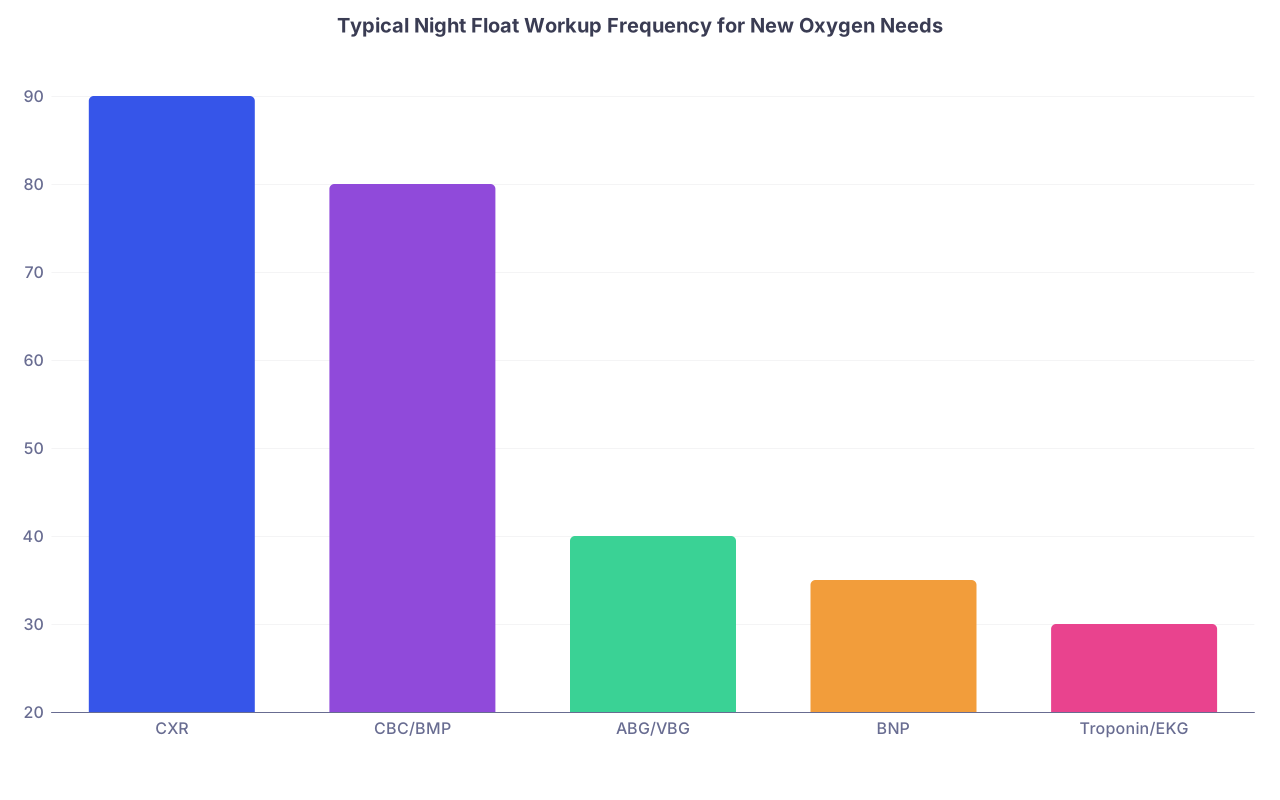
| Category | Value |
|---|---|
| CXR | 90 |
| CBC/BMP | 80 |
| ABG/VBG | 40 |
| BNP | 35 |
| Troponin/EKG | 30 |
(Percentages roughly approximate what I actually see people order in practice, not textbook ideals.)
Reserve CT scans (CT-PE, CT chest) for cases where it will truly change acute management and where you can physically get them down safely. If they need a CT but look too unstable to travel, that is an ICU-level conversation.
7. When to call RRT, ICU, or your senior
You are not supposed to be a one-person ICU at night. Use the resources.
RRT (or equivalent) should be called if:
- SpO₂ remains < 90% despite NRB or very high NC.
- RR > 30 with increased work of breathing.
- New hypotension (SBP < 90 or MAP < 65).
- Acute mental status changes.
- You are at the bedside and thinking “this feels bad.”
- Need for BiPAP/HFNC in most hospitals.
- Hemodynamic instability requiring pressors.
- Multi-organ failure picture (shock, AKI, rising lactate).
- Recurrent RRTs or persistent high O₂ needs (e.g., 10–15 L NRB continuously).
Call your senior early in the following scenarios:
- You are considering RRT or ICU.
- You think the patient might need intubation.
- You are about to start anticoagulation for suspected PE with bleeding risk.
- You are not sure if this is volume overload vs sepsis vs something else and your next move is unclear.
The only bad call is the late call.
8. Special situations: DNR/DNI, end-of-life, and “how aggressive are we?”
Some of the hardest 2 a.m. decisions are not about pathophysiology. They are about goals.
If the patient is:
- DNR/DNI but otherwise full treatment:
- You can escalate O₂, give IV antibiotics, diuresis, etc., but you will not intubate.
- Non-invasive ventilation use (BiPAP/CPAP) depends on institutional norms and prior discussions.
- Comfort measures only:
- You should not be chasing SpO₂ numbers with escalating devices.
- Focus shifts to relieving dyspnea: opioids, positioning, maybe low-flow O₂ if it provides comfort, not for a number target.
Check the chart for recent goals-of-care notes. If absent and the patient is borderline, sometimes the right move is to stabilize as best you can and flag it for an early morning family/team meeting. But do not withhold indicated acute treatment based on “I think they would not want this” without documentation or discussion.
9. Documentation and sign-out: protect yourself and help the day team
You stabilize the patient, adjust their O₂, maybe give diuretics, order a CXR and labs. They are better. Now what?
Your note at night should be:
- Brief.
- Structured.
- Concrete about what you did and what you are worried about.
Example skeleton:
- Reason for evaluation: “Called to bedside for new O₂ requirement, now 4 L NC from RA, SpO₂ 88% improving to 94% on 3 L.”
- Pertinent history: “Admitted for CHF exacerbation, on IV furosemide. Baseline RA at home.”
- Exam summary: “Mild dyspnea, speaking full sentences, RR 22, BP 148/82, HR 96, SpO₂ 94% on 3 L. Bilateral basilar crackles, 1+ edema, +JVD.”
- Assessment: “Likely mild volume overload vs early pneumonia, currently hemodynamically stable.”
- Plan:
- “Increase O₂ to 3 L NC, goal SpO₂ > 92%.”
- “Give additional 40 mg IV furosemide now.”
- “Stat CXR and BMP; follow up results.”
- “If O₂ need progresses to > 4–6 L or respiratory distress worsens, recommend RRT and possible ICU transfer.”
Sign-out for day team: put it clearly in your handoff tool:
“6W-12 Lee – new 3 L O₂ overnight for SOB, likely mild volume overload vs early PNA. Got extra IV lasix 40, CXR pending, labs pending. Still needs reassessment in AM and follow-up on imaging/labs.”
You’re thinking for future-you or your colleague.
10. Pattern recognition: what tends to go wrong at night
I have seen the same mistakes repeatedly from interns and even seniors:
- Treating the number instead of the patient.
- Turning O₂ up to “fix” a monitor without understanding why the saturation dropped.
- Ignoring the respiratory rate and work of breathing.
- The patient who is 93% on 4 L but breathing 34 times per minute is in more danger than the one who is 88% on 2 L, calm, RR 18.
- Delay in imaging.
- Waiting 6–8 hours for a CXR in someone whose story already changed significantly.
- Underestimating progressive trends.
- “He was on 1 L this morning, now 4 L, but looks okay.” That delta matters.
- Over-ordering vs under-thinking.
- Shotgun labs/CTs instead of building a differential and targeting the workup.
Recognizing a “trajectory” is the real night float skill. Single datapoints are noisy. Direction over time is not.
11. A repeatable bedside algorithm you can actually use at 2 a.m.
Let me crystalize this into something simple enough that you can run half-asleep.

| Step | Description |
|---|---|
| Step 1 | New O2 requirement page |
| Step 2 | Ask nurse vitals, mental status, work of breathing |
| Step 3 | Increase O2, go now, call RRT |
| Step 4 | Chart review 2 min |
| Step 5 | Go to bedside |
| Step 6 | Assess appearance, RR, SpO2, exam |
| Step 7 | Escalate O2 device, consider RRT/ICU |
| Step 8 | Maintain O2 92-96 (or 88-92 COPD) |
| Step 9 | Targeted dx - infection, CHF, COPD, PE, other |
| Step 10 | Order focused labs/CXR as indicated |
| Step 11 | Call senior, ICU/RRT |
| Step 12 | Document, clear sign-out, monitoring orders |
| Step 13 | Unstable? |
| Step 14 | SpO2 30? |
| Step 15 | Needs higher level of care? |
Print that flow in your head. You will not follow it perfectly every time, but if you roughly track it, you will avoid the common disasters.
12. A realistic night: putting it all together
You get two pages in 10 minutes.
- “Pt now on 5 L NC, was 1 L, RR 30, looks winded.”
- “Pt needed 1 L from RA, SpO₂ 89–90%, RR 18, feels fine.”
You go see #1 immediately. Chart shows CHF, IV fluids earlier, rising weight. At bedside: hypertensive, JVD, crackles, 2+ edema, 88% on 4 L, RR 30. You:
- Put him on NRB briefly, call RRT because he is in clear distress.
- Give IV lasix.
- Get stat CXR and BNP.
- Discuss with ICU about BiPAP and possible transfer.
You stabilize him, document, sign out.
Then you see #2. Chart: post-op day 2 after colectomy, mild atelectasis on prior CXR, walking poorly. Exam: clear lungs, minimal effort, 92% on 1 L, RR 18. You:
- Encourage IS, pain control, mobilization.
- Keep 1 L NC overnight with target > 92%.
- Order morning CXR only if no prior imaging or if symptoms progress.
- No RRT, no heroics.
That is the difference between panic and strategy.
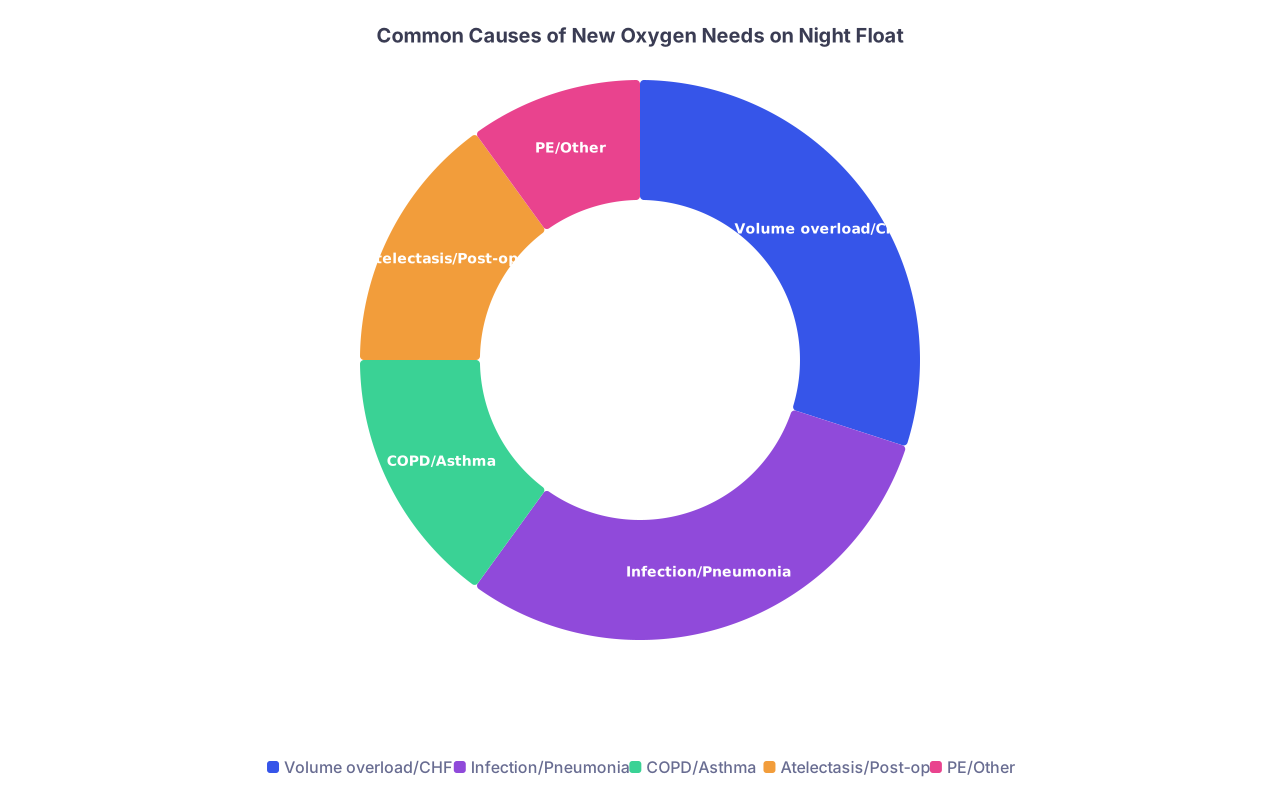
| Category | Value |
|---|---|
| Volume overload/CHF | 30 |
| Infection/Pneumonia | 30 |
| COPD/Asthma | 15 |
| Atelectasis/Post-op | 15 |
| PE/Other | 10 |
These rough proportions are what many residents actually see. CHF and infection dominate, but the low-percentage killers (PE, pneumothorax) matter a lot.
FAQ (exactly 4)
1. When should I get an ABG or VBG for new oxygen needs?
Get one if the patient is altered, has significant work of breathing, has known or suspected CO₂ retention (COPD, obesity hypoventilation), or is worsening despite escalation of oxygen. You do not need a gas for every person going from RA to 1–2 L, but you should not skip it in the drowsy COPD patient on 4–6 L whose RR is climbing.
2. How long do I wait after changing oxygen before deciding if it worked?
You usually see the SpO₂ response to an increased O₂ device within 1–3 minutes. If you crank from 2 L to 6 L and they are still 86–88% after a couple minutes, that is a failure of simple escalation and a sign you need help (RRT/ICU) and a higher-level plan.
3. Do I have to call the attending for every new oxygen requirement overnight?
No. For mild, clearly explained increases (e.g., 0 to 1–2 L post-op atelectasis, stable vitals) you manage and sign out. You should loop in the attending (directly or via your senior) when the patient is unstable, requires RRT/ICU, has a major change in diagnosis (new PE, massive pneumonia, flash pulmonary edema), or when you initiate high-risk therapies like emergent anticoagulation in a borderline patient.
4. How aggressive should I be diuresing suspected CHF volume overload at night?
If the story, exam, and CXR strongly support volume overload and the patient is hypertensive or normotensive with good kidneys, giving an extra dose of IV loop diuretic (similar or slightly higher than their home or daytime dose) is reasonable. Avoid huge, repeated doses without labs or clear follow-up, and be cautious in borderline blood pressures, CKD, or unclear diagnosis. If you are considering large diuresis in someone who is tenuous, run it by your senior.
Two main points to leave with you:
- “New oxygen requirement” is not a nursing nuisance; it is early warning of decompensation. Look at the patient, not just the saturation.
- Build a consistent pattern: rapid triage, quick chart review, focused exam, targeted escalation, and decisive use of RRT/ICU and your senior. That is how you survive night float and keep your patients alive.