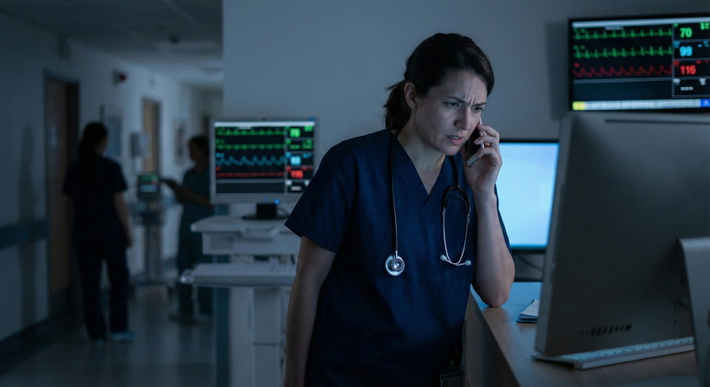
“It can wait until morning” is one of the most dangerous phrases in residency.
Not because every issue is an emergency. But because this sentence gets used as a reflex, a coping mechanism, and sometimes as a lazy shortcut—often in situations where the data, and the morbidity reports, say you should act now.
Let me be blunt: a huge chunk of preventable bad outcomes at night are not about freak events. They’re about delayed, basic interventions on problems that “weren’t that bad” a few hours earlier.
You’re on call, exhausted, juggling four cross-cover pages and a transfer. You need to triage. But the mythology of “overnight is just for putting out fires; real medicine happens in the morning” is wrong. And it’s not just an opinion—there’s hard data on overnight deterioration, sepsis timelines, and delays in escalation of care.
This is about learning which things really can wait, and which ones statistically burn you if you punt.
The Night Shift Is Not Neutral Time
Night isn’t just daytime with fewer people. It’s a different physiological and system environment.
| Category | Value |
|---|---|
| Day | 20 |
| Evening | 30 |
| Night | 50 |
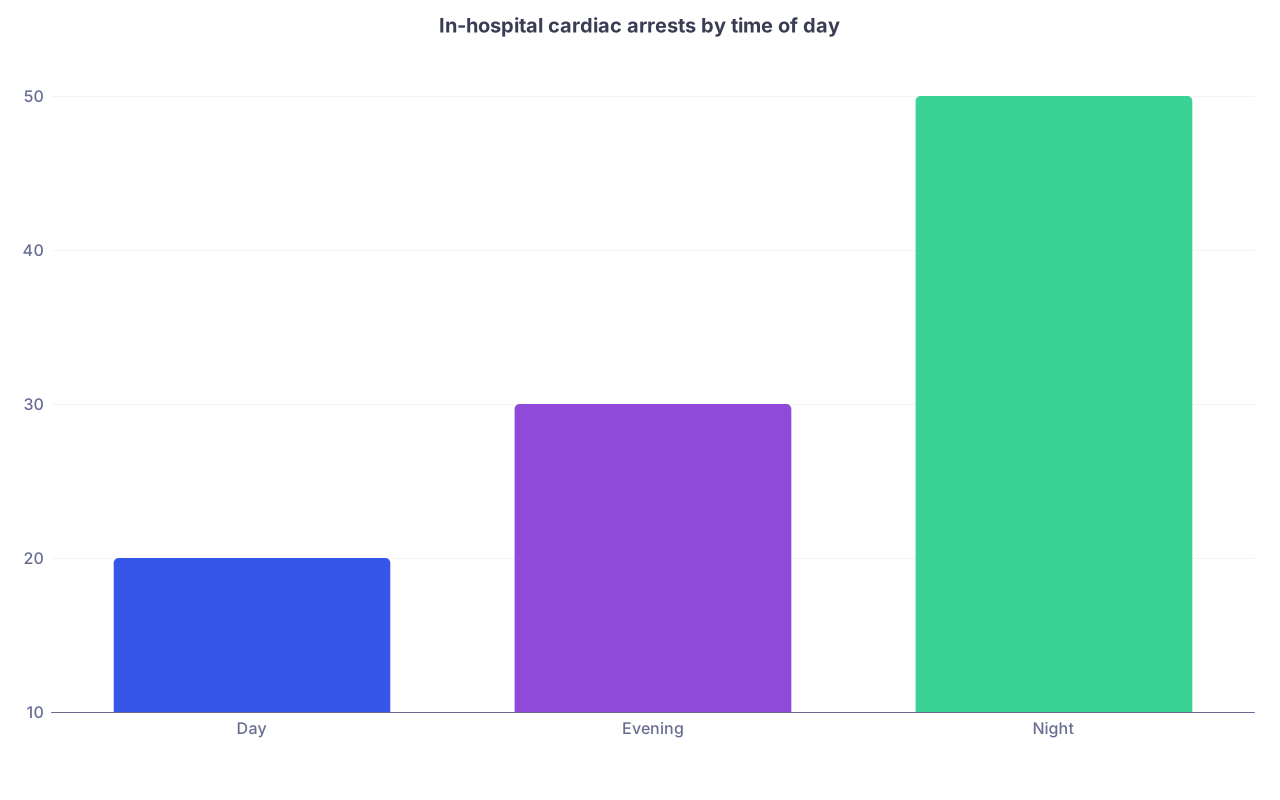
Multiple large studies show in-hospital cardiac arrest and mortality rates are higher at night. One meta-analysis looking at tens of thousands of arrests found:
- Higher odds of death for arrests at night vs day
- Worse survival after ICU transfers done overnight
- Longer response times and more delays in recognizing deterioration at night
This isn’t surprising. At night you have:
Fewer nurses per patient. Fewer RTs. Fewer phlebotomists. Slower lab turnaround. Often no in-house specialists. Attendings at home. Step-down and floor units running as pseudo-ICUs with one resident overseeing 40–80 patients.
So when you say “it can wait until morning,” what you’re really saying is: “This problem can probably survive 8 hours in the worst-resourced environment of the day, with the sickest staffing ratios and the slowest support.”
Sometimes that’s true.
Often it’s fantasy.
Where “It Can Wait” Quietly Kills: The Usual Suspects
There are specific categories of problems that routinely get minimized at night, then show up in M&M as “opportunities for earlier intervention.”
I’ve sat in those conferences. The pattern repeats.
1. The Soft-Seeming Sepsis
The script you’ve heard:
“Temp 38.6, HR 110, BP 108/60, WBC 15. Looks okay, they just need fluids. We’ll see them on rounds.”
Except:
Sepsis mortality goes up with every hour of delay in appropriate therapy. That’s not hyperbole; it’s in the Surviving Sepsis data and countless retrospective studies. The “window” is not days—it’s hours.
The more subtle problem: early septic patients often look deceptively okay. Compensated, talking, “mildly tachy.” You know when they don’t look okay? When they’ve burned through compensation at 5 a.m. and now you’re calling a rapid response for hypotension, lactate of 5, and a patient who’s cold and altered.
Where “wait until morning” is usually wrong for suspected infection:
- New fever plus tachycardia out of proportion to baseline, especially if hypotension is even slightly trending down
- New oxygen requirement + fever or leukocytosis
- Post-op patient with increasing pain, tachycardia, and borderline vitals
No, you don’t always need to activate a full code sepsis. But you do need to stop pretending that pushing off: blood cultures, lactate, antibiotics, and an actual assessment is harmless.
Because the mortality data says it isn’t.
2. The “Just a Little” Hypoxia
This one is chronic in medicine and surgery.
Nurse: “Hey, Mr. X is 88% on 2L, was 94% earlier.”
Night resident: “Okay, bump to 3L, recheck. If still low, page again.”
On paper, that sounds fine. In real life, the “page again” is often 90 minutes later, when they’re 84% on 5L and now everyone is shocked.
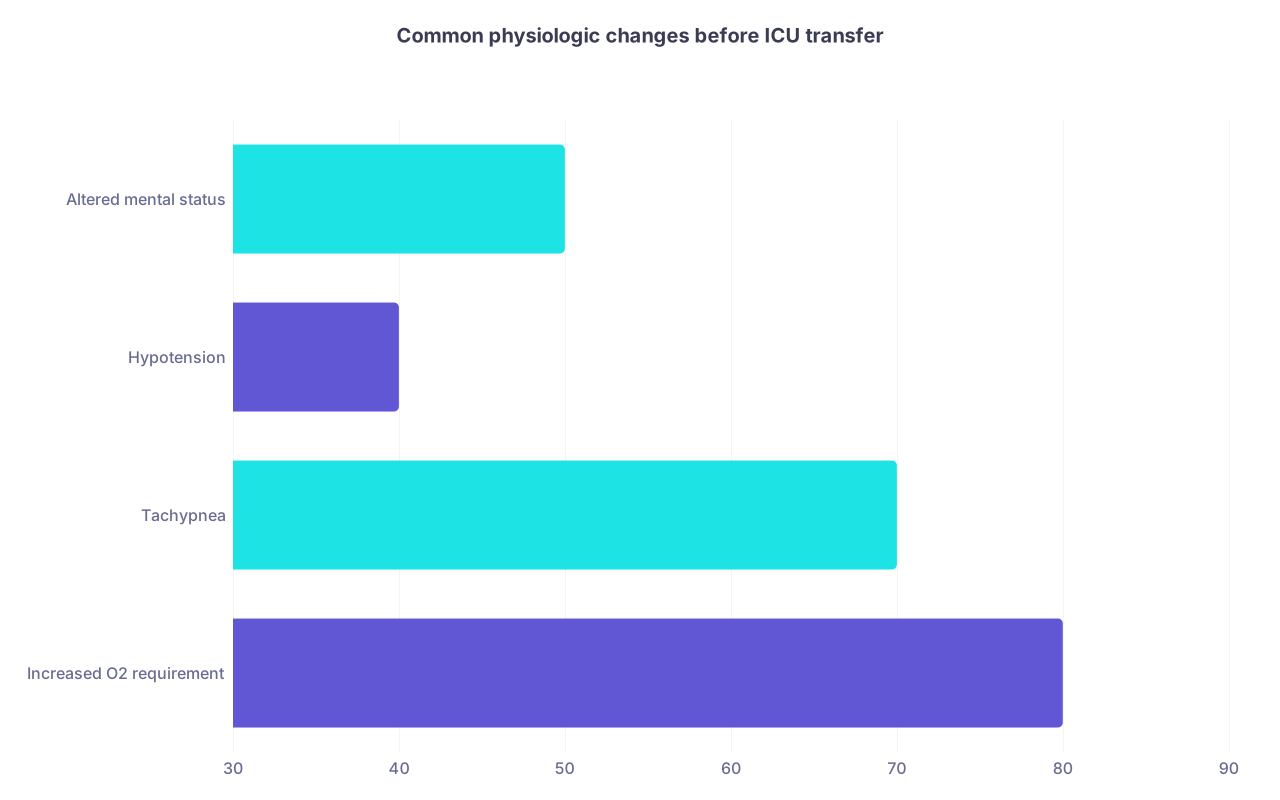
There’s solid evidence that:
- Worsening oxygen requirements precede ICU transfer by hours
- Subtle hypoxia and tachypnea are more predictive of deterioration than blood pressure in many cohorts
- Night-time respiratory arrests are frequently preceded by unaddressed rising O2 needs
| Category | Value |
|---|---|
| Increased O2 requirement | 80 |
| Tachypnea | 70 |
| Hypotension | 40 |
| Altered mental status | 50 |
When “it can wait until morning” is a bad idea:
- Any escalation from room air to nasal cannula, or from low-flow to higher-flow, in a patient not previously on home oxygen
- HFpEF/COPD/obese or post-op patient whose work of breathing is visibly up, even if the saturation looks “acceptable”
- Anyone with new hypoxia and chest pain, fever, or altered mental status
You don’t need to CT angiogram everyone at 2 a.m. But you must see them, listen to lungs, maybe get a stat CXR, consider ABG/VBG, and decide if they belong on telemetry or ICU.
Patients do not suddenly crash from perfect sats to intubation level. They telegraph the decline. Night teams just choose not to listen.
3. The “They’re Just Old/Confused” Delirium
New or worsening confusion is another thing that gets written off overnight because “they’ve been like that.”
Except: the charts often show they haven’t been like that.
Delirium is not just an annoyance. It’s an independent predictor of morbidity, mortality, falls, aspiration, and readmission. And new delirium at night can be the first sign of: sepsis, stroke, hypoglycemia, electrolyte derangement, medication toxicity, or respiratory failure.
One common story:
- 11 p.m.: “Patient is more confused and pulling at lines.” Resident: “They’re sundowning. Just give a little haldol.”
- 3 a.m.: Staff discover the patient on the floor after a fall, or obtunded with a CO2 of 90, or with a new dense hemiparesis.
Things that should not wait until morning:
- New focal deficits in the context of “confusion”
- New agitation in a COPD/OSA patient on opioids or benzos
- Sudden change from calm to agitated in someone who was stable the prior shift
You won’t scan every delirious 85-year-old head-to-toe at night. But you should stop pretending all delirium is benign and uniformly wait-worthy.
4. The “Borderline” Labs That Scream Trouble
Here’s where a lot of cross-cover residents get burned: the labs look “a little off,” and they’re too tired to ask why they’re off now.
Examples that don’t actually age well:
- Sodium drifting down in a patient on SSRIs, thiazides, or with CNS disease
- Potassium 2.9 in someone on diuretics or insulin drips who is “otherwise fine”
- Hgb falling from 9 to 6.5 in six hours with “no obvious bleeding”
- Lactic acid creeping from 1.5 to 3.2 in a “stable” patient
There’s research showing that uncorrected overnight critical labs are linked with worse outcomes and delayed interventions. The issue is rarely the single lab value; it’s that the trend is already happening, you just choose to watch it for 8 more hours.
| Lab / Issue | Common Bad Outcome if Delayed |
|---|---|
| K ≤ 3.0 or ≥ 6.0 | Arrhythmia, arrest |
| Na ≤ 120 or fast drop | Seizure, herniation |
| Hgb < 7 with drop | Hemodynamic collapse |
| Lactate rising > 2 | Progressing shock |
| Cr acute jump | Missed nephrotoxin/obstruction |
No, you don’t need nephrology on the phone for every creatinine bump. But you do need to stop thinking “we’ll let day team handle it” when the physiology is already sliding in the wrong direction.
The Hidden Cost: Moral Injury and Risk Transfer
There’s another problem with habitual “wait for morning” triage: it transfers risk and moral burden downstream.
You know who often discovers the patient hypotensive, hypoxic, or unresponsive at 7 a.m.? The day intern walking in, reading the overnight notes that said “monitor, reassess in the morning,” and then realizing the reassessment is now a code blue.
I’ve watched more than one junior resident sit in M&M, being technically “covered” by that plan, and still feel sick because they know that decision point was a layup for earlier intervention.
The pattern:
- Overwhelmed night resident normalizes borderline issues so they can survival-mode through the shift
- No one explicitly owns the risk; it’s silently pushed onto the system and the next team
- When something goes wrong, every note looks “reasonable” in isolation, but the trajectory shows neglect
The data on night and weekend mortality (so-called “off-hours effect”) suggests that this isn’t about a few bad residents. It’s a system-level mindset problem. Off-hours care globally accepts a lower standard of responsiveness and escalation.
You don’t fix that overnight. But you don’t have to participate in it blindly either.
When “It Can Wait” Is Actually Reasonable
Let’s swing the other way so this doesn’t turn into “panic about everything at 2 a.m.”
There are problems that clearly can wait:
- Stable, chronic issues: A1c management, long-standing hyponatremia in a non-symptomatic patient, elective imaging for a weeks-old complaint
- Non-progressive pain with a known cause and no red flags
- Social work, placement, routine clinic follow-ups, prior-auth fights (no one sane attacks these at 3 a.m.)
The trick is simple, and I’ll put it plainly:
If the problem has meaningful potential to become harder or more dangerous in the next 4–8 hours, it probably shouldn’t wait.
If the only real downside of delay is a longer length of stay or patient annoyance, it probably can.
That’s not “feelings-based.” That’s in line with deterioration curves and timelines we know from sepsis, AKI, respiratory failure, and neurologic injuries.

| Step | Description |
|---|---|
| Step 1 | Page received |
| Step 2 | Objective change in vitals or mental status |
| Step 3 | See patient now |
| Step 4 | New symptom only |
| Step 5 | Act overnight |
| Step 6 | Discuss, document plan |
| Step 7 | Could this worsen in 4-8 hours? |
| Step 8 | High-risk complaint? |
This isn’t a flowchart you memorize. It’s a mental model: trajectory and time horizon matter more than the current snapshot.
What The Better Night Residents Actually Do
The best night residents I’ve watched are not the ones who run to every page in a panic. And they’re definitely not the ones who “just write an order and move on” from the computer.
They do three smart, boring things consistently:
They physically see the gray-zone patients.
New tachycardia, new 2L O2, new confusion—these get eyeballs, not just orders.They escalate early when the trajectory is bad.
I’ve heard strong seniors say to nurses: “If they need even 1 more liter of O2 after this, we’re calling rapid,” or “If BP drops below 95, page me and we’re going to the ICU.” Clear thresholds. Written in notes. Not vibes.They document the thinking, not just the plan.
“Seen at bedside, lungs clear, CXR no infiltrate, sats 90–92% on 2L, low suspicion for PE, likely atelectasis. Incentive spirometry, ambulate, if O2 needs increase, consider CTA and ICU eval.”
When that patient crashes, this note proves you took it seriously, not that you blew it off.
| Category | Value |
|---|---|
| Order-only from desk | 30 |
| See only obvious sick | 50 |
| See and risk-stratify gray-zone | 20 |
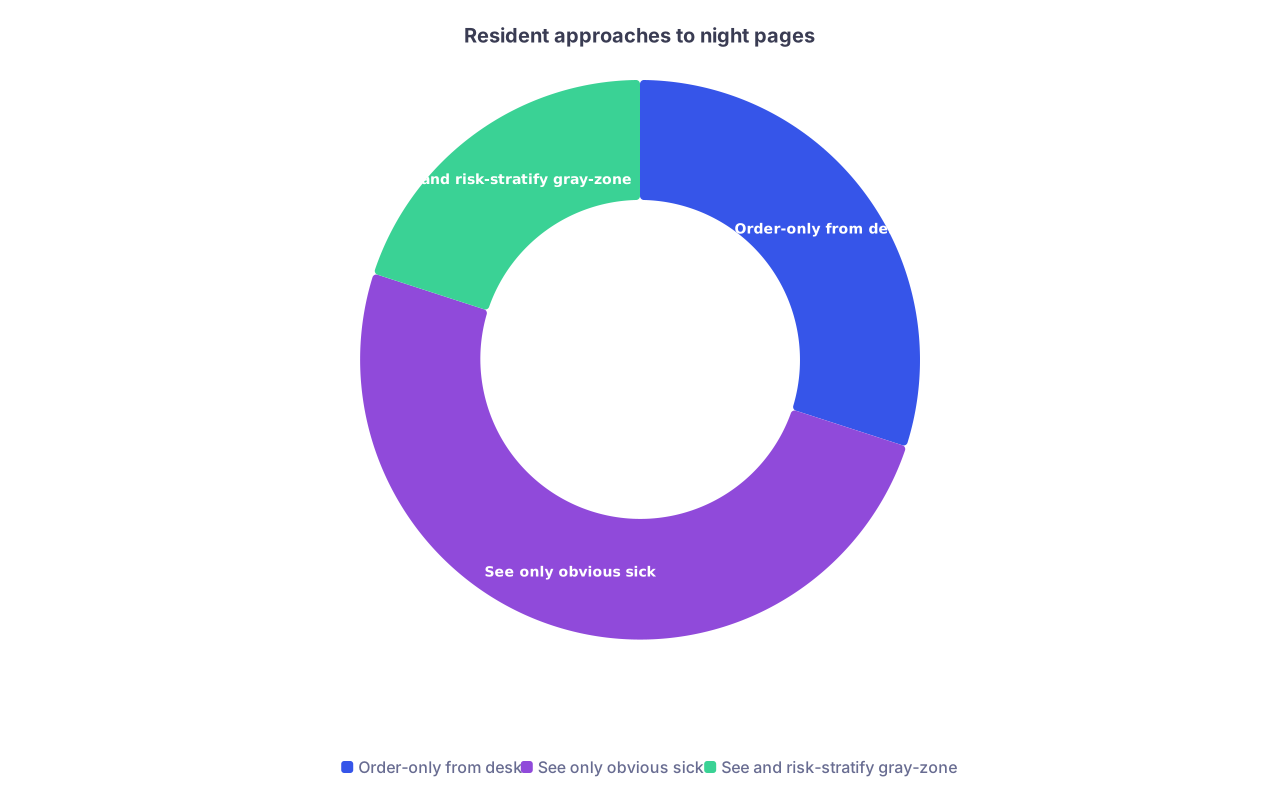
Most residents live in the first two categories. The third group—the small minority who take the extra 5 minutes for assessment—are the ones who get fewer ugly surprises and fewer apologies to families.
How To Decide in Real Time: Three Brutal Questions
When you’re on hour 25 and getting hammered with pages, use these three questions. They cut through the noise.
If this gets worse by 30–50%, is it still safe on the floor?
Think: BP 100 → 70, O2 92% on 2L → 86% on 5L, Hgb 8 → 6. If the answer is “no,” you need to act now.If this patient coded at 6 a.m., would an honest reviewer say, “The signs were there at 1 a.m.”?
If your gut is already whispering yes, stop punting.What’s the fastest way to know if I’m underestimating this?
Often the answer is: go see them, listen to the nurse, grab a basic test (CXR, gas, lactate, repeat vital trend), then decide.

Use these questions as a quick triage filter. You’re not aiming for perfection; you’re trying to avoid the stupid, foreseeable misses.
The Cultural Lie You Have To Unlearn
The real myth here isn’t just the words “it can wait until morning.” It’s the underlying belief baked into many training programs:
Night is for holding things together. Day team does the real thinking.
That mindset is garbage.
Sick patients do not pause their physiology from 11 p.m. to 7 a.m. They deteriorate on the same timeline regardless of your shift.
And the evidence is crystal clear: off-hours care is more dangerous. Not because the patients change. Because we, the system and the clinicians, lower our standards.
You cannot fix the whole system. But you can refuse to participate in denial.
Start with this rule-of-thumb:
If the potential downside of waiting is organ failure, ICU transfer, or death, you don’t get to say, “We’ll see in the morning,” just so you can finish your notes in peace.
You chose this job. Night coverage is part of the real medicine, not its annoying after-hours cousin.

FAQs
1. How do I push back if a senior or attending tells me something can wait but I’m worried?
Ask specific, pointed questions instead of vague objections. “I’m concerned because their O2 requirement has doubled in 4 hours and their RR is 28. If they drop any further, they may need ICU—are you comfortable keeping them on the floor without at least a gas and CXR?” Document that you discussed with them. If you’re still uneasy, escalate within the chain (ICU fellow, hospitalist, etc.). Your job is to be the patient’s advocate, not to protect someone’s ego.
2. Won’t I burn out if I treat every issue as urgent at night?
You will. That’s not what I’m advocating. You have to let routine issues wait. The point is to correctly identify which things are time-sensitive based on data and trajectories. Once you build pattern recognition, you’ll actually stress less, because you’ll trust your instincts about what truly can wait instead of living in constant vague anxiety.
3. What about resource-limited settings where I literally can’t escalate easily at night?
Then you lean even harder on early recognition. If getting an ICU bed or urgent imaging is a nightmare after hours, that’s even more reason not to sit on a borderline patient for 8 hours. You’ll need to advocate more, earlier, and accept that you’ll sometimes have to fight the system to avoid predictable disasters.
4. Any simple documentation phrases that help protect me and clarify thinking overnight?
Yes. Use language that shows risk assessment and a plan: “Seen at bedside for new hypoxia; current status stable but at risk for deterioration. Discussed with nurse. Plan: [specific actions]. If [clear threshold], will escalate to [rapid response/ICU/attending].” That tells anyone reading the note that you recognized the risk, set criteria, and weren’t just kicking the can to morning.

Key points: Night coverage isn’t a holding pattern; deterioration risk is higher off-hours, not lower. The phrase “it can wait until morning” is often wrong for early sepsis, evolving hypoxia, new delirium, and trending abnormal labs—because those are exactly the problems that worsen over 4–8 hours. If the downside of waiting is organ failure or ICU-level care, you don’t wait; you act, assess, and escalate before the sun comes up.