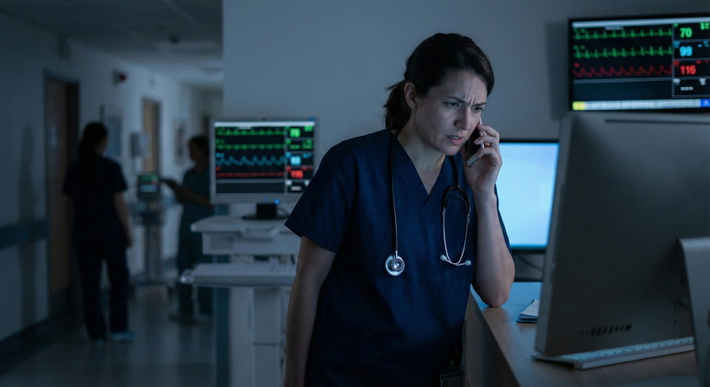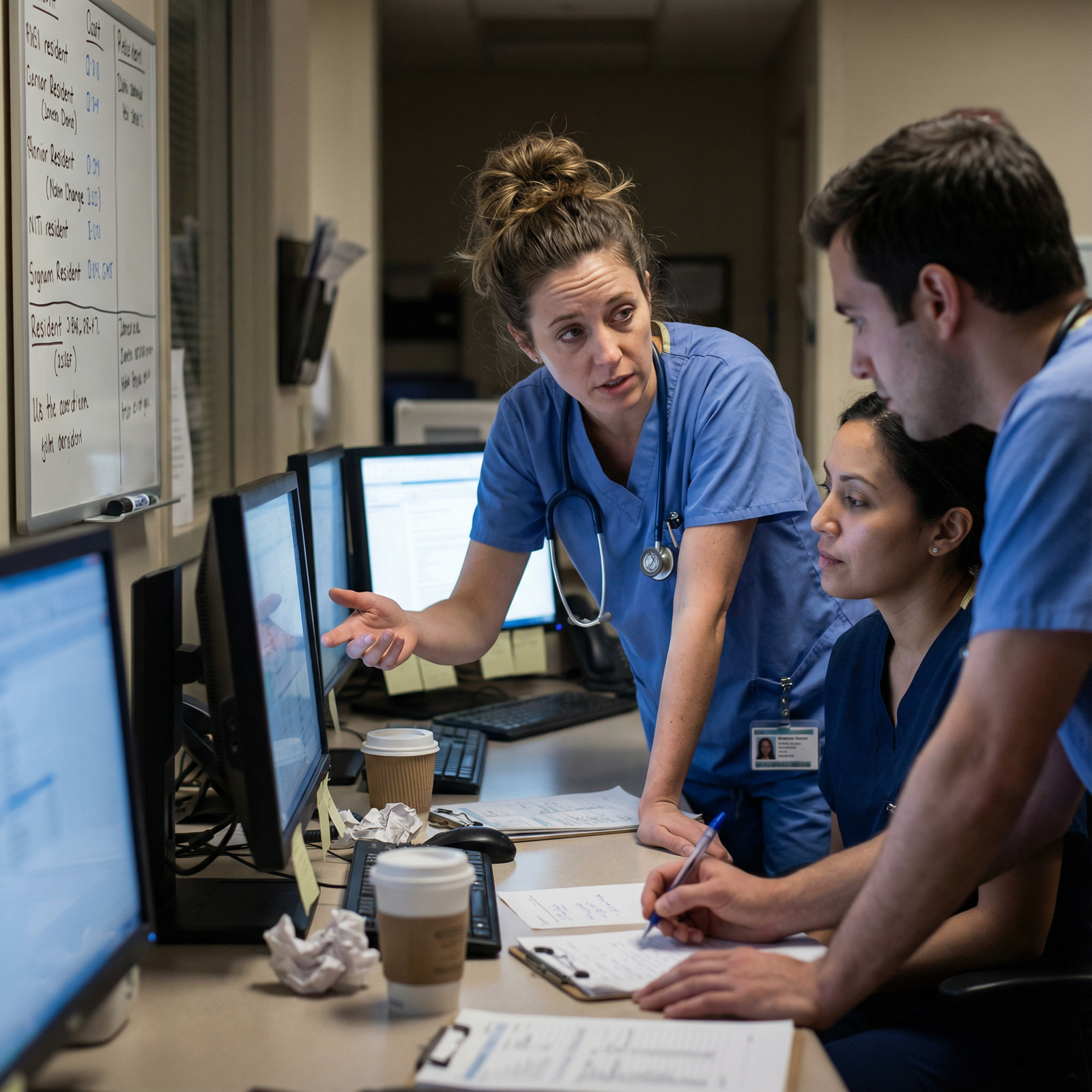
Introduction: Why Communication Under Pressure Defines Your On-Call Performance
On-call duty is one of the defining features of medical residency life. Long hours, frequent interruptions, limited information, and high-stakes decisions create an environment where small missteps can have major consequences. In this setting, your communication skills are just as important as your clinical knowledge—sometimes even more so.
For residents, especially early in training, on-call shifts can feel like being thrown into the deep end. You’re juggling cross-cover pages, new admissions, deteriorating patients, and anxious families, all while trying to coordinate with nurses, attendings, consultants, and ancillary staff. How you communicate under pressure affects:
- Patient safety
- Team collaboration and morale
- Your credibility and professional identity
- Your own stress management and resilience
This expanded guide explores core communication skills for on-call residents, offers practical tools you can use immediately, and provides real-world examples of how to apply them on a busy night. The goal is not perfection, but continuous improvement—so that with each call shift, you become safer, more effective, and more confident.
Why Strong Communication Skills Matter During On-Call Shifts
Communication and Patient Safety: Reducing Preventable Harm
Communication problems are consistently identified as a major contributor to preventable adverse events in hospitals. Studies from organizations such as the Joint Commission and WHO estimate that a majority of sentinel events involve communication breakdowns—during handoffs, in phone orders, between services, or between nurses and physicians.
On call, risk skyrockets because:
- You often don’t know the patient well (or at all).
- Information can be incomplete, outdated, or scattered in the chart.
- You may be covering multiple services or units simultaneously.
- Fatigue and cognitive overload are constant threats.
Clear, structured communication improves patient safety by:
- Ensuring critical information (allergies, code status, recent vitals, trends) is not missed.
- Reducing diagnostic errors caused by incomplete histories or misheard details.
- Supporting time-sensitive decisions (e.g., sepsis, stroke, STEMI, airway compromise).
- Facilitating safer handoffs between shifts and services.
Every page, phone call, and handoff is an opportunity either to reduce or increase risk. Treat your communication skills as core patient safety tools, not “soft add-ons.”
Team Collaboration: Functioning as Part of a High-Performance Clinical Team
On call, you are rarely acting alone. You’re working inside a dynamic system:
- Nurses at the bedside who see changes first
- Senior residents and attendings who guide complex decisions
- Consultants who provide specialty input
- Respiratory therapists, pharmacists, and other allied health staff
When communication is strong, team collaboration improves:
- Nurses feel heard and are more likely to escalate concerns early.
- Consultants receive clear questions and respond more efficiently.
- Work is shared appropriately, preventing burnout and resentment.
- Mistakes are caught earlier by multiple sets of informed eyes.
Conversely, vague, dismissive, or fragmented communication creates confusion, delays care, and erodes trust—making the next crisis even harder to manage.
Stress Management: How Communication Affects Your Mental Load
On-call shifts can amplify stress and anxiety—for you, your colleagues, and your patients. Poor communication increases this burden:
- Unclear plans lead to repeated pages and interruptions.
- Misunderstandings create conflict, frustration, and moral distress.
- Patients and families feel ignored, generating more escalations.
Good communication skills are powerful stress management tools:
- Clarity reduces cognitive load—everyone knows the plan.
- Proactive updates decrease anxiety for patients, families, and staff.
- Assertive but respectful boundaries help you manage workload.
- Debriefing after difficult cases supports emotional processing and resilience.
Improving your communication is one of the most effective ways to make your on-call life more sustainable and less chaotic.
Core Communication Skills Every On-Call Resident Needs
1. Active Listening: Getting the Whole Story Under Time Pressure
Active listening means you are fully engaged in understanding the speaker’s message—not just waiting for your turn to talk. On call, it’s easy to rush, interrupt, or assume you already know what’s going on. That’s when details get missed.
Why Active Listening Matters on Call
- You often rely on others’ observations (nurses, cross-cover notes, family).
- Key safety information may be subtle or buried in a long story.
- Patients and families are more likely to disclose concerns when they feel heard.
- Team members who feel respected are more willing to speak up next time.
Practical Techniques for Active Listening
Signal full attention, even briefly
- Sit or stand facing the person.
- Minimize distractions for 30–60 seconds (pause typing, silence pager if safe).
- Use brief verbal cues: “Go ahead,” “I’m listening.”
Use focused questions
- “What specifically made you concerned enough to call?”
- “Has anything changed in the last hour?”
- “What is your biggest worry right now?”
Summarize and confirm
- “So you’re saying the patient’s blood pressure has dropped from 130s to 80s over the last 30 minutes, and they’re now more confused—did I get that right?”
- Ask: “Is there anything I’m missing?”
Listen beyond the words
- Notice tone, urgency, or hesitancy—especially from nurses who know the patient well.
- Take seriously statements like “Something’s just not right,” and ask for specifics.
Active listening does not mean long conversations every time. It means making each brief interaction accurate, respectful, and complete.
2. Clear, Concise Verbal Communication: Saying the Right Thing, the Right Way
When seconds or minutes matter, rambling explanations or scattered details can harm patients. Clear, concise communication is a critical on-call competency—especially over the phone.
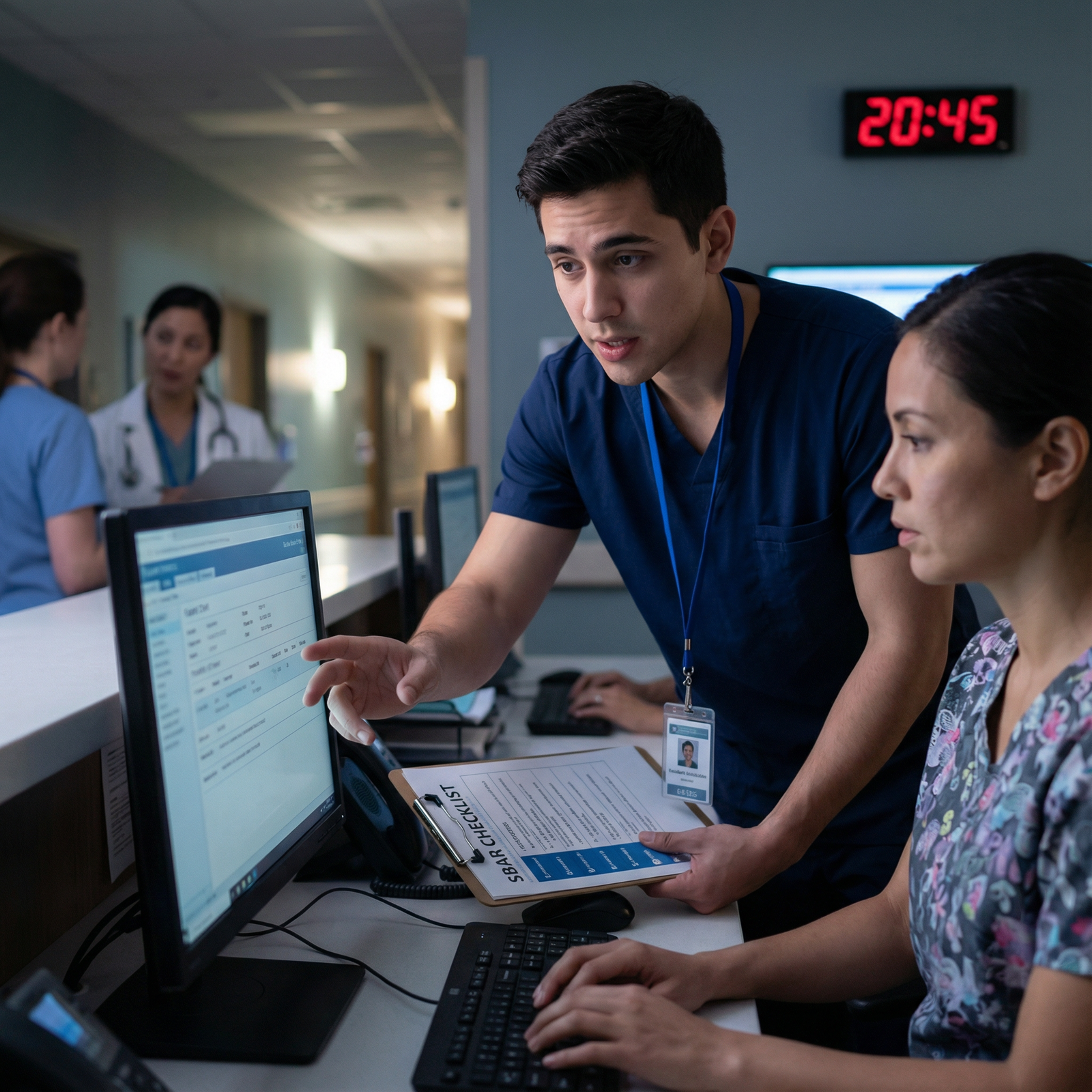
The SBAR Framework: Your Go-To Tool for On-Call Communication
SBAR (Situation, Background, Assessment, Recommendation) is widely used for structured clinical communication. It:
- Saves time
- Reduces confusion
- Helps you sound more organized and confident
Example: Calling your attending about a deteriorating patient
S – Situation:
“Dr. Patel, this is Dr. Lopez, the night resident on 6B. I’m calling about Mr. Smith in room 612 with acute respiratory distress.”B – Background:
“He’s a 68-year-old with COPD and pneumonia, admitted this afternoon. He was stable on 2L nasal cannula earlier. Over the last hour, his work of breathing has worsened, and he now needs 6L to maintain sats in the low 90s.”A – Assessment:
“On exam, he’s tachypneic to 32, using accessory muscles, with diminished breath sounds and diffuse wheezes. Blood pressure is stable; no chest pain. I’m concerned about impending respiratory failure.”R – Recommendation:
“I’ve started nebs and ordered a stat ABG and CXR. I recommend we transfer him to a higher level of care and consider early BiPAP. Would you agree, and are there additional steps you want?”
Tips for Concise, High-Yield Verbal Communication
Lead with the headline:
Start with the most important information: “I’m calling about a hypotensive post-op patient,” not “Remember that patient we admitted earlier today...”Prioritize safety-critical details:
- Vitals trends, mental status changes
- Recent interventions and responses
- Allergies, anticoagulation, code status
Avoid unnecessary digressions:
Keep long background details for when they are explicitly needed, or summarize: “Multiple prior admissions for heart failure; last echo EF 25%.”Clarify decisions and next steps:
End with: “So the plan is: increase fluids to 125/hr, repeat lactate in 2 hours, and call you if MAP stays <65 despite a 500cc bolus—correct?”
3. Non-Verbal Communication: What You Say Without Words
Non-verbal signals—facial expressions, posture, eye contact, tone of voice—can either reinforce or undermine your verbal message. On call, when everyone is tired and stressed, your non-verbal communication strongly affects how colleagues and patients experience you.
Non-Verbal Skills That Matter on Call
Calm presence in crisis
Even when you’re internally stressed, a steady tone and controlled movements help others stay focused. Speak slightly slower, avoid sudden gestures, and keep your voice level.Open, approachable posture
- Face the person talking to you.
- Uncross arms when possible.
- Avoid constantly checking your phone or pager while someone explains a concern (unless there’s an active emergency).
Facial expressions consistent with message
- Show concern when patients or families share fears.
- Avoid visible irritation when you’re paged—especially in front of patients.
Tone as a tool
- Use a firmer, more urgent tone when a situation is critical but avoid yelling.
- Use a softer tone when de-escalating an upset patient or colleague.
Remember that nurses and other staff will quickly pick up on whether it feels “safe” to approach you. Your non-verbal cues strongly influence team collaboration over the course of the night.
4. Assertiveness: Speaking Up Clearly, Respectfully, and Safely
Assertiveness is the ability to express your clinical concerns, needs, and limits clearly and respectfully—even under hierarchy and time pressure. It is not aggression; it is a patient safety behavior.
Why Assertiveness Is Crucial for On-Call Residents
- You may be the only person at the bedside noticing a concerning change.
- You need to ask for help early when a situation exceeds your experience.
- You may need to push back against unsafe requests or premature discharge.
- You must set boundaries to manage unrealistic expectations or unsafe workloads.
Strategies to Strengthen Assertive Communication
Use “I” statements for clarity
- “I’m concerned that continuing this rate of sedation will compromise his airway.”
- “I don’t feel comfortable discharging her until her blood pressure is more stable.”
Be specific about your concern
Avoid: “I have a bad feeling about this.”
Instead: “Her heart rate has risen from 90 to 130 in the last 30 minutes, her blood pressure has fallen to 82/48, and she’s more confused. I’m worried this is sepsis and we need to escalate now.”Name the risk to patient safety
- “I’m concerned this could lead to respiratory failure if we delay intervention.”
- “I’m worried we might miss a stroke if we don’t get imaging urgently.”
Escalate appropriately when needed
If your concern is not being addressed, follow your institution’s chain of command. Document conversations when appropriate.
Assertiveness protects patients and protects you. It also builds trust—colleagues learn that you will speak up when it matters.
5. Empathy and Compassion: Human Connection Under Pressure
Even on the busiest call night, you are caring for human beings in some of the worst moments of their lives. Empathic communication doesn’t have to be long to be meaningful.
How Empathy Improves Care and Reduces Conflict
- Patients and families feel heard and respected, reducing anger and mistrust.
- They are more likely to cooperate with treatment and follow recommendations.
- Colleagues feel supported rather than blamed, improving team resilience.
Practical Ways to Show Empathy Efficiently
Acknowledge emotions explicitly
- “I can see this is really frightening for you.”
- “It sounds like tonight has been really overwhelming.”
Name the situation honestly
- “This is a serious situation, and we’re moving quickly to help him.”
- “We don’t have all the answers yet, but here’s what we’re doing right now.”
Give small but meaningful time
Even 30–60 seconds of focused, compassionate attention can change the tone of an encounter: sit down, make eye contact, briefly listen, then summarize and outline the next step.Use simple, non-jargon language with patients and families
Instead of “Your troponin is elevated,” say “Your blood test shows some strain on your heart muscle, which we’re taking very seriously.”
Empathy is not a luxury; it is a core skill that improves patient satisfaction, reduces complaints, and protects you from becoming emotionally numb.
6. Conflict Resolution: Navigating Disagreements on a Busy Night
Even in the best teams, conflict is inevitable—especially in high-stress on-call settings. Conflicts may emerge between:
- Residents and nurses about urgency or plan
- Residents and consultants about responsibility or timing
- Residents and patients/families about expectations or decisions
How you communicate in those moments can either escalate tensions or transform them into collaboration.
Steps for Effective Conflict Resolution on Call
Pause and regulate yourself first
Take one slow breath before responding. Avoid reacting from frustration or fatigue.Clarify the issue, not the personalities
- “Let’s focus on what’s best for the patient right now.”
- “I think we’re seeing this situation differently—can we review the key facts together?”
Use curiosity instead of assumption
- “Help me understand what you’re most concerned about.”
- “What are you seeing at the bedside that I might be missing?”
Seek common ground
- “We both want her pain better controlled without causing harm. How can we get closer to that together?”
- “We all want to prevent another decompensation overnight.”
End with a clear, shared plan
Summarize agreed actions and responsibilities: “So we’ll increase the frequency of vitals to every hour, I’ll order repeat labs now, and you’ll page me if her MAP drops below 65—does that sound right?”
When conflicts do arise, debrief briefly afterward if possible to repair relationships and improve the next interaction.
Real-World Applications: Communication in Action During On-Call Shifts
Case Study: The Emergent Stroke Assessment, Expanded
You receive a STAT page from the ED: “Potential stroke, need you here now.”
Active Listening:
In the ED, the triage nurse quickly reports: “72-year-old woman, sudden right-sided weakness and slurred speech, last known well 45 minutes ago.” You focus fully, listen, then clarify: “Any history of anticoagulant use? Any seizure activity? What’s her current blood pressure and glucose?”
Clear, Concise SBAR to Neurology:
You call the neurology resident:
- S: “I’m the on-call medicine resident with a suspected acute stroke in the ED.”
- B: “72-year-old woman, sudden-onset right-sided weakness and dysarthria, last known well 45 minutes ago. History significant for hypertension and atrial fibrillation on warfarin.”
- A: “She has an NIHSS of 9, BP 178/96, glucose 120, INR pending. No seizure activity, no trauma, symptoms persistent.”
- R: “We’ve activated the stroke protocol and are arranging emergent CT. I recommend we prepare for possible thrombolysis pending imaging and labs. Can you come evaluate her now?”
Non-Verbal Reassurance to Patient and Family:
At the bedside, you make eye contact with the patient and family: “We’re moving very quickly because time is critical in stroke. You’ll see a lot of people and tests happening fast, but our goal is to do everything we can to minimize long-term damage.”
In this scenario, your communication:
- Ensures rapid, accurate coordination between ED, neurology, and radiology.
- Provides emotional containment for the patient and family.
- Enhances patient safety by avoiding delays and miscommunications.
Real-Life Application: Post-Call Team Debriefs
After a particularly intense night—multiple rapid responses, a challenging code, or a conflict with a consultant—brief debriefs can be invaluable.
What to Cover in a Communication-Focused Debrief
Facts first: What happened, in order?
Communication wins:
- “The way you used SBAR with the ICU team really streamlined the transfer.”
- “The nurse’s early escalation probably prevented an arrest.”
Areas for improvement:
- “We realized no one clearly stated who was leading the code.”
- “Our handoff to the day team didn’t include the reasoning behind stopping the heparin.”
Actionable changes:
- “Next time we’ll explicitly assign roles at the start of a code.”
- “Let’s use a standard checklist for overnight cross-cover handoffs.”
Debriefs not only improve systems and communication but also support emotional processing, which is essential for long-term resilience in residency.

Frequently Asked Questions (FAQ)
1. Why are communication skills especially important for on-call residents?
On-call residents operate in high-stakes, time-pressured environments with incomplete information and frequent interruptions. Strong communication skills directly influence:
- Patient safety: Better handoffs, clearer orders, and safer escalation.
- Team collaboration: More efficient coordination with nurses, attendings, and consultants.
- Stress management: Less confusion, fewer repeated pages, and more predictable nights.
- Professional credibility: Colleagues quickly form impressions based on how you speak and listen under pressure.
In many critical events, how you communicate can be as consequential as what you decide.
2. What are practical steps I can take to improve my communication on my very next call shift?
You can implement several changes immediately:
- Use SBAR for all important calls (e.g., to attendings, ICU, consultants).
- Start each new patient encounter with 30 seconds of active listening before jumping to conclusions.
- At the end of each interaction, summarize the plan and ask, “Any questions or concerns?”
- When paged, ask the nurse: “What’s your main concern right now?” to focus the conversation.
- After a difficult interaction, take one minute to reflect: What worked? What would I say differently next time?
These small habits quickly accumulate into more efficient and safer communication.
3. How can I handle conflicts with nurses or colleagues during a stressful night?
Use a calm, structured approach:
- Pause before responding; avoid reacting from frustration.
- Acknowledge their perspective: “I hear that you’re really worried about his breathing.”
- Clarify facts together: Review vitals, labs, exam findings.
- Seek a joint solution: “Given both our concerns, what would feel like a safe plan for the next 2 hours?”
- Keep the focus on the patient, not on who’s right or wrong.
If tensions remain, debrief later when emotions have cooled, and, if needed, involve a senior resident or attending to help mediate.
4. How does communication relate to my own stress management and well-being?
Good communication reduces stress in several ways:
- Clear plans mean fewer unanticipated crises and repeat pages.
- Setting expectations with nurses and families (when you’ll re-evaluate, what to call for) allows you to manage your time better.
- Expressing your limits (“I’m covering 3 units; if this is urgent, please page me STAT”) helps prevent overload.
- Debriefing with peers after difficult shifts reduces emotional isolation and burnout risk.
Over time, strong communication habits make your on-call nights feel more controlled and less chaotic.
5. How can I deliberately practice and develop my communication skills during residency?
Treat communication like any other clinical skill:
- Ask for specific feedback: “Did my sign-out give you what you needed?” “How could I have explained that better to the family?”
- Observe role models: Notice how your best attendings handle difficult conversations or codes.
- Practice frameworks: SBAR, closed-loop communication, and standard phrases for empathy or assertiveness.
- Use simulation and role-play in educational sessions to rehearse crises and conflicts.
- Reflective journaling: After challenging cases, jot down what you said, how it went, and how you’d like to handle it next time.
Consistent, intentional practice will make effective communication under pressure feel more natural over time.
By deliberately strengthening your communication skills—active listening, structured verbal communication, non-verbal awareness, assertiveness, empathy, and conflict resolution—you enhance not only patient safety and team collaboration, but also your own sense of control and resilience during demanding on-call shifts. These are not “extra” skills; they are core competencies that define you as a safe, effective, and trusted physician in training.