The Psychology of Emergency Response: Staying Mentally Agile as a Resident
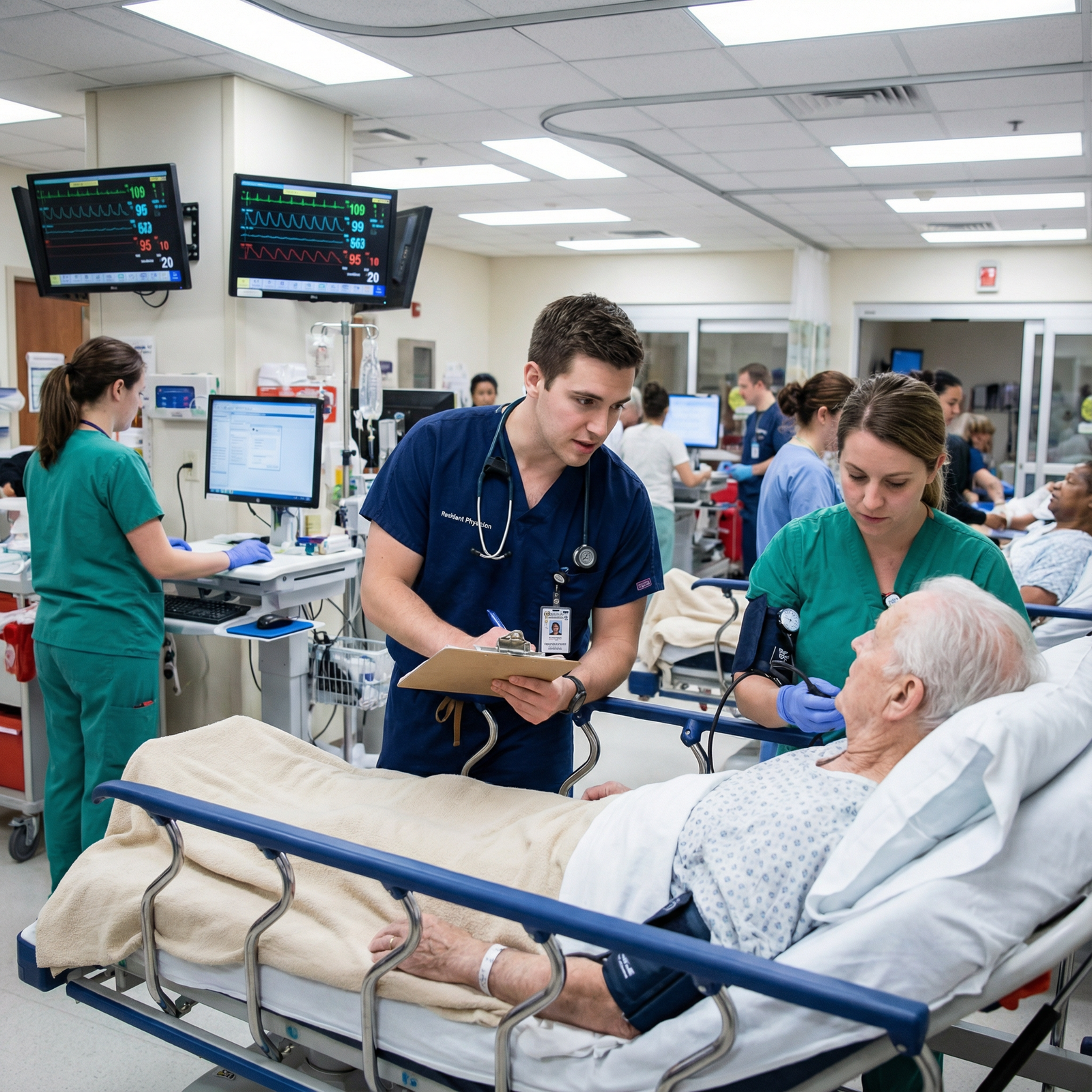
As a resident in Emergency Medicine or any acute care specialty, you practice at the intersection of high stakes, limited time, and incomplete information. Every shift, you are asked to make decisions that can change the course of a patient’s life—often in seconds, often without all the data you would like.
In this environment, clinical knowledge alone is not enough. Your ability to maintain mental agility, manage stress, and sustain resilience can be just as determinative as your ability to interpret an EKG or manage an airway. Understanding the psychology behind emergency response gives you tools to think clearly, act decisively, and protect your own well-being in the process.
This guide explores how mental agility, stress management, resilience training, and effective teamwork in healthcare come together to help you thrive—rather than simply survive—during residency on call and in the emergency department.
Understanding Mental Agility in Emergency Situations
Mental agility is the foundation of effective emergency response. It shapes how quickly and accurately you can assess situations, shift strategies, and execute plans when seconds count.
What Is Mental Agility in Emergency Medicine?
Mental agility is the capacity to think clearly, flexibly, and efficiently in rapidly changing, high-pressure situations. In Emergency Medicine, mental agility looks like:
- Rapidly integrating vital signs, history, and physical exam findings into a working diagnosis
- Prioritizing multiple patients and tasks under time constraints
- Shifting from one cognitive “mode” to another (e.g., from resuscitation to reassurance to disposition planning) without losing focus
- Updating your plan quickly as new information arrives—lab results, imaging, or a sudden patient deterioration
Mental agility is not about being perfect or never missing anything. It is about recognizing patterns, adapting quickly, and staying functional under stress.
Why Mental Agility Matters in Emergency Medicine
In high-acuity care, mental agility is not a bonus skill; it is a core competency.
Rapid Decision-Making: Emergencies often demand decisions in seconds—intubate or not, activate the cath lab, call a stroke alert, start vasopressors. Mental agility allows you to move from data to action without paralysis.
Cognitive Load Management: ED shifts and on-call nights bombard you with interruptions, competing priorities, and incomplete information. Mentally agile residents can triage cognitively, deciding what deserves full attention and what can wait.
Emotional Regulation Under Pressure: Stress, fear of failure, and emotional reactions to suffering can cloud judgment. Mental agility helps you acknowledge emotions without letting them control your decisions.
Adaptability to Unique Cases: No two emergencies are truly identical. Mentally agile clinicians can move beyond protocols when needed, tailoring management to each patient’s specific context.
A useful way to think about mental agility is to compare it with “mental rigidity.” Mental rigidity might show up as:
- Getting “locked in” on the first diagnosis and ignoring disconfirming data
- Over-reliance on checklists without considering atypical presentations
- Freezing when unexpected complications arise
Developing mental agility helps you avoid these traps and stay effective even when the script falls apart.
The Role of Stress and Pressure in Emergency Response
Stress in Emergency Medicine is inevitable. How you understand and manage that stress largely determines whether it sharpens your performance or undermines it.
The Physiology and Psychology of Acute Stress
In acute emergencies, your body activates the fight-or-flight response, driven mainly by the sympathetic nervous system:
- Increased heart rate and blood pressure
- Faster breathing
- Pupil dilation and heightened sensory alertness
- Release of adrenaline and cortisol
In short bursts, this physiological state can improve performance: faster reaction times, sharper focus, and increased energy. Many residents describe a “zone” or “flow” state during resuscitations that feels both intense and focused.
However, when stress is sustained or overwhelming, it can backfire:
- Cognitive Effects: Difficulty concentrating, tunnel vision, impaired working memory, slower information processing
- Emotional Effects: Anxiety, irritability, fear of making mistakes, imposter feelings
- Behavioral Effects: Rushing, skipping steps, over-ordering tests, communication breakdowns
Chronic exposure to unmanaged stress can contribute to burnout, depersonalization, and even medical errors.
Practical Stress Management Strategies for Residents
Managing stress in Emergency Medicine is not about eliminating it; it is about modulating it so it works for you. The following strategies align with evidence-based stress management and resilience training approaches.
1. Micro-Mindfulness in the Moment
You rarely have 20 minutes to meditate during a shift, but you almost always have 20 seconds.
Box Breathing (4–4–4–4):
- Inhale for 4 seconds
- Hold for 4 seconds
- Exhale for 4 seconds
- Hold for 4 seconds
Repeat for 3–4 cycles while walking between rooms or waiting on a lab result.
Grounding Technique (5–4–3–2–1):
- Name 5 things you can see
- 4 things you can feel
- 3 things you can hear
- 2 things you can smell
- 1 thing you can taste
This can quickly pull you out of spiraling thoughts and into the present moment.
Mindfulness-based interventions have been shown to reduce anxiety and increase focus among healthcare workers, making them powerful tools for stress management during residency.
2. Structured Micro-Breaks During Shifts
Even in the busiest ED, 30–60 second breaks can be built into your routine:
- Take a deliberate pause before starting a new consult: sip water, stretch, take three slow breaths
- Step away briefly after a code or difficult family conversation, if patient flow allows
- Use natural “waiting periods” (e.g., while pharmacy mixes a medication) to reset your breathing and posture
Short, intentional breaks help discharge accumulated stress, reduce cognitive fatigue, and sustain mental agility throughout long shifts.
3. Debriefing and Emotional Processing
Debriefing is more than a formality; it is a psychological necessity in high-acuity care.
Hot Debrief (Immediately After Event):
- Quickly review what happened, what went well, and what could be improved
- Allow team members to briefly share emotional reactions (“That was tough,” “I felt rushed when…”)
- Identify concrete system or communication changes
Cold Debrief (Later, Often with Faculty or Peers):
- Analyze the case in detail
- Reflect on emotional impact and lessons learned
- Normalize reactions and address guilt or self-blame when appropriate
Regular debriefing sessions foster a culture where emotional reactions are expected and processed rather than suppressed, which protects long-term mental health.
4. Off-Shift Stress Management Habits
What you do outside the hospital strongly influences how you function inside it:
- Exercise regularly (even short, high-intensity sessions)
- Keep a consistent sleep schedule when possible
- Maintain non-medical relationships and hobbies
- Use structured stress-management tools: journaling, therapy, peer-support groups
These practices help keep your baseline stress lower, making it easier to handle on-call surges and ED chaos.
Training for Mental Agility: From Simulation to Cognitive Skills
You can deliberately train mental agility just as you train procedural skills. Modern residency programs increasingly integrate simulation, cognitive training, and resilience training into their curricula.
Simulation-Based Training for Emergency Response
Simulation is one of the most powerful tools for preparing residents for real emergencies.
Benefits of Simulation in Emergency Medicine
Realistic Scenario Exposure:
- High-fidelity manikins and standardized patients can simulate cardiac arrest, trauma, sepsis, pediatric emergencies, and more.
- You can experience the psychological and cognitive demands of crisis care without putting real patients at risk.
Repetitive Practice Under Pressure:
- Repetition helps automate critical actions—running ACLS algorithms, giving a handoff, leading a trauma activation.
- As more steps become automatic, you free up mental bandwidth for higher-order decisions.
Safe Space for Error and Feedback:
- In simulation, errors become learning opportunities rather than adverse events.
- Faculty and peers can provide targeted feedback on decision-making, communication, and leadership.
Getting the Most Out of Simulation as a Resident
To maximize the mental agility benefits of simulation:
- Treat each case as if it were real, including emotional investment
- Verbally share your thought process (“I’m thinking this could be septic shock because…”)
- Ask specifically for feedback on cognitive aspects, not just procedures (“Did I anchor too quickly on PE?”)
- After each session, identify one mental skill to improve (e.g., speaking your plan aloud, checking vital signs before every major decision, using closed-loop communication)
Psychological and Cognitive Training for Residents
Beyond simulation, there are specific psychological tools that enhance performance under stress.
Cognitive-Behavioral Techniques (CBT) for Performance
CBT-based approaches can help you notice and reframe unhelpful thought patterns common in residency:
Catastrophic Thinking:
“If I miss this, I’ll kill someone and I’m not meant to be a doctor.”
→ Reframe: “This is a high-stakes situation, and I’m using my training and team to do my best. Medicine always carries risk; my job is to manage it thoughtfully.”All-or-Nothing Thinking:
“If I don’t know the answer immediately, I’m incompetent.”
→ Reframe: “Recognizing what I don’t know and asking for help is part of being a safe physician.”Personalization:
“The code went poorly; it’s my fault alone.”
→ Reframe: “Outcomes in critical illness are multifactorial. I can review what I controlled, learn from it, and improve without owning the entire outcome.”
Working with faculty mentors, mental health professionals, or peer groups trained in CBT principles can help you build these thought-reframing skills.
Formal Stress-Management and Resilience Workshops
Look for (or request) training that covers:
- Practical breathing and grounding techniques for in-shift stress
- Cognitive tools for handling self-criticism and perfectionism
- Sleep strategies for shift work and post-call recovery
- Communication skills for difficult conversations with families and colleagues
When approached seriously, these sessions become part of your resilience training toolkit, not “extra” content.
Teamwork in Healthcare: Communication, Roles, and Psychological Safety
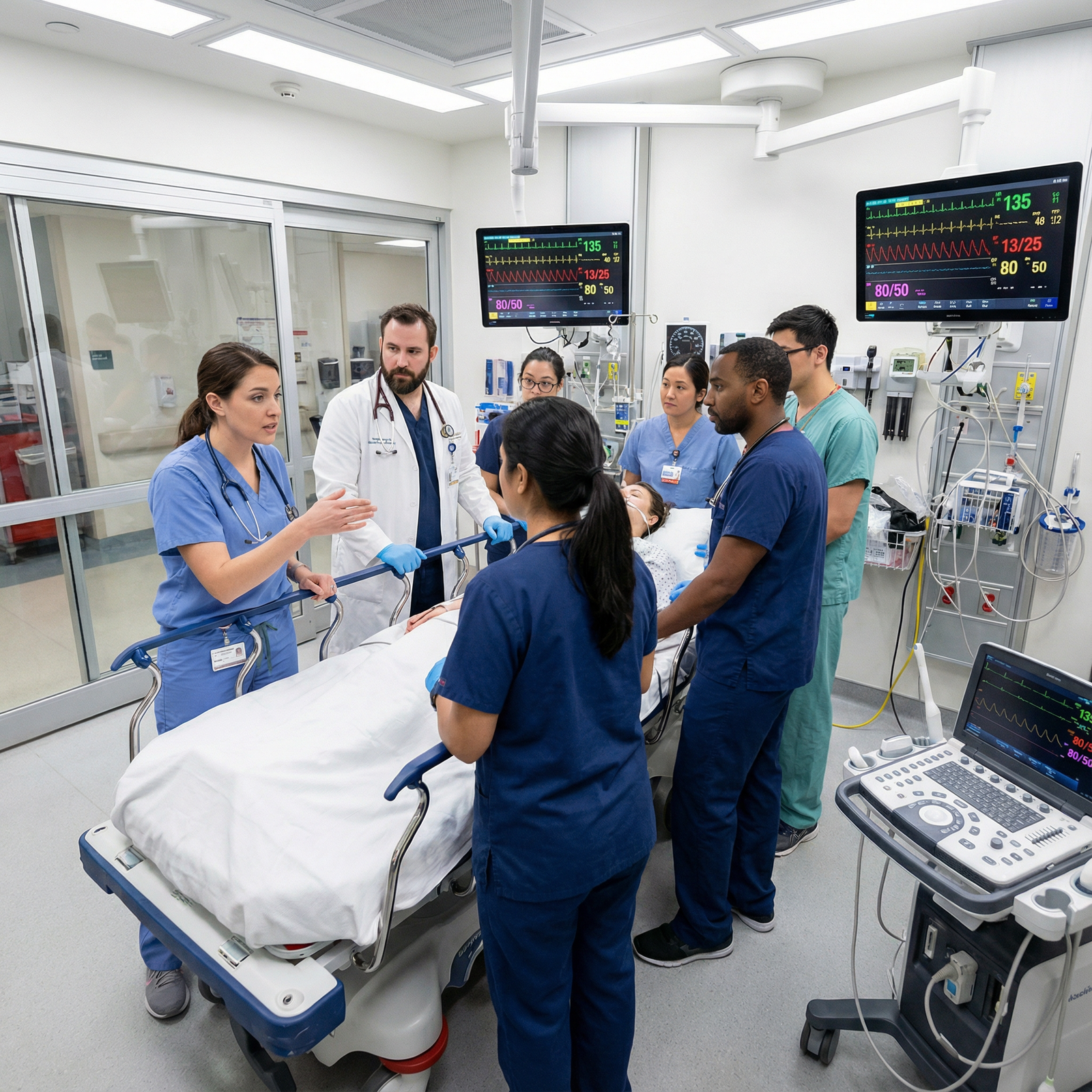
Even the most mentally agile resident cannot manage complex emergencies alone. Effective teamwork in healthcare multiplies your individual capabilities and buffers against cognitive overload.
High-Quality Communication in Emergencies
In multiprofessional teams, communication is often the difference between coordinated care and chaos.
Key communication principles in Emergency Medicine include:
Clear Role Assignment:
- Designate a team leader who stands back from the bedside to think and direct
- Assign specific roles (airway, compressions, medications, documentation, family liaison)
- Reconfirm roles when new team members arrive or circumstances change
Closed-Loop Communication:
- Leader: “Nurse Smith, give 1 mg epinephrine IV now.”
- Nurse: “Giving 1 mg epinephrine IV now.”
- Leader: “Thank you—epinephrine is in.”
Speak-Up Culture:
- Encourage all team members, regardless of hierarchy, to voice concerns (“I’m worried the rhythm changed,” “Do we want to recheck the glucose?”)
- As resident, model openness to feedback—thank nurses or students when they catch something
Collaborative Strategies to Enhance Team Performance
Residents can actively build better team functioning:
Interdisciplinary Team Drills
- Practice mock codes, trauma activations, and sepsis alerts with nurses, RTs, pharmacists, and techs
- Focus not only on algorithms but also on communication: who leads, how information is shared, and how to handle evolving situations
Non-Clinical Team-Building
- Participate in informal gatherings, wellness events, or cross-discipline teaching sessions
- Knowing your colleagues beyond their roles increases trust when the ED gets hectic
Psychological Safety in the ED
- Psychological safety means team members feel safe to speak up, admit uncertainty, and acknowledge mistakes
- As a resident, you can foster this by:
- Asking for input (“Anything I’m missing?”)
- Admitting your own learning edges
- Thanking others when they voice concerns or corrections
Strong teamwork lightens your cognitive and emotional load, making mental agility more sustainable over time.
Building and Sustaining Resilience as a Resident
Resilience is not about being unaffected by the stress and suffering you witness; it is about your ability to recover, learn, and continue to grow in the face of that stress.
The Psychology of Resilience in Emergency Medicine
In the residency context, resilience includes:
- Maintaining performance under repeated exposure to critically ill patients and high workload
- Bouncing back after difficult cases, complications, or errors
- Integrating adverse experiences into your professional identity in a healthy way, rather than becoming numb or overwhelmed
- Recognizing when you need support—and seeking it
Research on resilience in healthcare highlights that it is not solely an individual trait; it is also shaped by systems, culture, and leadership. Still, there are personal strategies you can use to strengthen your own resilience.
Practical Tactics to Enhance Resilience During Residency
1. Fostering a Supportive Environment
- Identify peers you can be honest with about your struggles
- Seek out attendings who model vulnerability and share their own learning moments
- Advocate for protected debriefing time after major events when it is feasible
A culture that normalizes asking for help reduces shame and isolation—both key to long-term resilience.
2. Maintaining an Identity Beyond Medicine
Residency can easily become all-consuming, but narrowing your identity solely to “doctor” makes every mistake feel like a threat to your entire self.
- Maintain at least one non-medical activity (music, sports, reading, art, gaming, family time)
- Protect small routines that anchor you—coffee with a partner, weekly phone call with a friend, one hobby session per week
These are not luxuries; they are protective factors against burnout.
3. Practicing Gratitude and Meaning-Making
Simple gratitude practices can reinforce your sense of purpose:
- After shifts, note 1–3 things that went well—no matter how small
- Keep a “wins” folder: patient thank-you notes, positive feedback, or memorable learning moments
- Reflect periodically on why you chose medicine and what aspects of patient care feel most meaningful to you
These practices counterbalance the brain’s natural tendency to fixate on negative events and perceived failures.
4. Knowing When to Seek Professional Help
Resilience is not about toughing everything out alone. Warning signs that you may benefit from professional support include:
- Persistent sleep disturbance unrelated to shift schedule
- Emotional numbing or cynicism toward patients
- Frequent intrusive thoughts about particular cases
- Difficulty enjoying anything outside of work
- Thoughts of self-harm or wishing you would not wake up
Accessing mental health resources—resident counseling services, employee assistance programs, or an outside therapist—is an act of professional responsibility, not weakness.

Frequently Asked Questions (FAQ)
1. What does “mental agility” specifically look like in an emergency department shift?
Mental agility on a busy ED shift includes:
- Rapidly generating and updating differential diagnoses as new information arrives
- Switching between patients and tasks without losing track of key details
- Recognizing when your initial impression might be wrong and pivoting accordingly
- Communicating clearly with team members while simultaneously processing complex information
It is not about always having instant answers; it is about staying mentally flexible, curious, and responsive to changing conditions.
2. How can I practice stress management when the ED is too busy for long breaks?
Use micro-strategies that fit into the natural flow of your shift:
- Take 3 slow, deep breaths before entering each new patient room
- Use brief pauses (e.g., waiting for labs, walking down the hallway) to scan your body for tension and relax your shoulders and jaw
- After a high-intensity event, ask for 30–60 seconds to reset if patient volume allows—even that short pause can help
Over time, these small habits accumulate, lowering overall stress and supporting mental agility.
3. How does teamwork in healthcare affect my individual performance as a resident?
High-functioning teams:
- Distribute cognitive load: you do not have to remember everything or do it all yourself
- Catch errors or omissions before they reach the patient
- Provide real-time feedback and support, which improves decision-making
In contrast, poor teamwork increases cognitive and emotional strain, making it harder to think clearly, manage stress, and perform optimally.
4. What are practical ways to build resilience during residency without adding more to my already full schedule?
Integrate small, sustainable practices into your existing routine:
- During your commute, reflect briefly on one thing you learned and one thing that went well
- Before bed, write down one non-medical activity you want to protect that week
- Once a week, check in with a co-resident and ask honestly, “How are you really doing?”
These small, consistent actions often have more impact than sporadic, intensive efforts.
5. How can I recover mentally after a bad outcome or medical error?
While every situation is unique, helpful steps often include:
- Debrief the case with your team and/or attending—focus on both system factors and individual actions.
- Allow emotional reactions rather than immediately suppressing them; talk with trusted peers, mentors, or professionals.
- Identify specific learning points—what you would do differently next time—and integrate them into your practice.
- Avoid global self-condemnation (“I’m a terrible doctor”) and focus instead on specific, actionable changes.
Most experienced Emergency Medicine physicians carry some difficult cases with them; the goal is to let those experiences shape you without defining you.
By understanding the psychology of emergency response—and deliberately cultivating mental agility, stress management skills, resilience, and effective teamwork—you can not only provide better care to your patients, but also protect your own well-being throughout residency and beyond.