
Introduction: Why Crisis Communication Matters on Call
In residency, it often feels like crises find you at 3 a.m. Code blues, massive traumas, deteriorating patients, IT outages, disaster alerts—these moments don’t just test your medical knowledge, they test your ability to communicate clearly under pressure.
In the fast-paced world of healthcare, Crisis Communication is not a “soft skill”; it is a core clinical competency. How you relay information in emergencies directly affects patient safety, team collaboration, and the hospital’s overall emergency management response. Poor or delayed communication can turn a manageable situation into chaos. Clear, timely messaging can stabilize care, calm teams, and save lives.
This enhanced guide is designed specifically for medical students, interns, and residents navigating on-call survival and the realities of residency life and challenges. You’ll learn practical principles, concrete strategies, and realistic examples you can apply on your next shift—whether you’re calling a rapid response, managing multiple sick patients overnight, or coordinating with disaster teams during a mass casualty event.
The High Stakes of Crisis Communication in Healthcare
How Communication Shapes Outcomes in Emergencies
During an emergency, you are not just managing a patient—you’re managing time, information, and people. Effective crisis communication helps:
Protect patient safety
- Ensures that everyone has accurate, up-to-date information
- Reduces delays in delivering life-saving interventions
- Prevents harmful errors such as duplicate medications, missed allergies, or mis-triaged patients
Strengthen team collaboration
- Aligns roles and expectations during codes, rapid responses, or mass casualty incidents
- Reduces “bystander” effect—people know what to do and when
- Lowers interpersonal friction when stress is high
Improve emergency management at the system level
- Coordinates triage, staffing, and resource allocation (beds, blood, ventilators)
- Facilitates communication between ED, ICU, OR, radiology, lab, and hospital leadership
- Enables faster, more organized escalation when the situation worsens
Maintain trust—from patients to the public
- Families feel informed rather than left in the dark
- Staff feel supported rather than abandoned in crisis
- Institutions that communicate transparently are perceived as safer and more competent
Resident-Specific Challenges in Emergencies
As a resident, you are often:
- The first to recognize deterioration and activate help
- The information hub between bedside nurses, consultants, and attendings
- The person who must translate complex medical data into understandable language for families
- The junior leader expected to maintain composure while still learning
Common pitfalls at this level include:
- Overloading your message with irrelevant details
- Assuming others know the same background you do
- Forgetting to close the loop (“Who is doing what by when?”)
- Not speaking up because you’re worried about being wrong
The good news: these are all learnable skills. With structure and practice, you can become a reliable communicator in any crisis.

Core Principles of Effective Crisis Communication
These foundational principles apply across all healthcare emergencies—from an unstable ICU patient to a hospital-wide disaster. Think of them as your mental checklist whenever the situation escalates.
1. Clarity: Be Unambiguous and Direct
In a crisis, people don’t have bandwidth for complexity. Clear, plain language is safer than elegant, technical explanations.
Practical tips:
- Lead with the most critical information:
- “BP is 70/40 and dropping,” not “He’s been a little hypotensive over the last hour.”
- Use direct statements instead of hedging:
- “We need to intubate now,” not “I’m a bit concerned about his airway.”
- Avoid unexplained abbreviations when speaking across disciplines:
- Spell out less common terms; don’t assume everyone shares your jargon.
- When speaking to families or non-clinical staff, use non-technical terms:
- “His heart stopped; we are doing CPR to try to restart it,” not “He’s in PEA arrest.”
2. Conciseness: Say What Matters, First
Emergencies compress time. Every second spent on irrelevant details is time taken from action.
Focus on:
- What is happening right now
- How urgent it is
- What you need from the listener
A useful mental model: headline → key facts → specific ask.
Example when calling a rapid response nurse:
- Headline: “This is the night float on 6 West. I have a patient with new-onset chest pain and hypotension.”
- Key facts: “Fell from 120/70 to 80/40 over 10 minutes; HR 120; oxygen saturation 90% on 4L; history of MI last year.”
- Ask: “I need rapid response at bedside now and EKG on the way.”
3. Timeliness: Communicate Early and Often
In emergencies, waiting for the “full picture” can be dangerous. Partial but accurate early information is better than late perfection.
Actionable practices:
- Escalate early if your gut says something is wrong:
- “I don’t know exactly what’s happening yet, but this patient is not okay and I need help.”
- Give iterative updates:
- “Trauma bay: ETA 5 minutes for two critical patients, details evolving—will update again in 2 minutes.”
- Don’t wait to call the attending until “you’ve tried everything” when the patient is crashing.
4. Reassurance: Communicate Calm and Control
Your tone affects team performance and family anxiety. Reassurance is not about pretending everything is fine; it’s about conveying structure, competence, and a plan.
With the team:
- Acknowledge the crisis: “This is a sick patient, but we’ve handled this before.”
- State the plan: “We’ll stabilize the airway, then circulation, then reassess.”
- Normalize speaking up: “If you see anything concerning, say it out loud.”
With patients and families:
- Validate emotions: “I can see this is very frightening.”
- Be honest but hopeful: “He is very sick. We are doing everything we can right now, and I’ll keep you updated frequently.”
- Give time anchors: “I’ll come back with an update in about 20 minutes.”
5. Feedback and Closed-Loop Communication
In a crisis, it’s unsafe to assume your message was heard and understood. You need closed-loop communication, where:
- The sender gives a clear instruction.
- The receiver repeats it back.
- The sender confirms or corrects.
Example in a code:
- “Nurse Smith, please push 1 mg epinephrine IV now.”
- “Pushing 1 mg epinephrine IV now.”
- “Confirmed, 1 mg epi IV now.”
For critical information handoffs, ask people to teach-back:
- “Can you repeat back the key changes in his status and the plan so we’re sure we’re aligned?”
High-Reliability Strategies for Crisis Communication
To move from “trying your best” to reliably effective communication, use structured tools and systems that have been proven in healthcare and high-risk industries.
1. Use Structured Communication Tools (SBAR, Checklists, Scripts)
The SBAR framework is the most widely used structured communication tool in healthcare:
- S – Situation: What is happening now?
- B – Background: What led to this?
- A – Assessment: What do you think is going on?
- R – Recommendation: What do you need or propose?
Example: Calling the ICU fellow from the floor
- S: “I’m calling about Mr. Lee in room 505. He’s acutely hypotensive and tachycardic.”
- B: “He’s a 68-year-old with sepsis from pneumonia, on broad-spectrum antibiotics; was stable on the floor the past 12 hours.”
- A: “Over the last 30 minutes his BP dropped from 110/70 to 80/40, HR 125, increased work of breathing, lactate trending up.”
- R: “I’m concerned he’s in septic shock. I recommend ICU evaluation for transfer and guidance on pressors. Can you come to the bedside now?”
Other helpful tools:
- Checklists (e.g., for intubation, massive transfusion)
- Standardized pages/calls (templates for calling consults or rapid responses)
- Pre-brief and debrief scripts during codes or mass casualty incidents
The more you use these tools during normal operations, the easier they become in true emergencies.
2. Establish and Respect a Clear Chain of Command
In emergencies, ambiguity about who is leading and who decides creates delays and conflict. A functional chain of command:
- Identifies a clear incident leader (often the senior resident, attending, or trauma team leader)
- Clarifies roles (airway, compressions, medications, documentation, family communication)
- Defines who communicates with:
- Nursing supervisors
- OR, ICU, ED
- Hospital incident command (in large-scale events)
As a resident:
- If you are the most senior person present initially, assume leadership until relieved:
- “I’m Dr. X, I’ll lead until the ICU team arrives. Let’s quickly assign roles.”
- Once leadership is transferred, announce it clearly:
- “Dr. Y is now the team leader; please direct all updates to them.”
3. Practice Active and Structured Listening
Effective crisis communication is not just about speaking. Active listening ensures you actually understand what others are telling you.
Tactics:
- Face the speaker when possible; minimize multitasking for critical exchanges.
- Use short verbal markers: “Okay,” “Got it,” “I hear that his pressure is still falling.”
- Summarize and verify:
- “So we’ve given 2 liters of fluids, started norepinephrine, and his MAP is still 55. Is that right?”
- Ask clarifying questions early:
- “When you say he looks worse, what specifically changed?”
Good listening reduces duplicated efforts, missed data, and confusion—especially when multiple teams are involved.
4. Leverage Technology for Real-Time Updates and Coordination
Modern emergency management in hospitals depends heavily on technology. As a resident, you can use these tools to improve information flow:
- Hospital communication systems / secure messaging apps
- Rapidly alert multiple team members or services
- Share critical updates: “Bed 7 just intubated, awaiting CT,” etc.
- Mass notification systems
- Activate code triage (disaster), code stroke, STEMI alerts, etc.
- Shared dashboards/whiteboards
- Track bed status, incoming traumas, pending imaging, lab results
- EHR alerts and order sets
- Standardize responses (e.g., sepsis bundles, massive transfusion protocols)
Key point: Technology is a tool, not a substitute for clarity. Always back up critical electronic messages with verbal confirmation when stakes are high.
5. Train for Crises Before They Happen: Simulation and Drills
The worst time to practice crisis communication is during a real crisis. High-performing teams invest in simulation training.
What you can do as a resident:
- Actively participate in:
- Mock codes
- Trauma simulations
- Disaster drills
- Rapid response scenarios
- During simulations, deliberately:
- Lead with SBAR
- Assign roles out loud
- Use closed-loop communication
- Practice talking to a distressed family member or calling a consultant
- Afterward, engage fully in the debrief:
- “What did we communicate well?”
- “Where did communication break down?”
- “What will I say differently next time?”
Treat every real emergency as a learning opportunity: mentally debrief yourself afterward and, when appropriate, with your team.
Real-World Application: A Multi-Casualty Trauma Scenario
Consider a multi-car highway collision with numerous casualties heading toward your hospital. You’re the senior resident on call covering the ED trauma bay.
1. Pre-Arrival: Building Situational Awareness
The EMS dispatcher calls with an early report using SBAR:
- Situation: “We have a multi-vehicle collision with at least six injured patients.”
- Background: “High-speed highway crash, multiple ejections, one trapped in vehicle.”
- Assessment: “Two are critical: one with suspected head injury and hypotension, one with chest trauma and respiratory distress.”
- Recommendation: “Prepare at least two trauma bays and possible OR availability.”
You relay this to your team concisely:
- “We’re getting at least six trauma patients, two likely critical. Let’s open four trauma bays, activate trauma and OR, and notify blood bank for possible massive transfusion.”
You also notify charge nurses, radiology, and the ICU: timely, anticipatory communication.
2. On Arrival: Structured Team Communication
You quickly establish and announce:
- “I’m Dr. Patel, ED senior. I’ll lead until the trauma attending arrives. Let’s assign roles now…”
As patients arrive:
- You request brief, structured EMS handoffs at each bedside.
- A scribe documents events and times.
- You use closed-loop communication:
- “Respiratory, secure the airway—please confirm once the tube is in.”
- “Nurse Kim, please start the massive transfusion protocol on Patient 1 now.”
- You coordinate with radiology:
- “CT, we have two critical patients; first will be head and neck, second chest and abdomen. We’ll call again as they’re rolling up.”
3. Ongoing Updates and Chain of Command
A trauma attending arrives and assumes leadership. You clarify this verbally to the team.
You then:
- Communicate with the OR about timing for emergent surgery.
- Update ICU about likely admissions and ventilator needs.
- Provide brief, honest updates to families:
- “Your son is very badly injured and we’re doing everything we can to stabilize him. I’ll return in 20 minutes with more information.”
Throughout, you keep the feedback loop open:
- Short, frequent team huddles:
- “Quick check-in: any critical issues we haven’t addressed? Any bottlenecks we’re missing?”
The difference between chaos and coordination in this scenario hinges on clear Crisis Communication, team collaboration, and adherence to structured processes.
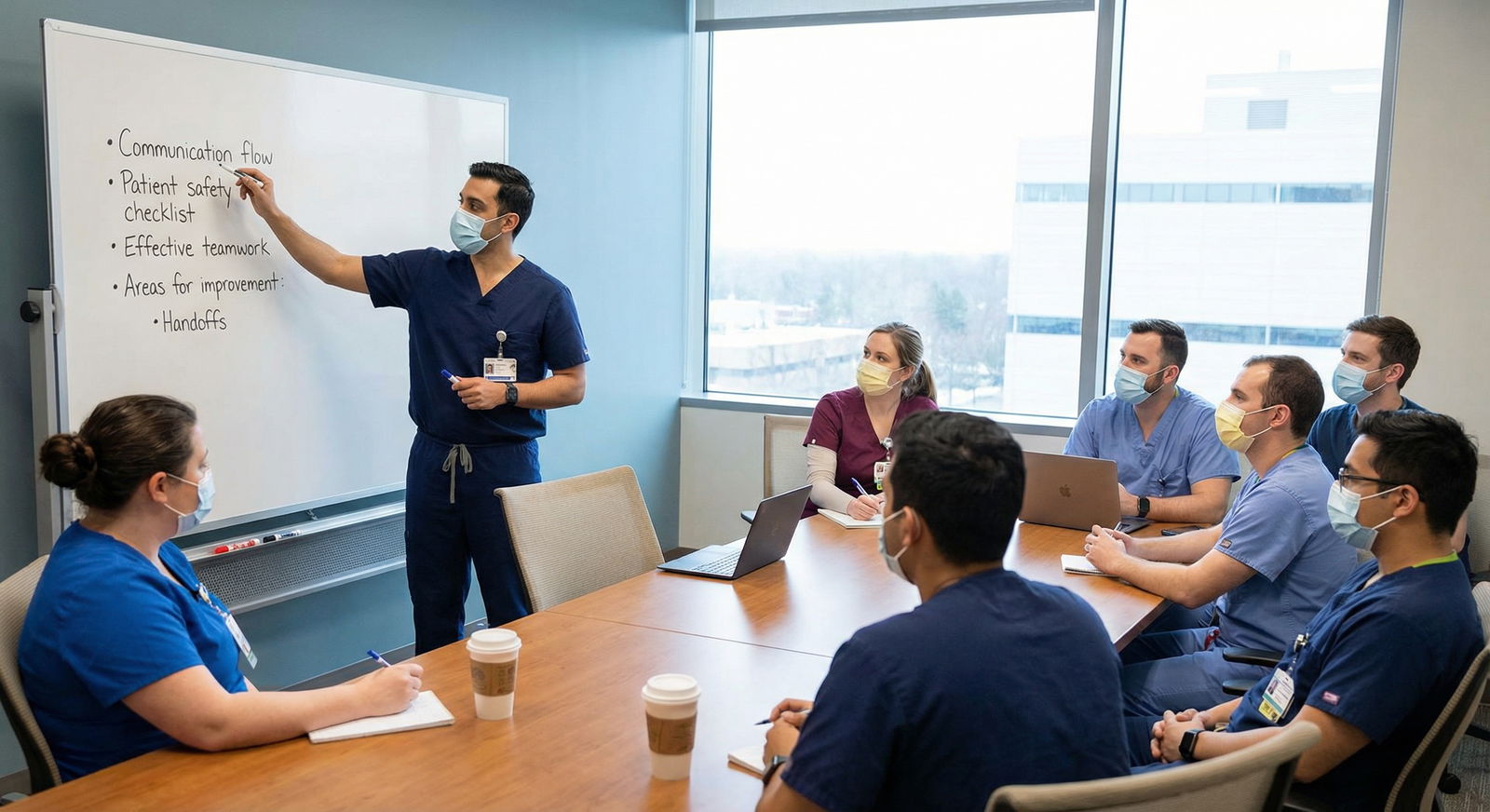
Practical Tips for Residents: Communicating Under Pressure
Build a Personal Crisis Communication “Playbook”
You can consciously develop habits that make you more effective when adrenaline is high:
- Have go-to opening phrases:
- “I’m concerned about…”
- “This is an emergency because…”
- “Here’s the key information you need…”
- Standardize your consult calls:
- Use SBAR; write a short template on your note card or phone.
- Clarify expectations early on call:
- Ask your attending how they prefer to be called at night:
- “At what point do you want to be notified for a deteriorating patient?”
- Ask your attending how they prefer to be called at night:
Manage Your Own Stress to Communicate Better
High stress narrows attention and can degrade communication. Countermeasures:
- Take one deliberate deep breath before speaking in a high-stakes moment.
- Mentally organize your message: “S–B–A–R” in your head before dialing.
- If you feel overwhelmed, say:
- “Give me 5 seconds to think,” then pause—this is safer than speaking in confusion.
Advocate for Patient Safety, Even When It’s Uncomfortable
Crisis Communication includes speaking up when something doesn’t feel right:
- Use graded assertiveness if needed:
- “I’m concerned…”
- “I’m uncomfortable…”
- “This is unsafe because…”
- If unclear orders are given in an emergency, ask respectfully:
- “Just to clarify, you’re asking for 1 mg, correct? Not 0.1?”
These communication behaviors reduce error risk and improve Patient Safety, even in hierarchies.
Frequently Asked Questions (FAQ)
1. Why is crisis communication so critical in healthcare emergencies?
Crisis communication is essential because time, information, and coordination are all compressed during emergencies. Clear, timely communication:
- Reduces medical errors and adverse events
- Improves response times for life-saving interventions
- Ensures that all team members are aligned on priorities and roles
- Supports better patient outcomes and safer care environments
In short, how well you communicate often matters as much as which treatment you choose.
2. How can I quickly improve my crisis communication skills as a resident?
You can make meaningful improvement by:
- Practicing SBAR on every significant phone call, not just in crises
- Volunteering to give brief patient summaries during rounds and codes
- Asking for feedback from nurses, co-residents, and attendings:
- “Was my handoff clear? What could I have done better?”
- Participating in simulation training and treating it seriously
- Observing senior clinicians who communicate well in emergencies and deliberately copying their phrasing and structure
3. What should I do if people don’t seem to understand me during a crisis?
If your message isn’t landing:
- Slow down and simplify your language.
- Ask for teach-back: “Can you tell me what you heard as the plan?”
- Break complex instructions into one or two steps at a time.
- Reduce background noise or move to a quieter space for critical calls.
- Use closed-loop communication: ensure every key task is assigned, repeated, and confirmed.
Misunderstandings in emergencies are common—and dangerous. Address them explicitly rather than hoping they’ll resolve on their own.
4. How does technology help—and sometimes hurt—crisis communication?
Technology supports crisis communication by:
- Sending rapid alerts to large groups (e.g., code stroke, disaster notifications)
- Sharing real-time data (vitals, imaging, lab results)
- Providing standardized order sets and protocols for emergency conditions
However, it can hinder communication when:
- Over-reliance on messaging replaces necessary direct verbal discussion
- Alert fatigue causes people to ignore or silence notifications
- Systems go down, and teams have no backup plan
Use technology as a supplement to, not a replacement for, clear human communication.
5. What role does team collaboration play in effective crisis communication?
Team collaboration and crisis communication are tightly linked:
- Good communication enables collaboration:
- Clear roles, mutual expectations, and shared goals
- Collaboration reinforces communication:
- Multiple team members cross-check information and catch errors
- High-trust teams feel safer speaking up, asking questions, and offering alternative perspectives—crucial for complex emergencies
Residents who facilitate both information flow and psychological safety become invaluable in high-stakes situations.
By deliberately practicing these principles and strategies, you can transform Crisis Communication from a source of anxiety into a strength. In the unpredictable world of on-call medicine, your ability to relay information clearly, quickly, and confidently is one of the most powerful tools you have to protect patients, support colleagues, and navigate the toughest moments of residency.