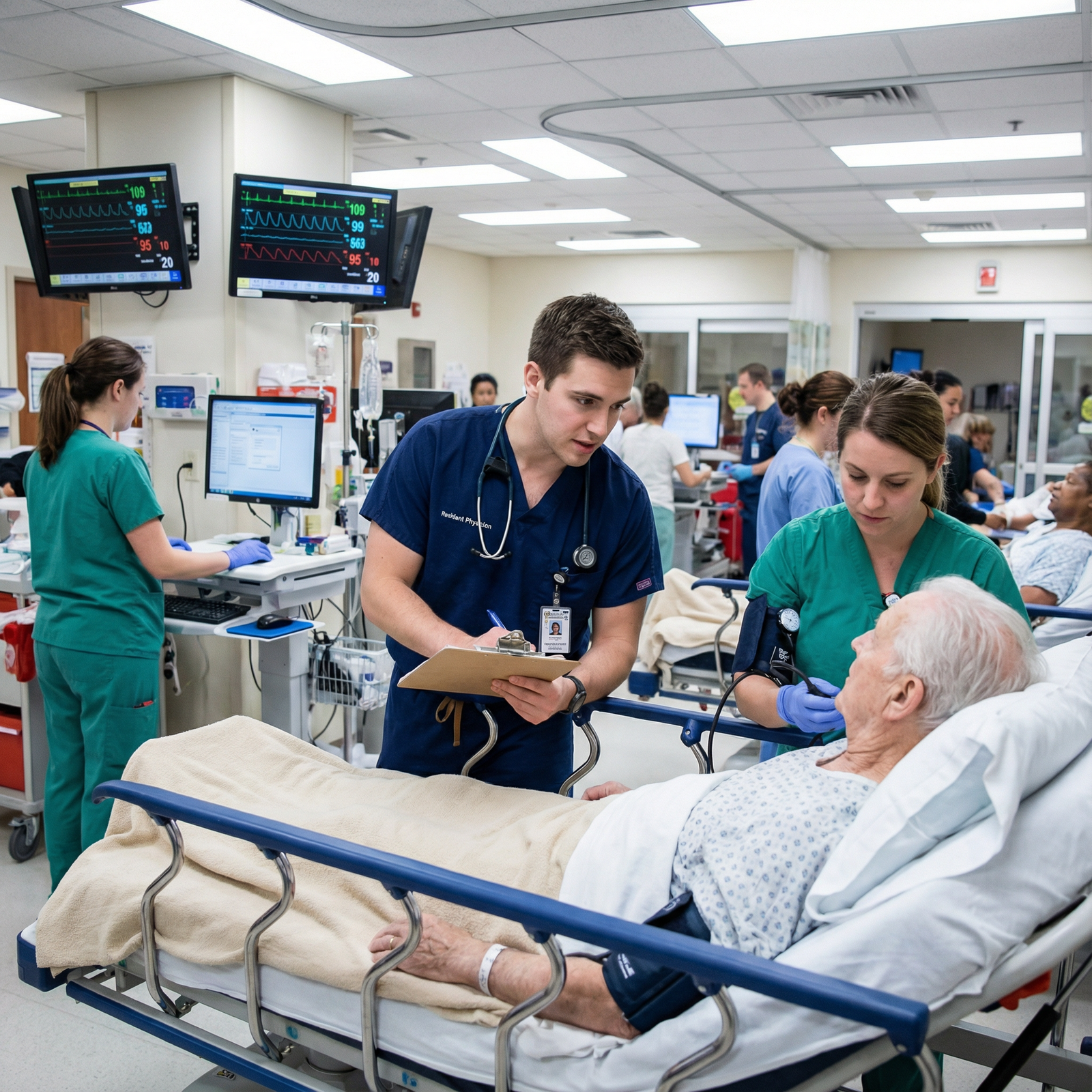
Understanding Triage: The Foundation of Patient Prioritization
Triage is one of the most important Healthcare Skills you will use as a resident, particularly in Emergency Medicine and acute care settings. It is the structured process of rapidly assessing patients and prioritizing Patient Care when time, staff, and resources are limited.
The term “triage” comes from the French word trier—to sort or select. At its core, triage is about answering three urgent questions quickly and safely:
- Who needs help right now to survive?
- Who can safely wait?
- Who is unlikely to benefit from immediate intervention, given the current resources?
From the perspective of Residency Life and Challenges, triage is not just a protocol—it is a daily reality. Whether you are on call in the ED, covering the wards overnight, responding to rapid responses, or working in disaster scenarios, how you triage directly influences outcomes, patient flow, team workload, and even medicolegal risk.
This expanded guide will help you:
- Understand what triage is and why it matters
- Compare common triage systems used in hospitals and in the field
- Walk through a stepwise triage process you can apply on shift
- Recognize common pitfalls and challenges
- Develop a practical approach to improving your triage skills during Medical Training
What Is Triage and When Do You Use It?
Core Definition: Triage in Modern Healthcare
Triage is the systematic assessment, categorization, and prioritization of patients based on the severity of illness or injury and the expected benefit from timely intervention. It is used whenever demand exceeds capacity—which, in many emergency departments, is almost all the time.
Although it is most often associated with Emergency Medicine, triage principles apply in many clinical environments:
- ED triage on arrival
- ICU and step-down bed allocation
- Operating room and procedural scheduling in resource-constrained settings
- Disaster medicine and mass casualty incidents
- Telephone and telemedicine encounter screening
- Night float or cross-cover decisions about which page or patient to see first
Situations Where Triage Is Critical
You will rely heavily on triage skills in:
Crowded Emergency Departments
- Dozens of patients waiting to be seen
- Limited monitored beds and staff
- Need to recognize the “sick but silent” patient among many stable ones
Mass Casualty Incidents (MCIs)
- Natural disasters (earthquakes, hurricanes, tornadoes)
- Transportation accidents (bus, train, plane crashes)
- Fires, explosions, or mass violence events
- Here, the number of patients can rapidly overwhelm available resources, and rapid, standardized triage may literally determine who lives or dies.
Resource-Limited or Rural Settings
- Limited imaging, specialists, or ICU capacity
- Longer transfer times
- High value on early recognition of deterioration
Inpatient and On-Call Situations
- You receive multiple pages at once:
- A patient with new chest pain
- Another with a low urine output
- A post-op patient with tachycardia
- You must decide whom to see first and what can safely be delegated, handled by phone, or delayed.
- You receive multiple pages at once:
Through residency, triage becomes less about memorizing systems and more about pattern recognition, prioritization, and risk management under pressure.
Why Triage Matters: Impact on Patient Care and Systems

Optimizing Resource Allocation
In any hospital, resources are finite: monitors, beds, ventilators, staff, operating rooms, imaging slots. Effective triage ensures that:
- Critically ill patients get faster access to life-saving interventions
- Stable patients are managed safely without overusing high-acuity resources
- The team avoids “logjams” where one complex case consumes disproportionate attention
As a resident, this might look like:
- Moving a borderline patient to a monitored bed instead of a hallway stretcher
- Calling ICU early for a septic patient rather than waiting until they crash
- Deciding that an ankle sprain can wait while you see a patient with chest pain
Enhancing Patient Safety
Good triage:
- Identifies time-sensitive emergencies (e.g., STEMI, stroke, sepsis, trauma, airway compromise)
- Decreases time to critical interventions (thrombolysis, antibiotics, airway management, hemorrhage control)
- Minimizes the risk that a “quietly sick” patient waits too long
Poor triage can lead to:
- Missed or delayed recognition of life-threatening illness
- Clinical deterioration in the waiting room, hallway, or general floor
- Adverse outcomes and increased mortality
Supporting Legal and Ethical Accountability
A documented, standardized triage process can help demonstrate that:
- Patients were assessed in a timely and systematic way
- Decisions were consistent with accepted standards and protocols
- Resource limitations and constraints were recognized and managed transparently
This is crucial in:
- Mass casualty events
- Overcrowded EDs with long waits
- Situations where a patient deteriorates after an initial triage decision
Improving Workflow and Team Efficiency
When triage is done well:
- Wait times and length of stay are reduced
- Staff can work at the top of their license, focusing effort appropriately
- Communication across nursing, residents, attendings, and consultants is clearer
- Burnout may be mitigated by reducing chaos and preventable crises
For residents, mastering triage is also a career skill—attendings and program leadership quickly notice who can keep calm, prioritize well, and keep the department or service moving safely.
Common Triage Systems You’ll Encounter in Training
There are many triage models; understanding the major ones will help you adapt quickly across rotations, hospitals, and scenarios.
1. Simple Triage and Rapid Treatment (START)
Setting: Pre-hospital and Mass Casualty Incidents
START is designed for speed—you spend seconds, not minutes, on each patient.
Patients are assessed using the RPM mnemonic:
- Respirations
- Perfusion
- Mental status
They are quickly categorized into four groups:
Immediate (Red)
- Life-threatening injuries requiring rapid intervention
- Breathing >30/min, cap refill >2 sec or no radial pulse, unable to follow commands
Delayed (Yellow)
- Serious but not immediately life-threatening
- Can wait without significant risk of deterioration
Minor (Green)—“Walking Wounded”
- Able to walk, minor injuries
- Often gathered in a separate area to free resources
Deceased/Expectant (Black)
- No respirations after airway repositioning
- In severe resource limitation, those unlikely to survive may be categorized as expectant
As a resident, you may encounter START in:
- Disaster drills
- Pre-hospital collaboration
- Emergency Medicine or EMS rotations
2. Emergency Severity Index (ESI)
Setting: Hospital Emergency Departments
ESI is a five-level triage tool used widely in the U.S.:
- ESI 1 – Immediate, life-saving intervention needed
- Examples: cardiac arrest, apnea, severe respiratory distress, active seizures, unresponsiveness
- ESI 2 – High risk, confused/lethargic/disoriented, severe pain or distress
- Examples: possible STEMI, stroke symptoms, sepsis features, suicidal with plan
- ESI 3 – Needs many resources but hemodynamically stable
- Examples: abdominal pain needing imaging and labs, moderate asthma
- ESI 4 – One resource needed
- Example: laceration needing sutures, isolated fracture needing x-ray
- ESI 5 – No resources needed
- Example: simple medication refill, staple removal
ESI combines:
- Acuity (how “sick” right now)
- Expected resource needs (labs, imaging, consults, procedures)
Understanding ESI helps you:
- Predict which patients need you now versus later
- Anticipate disposition and resource usage
- Communicate urgency to consulting services
3. Triage Risk Assessment Tools in Outpatient and Telehealth
In clinics, call centers, and telemedicine, structured triage risk tools (similar to TRAT or nurse triage protocols) guide decisions on:
- Same-day versus routine appointments
- Advice for home care versus ED referral
- Need for immediate EMS activation
You may use:
- Symptom-based algorithms (e.g., chest pain, shortness of breath, fever in infants)
- Standardized questionnaires for mental health crises
4. Military and Tactical Triage
Setting: Battlefield, tactical EMS, austere environments
Military triage:
- Focuses on returning the greatest number of personnel to function as rapidly as possible
- Uses principles like:
- Care under fire versus tactical field care
- Rapid hemorrhage control (tourniquets, hemostatic dressings)
- “Scoop and run” to higher echelon care
While you may not practice battlefield medicine in residency, military triage illustrates extreme resource-constrained decision-making—valuable conceptual training for disaster medicine and crisis standards of care.
A Practical Triage Process: Step-by-Step for Residents
Regardless of system, a sound triage process follows consistent stages. As a resident, you will often be doing “secondary triage” after an initial nurse or pre-hospital triage, reassessing and upgrading or downgrading based on your exam and clinical judgment.
Step 1: Rapid Initial Assessment – “Is This Patient About to Die?”
Your first priority is to identify patients needing immediate stabilization.
Use an ABCDE approach:
- A – Airway: Is it open? Is there obstruction, stridor, gurgling, inability to speak?
- B – Breathing: Rate, work of breathing, oxygen saturation, symmetry, audible wheeze or crackles
- C – Circulation: Pulse, blood pressure, skin color and temperature, obvious bleeding
- D – Disability (Neuro): Level of consciousness, orientation, focal deficits, seizure activity
- E – Exposure/Environment: Significant trauma, burns, rash (e.g., meningococcal, anaphylaxis), temperature issues
If any immediate life threat is present, the patient is top priority—start stabilization and call for help simultaneously.
Step 2: Categorize Acuity
Apply the appropriate system (e.g., ESI in the ED) and decide:
- High acuity: needs life-saving or time-sensitive intervention now or within minutes
- Moderate acuity: needs evaluation and multiple resources but is currently stable
- Low acuity: can safely wait and might need minimal workup
Key actions:
- Assign a category (e.g., ESI level)
- Document why (e.g., chest pain with hypotension, suspected sepsis, isolated minor trauma)
Step 3: Document Clearly and Efficiently
Good documentation should include:
- Time of your assessment
- Key vital signs
- Red flag symptoms or exam findings
- Triage category and immediate plan
- Any escalation (e.g., “Discussed with ED attending, ICU aware”)
In crowding or disaster situations, documentation may be brief, but it must:
- Be legible
- Capture the core clinical reasoning
- Support handoffs to other providers
Step 4: Reassess and Re-Triage
Triage is dynamic, not a one-time decision.
Patients can:
- Deteriorate while waiting
- Improve after initial treatment
- Reveal new information (e.g., lab results, imaging) that changes risk stratification
As a resident:
- Encourage nurses and techs to alert you to subtle changes (new tachycardia, hypoxia, confusion, increased pain)
- Build reassessment into your workflow (e.g., recheck vitals personally on borderline patients)
- Do not hesitate to upgrade triage status when warranted
Step 5: Communicate Priorities to the Team
Good communication is what turns triage decisions into coordinated action.
Strategies:
- Use brief, structured huddles:
- “These are the three sickest patients right now; here’s what each needs next.”
- Use closed-loop communication:
- “Can you place an IV, draw labs, and give 30 mL/kg fluids for bed 4 with sepsis? Please repeat vitals in 15 minutes and call me with any changes.”
- Make priorities explicit:
- “I need to see the new chest pain patient first, then the febrile infant, then I’ll suture the laceration.”
Real-World Challenges in Triage During Residency
Subjectivity and Cognitive Bias
Even the best triage systems depend on human judgment. Common biases include:
- Anchoring: Fixating on an initial impression (e.g., “young, looks fine”) and missing serious illness
- Triage bias toward visible trauma: Underestimating “medical” emergencies that appear less dramatic
- Overconfidence: Under-triaging because you feel you can “handle it” later
Mitigation strategies:
- Use checklists or standardized pathways for high-risk complaints (chest pain, shortness of breath, altered mental status)
- Take nurse concerns seriously—nursing intuition about “sick” patients is often accurate
- Ask yourself: “What’s the worst thing this could be, and am I safely ruling that out in time?”
Crowding and Overload
In crowded systems:
- Initial triage may be rushed
- Wait times can be hours
- Patients can be placed in non-ideal locations (hallways, chairs)
As a resident:
- Proactively identify and pull in higher-risk patients from the waiting room when possible
- Advocate for better throughput (e.g., early discharge of stable admits, using fast-track for low-acuity cases)
- Recognize that efficient triage is a patient safety intervention, not just a flow metric
Complex and Ambiguous Presentations
Patients with:
- Multiple comorbidities
- Atypical symptoms (e.g., silent MI in diabetics, “just tired” in sepsis)
- Communication barriers (language, cognitive impairment, intoxication)
…are notoriously difficult to triage.
What helps:
- Lower threshold to prioritize evaluation of elderly, immunocompromised, or high-risk patients even if they appear stable
- Use interpreter services early and consistently
- Rely on objective data (vital signs, early labs) and trend changes over time
Ethical and Emotional Burdens
Triage can force painful decisions:
- In disasters, you may categorize patients as “expectant”
- In under-resourced environments, some may not receive ideal care
- You may feel responsible when a patient deteriorates in the waiting room or on the ward
Coping and professionalism:
- Remember that triage aims to maximize overall survival and safety, not guarantee perfect care to every individual
- Debrief after difficult cases with your team or mentors
- Recognize moral distress as a normal human response; seek institutional resources if needed
How to Improve Your Triage Skills During Medical Training

Engage in Simulation and Drills
High-quality simulation is one of the best ways to build triage expertise without risking patient safety.
Options include:
- Mass casualty simulations with START or similar systems
- ED or ward scenario simulations with multiple simultaneous emergencies
- Tabletop exercises for disaster or surge planning
Focus on:
- Decision-making under time pressure
- Team communication and leadership
- Post-simulation debrief to analyze choices and improve reasoning
Study and Apply Evidence-Based Protocols
Stay current with:
- ED triage policies (e.g., ESI manuals, hospital-specific triage algorithms)
- Guidelines on sepsis, acute coronary syndrome, stroke, trauma, and respiratory failure
- Local policies on rapid response activation and escalation criteria
Practical tip:
- For common presentations (e.g., chest pain, abdominal pain, fever in infants), review pathways that specify:
- Red flags that warrant high-acuity triage
- Recommended timelines for evaluation and treatment
Learn from Each Shift
After your call or ED shift:
- Reflect on at least one triage decision that was challenging:
- What did you think initially?
- What did you miss or catch?
- How would you handle it differently next time?
- Ask attendings and senior residents to walk you through their prioritization for the shift:
- “Which patients worried you the most and why?”
- “What made you decide to admit vs discharge?”
Case-based learning:
- Keep a log of near-misses, delayed diagnoses, or surprising deteriorations
- Review these cases to sharpen pattern recognition
Build Interdisciplinary Collaboration
Triage is a team sport.
Ways to collaborate:
- Include triage nurses and charge nurses in brief huddles:
- “Who are you most worried about right now?”
- Ask paramedics or pre-hospital providers for their on-scene impression
- In mass casualty drills, coordinate with:
- EMS
- Surgery and anesthesia teams
- Hospital command center
You will quickly see that experienced nurses and paramedics often have finely tuned triage instincts—learn from them.
Take Care of Yourself
Fatigue, burnout, and stress impair triage judgment.
Protect your performance:
- Prioritize sleep before heavy on-call or ED blocks when possible
- Hydrate, eat, and take short mental breaks during long shifts
- Use mindfulness or brief breathing techniques when you feel overwhelmed—calm clinicians triage better
Putting Triage Into Practice: Real-World Examples
In the Emergency Department
You arrive for an evening shift. The board shows:
- A 60-year-old with chest pain in triage
- A 25-year-old with ankle pain in the waiting room
- An 80-year-old with “weakness, not feeling right” in a hallway bed
- A 3-year-old with fever and cough, stable vitals
Effective triage-based prioritization:
- See the chest pain and 80-year-old first (potential MI, stroke, sepsis, arrhythmia)
- Delegate preliminary evaluation of the 3-year-old to a colleague or fast-track area if possible
- Allow the ankle pain to wait after ensuring no signs of limb ischemia or open fracture
On the Wards During Night Float
You get three pages simultaneously:
- “Patient in 5B with shortness of breath and sats 88%”
- “Patient in 7A with BP 88/50”
- “Patient in 3C wants something for sleep”
Your triage response:
- Ask for immediate vitals and O2 on patient 5B; tell nurse you’re coming now
- Ask nurse on 7A to recheck BP, check mental status, and start a fluid bolus if appropriate while you finish with 5B
- Defer the sleep medication page until after both acute issues are stabilized
This is triage in action: prioritizing actual or imminent harm over comfort issues, while still planning to address all needs.
Disaster or Surge Scenario
A regional influenza surge overwhelms your ED. ICU beds are nearly full, and step-down is boarding patients.
Triage considerations:
- Early use of observation units for moderate-risk patients
- Clear criteria for who truly needs ICU-level care versus high-dependency monitoring
- Strict outpatient follow-up and safety-net instructions for patients discharged with respiratory illness
Triage here is both clinical and systems-level—you are triaging not only patients, but also where they go in the hospital.
FAQs: Triage, Patient Care, and Residency
1. What is the main goal of triage in clinical practice?
The main goal of triage is to prioritize Patient Care based on urgency and potential benefit, ensuring that patients with life-threatening or time-sensitive conditions receive prompt evaluation and treatment while safely managing those who can wait. It is about making the best possible use of limited resources to maximize overall outcomes.
2. How does triage differ between routine Emergency Medicine care and disaster situations?
In routine Emergency Medicine:
- Triage (often using ESI) balances acuity and resource needs for individual patients.
- There is an assumption that most critically ill patients can receive definitive care.
In disasters or Mass Casualty Incidents:
- Triage (often using START or similar systems) emphasizes speed and population-level outcomes.
- Some patients may be categorized as “expectant” when resources are insufficient for everyone.
- The guiding principle shifts toward saving the greatest number of lives, not necessarily providing maximal care to each person.
3. What is the role of communication in effective triage?
Communication is essential to translate triage decisions into action:
- It aligns the team on who is sickest and what needs to be done first.
- It ensures handoffs include triage reasoning and red flags to watch for.
- It supports coordination across nursing, residents, attendings, consultants, EMS, and hospital leadership, particularly during surges or disasters.
Poor communication can negate accurate triage by leading to delayed or misdirected care.
4. How can I practically improve my triage skills as a resident or medical student?
You can improve triage skills by:
- Participating in simulation-based training and disaster drills
- Studying triage systems used in your institution (ESI, rapid response criteria, sepsis pathways)
- Reflecting on challenging or missed cases and discussing them with mentors
- Actively observing how experienced clinicians prioritize patients on busy shifts
- Practicing structured reassessment and consciously asking: “Is this patient sicker than I thought?”
5. Are there ethical considerations involved in triage decisions?
Yes. Triage inherently involves:
- Balancing individual patient needs with population-level fairness and outcomes
- Making difficult decisions in resource-limited contexts (e.g., ICU capacity, ventilators, blood products)
- Navigating moral distress when ideal care is not possible for all
Ethical frameworks for triage emphasize: - Transparency in criteria used
- Equity and avoidance of discrimination
- Consistency and adherence to established protocols
Resident physicians should familiarize themselves with their institution’s ethics and disaster policies and seek support when faced with morally challenging triage situations.
By deepening your understanding of triage principles and practicing them deliberately during Medical Training, you will become more effective, confident, and calm under pressure. These skills will serve you throughout your residency and beyond—whether you pursue Emergency Medicine, critical care, surgery, internal medicine, or any field where prioritizing Patient Care is central to saving lives.