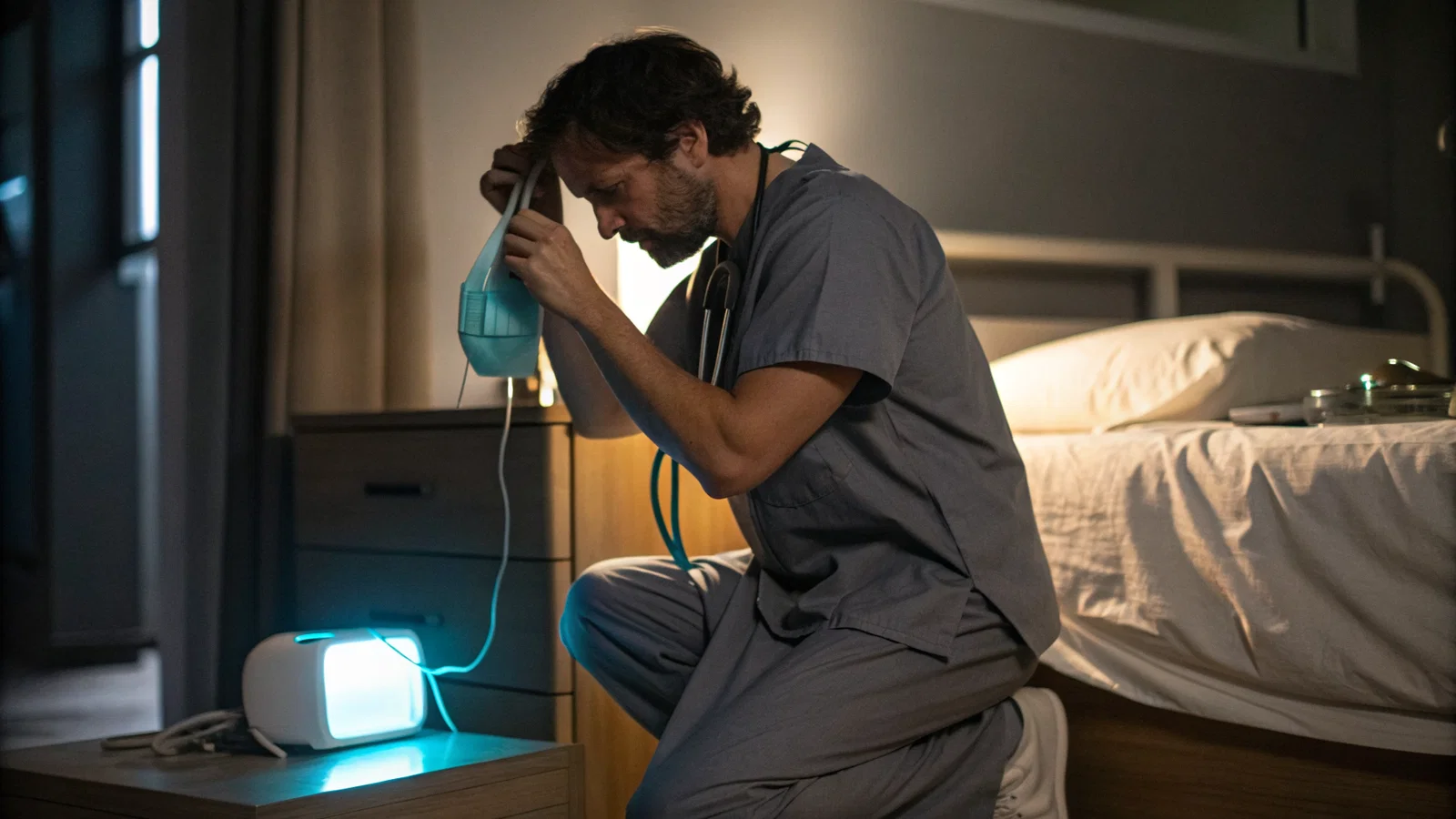
That hissing sound will wake you up faster than any code pager. You are half-asleep, the BiPAP is alarming for high leak, and the patient looks uncomfortable. Your brain says: fix the mask. Your gut should say: prove it is the mask first.
This is the core distinction that keeps patients alive. Mask leak is an equipment problem. Lung leak is a patient problem. At 3 AM, they sound identical. One annoys. The other kills. The Problem Solver approach is simple: rule out the catastrophe, then fix the annoyance.
Immediate triage in 30 seconds:
- Look at the patient, not the machine. Are they breathing? Speaking? Cyanotic?
- Look at the vitals. Is there new hypotension, tachycardia >120, SpO2 dropping despite BiPAP?
- If yes to instability, forget the mask. You are in pneumothorax territory until proven otherwise.
- If stable, you have time to run the algorithm.
Tension pneumothorax on BiPAP is not rare. Positive pressure finds the weakest spot in the lung and makes it a one-way valve. I have seen it in COPDers with blebs, in tall thin 24-year-olds on 18/8, in anyone you over-pressured because the ABG was ugly.
Do not panic. Follow a flow.
Step 1: The Diagnostic Algorithm (Don't Guess, Flow)
Stop adjusting straps randomly. That is guessing. Guessing wastes time and you will miss the real pathology.
Use the Listen Localize method. It takes ten seconds and tells you where the air is going.
Get close. Really close. Put your ear within 6 inches of the mask cushion, then the tubing connection, then the patient's neck and upper chest. The hiss has a source. Your job is to find it.
- Hiss at the bridge of the nose, cheek, or under the chin? Mask leak.
- Hiss at the circuit joints or humidifier? Circuit disconnect.
- No hiss at the mask, but you hear crackling or asymmetric breath sounds when you auscultate? Lung leak.
If the seal looks perfect and the machine still reports 80+ L/min leak, that is your red flag. A good seal does not leak. If it says it is leaking and you cannot find it at the interface, the air is escaping somewhere else. The lung.
Here is the exact flow I teach interns:
Protocol: If you fix the seal, reassess in 2 minutes. Leak drops below 40 L/min and sats improve? You were right. Leak persists despite a textbook seal and the patient is getting more tachypneic? Stop touching the mask. You are dealing with lung.
Step 2: The Physical Exam Protocol
This is where residents get lazy. They listen quickly to the back and chart "breath sounds present." That exam will kill someone.
On BiPAP, with positive pressure and a noisy machine, you have to be deliberate.
1. The Tracheal Tug and Deviation: Stand at the head of the bed. Look at the trachea. Is it midline? With tension, intrathoracic pressure pushes it away from the affected side. Place a finger gently in the suprasternal notch. Can you feel the tug with each breath? Late sign. Bad sign. If you see it, you are already behind.
2. Simultaneous Auscultation: Do not listen left, then right, then try to remember. Use your own memory against you. Place the bell on the left anterior chest and your hand on the right chest to feel movement, then switch. Or better: have a nurse listen with you on the other side. The point is to compare in real time. On BiPAP, a pneumothorax will be dead silent on one side while the other side is loud with transmitted machine noise.
3. Chest Wall Asymmetry: Lift the gown. Watch. Is one side rising while the other lags? Is there paradoxical inward movement? On positive pressure ventilation, the chest should rise symmetrically. If the left chest barely moves and the right is hyper-expanding, that is air trapping on the right. Even 1cm of asymmetry matters at night under blue light.
4. The Rule of 4: Vitals confirm what your hands suspect.
- Hypotension: SBP drops >20 mmHg from baseline. Blood cannot return to the heart.
- Tachycardia: Heart racing to compensate. >120 is my threshold to act.
- Hypoxia: Saturation that will not climb despite 100% FiO2 and no leak.
- Tachypnea + Hypertension of neck veins (if you can see them): Distended veins with clear lungs.
Two of these four plus a unilateral silent chest? Do not wait for X-ray.

Step 3: The 'Don't Wake the House' Fix
Okay. Patient is stable. Vitals are okay. You have proven breath sounds are equal and trachea is midline. Now you can fix the mask without feeling guilty.
Do it in this order. Do not skip steps.
1. Straps and Headgear: Most leaks are from overtightening, not undertightening. Overtight straps deform the silicone cushion and create channels. Loosen both lower straps completely, seat the cushion on the nasal bridge with light pressure, then snug the lower straps until you get just enough seal. One finger should fit under the strap. If you leave strap marks on the face, it is too tight.
2. Chin Support: If it is an oronasal mask and the mouth is falling open, the air is dumping out the mouth. That reads as a leak. A simple chin strap or switching to full face will cut leak by 50%. If you do not have one, roll a towel under the chin.
3. Position: Semi-Fowlers, 30-45 degrees. Supine makes the tongue fall back, makes the mask ride up, makes everything worse. Turn the patient slightly lateral if they have a beard or facial asymmetry. I have fixed 60 L/min leaks just by sitting the patient up.
4. Circuit Check: Run your hand along the entire circuit. Feel for disconnections at the back of the machine where the respiratory therapist pushed it against the wall. Empty water from the tubing. Check the exhalation port - if it is blocked by bedding, CO2 rises and the machine compensates with more flow, which looks like a leak.
When to call for help? This is not weakness. This is protocol.
- Leak >60 L/min after 3 fixes and patient remains hypoxic.
- Any hypotension or tracheal deviation.
- Subcutaneous emphysema - that crunchy Rice Krispies feeling on the neck/chest. Game over. Call surgery, call senior, get a chest X-ray now.
- Patient says "I can't breathe" despite your fixes. Believe them.
Step 4: The Red Line Protocol
There is a point where troubleshooting ends and resuscitation starts. Learn to see it early.
The Kill Shot signs: sudden agitation, gasping against the BiPAP, sats in the 70s that do not recover, SBP in the 70s, jugular veins bulging like ropes, trachea deviated, one side of the chest hyper-resonant when you percuss it. That is tension. That is not going to improve with 15 minutes of observation.
Here is what you do, in order:
1. Disconnect BiPAP: Take the positive pressure off. If it is tension pneumothorax, positive pressure is making it worse every second. Put on a non-rebreather at 15L. Yes, they will desat. They were going to desat anyway. You buy time to decompress.
2. Needle Decompression: If unstable and you cannot get an immediate chest film in under 2 minutes. 14 or 16 gauge angiocath, 2nd intercostal space midclavicular line OR 5th intercostal space anterior axillary line. I prefer 5th space - less muscle, less failure. Rush of air = you were right. Leave the catheter open.
3. Intubation vs. Chest Tube: Do not intubate a tension pneumothorax without decompressing first. You will convert bad to dead. If you have decompressed with a needle, now call for chest tube tray and prepare for definitive airway if they are still in respiratory failure. But many patients stabilize after decompression alone.
4. Communication: Say it clearly: "This is [Name], I have a suspected tension pneumothorax on BiPAP in room 422, vitals unstable, I need attending, respiratory, and chest tube tray at bedside NOW." Not "the BiPAP is acting funny, can you come look?" Words matter at 3 AM. Be direct. Do not cause panic, cause action.
After: Document everything. Time of leak alarm, leak rate, your exam, vitals trend, what you did. Not for legal cover. For your brain. Next time you hear that hiss, you will remember what you felt in your chest when you saw that deviated trachea. That is how you get good.
You are not there to be a BiPAP technician. You are there to catch the one lung leak that masquerades as a mask leak. Fix the equipment fast, but prove it is the equipment first. That habit is what separates a task-doer from a doctor.