
Why Your Step 2 CK Score Is Now Everything
The safety net is officially gone.
When the NBME converted Step 1 to Pass/Fail, medical students around the country celebrated. They thought the pressure was off. They thought they could breathe.
They were dead wrong.
What actually happened was a massive shift of high-stakes pressure directly onto Step 2 CK. Before the change, a mediocre Step 1 score could be redeemed by a stellar Step 2 CK performance, or a great Step 1 score could cushion a soft Step 2. Today? You get exactly one numeric score on your transcript when residency program directors filter applications.
One number to decide whether your application gets opened or dumped into the automated rejection pile.
Program directors are swamped with thousands of applications for a handful of residency slots. When Step 1 went Pass/Fail, they didn't magically adopt a purely holistic, warm-and-fuzzy review process for everyone. They simply moved their filters to the only remaining hard metric they have: your Step 2 CK score.
I see students make the same arrogant, sloppy errors every single match cycle. They get comfortable because Step 1 felt like a breeze to pass, they coast through third-year clerkships, and then they crash face-first into a 220 on Step 2 CK.
That single mistake alters their entire career trajectory.
Don't let that be your story. Let's walk through the seven costliest errors students make in this new Step 2 CK-dominated landscape, and exactly how you can avoid them.
Mistake #1: Treating Step 2 CK Like Step 1
If you open First Aid for the USMLE Step 1 and try to memorize facts for Step 2 CK, you are actively sabotaging yourself.
Avoiding these costly mistakes requires a strategic approach. For a comprehensive guide to Step 2 CK timing and common errors that can derail your application, check out our analysis of timing mistakes that quietly tank your match odds.
Managing the psychological pressure of having everything ride on one exam is critical, see strategies for (managing Step 2 CK pressure)[https://residencyadvisor.com/resources/step1-pass-fail-era/afraid-step-2-ck-is-now-all-or-nothing-managing-the-pressure] to avoid burnout.
Step 1 was an exam of recognition and recall. It asked: "What is the enzyme deficiency in this metabolic pathway?" or "Which microorganism causes this specific histology?" Step 2 CK does not care if you can recite the Krebs cycle. Step 2 CK wants to know if you can manage a sick patient in real time.
The questions on Step 2 CK test clinical decision-making. You will rarely be asked for a diagnosis directly. Instead, you'll be given a 50-year-old patient presenting with atypical chest pain, elevated troponins, and a complex medical history, and the question will ask: "What is the most appropriate next step in management?"
If you're worried that your Step 2 CK score might fall below specialty averages, learn proactive strategies for rescuing your residency application before it's too late.
Notice the wording: next step. Not the best theoretical cure, but the immediate, real-world clinical decision.
When you study for Step 2 CK using passive recall tools like memorizing First Aid bullet points, you train your brain for the wrong task. You might know every side effect of every anti-arrhythmic drug, but if you don't know whether to order an echocardiogram before or after starting a beta-blocker, you will miss the question.
The Fix: Focus on Management Algorithms and Question Banks
Ditch passive reading. Your primary study drivers must be interactive, clinical case-based resources:
- UWorld & Amboss: Treat question banks as your textbook, not just an evaluation tool. Read the explanation for every wrong answer choice to understand why a clinical step was premature or dangerous.
- Clinical Decision Trees: Learn diagnostic algorithms (e.g., initial workup for a thyroid nodule vs. suspected pulmonary embolism).
- Step 2 CK Specific Case Books: Use resources like Step-Up to Medicine or Amboss Clinical Knowledge Library to dive deep into diagnostic sequences.
Mistake #2: Underestimating the Breadth of Internal Medicine
Let's look at the actual distribution of content on Step 2 CK.
Look at that chart. Internal Medicine makes up roughly 50% to 60% of the entire exam.
I've seen students waste weeks obsessing over obscure pediatric syndromes or niche surgical subspecialties while completely neglecting the bread-and-butter of Internal Medicine. If you perform poorly on Internal Medicine, you will fail to score above 240 on Step 2 CK. Period.
The biggest traps within Internal Medicine aren't the obvious ones. Students usually handle basic hypertension or diabetes management fine. Where they get destroyed are the nuanced subspecialties:
- Cardiology: Differentiating stable angina, NSTEMI, STEMI, and aortic dissection under time pressure.
- Pulmonology: Escalation of care in acute asthma vs. COPD exacerbations.
- Infectious Diseases: Empiric antibiotic coverage based on subtle patient risk factors (e.g., hospital-acquired vs. community-acquired pneumonia).
- Rheumatology: Distinguishing lupus nephritis flares from drug-induced toxicities.
If you coasted through your Internal Medicine clerkship or relied on short-term cramming for your shelf exam, those gaps will explode on Step 2 CK.
The Fix: Prioritize Deep IM Blocks
When structuring your dedicated study period, weight your question blocks according to the exam distribution. Half of your daily question volume should consist of Internal Medicine concepts. Master diagnostic workups for chest pain, shortness of breath, abdominal pain, and acute kidney injury until the management steps become second nature.
Mistake #3: Skipping or Mishandling Practice Exams
I am amazed by how many students walk into Step 2 CK having taken only one or two practice tests. Or worse, taking six practice tests and treating them like simple score predictors rather than learning tools.
Going into this exam without aggressive, systematic practice testing is financial and professional suicide.
The data is crystal clear: students who take 6 or more practice tests consistently score higher than those who rely on question bank percentages alone. Why? Because Step 2 CK is an endurance test as much as a knowledge test.
Taking a practice exam isn't just about getting a score prediction. It's about training your brain to stay sharp during hour eight of a grueling testing session.
How Students Misuse Practice Tests
- Taking them too late: Waiting until two weeks before the exam to take your first NBME. By then, it's too late to fix systemic knowledge gaps.
- Shallow Review: Spending 4 hours taking an exam and only 30 minutes skimming the missed questions.
- Ignoring the "Why": Not asking why you missed a question. Was it a knowledge gap? A reading comprehension error? A pacing panic?
The Fix: The 1:1 Review Rule
For every hour you spend taking a practice exam, spend at least one hour reviewing it.
Create an Error Journal. For every question you get wrong (or guessed right on), write down three things:
- What was the core clinical clue I missed?
- What was the underlying medical rule I didn't know?
- What logic error led me to choose the distractor?
Space out your exams: start with a baseline NBME early in your prep, use UWorld Self-Assessments (UWSAs) in the middle, and finish with the latest official NBME forms (Forms 10, 11, 12, 13, and 14) in the final weeks before test day.
Mistake #4: Poor Time Management During the Exam
Step 2 CK question vignettes are notoriously long. We are talking about dense paragraphs packed with vital signs, lab values, family histories, and subtle physical exam findings.
If you get stuck on question 12 of a block, spend three minutes wrestling with it, and panic, you will ruin the remaining 28 questions.
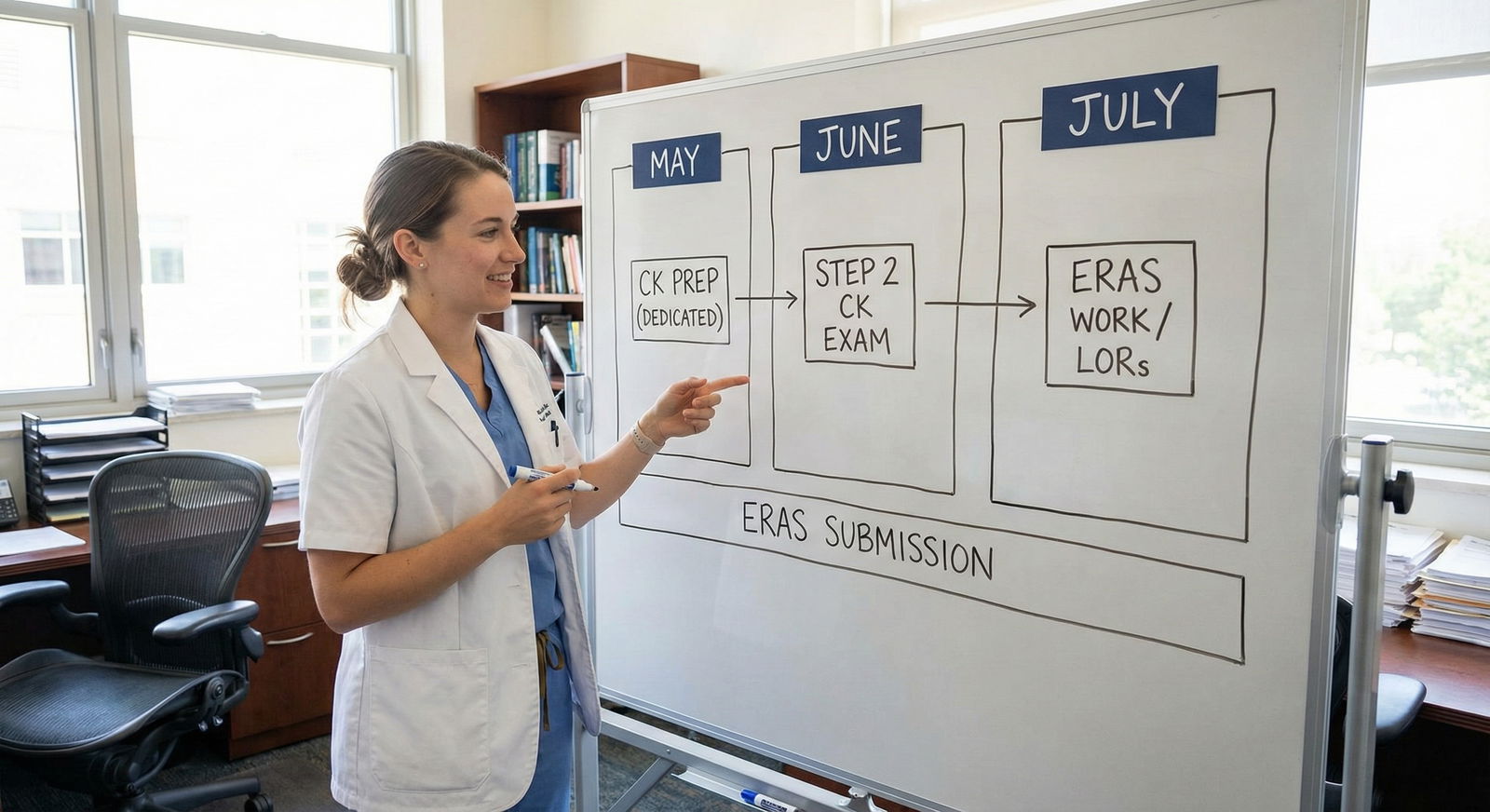
Running out of time on a Step 2 CK block isn't a bad luck scenario; it's an execution failure.
The Second-Guessing Spiral
Another massive time sink is answer-changing. I've watched students review their practice tests and realize they changed 15 answers from correct to incorrect because they had extra time at the end of the block and started overthinking.
Your first instinct, when driven by sound clinical reasoning, is right far more often than your second-guessing mind.
The Fix: Execute the 90-Second Strategy
Implement these strict pacing rules during your prep:
- The 90-Second Rule: You have roughly 90 seconds per question. If you hit 60 seconds and have no clear direction, pick your best guess, flag the question, and move on immediately.
- Read the Last Sentence First: Read the actual question prompt and answer choices before reading the massive vignette. Knowing that the test is asking for a medication side effect allows you to scan the vignette for the drug list, saving 30 crucial seconds.
- Never Change Answers Unless You Find New Evidence: Unless you misread a critical word like "NOT" or noticed a lab value you missed on the first pass, do not change your flagged answer.
Mistake #5: Ignoring Weaknesses and Over-Studying Strengths
It feels great to do a block of Psychiatry questions and score an 85%. It feels terrible to do a block of Rheumatology or Renal Pathology and score a 42%.
Because human beings like feeling smart, medical students naturally gravitate toward studying subjects they are already good at. They spend hours refining their knowledge of conditions they'll never miss while avoiding the dark, uncomfortable corners of their weak subjects.
This is comfortable. It is also lethal to your final score.
Every topic on Step 2 CK is worth the same points. Raising your performance in a weak area from 40% to 70% yields a massive score increase. Fine-tuning a strong area from 80% to 85% yields almost nothing.
The Fix: Weekly Weakness Audits
Every Sunday evening, look at your question bank analytics. Filter your performance by subject and organ system.
Force yourself to assign 60% of your time the following week to your bottom two performing categories. If Obstetrics and Biostatistics are dragging down your average, you should be doing target blocks on Ob/Gyn and Math every single morning until those percentages climb.
Embrace the discomfort. If your study session doesn't feel challenging, you aren't learning.
Mistake #6: Not Understanding the New Scoring Landscape
Let's address the elephant in the room: score inflation.
When Step 1 was scored numerically, a 240 was considered a respectable, solid score across almost every specialty. Today? A 240 on Step 2 CK is actually below the average for several competitive fields.
Look at the reality of the numbers above. If you are aiming for Dermatology, Orthopedics, or ENT, scoring a 245 is not going to cut it unless you have extraordinary connections or groundbreaking research. Even core specialties like General Surgery and Internal Medicine now expect scores hovering around 250.
Too many students target the scores of three years ago. They aim for a 240, hit a 241, and then realize during match season that they got filtered out of top-tier residency programs before a human eye ever saw their application.
The Fix: Set Data-Driven Target Scores
Look up the latest NRMP Match Data (Charting Outcomes in the Match) for your target specialty. Look at the mean Step 2 CK score for matched applicants in your category (US MD, US DO, or IMG).
Set your target score 5 to 10 points above that published average. That buffer protects you against unexpected test-day variance.
Mistake #7: Treating Step 2 CK as Your Entire Application
I have seen students with a 265 Step 2 CK score fail to match.
How does that happen? Because they fell into the trap of tunnel vision. They assumed that a massive exam score made them invincible, so they neglected everything else: clinical rotations, letters of recommendation, research, and personal statements.

Your Step 2 CK score is the key that opens the door. It gets your application past the initial digital filters. But once your application is opened, human beings read it.
If your clinical evaluations mention that you were lazy, arrogant, or lacked basic interpersonal skills, a 260+ score will not save you. If your letters of recommendation are generic single-paragraph templates because you didn't build relationships with attending physicians, programs will pass on you for candidates with a 248 who have glowing evaluations.
The Fix: Play the Whole Game
Do not sacrifice your Sub-I performance or core clerkships just to study an extra hour for Step 2 CK.
- Clinical Honors Matter: High grades on core clinical rotations signal strong teamwork and bedside manner.
- Securing Strong LORs: Build relationships with attendings in your chosen specialty early. Ask for letters of recommendation directly at the end of strong rotations.
- Be a Great Teammate: Program directors hire future colleagues. They want reliable, hard-working team players who are pleasant to work a 12-hour night shift with.
Protecting Your Future by Avoiding These Mistakes
Step 2 CK is now the single most critical academic milestone of your medical school journey. The shift to a Pass/Fail Step 1 transferred all the numeric weight onto this single exam.
That doesn't mean you should panic. It means you must be strategic.
Stop studying passively. Treat Internal Medicine with the respect it demands. Take practice tests under real exam conditions, analyze your mistakes relentlessly, and pace yourself ruthlessly on test day. Above all, remember that while Step 2 CK is your primary academic filter, your clinical reputation and application holistic strengths carry you across the finish line on Match Day.
Take control of your preparation today. Execute a deliberate, data-driven plan, and don't let easily avoidable mistakes stand between you and the residency of your dreams.
Key Takeaways
- Step 2 CK is your only numeric score: Treat it with extreme seriousness, residency programs rely heavily on it for screening filters.
- Shift from recall to clinical decision-making: Ditch passive reading; focus on management algorithms, next steps in care, and active question bank practice.
- Internal Medicine is the core: Since IM comprises 50-60% of the exam, mastering IM subspecialties is mandatory for high performance.
- Master pacing and review practice exams deeply: Aim for 6+ practice exams and dedicate equal time to analyzing your missed questions.
- Maintain a balanced application: High scores open doors, but strong clerkship evaluations, glowing LORs, and personal connections secure the match.