
Last week I talked to an MS3 who said, dead serious, “If I screw up Step 2, that’s it. Career over. Step 1 is pass/fail now, so Step 2 is literally my entire worth as a human.”
I laughed for half a second…then realized I’ve basically been thinking the same thing about myself.
If you’re terrified that Step 2 CK has become “all or nothing” in the Step 1 pass/fail era, you’re not crazy. The pressure feels different now. Sharper. And everyone keeps repeating the same vague line: “Step 2 is just more important now.” Cool. Helpful. Thanks.
Let’s actually unpack this. Honestly. With the worst-case scenarios laid out, and then what’s actually real.
1. Did Step 1 Pass/Fail Just Dump Everything Onto Step 2?
Short answer: No, not literally everything. But a lot more weight? Yes. And you can feel it.
Back when Step 1 was scored, people had two big numbers to show programs: Step 1 and Step 2. Now:
- Step 1: pass/fail
- Step 2 CK: still scored, still numeric, still reported
So of course PDs shifted their attention. They didn’t suddenly find inner peace and start reading every personal statement like it’s poetry. They wanted another filter. Step 2 became the obvious candidate.
But “more important” doesn’t equal “only thing that matters.” Programs still care about:
- Your school’s reputation and your class rank/MSPE comments
- Clinical grades, especially core clerkships
- Letters (especially from their department or big names)
- Research for competitive specialties
- Red flags (leaves, professionalism issues, multiple fails, etc.)
Step 2 is now:
A very loud voice. Not the only voice.
What changed is where the “panic” moved:
- Before: “If I bomb Step 1, I’m screwed.”
- Now: “If I bomb Step 2, I’m screwed…and I don’t even have Step 1 to balance it.”
So yeah, the anxiety is real. But this idea that one day of testing now defines the next 40 years of your life? That’s not how programs actually work in practice.
2. What Are Programs Really Doing With Step 2 Now?
Here’s the part nobody explains in detail. Programs aren’t all treating Step 2 the same way.
Some are obsessed with it. Especially in competitive fields. Some treat it as “good to know but not everything.” It’s not a monolith.
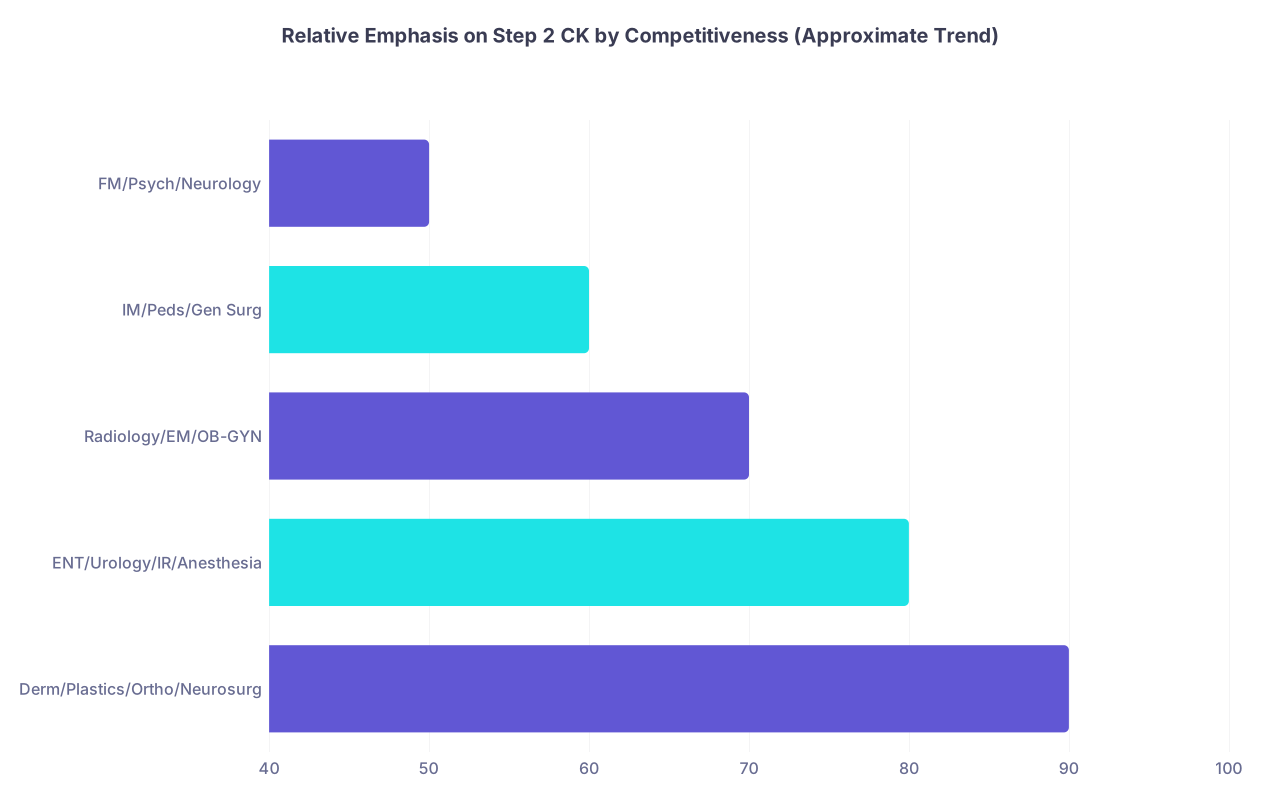
| Category | Value |
|---|---|
| Derm/Plastics/Ortho/Neurosurg | 90 |
| ENT/Urology/IR/Anesthesia | 80 |
| Radiology/EM/OB-GYN | 70 |
| IM/Peds/Gen Surg | 60 |
| FM/Psych/Neurology | 50 |
Let me translate what I actually see/hear from residents and PDs:
Highly competitive specialties (derm, ortho, plastics, neurosurg, ENT):
Step 2 is basically the new Step 1 filter. They won’t say “cutoff,” but they absolutely have a range where they start paying attention to the rest of your file.Moderately competitive (EM, anesthesia, radiology, OB):
Step 2 matters a lot, but strong clinical evaluations, SLOEs (for EM), and letters can soften a slightly lower score.Less competitive (FM, psych, peds, IM at community or mid-tier academic):
Step 2 is more about: Did you pass? Are you reasonably safe? Are you above some loose lower bound?
Programs still like data. But they’re not entirely reckless. They know Step 2 has noise: bad days, test anxiety, test center disaster stories.
The most common thing I hear:
“We use Step 2 to confirm what the rest of the app already suggests.”
So if your whole app says: hardworking, honors on rotations, solid letters, some research, no professionalism issues—Step 2 is one more “yes.”
If your app is shaky and Step 2 is bad, then yeah, it might reinforce that story.
That’s very different from “all or nothing.”
3. Harsh Reality Check: How Bad Is ‘Bad’?
This is what keeps you up at 2 a.m. You don’t just want “Step 2 matters.” You want: “At what number is my life over?”
No one will give you a clean answer because programs differ, but let’s at least outline the general ranges people talk about:
| Step 2 Range | General Vibe (Broad, Not Absolute) |
|---|---|
| 270+ | Unicorn. Overkill. Not required. |
| 255–269 | Very strong for almost everything. |
| 245–254 | Solid to strong for many fields. |
| 235–244 | OK to good; depends on specialty. |
| 220–234 | Acceptable for many primary care / some IM / psych / peds; more challenging for very competitive fields. |
| < 220 | Red flag territory at many places, but still not automatic career death. |
Please don’t obsess over each boundary. These aren’t laws; they’re vibes.
The worst mental trap is thinking:
- “If I don’t get 250+, I’m done.”
- “If I get under 240, no one will ever interview me.”
- “Under 230? Might as well quit.”
Here’s what’s actually more honest:
- Ultra-competitive fields + low Step 2 = hard. I won’t sugarcoat that. Might require a backup plan or an extra year to strengthen your app.
- Middle-of-the-road or less competitive fields + average Step 2 + good clinical story = still very possible.
- Awful Step 2 (really low or fail) + other red flags = you’ll need strategy, advising, maybe a pivot—but I’ve seen people recover, switch fields, do prelim years, reapply, still end up as practicing physicians.
Career over? No.
Brutally harder? Sometimes, yes.
But the idea that one non-stellar score immediately writes “UNMATCHABLE” on your forehead is just your anxiety doing theater.
4. The “All or Nothing” Mindset: How It Actually Makes You Perform Worse
This is the sick joke: the more you convince yourself Step 2 is your entire life, the more likely you are to underperform.
I’ve watched it happen:
- People study 12–14 hours a day out of panic, not strategy.
- They do 4–5 UWorld blocks daily, but review so poorly they’re just … clicking.
- They refuse days off, sleep terribly, and then feel like zombies 2 weeks before the test.
They’re not “working hard.” They’re destroying their own cognition.
This mindset does a few specific toxic things:
Turns every practice test into a referendum on your future.
NBME score drops 5 points? Suddenly, you’re on Reddit for 4 hours spiraling into doom threads.Makes you hypersensitive to mistakes.
Miss 12 questions in a block? Instead of learning from them, you just think: “I’m not built for this. Everyone else is smarter.”Pushes you toward avoidance.
People who are the most scared often procrastinate the most. They keep “studying” but never take a real NBME because they’re terrified of seeing a number.
Here’s the messed-up truth: Step 2 is beatable with competent, not perfect, prep. The people who implode are usually not the “lazy” ones. They’re the ones who panic themselves into stupidity.
5. Concrete Ways to Manage the Pressure Without Pretending It’s “Not a Big Deal”
I’m not going to say “just relax.” That’s insulting. You care about this. I care about this. The stakes are real.
But you need structure, or the fear just spreads into everything.
A. Decide your actual target range (not your dream flex score)
Pick three numbers:
- “I’d be really happy with”: e.g., 250
- “I’d be OK with”: e.g., 240
- “Below this, I’ll talk with an advisor about strategy but not collapse”: e.g., 230
That third number is key. It’s the line where you plan a rational response instead of dissolving into chaos. It gives your brain a script other than “if under X, life is ruined.”
B. Treat Step 2 like what it actually is: a clinical exam
This is where a lot of us overcomplicate things. You don’t need to memorize every obscure zebras from every subspecialty.
Core moves the needle more than flex knowledge:
- UWorld (or Amboss) done well, not just “finished”
- NBMEs / UWSAs spaced out, reviewed deeply
- Review of your own weak areas in a targeted way, not “re-read everything”
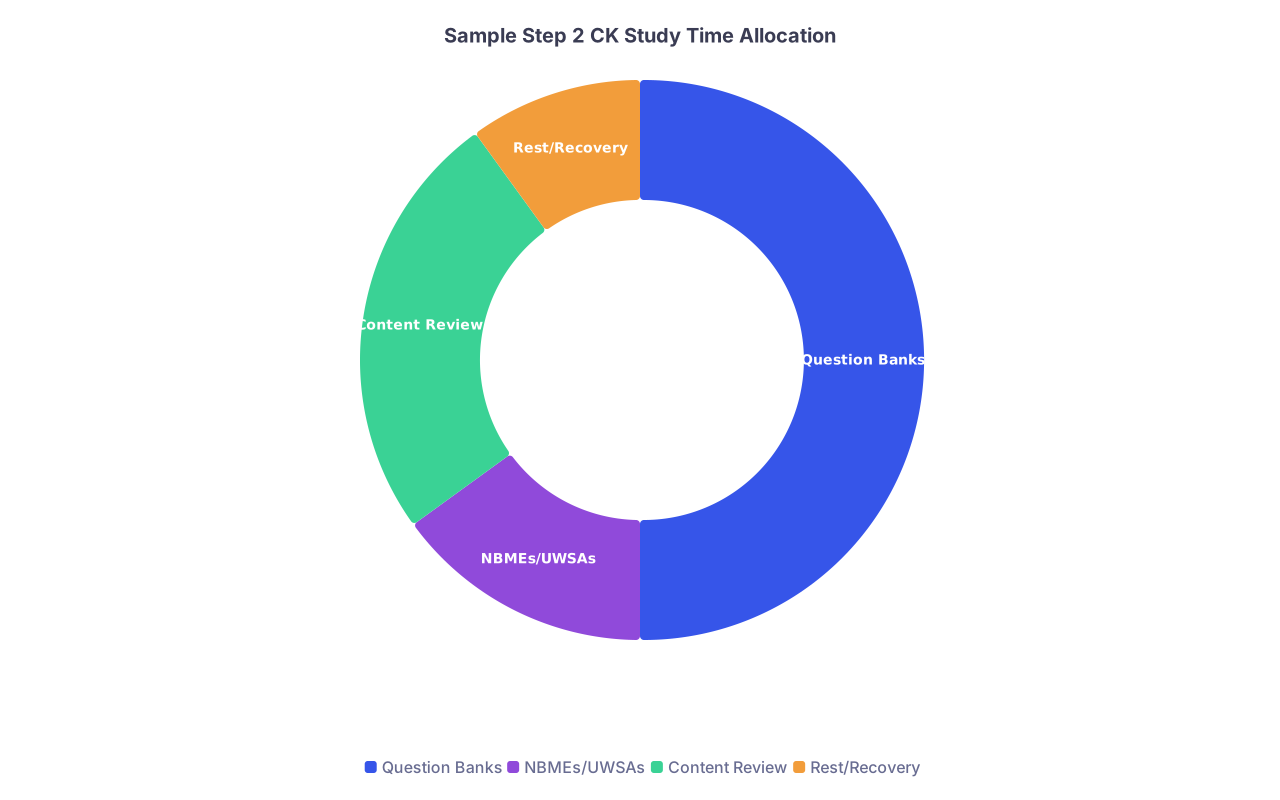
| Category | Value |
|---|---|
| Question Banks | 50 |
| NBMEs/UWSAs | 15 |
| Content Review | 25 |
| Rest/Recovery | 10 |
What tanks people is not “I didn’t do enough exotic resources.” It’s:
- Too many resources, none done well
- No practice integrating timing + stamina + anxiety under test-like conditions
C. Put guardrails on your anxiety
You’re not going to fully eliminate anxiety. Fine. Make it less destructive.
Some real guardrails I’ve seen help:
- Limit Reddit/Discord consumption: 10–15 minutes a day, max. After that, it’s just self-harm.
- Fixed bed and wake times 80–90% of days. Your brain can’t think on 4–5 hours of sleep for weeks.
- One day fully off every 1–2 weeks. Not “study light.” Actually off.
Think of it like this: your brain is your Step 2 engine. You keep running it in the red, it seizes up.
6. But What If I Actually Do Badly? Like, Really Badly?
This is the fear you’re probably quietly carrying: “What if I do everything ‘right’ and still bomb it?”
So let’s go there. Worst-case mode.
Worst-case scenarios people imagine:
- Score way below average for their specialty of interest
- Major gap between Step 1 (pass) and Step 2 (low score)
- Borderline fail or outright fail
Do those make your life easier? Of course not. But here’s what people actually do in those situations:
Reassess specialty target.
Yes, sometimes people pivot. Derm to IM. Ortho to anesthesia. EM to FM. Those people still become real, practicing doctors.Increase application breadth.
Apply wider: community programs, multiple regions, prelim years where appropriate.Lean on everything else in the app.
Great rotation evals, strong PD/Chair letters, research, away rotations performance. Programs don’t just read one number and hit “Delete.”Retake if truly needed.
For actual failures or disaster scores, people retake, improve, explain. I’ve seen someone go from failing to a solid passing score and still match into IM.
Is it pretty? No. Does it feel fair? Also no.
But “Step 2 disaster = banished forever from medicine” is just not the pattern in real life.
7. How to Think About Step 2 Without Letting It Eat Your Life
Honestly, this is what I’m still trying to internalize myself.
Step 2 is:
- A big, high-stakes exam
- A major filter in a system that still loves numbers
- One of several important signals in your application
Step 2 is not:
- Your IQ
- Your decency as a human
- A prophecy about how good you’ll be as a clinician
- The only path to matching, or the only path to being fulfilled in medicine
Here’s the mental model that helps me not lose it:

| Step | Description |
|---|---|
| Step 1 | You as Applicant |
| Step 2 | Academic Record |
| Step 3 | Clinical Performance |
| Step 4 | Professionalism and Fit |
| Step 5 | Step 1 Pass |
| Step 6 | Step 2 Score |
| Step 7 | Clerkship Grades |
| Step 8 | Letters of Recommendation |
| Step 9 | Personal Statement |
| Step 10 | Interview Performance |
| Step 11 | Interview and Rank Decisions |
One node. Important, yes. But still one node.
If you treat it like the entire graph, you’ll crush yourself long before test day.
8. What I’d Tell You if You Were Sitting Across From Me Right Now
I’m not going to lie to you and say, “Don’t worry, Step 2 doesn’t matter.” It does.
But I’d probably say something like this:
You’re allowed to be scared. Step 2 is a big deal in a messed-up system that loves standardized tests. The fear makes sense.
Just don’t let that fear rewrite reality:
- No, your life is not determined by one number.
- No, you’re not the only one anxious. The calm people are just quieter about it.
- No, a non-perfect score does not close every door. It narrows some. Others stay open. You can also build new ones.
You are more than one 9-hour exam written by people who haven’t touched a real patient in years.
Study hard, but also study sanely. Respect the exam, but don’t worship it. If (when) the anxiety spikes, remember: this is one piece of your story, not the entire plot.
Key points to hold onto:
- Step 2 CK matters more in the Step 1 pass/fail era, but it’s not literally “all or nothing.” Programs look at your whole file.
- A less-than-dream score makes some paths harder, not impossible; there are real, practical ways people recover, pivot, and still match.
- The “this exam is my entire worth” mindset doesn’t make you perform better—it usually does the opposite. Structure, guardrails, and perspective are part of the prep, not extras.