
Program directors didn’t “adapt” to Step 1 going pass/fail. They just moved the game to places you can’t see as easily.
Let me walk you into the rooms you’re not invited into—the Zoom debriefs, the side texts between PDs, the “off the record” GME meetings—where your Step 1 pass/fail reality is actually being decided and interpreted.
Because what you see in public statements and webinars is the sanitized version. The real conversations sound very different.
What PDs Really Say When Step 1 Is Pass/Fail
I’ve sat in those meetings. Step 1 went pass/fail, and for about one cycle, everyone pretended we were going to “holistically review” applicants. Then the spreadsheets came back out.
Here’s the dirty truth: most programs did not mourn the loss of the Step 1 exam. They mourned the loss of a quick, sortable number.
A few actual lines I’ve heard in selection meetings:
- “Pass is the new 230 if everything else looks clean.”
- “I don’t trust pass/fail; what’s their Step 2 number?”
- “If they failed Step 1 in this era, that’s a big problem.”
Nobody says that last one on a webinar. They say “we understand the stress of this era” and “we review each case in context.” But when they’re ranking 600 people for 8 slots at 11 p.m. after a full clinic day, nuance goes out the window.
Here’s what changed when Step 1 went pass/fail:
- Programs split applicants into only two bins: “passed on time” and “problem file.”
- The definition of “problem file” quietly expanded: delayed test, first-day fail, late Step 2, weak school reputation, shaky narrative.
- Step 2 became the de facto screen for many competitive and even mid-tier programs, especially in fields like derm, ortho, plastics, rads.
If your Step 1 is a clean pass on first try, the nuance for you isn’t in the Step 1 result anymore. It’s in how that pass/fail label gets weaponized in the context of everything else.
The New Sorting Algorithm: What Actually Replaced Step 1
Programs didn’t become more holistic. They became more layered.
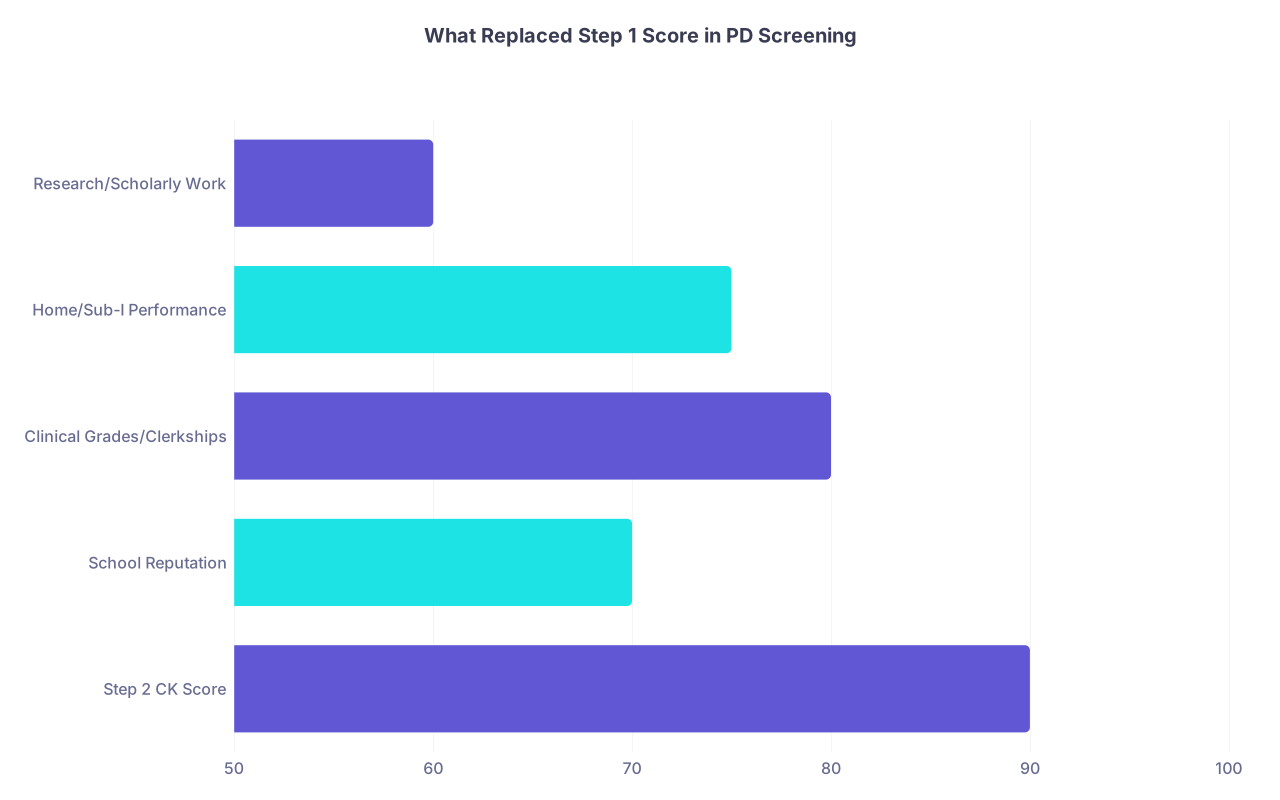
| Category | Value |
|---|---|
| Step 2 CK Score | 90 |
| School Reputation | 70 |
| Clinical Grades/Clerkships | 80 |
| Home/Sub-I Performance | 75 |
| Research/Scholarly Work | 60 |
Those percentages aren’t from a glossy paper. They’re an honest reflection of what multiple PDs admit when they’re not being recorded.
Here’s the actual mental algorithm I’ve heard and seen:
First pass: filter by Step 2 CK (if available)
- Surgery PD: “Below 240, I’m only looking if there’s a hook—URiM, our med school, insane letters, or a personal connection.”
- IM PD at a big-name program: “250+ makes my job easy. I know they can test. Then I ask, do I actually want to work with this person?”
Second pass: school and rotation reputation Programs will not say this on the record, but they absolutely rank “trust level” in schools.
At one east-coast academic IM program, the conversation sounded like this:
- “A pass from Hopkins or UCSF? I don’t worry.”
- “Pass from an unknown Caribbean school? I want a strong Step 2 and top-tier letters before I risk an interview.”
Third pass: clinical grades and narrative Honors in core rotations, especially medicine and surgery, are now a bigger deal. Not because PDs suddenly love clerkship grading. They just need something that approximates rigor.
Fourth pass: “hooks” Strong research with real productivity. Sub-I at the program. A PD text from your home institution. URiM applicants. Significant prior career. Anything that gives someone on the committee a reason to say: “I’ll stick my neck out for them.”
Notice what’s missing here: Step 1 beyond “pass” vs “issue.” Once you’ve passed, your fate is decided elsewhere.
Unless you failed. Then the whole tone changes.
How a Step 1 Fail Is Really Discussed in 2025
Publicly, faculty say things like: “A Step 1 fail doesn’t define you” and “We review this in context.”
Behind closed doors, the conversation is harsher and a lot more binary.
I’ve heard versions of this more times than I can count:
- “We have more than enough applicants who passed everything on the first try. Why take the risk?”
- “If they struggled with Step 1 when it’s pass/fail, what happens when they have to pass boards later?”
- “If there’s a fail, I want to see a monster Step 2 and bulletproof narrative. Otherwise, no.”
Let’s be precise about how different failure patterns land.
| Scenario | Typical Backchannel Interpretation |
|---|---|
| Pass on first attempt, on-time | “Fine, move on. What’s Step 2? How are the rotations?” |
| Delayed Step 1 but pass on first try | “Why the delay? Need explanation in MSPE or PS.” |
| One fail, then strong pass and strong Step 2 | “Maybe. Flag for discussion. Need context and evidence of turnaround.” |
| One fail, marginal Step 2 | “No. Too much risk.” |
| Multiple fails | “Automatically out for us.” |
I’ve literally watched committees hard-stop at “multiple fails” with zero further discussion, even for nice people, even with some research.
When a file with a Step 1 fail does get a chance, this is the unspoken test: does everything else scream overcompensation and recovery? Or does it feel like a pattern?
- Significant upward trend in preclinical/clinical performance.
- Step 2 CK that makes the committee say “okay, they figured it out.”
- Letters that explicitly frame the fail as an old story, not their current reality.
If you have a fail and those pieces are missing, goodwill alone will not save you. Not in competitive specialties. Not even at many “average” programs that are still drowning in applicants.
The Real Winners and Losers of Pass/Fail
Step 1 going pass/fail created winners and losers, but not in the way most students think.
Who quietly benefited
Students at top-tier med schools with strong home departments
At a strong academic IM program, the PD literally said:
“If you’re at a top-20 school and you passed Step 1, I don’t care about the number. I assume it was fine. I can get what I need from your dean’s letter and our faculty who know your people.”Translation: they trust your institution more than they trusted your test score.
Students who are naturally strong test-takers but terrible at pacing
These folks used to burn months on Step 1 to squeeze from 241 to 248. Now they bank that time to:
- Do more meaningful research.
- Build genuine mentorship.
- Crush their core clerkships and sub-Is.
The PDs I talk to have started saying: “Show me you can excel in real clinical work and I will forgive not seeing an exact Step 1 number.”
Students who would’ve scored in the “fine but not fabulous” band
Old era: 220–230 in a competitive specialty? You’re auto-screened out from some top programs, no matter how good your letters are.
New era: clean pass, strong Step 2, great letters, and a strong sub-I can absolutely push you into interview territory, even at places that used to be rigid about numbers.
Who quietly got punished
Students at unproven or lower-reputation schools
With Step 1 gone as an “objective” equalizer, more programs fall back on institutional trust. They know what an A at UCSF means. They have no idea what “high pass” at a brand-new school in a different region means. So they lean heavily on:
- Step 2 CK.
- Known letter writers.
- Rotations at their site or somewhere they trust.
Borderline test-takers who used to scrape by with “good enough” scores
When Step 1 was scored, a 225 plus a solid application could still open doors. Now, with Step 1 pass/fail and Step 2 as the big number, “just okay” Step 2 scores get hammered because there’s no earlier test to show an upward trajectory.
Students without access to real mentorship and advocacy
Backchannel advocacy is more powerful now. When you remove a central objective metric, whispers get louder: texts between PDs, emails like “take a close look at this student,” phone calls from a former resident now on faculty somewhere else.
If nobody is out there saying your name, you’re at a disadvantage in this era.
How Programs Actually Handle This In Committee
Let me pull you straight into a typical ranking or screening committee discussion now.
We’re in a conference room, it’s 7:30 a.m., someone grabbed cold bagels from last night’s dinner, everyone’s tired.
The coordinator puts up a slide: 950 applications, 120 interview invites.
There’s a pre-sorted Excel sheet. Columns for school, Step 1 (P/F), Step 2, AOA, research count, URiM status, home rotator, red flags.
What you need to understand is this: nobody is scrolling line by line from applicant #1 to #950. They’re working the filters and columns.
Common moves:
- Sort by Step 2 descending. Start from the top, mark the obvious “yes” files.
- Filter out “no Step 2” for now with a quick: “We’ll come back to them if we have space.”
- Filter by “home student” and “home rotator” and URiM, make sure those groups get close attention.
- Identify “automatic no” buckets: multiple fails, no Step 2 and marginal school, glaring professionalism issues.
Step 1 pass/fail shows up visually like this: a long column of P, P, P, P… and then a few bold red “F” or “F/P” combos. Those get flagged for “special discussion”—which mostly means “reasons to justify taking a chance or reasons to comfortably say no.”
What happens to the “clean pass” people? They just blend. Which is both good and dangerous.
Good because your Step 1 is no longer a reason to knock you down if you weren’t a star. Dangerous because you’re now competing in a much more crowded middle, where soft signals and tiny differences start to matter.
That’s where letters, school prestige, research, and sub-I performance quietly do the heavy lifting.
The Step 2 Problem Nobody Talks About Publicly
Step 1 went pass/fail, but the system’s obsession with a single number didn’t evaporate. It migrated.
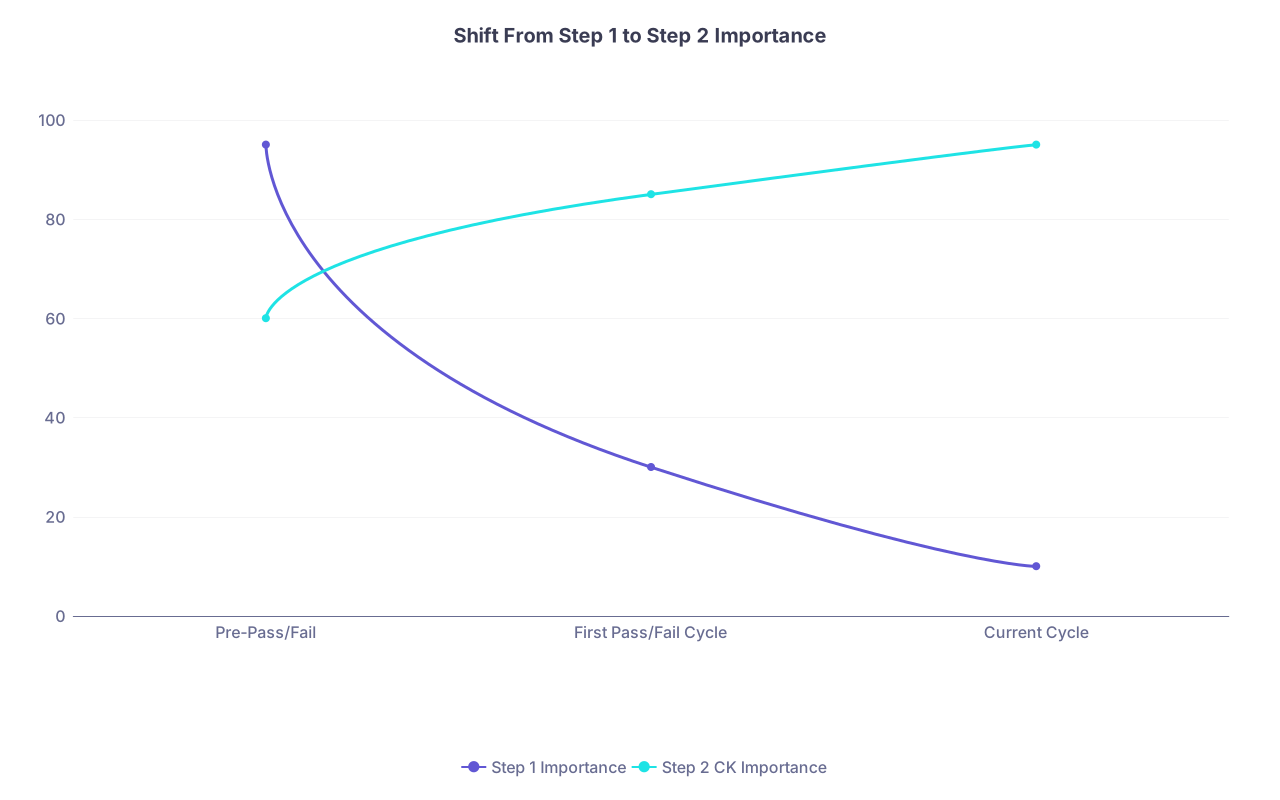
| Category | Step 1 Importance | Step 2 CK Importance |
|---|---|---|
| Pre-Pass/Fail | 95 | 60 |
| First Pass/Fail Cycle | 30 | 85 |
| Current Cycle | 10 | 95 |
On PD calls, the tone is blunt:
- “Step 2 is now our primary screening test.”
- “If they don’t have Step 2 in by ranking time, we’re not comfortable ranking them high.”
And one that came from a surgical subspecialty PD that stuck with me:
“Step 1 pass/fail didn’t free students from test pressure. It just pushed the pressure later into med school when they have less time.”
In other words: the stakes moved, not diminished.
You need to understand one ugly dynamic: in the Step 1 scored era, Step 2 could redeem a mediocre Step 1. Now, Step 2 is often your only number. If it’s weak, there’s no earlier datapoint to say “they improved.”
So backchannel conversations about Step 2 sound harsher than you hear in public:
- “Below 230 in this era is concerning. Where’s the struggle?”
- “Great narrative, good letters, but a 221 Step 2? I’m not convinced they’ll pass boards on first try.”
If your Step 2 is strong, though? Programs are surprisingly quick to forgive lack of Step 1 data and even moderate concerns elsewhere. I’ve seen borderline clinical comments overridden by a rock-solid Step 2 with comments like: “They clearly can learn and perform on demand, and that matters for board pass rates.”
And yes, board pass rates matter for programs—A LOT. Every time they fail to graduate residents who pass boards, their accreditation stress goes up. That’s why they’re paranoid about your testing track record. Not because they hate you. Because the system punishes them for betting on the wrong people.
What You Should Actually Do in This Era
Here’s the part you’re looking for: how to play this game in a way that reflects how decisions are really made.
If you passed Step 1 cleanly
Your job is to make Step 1 a non-story. Which means:
- Do not try to “explain” or dress it up. Pass is pass. Move on.
- Pour your anxious energy into Step 2 CK, core clerkships, and building relationships for powerful letters.
- Use your personal statement and interviews to show maturity, clinical reasoning, and reliability—not to rehash preclinical study grind.
You win by being obviously safe and obviously good to work with.
If you failed Step 1
You do not get to be casual about the narrative. People will judge. Harshly.
Your counterattack has to be multi-pronged:
Step 2 must be unmistakably solid. Not just “barely improved.” You need a clear signal of turnaround.
Own the fail directly in your application narrative. No vague hand-waving. PDs can smell dodge-and-spin a mile away. The version that plays best in selection meetings sounds like:
- Clear reason (overcommitted, mental health, family crisis, poor strategies).
- Specific changes you made (study structure, seeking help, test-taking coaching).
- Tangible results (strong Step 2, strong clinical record).
Get at least one letter that explicitly addresses your current reliability. Not just “they’re nice and hardworking.” You want something like:
“Whatever issues they faced early in med school, I see none of that now. They show up prepared, they synthesize data quickly, and I would trust them with my own family.”
That kind of line changes the tone of the backchannel debate from “why risk this person” to “we might miss out on someone who grew a lot.”
The Ugly Truth About “Holistic Review” in the Pass/Fail Era
Holistic review is real. But not the way schools market it.
In practice, “holistic” usually means:
- Strong objective screens (Step 2, school, clerkship grades) get you through the door.
- Within that pile, softer factors like narrative, service, fit with program culture, and diversity goals shape who gets interviews and how high they’re ranked.
- Outliers with powerful advocacy or unique backgrounds can occasionally jump the line.
Here’s the line I’ve heard multiple PDs use off the record:
“We’re holistic inside a band of people we already trust academically.”
That’s what “holistic” really means. It’s not random. It’s not vibes-based. It’s academic safety first, then human factors.
So your real job isn’t to write the world’s most soulful personal statement. It’s to:
- Clear the unspoken academic safety bar for your target specialty.
- Then give at least one person on the committee a compelling reason to say, “I want this person on our team.”
If you do only one of those two, you will underperform your potential.
FAQ – The Backchannel Version
1. Is a Step 1 pass now completely meaningless?
No. A clean, on-time pass quietly signals “no obvious academic disaster.” That’s still worth something. Especially at programs nervous about board pass rates. But once you’re in the “passed” bucket, other things dominate the conversation—particularly Step 2 CK and clinical performance.
2. If I’m at a lower-tier or newer school, how do I compensate without a Step 1 score?
You have three levers: a strong Step 2 CK, high-quality away rotations where you prove yourself in person, and letters from people programs recognize and trust. If no one on your application is known to the committee and your Step 2 is mediocre, your chances at competitive programs drop fast in this era.
3. Does a Step 1 fail automatically kill my chances at a competitive specialty?
Not automatically, but it shrinks your options and raises the bar for everything else. You’ll need a clearly strong Step 2, excellent clinical narrative, and real advocates. And even then, some programs will hard-pass on your file without saying it publicly. You’re playing on “hard mode,” not “game over.”
4. Should I delay Step 2 CK to “protect” myself if I’m not ready?
If you’re truly not ready, yes—rushing into a bad Step 2 score is worse than waiting a bit. But understand the trade-off: many programs want Step 2 in hand before interview offers or ranking. A late score can push you into the “maybe next year” pile. The sweet spot is simple: take it when you can reasonably expect to do well, not just to get it done.
5. What’s one strategic move most students in the pass/fail era still overlook?
They underestimate the power of targeted, real mentorship. One strong advocate—a PD at your home program, a well-known subspecialist you worked with, a former resident now on faculty elsewhere—can influence how your file is interpreted behind closed doors. Students still spend 90% of their energy on solo grinding and maybe 10% on relationship-building. In this era, that ratio is backwards.
Key takeaways:
Step 1 pass/fail didn’t make the system kinder; it shifted the battleground to Step 2 CK, school reputation, and the strength of your advocates. A clean Step 1 pass keeps you out of trouble, but it doesn’t get you in the door—that work now happens in your clinical years. And for anyone with a stumble, the only thing that matters is whether your later performance and your narrative make the committee say, “this isn’t a risk, this is a comeback story we’re glad to bet on.”