
The shift to Step 1 pass/fail did not kill the strategic gap year. It just changed when it still makes sense—and when it’s a complete waste of time.
You’re not choosing between “gap year or no gap year” in the abstract. You’re choosing when to step off the conveyor belt: preclinical, between exams, between M3 and M4, or after graduation. The timing is the whole game now.
I’ll walk you through this chronologically—M1 to post‑grad—with hard opinions on:
- When a gap year actually moves the needle in the pass/fail era
- When you’re just delaying the inevitable
- What you should be doing month by month if you’re even thinking about hitting pause
Big Picture: How Step 1 P/F Changed the Gap Year Equation
Before we get into the timeline, you need the new reality in one sentence:
With Step 1 pass/fail, a gap year only makes sense if it boosts one of three things: Step 2, research, or clear red‑flag repair.
Not vibes. Not “finding yourself.” Not “I feel behind.” Programs do not care about your self-actualization arc.
Here’s how PDs now weigh your time:
| Problem Type | Can a Gap Year Help? | What You Must Target |
|---|---|---|
| Weak Step 1 (Pass) | Rarely | Step 2 CK, clinical evals |
| Weak Step 2 CK | Yes | Dedicated retake year |
| No Research | Yes | 1–2 strong projects/pubs |
| Lacks Home Program | Yes | Away rotations + networking |
| Failed Course/Exam | Sometimes | Repair narrative + evidence |
Now let’s go through your actual calendar.
Phase 1: M1–Early M2 — “Thinking About It” Stage
At this point you should not be committing to a gap year. You should be cleaning up your foundation.
M1 Fall–Spring: Shut Down the Daydreaming
If you’re in your first year and already asking, “Should I take a gap year?” my answer is: not yet. You don’t have enough data.
From M1 August–May, your job:
Dominate coursework
- Aim for top quartile if you’re thinking competitive: derm, ortho, plastics, ENT, rad onc, ophtho.
- For less competitive fields, “solidly above average” is fine—but you don’t know that yet.
Dip a toe into research, not your whole leg
- One project. One mentor. Preferably in something remotely related to your potential interest.
- Your bar: meet a faculty who will remember your name and answer email.
Reality check by April–May
Ask yourself:- Am I consistently passing with margin, or scraping by?
- Do I enjoy any clinical/research area enough to consider specializing?
- Am I already drowning with current load? (If yes, a gap year for “more stuff” is probably fantasy.)
If you’re failing courses or barely passing, a gap year is not your first fix. First fix is: figure out why you’re struggling while you’re in the system. Disability services. Tutoring. Study strategy overhaul. You don’t pause the game before you even start playing.
Summer After M1 (June–July): Micro‑Test Your Future Self
This is your first mini‑experiment.
At this point you should:
Do a short, focused research block (6–8 weeks)
- Goal: see if you can be productive with unstructured time. Many students think a research year will be great—then waste 10 weeks checking email and refreshing PubMed.
- Deliverable by August: at least a poster abstract, data collection, or a manuscript draft started.
Check your stress baseline
If you’re completely wrecked by M1 and “just need a break,” I’m going to be blunt: a “research gap year” will not magically restore your mental health. It often adds guilt and isolation.
This summer is a low‑risk place to discover that you hate research. Better to learn now than two months into an unpaid research year where your PI ghosts you.
Phase 2: Late M2 – Around Step 1 — First Real Decision Point
Step 1 is now pass/fail. You still can’t blow it off. A fail here is a five‑alarm fire.
M2 Fall–Winter (August–December): Decide If You Even Need Extra Time
At this point you should:
Track your practice NBME/UWorld self-assessments honestly
- If you’re passing by comfortable margin on multiple forms, a “gap year to study for Step 1 more” is nonsense.
- If you’re failing repeatedly and far from the pass line, a gap year may become part of a remediation plan, but you do not jump there first.
Clarify specialty competitiveness by December
- Thinking derm, ortho, neurosurg, plastics, ENT, rad onc? Flag yourself as “research‑heavy track”.
- Thinking IM, peds, FM, psych, EM, OB/GYN? Research helps, but you’re not automatically a gap‑year candidate yet.
Your aim in late M2 is to position yourself for a clean Step 1 pass and a strong start to clerkships. You do not step off the track here unless Step 1 is genuinely in jeopardy.
Dedicated Step 1 (usually Jan–March): Do Not Plan a Gap Year Around Step 1
New temptation I’m seeing: “Since Step 1 is P/F, I’ll just take a gap year after I pass to work on research.”
This is backwards. At this point you should:
Treat Step 1 as a must-pass, one-shot exam
- Pass cleanly. Avoid failing. A fail almost always costs you time later anyway in remediation.
Do NOT schedule a gap year that begins the moment you pass Step 1
Programs do not give you extra credit for taking a victory lap after a pass. The value of a gap year is now tied to Step 2 and M3 performance, not Step 1.
If you barely pass Step 1, a gap year still doesn’t directly fix that. What matters next: crushing Step 2 and clinical evals.
Phase 3: M3 Clinical Year — Where Gap Years Start to Make Sense
This is where the conversation finally gets real.
With Step 1 pass/fail, M3 is the primary signal. PDs stalk your rotation comments and Step 2 score. A well‑timed gap year here can actually change your trajectory.
Early M3 (First 3–4 Months): Just Collect Data
At this point you should:
Watch your shelf exam performance
- If you’re consistently below national average on shelves, Step 2 risk is real.
- If you’re at or above average, your Step 2 floor is decent.
Read your evals closely
- Phrases like “needs frequent direction,” “below expected level,” or “concerns about reliability” are red flags.
- You cannot research‑year your way out of a reputation for being unreliable on the wards.
Keep soft tabs on research
- If you’re leaning competitive specialty and have zero research by early M3, your window is shrinking.
Do not decide on a gap year in month 1 of M3. Your clerkship performance is still noise at that point.
Mid‑M3 (Months 5–8): First Serious Gap Year Calculation
This is your prime decision window if you’re going to insert a research year before M4.
At this point you should sit down with three things:
- Your shelf scores trend
- Your likely Step 2 practice range (from any early NBME/CCSSA if you’ve taken them)
- Your research CV (or lack of it)
Now break it down by scenario.
Scenario A: Competitive Specialty, Weak Research, Decent Academics
Example: You’re thinking ortho. You passed Step 1. You’re scoring near/above average on shelves. But your CV is 1 poster from undergrad neuroscience and nothing else.
At this point a dedicated research year between M3 and M4 still makes sense. Why?
- Step 2 can be taken during/just before the research year and boosted.
- You can aim for:
- 1–2 first‑author projects
- 3–5 total pubs/abstracts
- Strong letters from big‑name faculty
This is one of the last high‑yield windows for a gap year.
Scenario B: Any Specialty, Concerning Step 2 Trajectory
Example: Practice CCSSA in mid‑M3 is projecting Step 2 in the low 220s, you want a moderately competitive field (anesthesia, EM, OB/GYN), and shelves are mediocre.
Here, a gap year might make sense as a Step 2 rehab year, but only if:
- Your school allows you to pause between M3 and M4
- You use the first 3–4 months to:
- Fix knowledge gaps
- Crush Step 2 (ideally > 240–245 if aiming for most competitive non‑derm/ortho fields)
- You combine it with some research or teaching so the year doesn’t look like pure “test exile”
If you just take a year to “study more” with no concrete output, it looks bad. That reads as academic probation dressed up as “enrichment.”
Scenario C: Red Flags on Clinical Performance
If your M3 comments include patient safety concerns, professionalism issues, or borderline failures, a gap year is not your primary tool.
You fix this in real time:
- More mentoring
- Direct feedback meetings
- Documented improvement on later rotations
Taking a year off right after bad evals looks like running away, not growth.
Phase 4: Late M3 – Early M4 — The Hard Deadline for Pre‑Match Gap Years
Once you’re inside the 6–9 months before ERAS opens, your options narrow fast.
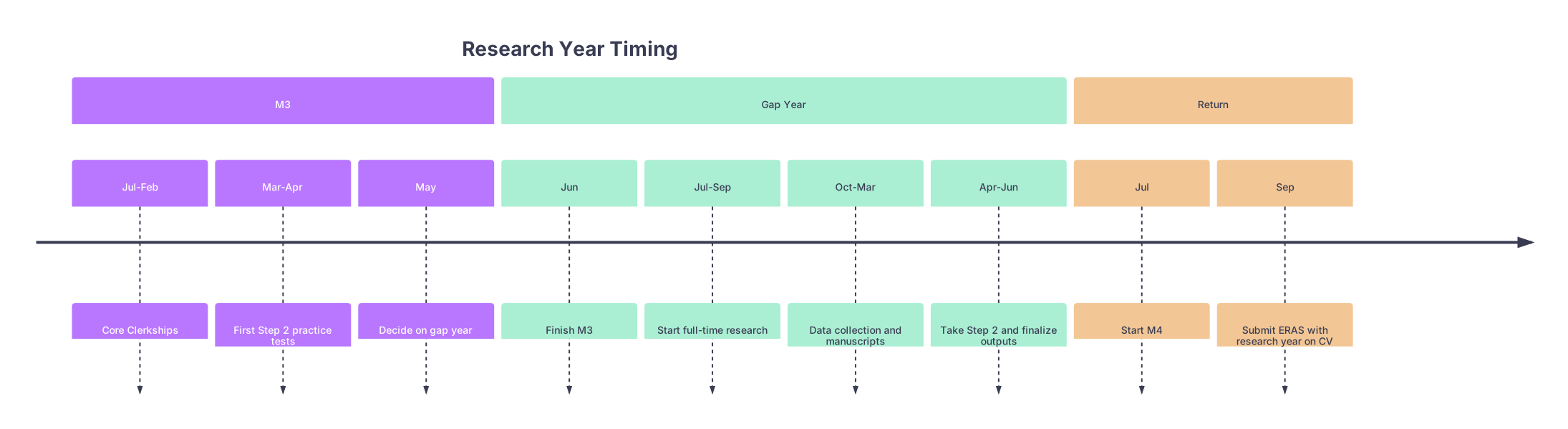
Timeline: If You’re Considering a Research Year Before M4
Assume standard US schedule:
- July–June: M3
- July (following year): Start M4
- September: ERAS opens for submission
To insert a gap year between M3 and M4:
| Period | Event |
|---|---|
| M3 - Jul-Feb | Core Clerkships |
| M3 - Mar-Apr | First Step 2 practice tests |
| M3 - May | Decide on gap year |
| Gap Year - Jun | Finish M3 |
| Gap Year - Jul-Sep | Start full-time research |
| Gap Year - Oct-Mar | Data collection and manuscripts |
| Gap Year - Apr-Jun | Take Step 2 and finalize outputs |
| Return - Jul | Start M4 |
| Return - Sep | Submit ERAS with research year on CV |
At this point you should:
Make the call no later than May of M3 if you want the research year to count for the very next ERAS cycle.
- Delaying the decision to August or September means your research will barely show up, and your letters may be weak.
Lock a mentor and funding by June
- “I’ll just find something after I finish M3” is how people end up scanning charts for six months with no credit.
Schedule Step 2 strategically
- Ideal: Take Step 2 about 6–9 months into the research year when you’re content‑solid and can crush it.
If you’re already deep into late M3 with Step 2 scheduled and no lined‑up research, the value of a gap year before M4 drops sharply. At that point, you might be better off doing:
- A strong Sub‑I
- 1–2 focused away rotations
- Part‑time research sprinkled into M4
Rather than pausing everything.
Phase 5: Post‑M4 / After Graduation — The “Last‑Chance” Gap Year
This is the year most people do not want to talk about, but it’s becoming more common:
- You did not match.
- Or you matched in a prelim / undesired spot and want to reapply.
- Or your Step 2 score/record is a real problem.
Here a gap year can absolutely make sense—but it’s not optional polish; it’s damage control.
If You Didn’t Match
At this point you should:
- Accept that the next year is a full-time job to fix your file
Not a “loosely structured sabbatical.” A grind.
Core priorities, month by month:
March–April (Immediately After Unmatched)
- Meet with your dean and at least one PD in your chosen specialty.
- Get explicit feedback: was it scores, no research, poor letters, bad interview, or unrealistic rank list?
- Decide stay in same specialty vs pivot.
May–June
- Secure:
- A research position in your target or backup specialty
- Or a structured clinical role (research fellow, prelim‑style position, chief year, etc.)
July–December
- Produce something measurable:
- Abstracts/manuscripts
- Strong letters
- Documented clinical performance if you have any role with patient care
January–February (Before Next ERAS Season)
- Tighten your story:
- “Here’s what went wrong.”
- “Here’s what I did with a full year to fix it.”
- “Here’s objective evidence I’m a different candidate now.”
If all you do for 12 months is shadow and “reflect,” PDs will notice. And they won’t care.
If You Need a Step 2 Reset (Low Score, Fail)
With Step 1 pass/fail, Step 2 is the new screening weapon. A bad score here hurts much more than a marginal Step 1 pass.
If you bombed Step 2:
At this point you should consider:
- A tightly structured test rehab year
- 3–4 months: content rebuild with question banks, tutoring if needed, spaced practice.
- Explicit score targets.
- Then 6–9 months of something productive (research, teaching, clinical) while the retake score ages a bit.
You must present that year as:
“I had a diagnostic failure. I treated it like a serious problem. Here’s the improvement and the discipline I showed.”
Not: “I panicked and took time off.”
When a Gap Year is Flat‑Out a Bad Idea Now
Let me be blunt: with Step 1 pass/fail, there are situations where a gap year is almost always a mistake.
Pure “wellness” gap year during preclinicals with no plan
- If you’re genuinely burned out, you need treatment and support, not unstructured emptiness and lost momentum.
Taking time off right after a Step 1 pass “because the pressure’s over”
- Programs care way more about Step 2 and M3 now. Walking away here is forfeiting your advantage.
“I’ll find research once I take time off” with no mentor, no project, no track record
- This is how you end up doing uncredited busywork and explaining a blank year on your CV.
Using a gap year to avoid addressing professionalism issues
- Those are fixed on‑service, under supervision, with documented improvement.
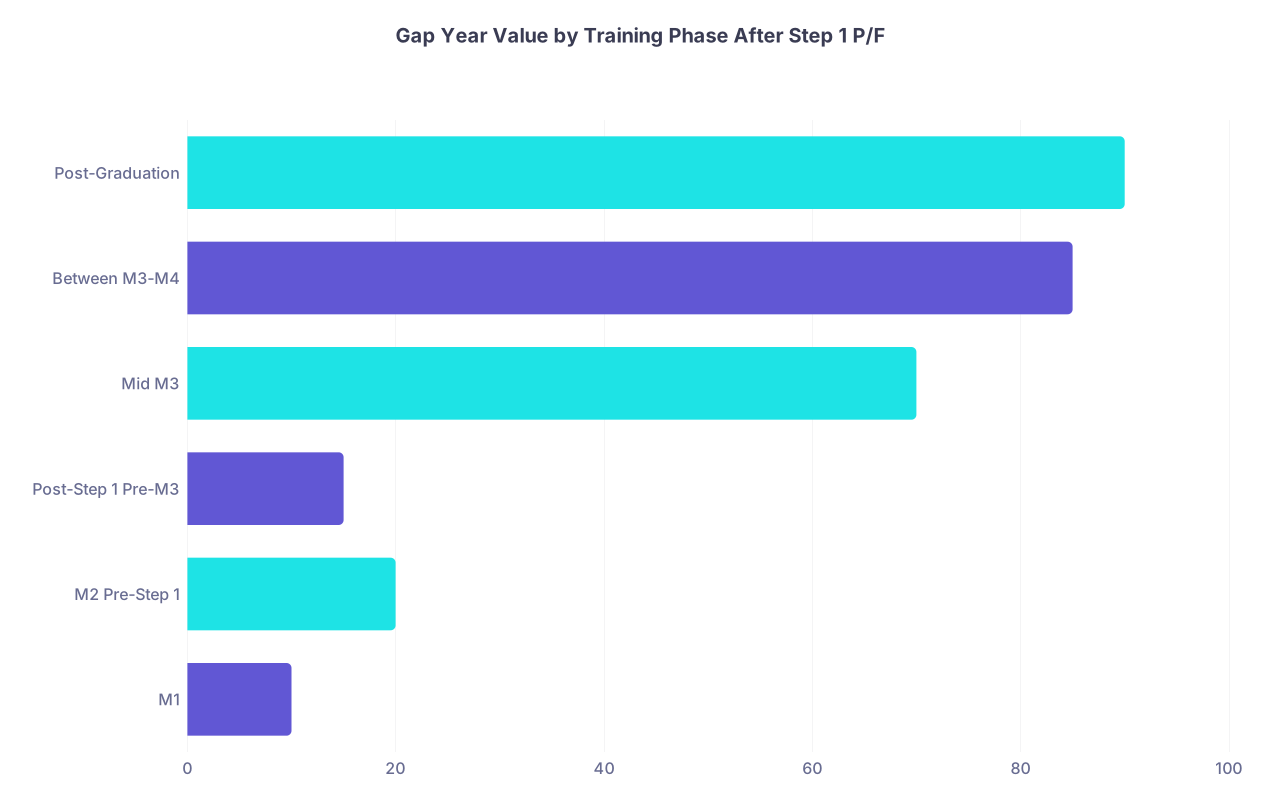
Quick Snapshot: Where Gap Years Still Make Sense by Phase
| Category | Value |
|---|---|
| M1 | 10 |
| M2 Pre-Step 1 | 20 |
| Post-Step 1 Pre-M3 | 15 |
| Mid M3 | 70 |
| Between M3-M4 | 85 |
| Post-Graduation | 90 |
(Values are a rough “utility score” out of 100—how often a gap year in that phase actually helps in the current era.)
- M1/M2: Rarely worth it, unless severe life/health situations.
- Mid M3: First genuinely smart window to consider it for research or Step 2 recovery.
- Between M3–M4: Peak value for competitive specialties.
- Post‑grad: Critical for unmatched or severely compromised applications.
How to Decide Month‑by‑Month: A Simple Flow
Use this if you’re somewhere between M2 and M4 and debating.

| Step | Description |
|---|---|
| Step 1 | Thinking about gap year |
| Step 2 | Talk to dean about leave |
| Step 3 | Stay on track |
| Step 4 | Consider research year between M3-M4 |
| Step 5 | Fix clinical performance first |
| Step 6 | Consider Step 2 focused gap year |
| Step 7 | No gap year needed |
| Step 8 | Structured remediation or research year |
| Step 9 | Proceed without gap year |
| Step 10 | What year are you in? |
| Step 11 | Failing or major life issue? |
| Step 12 | Competitive specialty and no research? |
| Step 13 | Shelves and evals solid? |
| Step 14 | Low Step 2 trajectory? |
| Step 15 | Unmatched or low Step 2? |
If You Decide to Take One: Non‑Negotiable Rules
No matter when you step off, the ground rules in this era are the same.
During your gap year, you must:
Have clear deliverables on a written timeline by month
- X abstracts by Month 4
- Manuscript submitted by Month 8
- Step 2 taken by Month Y with target range
Meet with your research or clinical supervisor at predictable intervals
- Monthly or biweekly check‑ins
- Email summaries of what you did and what’s next (create a paper trail of productivity)
Keep your school or alumni office in the loop
- They’re the ones writing your MSPE and advocating if PDs ask, “What did this person do for 12 months?”
Prepare a two‑sentence explanation that doesn’t sound defensive:
- “I took a dedicated research year between M3 and M4 to strengthen my application for ortho. I focused on clinical outcomes in joint replacement and completed X, Y, and Z projects.”
- “After a disappointing Step 2 score, I worked with my school to take a year for intensive remediation and research in internal medicine. I improved my performance to [score], and gained experience in [specific project].”
If you can’t write that explanation before you start the year, you’re not ready to take it.
The 3 Things to Remember
Timing is everything now. With Step 1 pass/fail, the high‑yield gap year windows are mid‑M3 to between M3–M4, and after graduation if you don’t match or need major repair. Preclinical “pause years” almost never pay off.
A gap year must fix something concrete. Step 2 trajectory, research deficit in a competitive specialty, or a damaged application after not matching. If it doesn’t clearly change your numbers or your narrative, it’s just a delay.
You need a plan before you hit pause. Mentor locked in, projects defined, Step 2 timing mapped out, and a tight explanation you’d be comfortable giving a program director. If you don’t have that, you’re not taking a gap year—you’re just stepping off the track with no map.